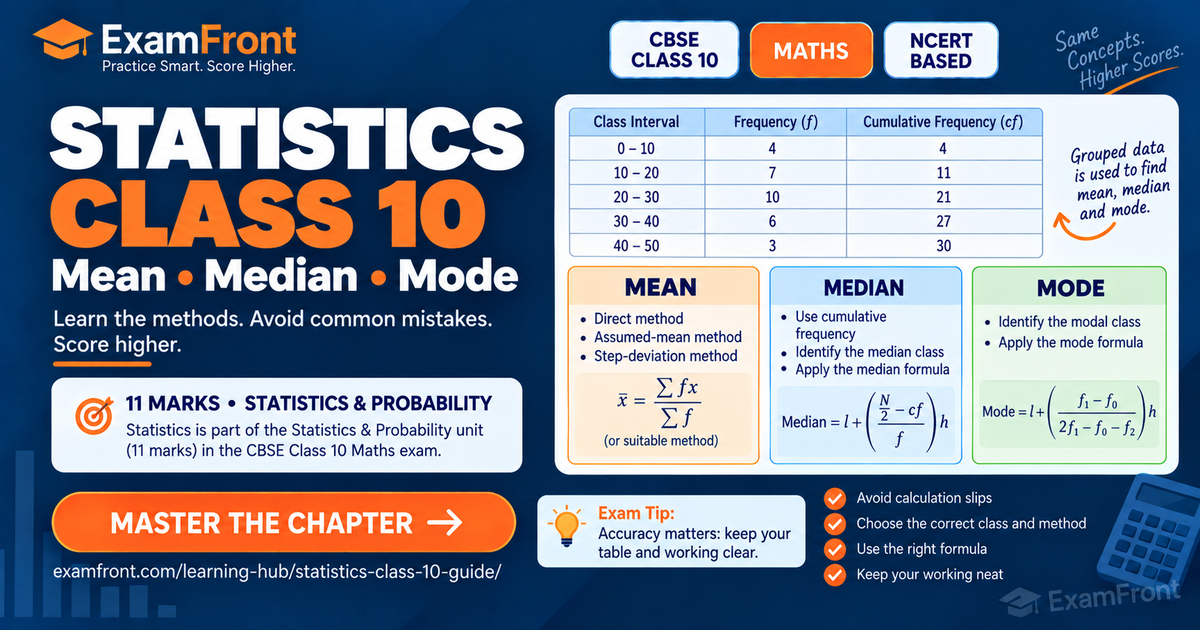
What the Statistics chapter covers, how CBSE tests it, the mistakes to avoid, and how to turn it into strong marks.
Statistics is a reliable, high-scoring chapter in Class 10 Maths — it’s about finding the mean, median, and mode of grouped data. The methods are systematic and the questions are predictable, which makes this a chapter where careful, organised working earns steady marks. It sits in the Statistics & Probability unit. This guide orients you on what it covers, how it’s tested, the traps, and how to master it.
Chapter snapshot
| Unit | Statistics & Probability |
| Official unit weightage | 11 marks (CBSE assigns marks per unit, not per chapter) |
| Difficulty | Moderate ⭐⭐⭐☆☆ |
| Practice priority | High (systematic, reliably tested) |
| Prerequisites | Averages, frequency tables, basic arithmetic |
| Estimated study time | 3–4 focused sessions |
(Difficulty and study time are a preparation guide, not official CBSE figures.)
What this chapter covers
Statistics at Class 10 level focuses on grouped data:
- Mean of grouped data — by the direct method, the assumed-mean method, and the step-deviation method.
- Median of grouped data — using the median formula and the cumulative frequency.
- Mode of grouped data — using the mode formula on the modal class.
- The relationship between mean, median, and mode.
The methods are procedural and repeatable — which is exactly what makes this chapter so reliably scoreable, as long as your working stays tidy.
Why this chapter matters
Statistics builds the careful, organised data-handling that recurs in later study:
Grouped data → measures of central tendency → data analysis in higher classes
The discipline of building a clean frequency table and computing accurately across many rows is exactly what senior statistics and data work demand. The Statistics & Probability unit carries 11 marks, much of it here.
How much is Statistics worth?
This chapter is part of the Statistics & Probability unit, worth 11 marks (see the unit-wise weightage guide). CBSE assigns weightage by unit, not by individual chapter, so Statistics contributes to that 11-mark total alongside Probability. As a frequent source of long-answer questions, it’s a high-priority target.
How CBSE tests Statistics
The board tests the same core skills in familiar formats:
| Common question type | Skill tested |
|---|---|
| Find the mean of grouped data | Procedure |
| Find the median of grouped data | Procedure |
| Find the mode of grouped data | Procedure |
| Interpret or relate the measures | Reasoning |
These appear as short-answer and long-answer questions (see how each CBSE question type is set). The wording changes yearly while the skills repeat (the idea behind analysing previous year questions).
Common mistakes in Statistics
A few classic traps cost students marks here:
- Calculation slips in long tables — a single row error throws off the final answer.
- Wrong method or class — picking the wrong modal or median class, or the wrong mean method.
- Formula errors — misremembering the median or mode formula.
- Untidy working — a disorganised table that leads to mistakes and loses method marks.
Most are calculation and presentation mistakes rather than concept gaps — exactly the kind the examfront Mistake Framework helps you catch and fix.
Where this sits in the NCERT and CBSE syllabus
NCERT sets the scope. Statistics is Chapter 13 of the NCERT Class 10 Maths textbook, and it has exactly three exercises — 22 questions in total:
| Exercise | Topic | Questions |
|---|---|---|
| Exercise 13.1 | Mean of grouped data (all three methods) | 9 |
| Exercise 13.2 | Mode of grouped data | 6 |
| Exercise 13.3 | Median of grouped data | 7 |
Two things trip students up here. First, NCERT teaches the mode before the median, so Exercise 13.2 is the mode, not the median. Second, the exercise numbers run one behind the section numbers, because the chapter opens with an introduction that has no exercise — if you look for “Exercise 13.4” you won’t find it. Twenty-two questions is a small, finishable set: work through all of it, as the guide to studying NCERT maths recommends, before you move on to mixed practice.
What was removed — and what wasn’t. The ogive (the cumulative frequency graph, “less than” and “more than” curves) was removed in the NCERT rationalisation, so no board question will ask you to draw one. You still need cumulative frequency tables, because the median formula depends on them. What was not removed is the step-deviation method — some “deleted syllabus” lists still say it was, but that was a temporary 2020-21 reduction. All three mean methods remain in Exercise 13.1 and in the CBSE competencies. Older textbook editions and some solution websites still print the ogive exercise, so check your edition before practising from it. The NCERT Class 10 Maths guide covers the rationalised book chapter by chapter.
CBSE sets the wording. The 2026-27 CBSE syllabus lists the chapter’s content in one line: “Mean, median and mode of grouped data (bimodal situation to be avoided).” Its competencies add that you compute the mean “using direct, assumed mean and step deviation method” and the median and mode “by algebraic method” — that is, by formula, not from a graph. The bracket is a useful self-check in the exam hall: board data will have one clear modal class. If your table shows two classes tied for the highest frequency, re-read the question and recheck your frequencies.
CBSE sets the priority by unit, not by chapter. The seven units carry 6, 20, 6, 15, 12, 10 and 11 marks — 80 in total. Statistics shares its 11 marks with Probability, and CBSE publishes no separate figure for Statistics alone. Chapter-wise percentage tables and pie charts you see online are unofficial estimates.
How it is actually asked. The theory paper is 80 marks (plus 20 for internal assessment), with 38 questions across Sections A to E — the CBSE exam pattern guide sets out the full split. Statistics usually appears as a 3-mark or 5-mark calculation, or inside a case-study question, and the question often hands you a “less than” table or a missing frequency rather than a clean distribution. Your frequency table — class marks, fx or cumulative frequency columns — is part of the answer, not rough work, because CBSE marks the method as well as the final value.
Skills you’ll build
Master this chapter and you’ll be able to:
- ✓ Find the mean of grouped data by all three methods
- ✓ Find the median using cumulative frequency
- ✓ Find the mode of grouped data
- ✓ Set out a clean frequency table and compute accurately
Your roadmap to full marks
Understanding Statistics is quick; mastering it comes from practice — building speed and accuracy across long calculations, choosing the right method, and keeping your tables tidy so errors don’t creep in.
That’s where examfront turns understanding into marks. You get targeted, chapter-wise adaptive practice on mean, median, and mode of grouped data — with instant feedback that pinpoints exactly where you slip (a table slip? the wrong class?) so you fix it fast. The adaptive practice serves the right questions at the right level, and mistake-tracking reveals your patterns. Practise Statistics on examfront and lock in these reliable marks.
Before moving on
Before you move to the next chapter, make sure you can:
- ✓ Find the mean by the step-deviation method
- ✓ Find the median of grouped data
- ✓ Find the mode of grouped data
- ✓ Build a clean, accurate frequency table
Continue your journey
← Previous: Surface Areas and Volumes · Next: Probability →
Or browse the full chapter list to plan your path.
Take the summary with you
Download the 2-page Statistics summary (PDF) → — all three formulas, the NCERT exercise map, and one frequency table worked for mean, median and mode on one printable sheet.
Frequently asked questions
Is Statistics an important chapter in Class 10 Maths? Yes — it’s part of the Statistics & Probability unit (11 marks), and mean/median/mode of grouped data are tested reliably, often as long-answer questions. It’s a high-value, scoreable chapter.
What are the main topics in Statistics Class 10? Finding the mean, median, and mode of grouped data, and understanding the relationship between them. The mean can be found by direct, assumed-mean, and step-deviation methods.
Why do students lose marks in Statistics? Usually through calculation slips in long tables, choosing the wrong class or method, or errors in the median and mode formulas — the working is long, so accuracy matters.
How do I get full marks in Statistics? Set out your frequency table clearly, know the mean/median/mode formulas and when to use each method, and work carefully through the calculations — showing complete working.
Is Statistics part of the NCERT and CBSE Class 10 syllabus, and are ogives still included? Yes. Statistics is NCERT Class 10 Chapter 13, with three exercises — Exercise 13.1 on the mean (9 questions), Exercise 13.2 on the mode (6 questions) and Exercise 13.3 on the median (7 questions). The CBSE 2026-27 syllabus lists it as “Mean, median and mode of grouped data (bimodal situation to be avoided)” inside the 11-mark Statistics & Probability unit. Ogives (cumulative frequency graphs) were removed in the NCERT rationalisation, but all three methods for the mean — direct, assumed-mean and step-deviation — are still examined. Older editions and some websites still print the ogive material, so check your edition.
Turn Statistics into strong marks. Practise on examfront →