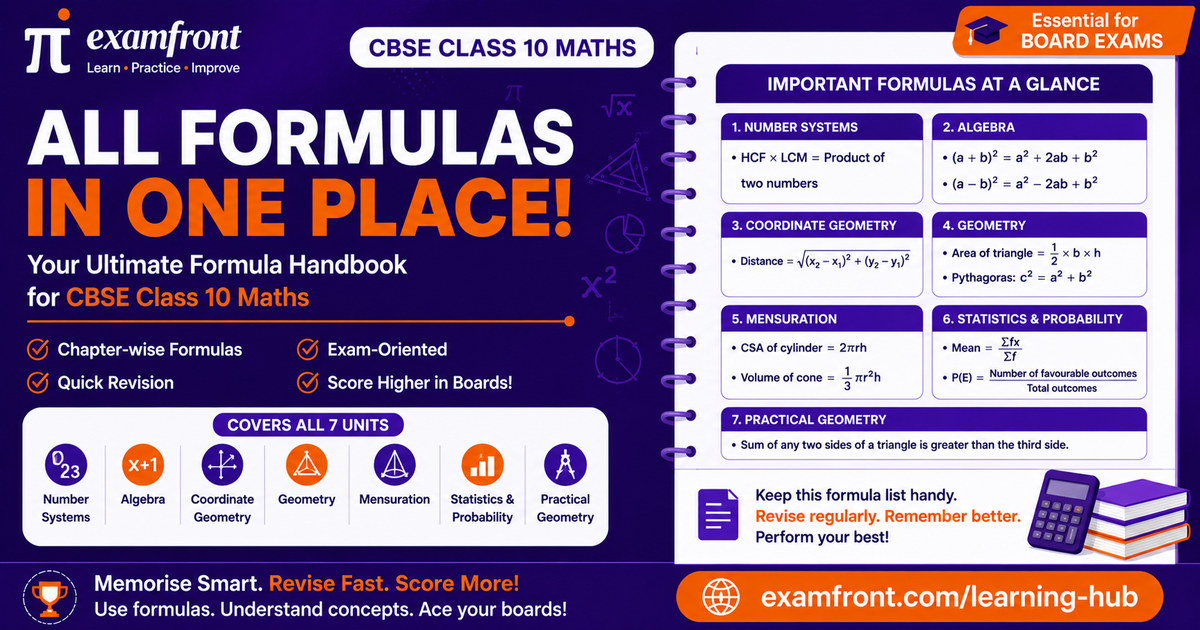
Every key CBSE Class 10 Maths formula, organised chapter by chapter — your one-stop revision sheet.
When the exam is close, you don’t want to hunt through fourteen chapters for one formula. This is your complete Class 10 Maths all formulas sheet — every important formula, grouped by chapter, in one clean place you can bookmark and return to. Use it for quick revision, last-minute checks, and making sure nothing slips through the cracks before your board exam.
A quick note on how to use this: a formula sheet is for revision and recall, not first-time learning. The real skill is knowing when and how to apply each formula — which comes from practice, not from re-reading the list.
📄 Download the printable formula sheet (PDF) — a clean, two-page A4 version you can print and keep beside you while you revise.
⭐ Top formulas to know before the exam
If you’re short on time, master these high-frequency formulas first — they appear again and again across the paper:
- Quadratic formula — x = [−b ± √(b² − 4ac)] / 2a
- Distance formula — √[(x₂ − x₁)² + (y₂ − y₁)²]
- AP nth term & sum — aₙ = a + (n − 1)d and Sₙ = n/2 [2a + (n − 1)d]
- Fundamental trig identity — sin²θ + cos²θ = 1
- Trig standard-angle values — the 0°/30°/45°/60°/90° table (below)
- Area of a sector — (θ/360) × πr²
- Surface areas & volumes — cone, sphere, cylinder, hemisphere
- Probability — P(E) = favourable outcomes / total outcomes
Now here is the complete sheet, chapter by chapter.
📘 Real Numbers
Key results (theorems, not formulas):
- Fundamental Theorem of Arithmetic: every composite number can be expressed as a product of primes, uniquely (apart from the order of the factors).
Formulas:
- HCF × LCM = product of the two numbers: HCF(a, b) × LCM(a, b) = a × b
Explore the chapter → All chapters
📗 Polynomials
For a quadratic polynomial ax² + bx + c with zeros α and β:
- Sum of zeros: α + β = −b/a
- Product of zeros: αβ = c/a
📗 Pair of Linear Equations in Two Variables
For a₁x + b₁y + c₁ = 0 and a₂x + b₂y + c₂ = 0:
- Unique solution (lines intersect): a₁/a₂ ≠ b₁/b₂
- Infinitely many solutions (coincident lines): a₁/a₂ = b₁/b₂ = c₁/c₂
- No solution (parallel lines): a₁/a₂ = b₁/b₂ ≠ c₁/c₂
📗 Quadratic Equations
For ax² + bx + c = 0 (a ≠ 0):
- Quadratic formula: x = [−b ± √(b² − 4ac)] / 2a
- Discriminant: D = b² − 4ac
- Nature of roots: D > 0 → two distinct real roots · D = 0 → two equal real roots · D < 0 → no real roots
⚠ Common mistake: the whole numerator, −b ± √(b² − 4ac), is divided by 2a — not just the square-root part. Keep the entire top over 2a.
📗 Arithmetic Progressions
For an AP with first term a and common difference d:
- nth term: aₙ = a + (n − 1)d
- Sum of first n terms: Sₙ = n/2 [2a + (n − 1)d]
- Sum (last term l known): Sₙ = n/2 (a + l)
📐 Coordinate Geometry
- Distance formula: distance between (x₁, y₁) and (x₂, y₂) = √[(x₂ − x₁)² + (y₂ − y₁)²]
- Section formula: a point dividing (x₁, y₁)–(x₂, y₂) in ratio m : n is ( (mx₂ + nx₁)/(m + n) , (my₂ + ny₁)/(m + n) )
- Midpoint: ( (x₁ + x₂)/2 , (y₁ + y₂)/2 )
⚠ Common mistake: in the distance formula, square each difference before adding — don’t add first and square after.
📙 Triangles
Key results (theorems):
- Basic Proportionality Theorem (Thales): a line parallel to one side of a triangle divides the other two sides in the same ratio.
- Area ratio of similar triangles: the ratio of areas of two similar triangles equals the square of the ratio of their corresponding sides.
📈 Introduction to Trigonometry
The ratios (for angle θ in a right-angled triangle):
- sin θ = opposite / hypotenuse
- cos θ = adjacent / hypotenuse
- tan θ = opposite / adjacent = sin θ / cos θ
- cosec θ = 1/sin θ · sec θ = 1/cos θ · cot θ = 1/tan θ
Standard-angle values:
| θ | 0° | 30° | 45° | 60° | 90° |
|---|---|---|---|---|---|
| sin θ | 0 | 1/2 | 1/√2 | √3/2 | 1 |
| cos θ | 1 | √3/2 | 1/√2 | 1/2 | 0 |
| tan θ | 0 | 1/√3 | 1 | √3 | not defined |
Identities:
- sin²θ + cos²θ = 1
- 1 + tan²θ = sec²θ
- 1 + cot²θ = cosec²θ
⚠ Common mistake: sin²θ means (sin θ)², not sin(θ²). Square the whole ratio.
This is the most formula-dense chapter in the course — if you want the ratios, the table and the identities explained rather than just listed, work through the full trigonometry guide.
📈 Some Applications of Trigonometry
- Heights and distances: solved using the basic ratios (usually tan θ) in right-angled triangles, with the angle of elevation or angle of depression. Problems use only the standard angles 30°, 45° and 60°.
📊 Areas Related to Circles
For a circle of radius r:
- Area of circle: πr²
- Circumference: 2πr
- Area of a sector (angle θ°): (θ/360) × πr²
- Length of an arc: (θ/360) × 2πr
- Area of a segment: area of the sector − area of the corresponding triangle
📊 Surface Areas and Volumes
r = radius, h = height, l = slant height, a = edge:
| Solid | Volume | Surface area |
|---|---|---|
| Cube | a³ | 6a² |
| Cuboid (l×b×h) | lbh | 2(lb + bh + hl) |
| Cylinder | πr²h | Curved 2πrh · Total 2πr(r + h) |
| Cone | (1/3)πr²h | Curved πrl · Total πr(r + l) |
| Sphere | (4/3)πr³ | 4πr² |
| Hemisphere | (2/3)πr³ | Curved 2πr² · Total 3πr² |
- Slant height of a cone: l = √(r² + h²)
- For combinations of solids, add or subtract the volumes and surface areas of the parts.
🎲 Statistics
For grouped data:
- Mean (direct): x̄ = Σfᵢxᵢ / Σfᵢ
- Mean (assumed-mean): x̄ = a + (Σfᵢdᵢ / Σfᵢ), where dᵢ = xᵢ − a
- Mode: l + [ (f₁ − f₀) / (2f₁ − f₀ − f₂) ] × h
- Median: l + [ (n/2 − cf) / f ] × h
(l = lower limit of the modal/median class, h = class size, f = frequency, cf = cumulative frequency; f₀, f₁, f₂ = frequencies of the classes before, at, and after the modal class.)
🎲 Probability
- Probability of an event: P(E) = favourable outcomes / total outcomes
- Range: 0 ≤ P(E) ≤ 1
- Complement: P(not E) = 1 − P(E)
⚠ Common mistake: a probability can never be more than 1 or less than 0. If you get 1.5, recheck your working.
How to use these formulas well
A formula sheet is powerful for revision — but only if you can apply what’s on it. A few tips to get the most from it:
Recall, don’t just re-read. Cover a section and try to write the formulas from memory. Passive reading feels productive but doesn’t build recall; active recall does.
Link each formula to a question type. A formula only becomes useful when you know which questions it unlocks. As you revise, pair each formula with an example of when you’d reach for it.
Master the trig table cold. The standard-angle values and the three identities appear across many questions — knowing them instantly frees up time and mental space in the exam.
Slot it into a plan. A sheet like this works best inside a schedule rather than opened at random — see the revision strategy guide for how to space formula recall across the weeks before the exam.
Knowing every formula is a great start, but the marks come from applying them accurately under exam conditions. examfront turns this formula sheet into active practice — testing you on exactly the questions where each formula applies, and showing you where your recall or application slips. Formulas for the foundation, examfront for the mastery. Practise with examfront and turn recall into real marks.
What to read next
- NCERT Class 10 Maths guide — how to work through the whole book
- Chapter list — all 14 chapters and what they cover
- Unit-wise weightage — where the marks sit
📄 Download the 2-page summary (PDF) — the highest-value formulas on one page and a worked example on the next, in examfront’s print-friendly format.
Frequently asked questions
Where can I find all Class 10 Maths formulas in one place? This page collects every key CBSE Class 10 Maths formula, organised chapter by chapter — from Real Numbers through to Probability — for quick revision.
Which chapter has the most formulas in Class 10 Maths? Trigonometry, Coordinate Geometry, and Surface Areas & Volumes are the most formula-heavy chapters, so they reward focused formula revision.
How do I memorise Class 10 Maths formulas? Use active recall (write them from memory), link each formula to the question type it solves, and practise applying them regularly rather than only reading them. The trigonometric ratio table and identities are the highest-value ones to know cold.
Is knowing formulas enough to score well in Maths? No — formulas are essential, but marks come from applying them correctly under exam conditions. Pair formula revision with regular problem practice.
Turn formula recall into real marks. Start practising with examfront →