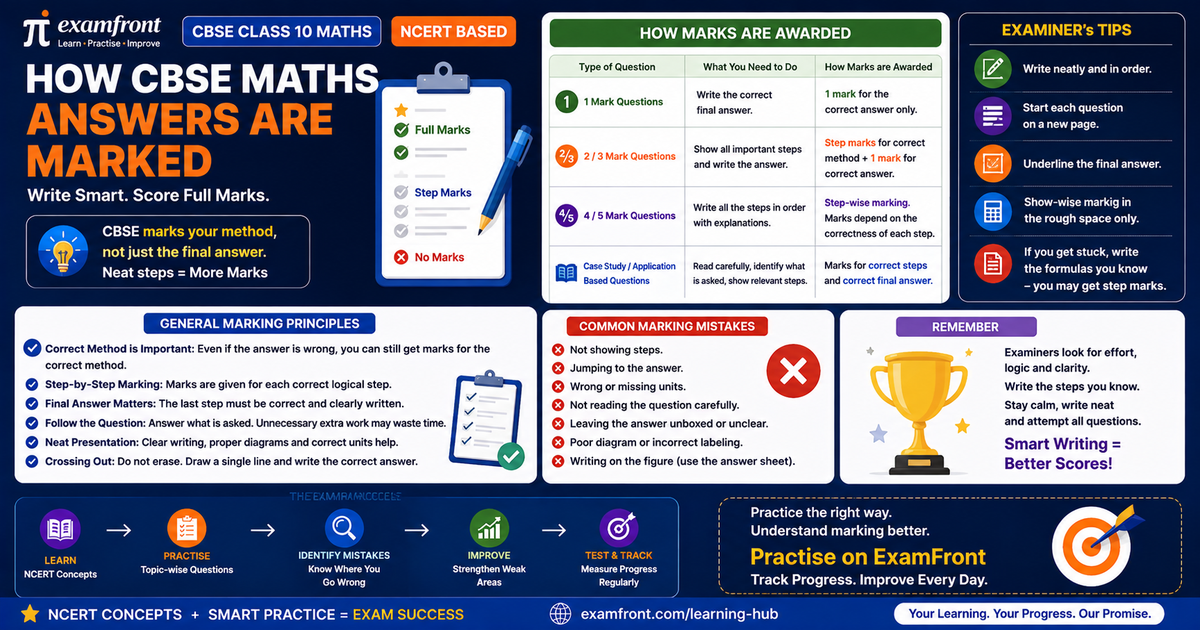
Understanding how your answers are marked is one of the fastest ways to score higher — because it tells you exactly how to write them. Here’s how CBSE Class 10 Maths marking works.
Most students write their answers hoping the maths is right. Top students write their answers knowing how they’ll be marked — and that changes everything about how they present their working. How CBSE Maths answers are marked isn’t a mystery: it follows an official marking scheme built around rewarding correct method, step by step. Once you understand that, you can write answers that earn every mark you’ve genuinely earned. This guide explains how it works and what to do about it.
A note on sources: this article is based on CBSE’s publicly available marking schemes and generally understood marking principles. Where something is good practice rather than an official rule, we say so. For the authoritative details, always refer to the official marking schemes CBSE publishes with its papers.
Marks are awarded step by step
The single most important thing to understand: in maths, marks are allocated to the steps of a solution, not just the final answer. CBSE publishes an official marking scheme for each paper that breaks down how the marks for each question are distributed across the working.
This is why maths is forgiving of small slips in a way many students don’t realise: if a question is worth 3 marks, those marks are typically spread across the method and the answer — so a correct approach with a small arithmetic error at the end can still earn most of the marks, if the working is shown.
Method marks: the marks you keep even when the answer is wrong
Method marks (or “step marks”) are awarded for the correct approach and working — independent of whether your final number is right. They’re the reason showing your working matters so much:
- Get the method right but slip on arithmetic → you keep the method marks.
- Skip the working and just write an answer → if the answer’s wrong, you may get nothing, even if you knew the method.
The lesson is direct: always show every step. You’re not writing working to please the examiner — you’re creating the opportunities for marks to be awarded.
What the marking scheme rewards
Studying an official marking scheme (published with CBSE’s sample papers) shows you what earns marks. In general, it rewards:
- A correct method or formula — often carries a mark in itself.
- Correct substitution and working — the steps that apply the method.
- The correct final answer, usually with appropriate units.
- Clear, logical presentation that lets each step be identified and credited.
As good practice, marking schemes also typically allow alternative valid methods — if there’s more than one correct way to solve a problem, a correct alternative approach generally earns the marks too.
How to write answers that earn every mark
Turning this understanding into marks is straightforward:
- Show every step, in order. Don’t do steps in your head — put them on paper where they can be marked.
- State the formula or method you’re using before applying it — that often secures a mark on its own.
- Write clearly and logically, so the examiner can follow (and credit) each step. If they can’t read or follow your working, they can’t award it.
- Include units and final statements where relevant — don’t lose the last mark to an unstated answer.
- Don’t rush to the answer. The working is where most of the marks live.
These habits directly counter the most common ways students lose easy marks.
Where this sits in the NCERT and CBSE syllabus
Marking is not a chapter you study — it is the rule the whole paper is judged by, so it is worth knowing exactly what that paper looks like.
NCERT decides what can be asked. Every question on the CBSE Class 10 Maths paper is set on the rationalised NCERT syllabus — seven units, fourteen chapters. That is why working through the NCERT examples and exercises is the single best preparation for the style of question you’ll face, and why a last revision is better spent on NCERT formulas and past CBSE papers than on a new book. Our guide to studying NCERT Maths for Class 10 covers how to work through the textbook properly, and the NCERT Class 10 Maths guide maps the whole book.
CBSE decides how the marks are split. The theory paper is 80 marks over 3 hours, with 20 more from internal assessment, and it is built from five sections:
| Section | Questions | Marks each | Total |
|---|---|---|---|
| A — objective (MCQ and Assertion–Reason) | 20 | 1 | 20 |
| B — very short answer | 5 | 2 | 10 |
| C — short answer | 6 | 3 | 18 |
| D — long answer | 4 | 5 | 20 |
| E — case-study / application based | 3 | 4 | 12 |
That table is where method marks actually live. A Section A question is one mark for the correct answer — there is no working to credit, so a slip there costs the whole mark. Everything from Section B onwards is marked step by step, and by Section D a single question carries five marks spread across the method, the substitution and the final statement. Note that there are no 4-mark questions outside Section E — the 4-mark case-study questions are marked as their own sub-parts. Our guide to the question types in the paper covers what each format expects, and the exam pattern covers the paper design behind it.
The practical read: the higher the mark value, the more of it is method — so the questions where showing your work pays most are exactly the ones students most often rush.
See it for yourself
The best way to internalise this is to work through a real paper with its official marking scheme beside you — you’ll see exactly where each mark is awarded, and it will change how you write. The marking schemes CBSE publishes alongside its sample papers are the authoritative guide, and our walkthrough on how to solve sample papers shows how to run one under real conditions before you check it.
And when you practise, practise the way you’ll be marked. examfront helps you build the habit of complete, well-structured working — and shows you where you tend to lose marks you’ve earned — so writing for the marks becomes automatic long before exam day. Practise the right way with examfront and make sure every mark you earn is a mark you keep.
Download the 2-page summary (PDF) — the marking principles, the section-by-section mark split and a fully worked 3-mark answer, on one printable sheet.
Frequently asked questions
How are CBSE Class 10 Maths answers marked? Against an official marking scheme that allocates marks step by step. In maths, marks are typically given for correct method and working as well as the final answer — so you can earn marks even if your final answer is wrong, provided your method is sound and shown.
What are method marks in CBSE Maths? Marks awarded for the correct approach and working — the steps you take — separate from the mark for the final answer. Showing your working means these marks are yours even if you slip at the end.
Where can I see the official marking scheme? CBSE publishes official marking schemes alongside its sample papers and past question papers on its academic website. Studying the paper with its marking scheme shows you exactly how marks are awarded.
Does showing working really get more marks? Yes. Because marks are allocated to steps, clear working lets the examiner award every method mark you’ve earned. Skipping steps risks losing marks even when your final answer is correct.
Is the CBSE Class 10 Maths marking scheme based on NCERT? The paper is set on the rationalised NCERT syllabus, and the marking scheme is published by CBSE for each paper it sets. So NCERT decides what can be asked, while the marking scheme decides how the marks for each question are split across method and answer. A correct alternative method that stays inside the NCERT syllabus still earns the marks.
Write for the marks. Practise with examfront →