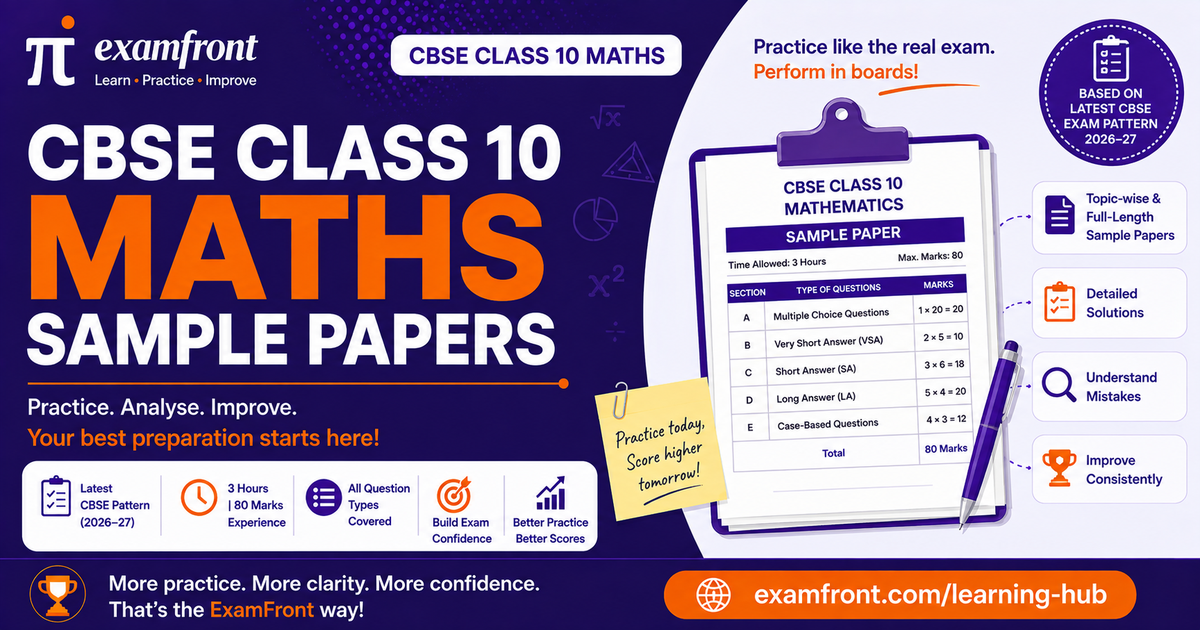
What sample papers are, why they’re your most powerful prep tool, and a clear cycle for turning each one into real marks.
Solving CBSE Class 10 Maths sample papers is probably the single most effective thing you can do in the months before your board exam — if you use them well. Most students treat a sample paper as a test: solve it, check the score, move on. But the real value isn’t in the score — it’s in what each paper teaches you about where you’re ready and where you’re not. This guide shows you what sample papers are, where to find the official ones, and a repeatable cycle to turn every paper you solve into genuine improvement.
What are CBSE Class 10 Maths sample papers?
A sample paper is a practice question paper built to match the real board exam — same structure, same sections, same marks distribution, same style of questions. CBSE releases official sample papers each year so students know exactly what to expect, and they’re the closest thing you have to sitting the real exam before the real exam.
Because they mirror the actual paper — the five sections, 80 marks, and question typology — solving them does something no amount of chapter practice can: it prepares you for the whole experience at once. The timing, the mix of question types, the stamina of a three-hour paper.
Where to find official CBSE sample papers
The official CBSE sample papers are published on CBSE’s official academic website each year, usually well ahead of the board exams, often alongside their marking schemes. These official papers should be your first choice — they’re the most accurate reflection of what you’ll actually face, because they come from the board itself.
There are countless sample papers from other publishers too, and they’re useful for extra practice once you’ve worked through the official ones. But start with the official set: they set the standard for structure and difficulty.
Why sample papers are your most powerful prep tool
Sample papers do three things that ordinary study can’t:
They reveal your real readiness. Studying a chapter tells you that you understand it. Solving a full paper under exam conditions tells you whether you can deliver it — across every topic, in sequence, against the clock. That’s a very different, much more honest picture.
They train your exam timing. Three hours, 38 questions, five sections. Pacing is a skill of its own, and the only way to build it is to practise the whole paper, not isolated questions.
They show you exactly where your marks leak. Every paper you solve surfaces your specific weak spots — the concept you thought you knew, the question type that eats your time, the careless slips. That information is gold, and it’s the whole point.
The Sample Paper Cycle
Here’s the key shift: don’t just solve sample papers — run each one through a cycle that turns it into improvement. This is how a strong student uses a sample paper versus how an average one does:
1. Attempt the paper in one sitting, under real exam conditions — three hours, no notes, no breaks. This is non-negotiable; a paper solved casually over two days teaches you almost nothing about exam readiness.
2. Review your answers honestly against the marking scheme. Mark yourself strictly, the way an examiner would — partial marks for method, nothing for unshown working.
3. Categorise your mistakes. This is the step that changes everything (more on it below) — sort why you lost each mark, don’t just note that you did.
4. Revise the specific weak areas the paper exposed — not everything, just what this paper showed you needs work.
5. Reattempt similar questions (or the paper again later) to confirm the fix took.
Then repeat with the next paper. Each loop sharpens the next.
The step most students skip: learning from mistakes
Steps 1 and 2 — solving and scoring — are what everyone does. Step 3, categorising your mistakes, is what separates students who improve from students who just keep solving papers at the same level.
When you get a question wrong, the reason matters enormously. Was it a concept you didn’t understand? A formula you forgot? A misread question? A careless calculation? Running out of time? Each of these needs a completely different fix — and lumping them together as “I got it wrong” means you never actually address the real cause. Our guide on analysing your sample paper mistakes breaks down exactly how to do this, and how to solve sample papers effectively walks through the full method.
This is exactly where examfront changes the game. Solving papers on your own, it’s genuinely hard to see the pattern in your mistakes — you feel like you’re “bad at maths” when really you’re losing most marks to, say, arithmetic slips or time pressure in one section. examfront takes your practice and shows you precisely where your marks are leaking and why, so every paper you solve points you straight to the fix. Practise sample papers with examfront and turn your mistakes into your fastest route to a higher score.
How many should you solve, and when to start?
There’s no official number, and quality beats quantity every time — five papers run properly through the full cycle will do more for you than fifteen solved and forgotten. As a general guide, begin with sample papers once you’ve covered most of the syllabus (so you can attempt a full paper meaningfully), and build up frequency as the exam approaches. The goal is enough repetition that the exam format feels completely familiar by the time you sit the real thing.
Download the 2-page summary: CBSE Class 10 Maths Sample Papers – Summary PDF
Frequently asked questions
What are CBSE Class 10 Maths sample papers? They’re practice question papers built to match the real board exam — same structure, sections, marks, and question style. CBSE publishes official ones each year on its academic website, often with marking schemes.
Where can I get official CBSE Class 10 Maths sample papers? From CBSE’s official academic website, which publishes them each year ahead of the exams. Start with the official set before using publisher papers for extra practice.
How many sample papers should I solve for Class 10 Maths? There’s no fixed number — solving fewer papers properly (attempting, reviewing, categorising mistakes, revising) beats rushing through many. Quality of practice matters more than quantity.
When should I start solving sample papers? Once you’ve covered most of the syllabus, so you can attempt a full paper meaningfully — then increase frequency as the exam approaches.
Turn every sample paper into real marks. Practise with examfront →