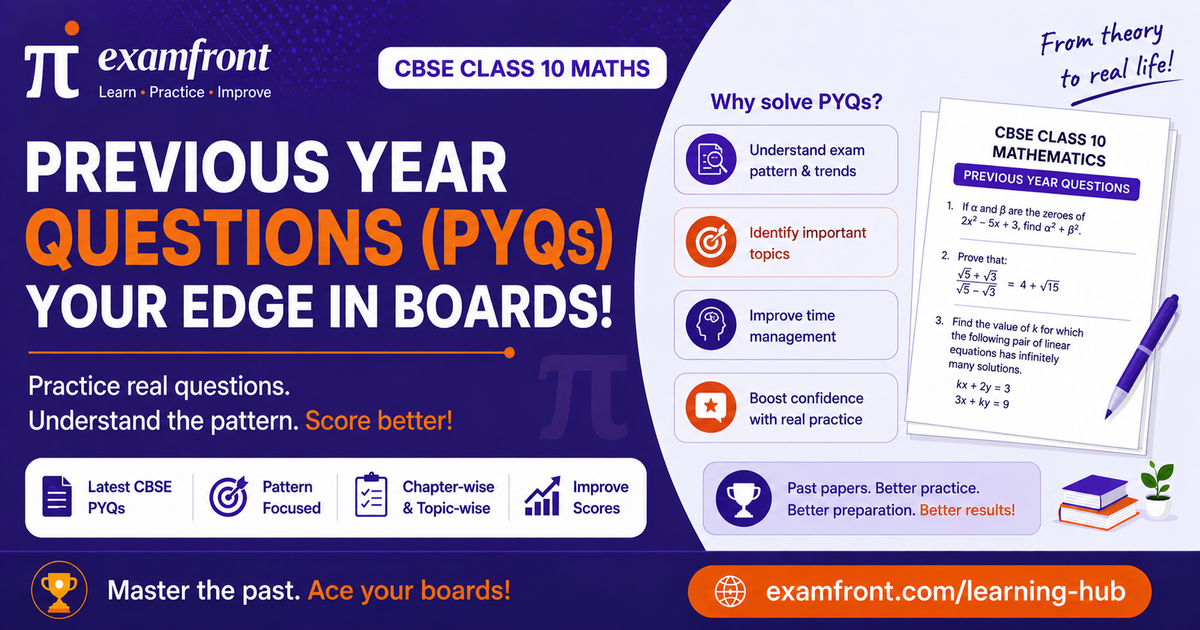
Why previous year questions are one of your best prep tools — and how to use them to master the concepts the board tests again and again.
Many students solve previous year papers hoping the exact questions will come back. That’s almost never how CBSE works. The real value of CBSE Class 10 Maths previous year questions isn’t predicting what will be asked — it’s recognising the concepts the board keeps testing. Because here’s the truth that makes PYQs genuinely powerful: board exams rarely repeat the exact question — they repeatedly test the same concepts in different forms. Once you understand that, PYQs stop being a memory game and become a map of exactly which ideas matter most.
Why previous year questions matter
Previous year questions are the real papers CBSE has actually set in past board exams. That makes them uniquely valuable: unlike any practice material, they show you what has genuinely been asked — the concepts the board returns to, the way questions are framed, the depth expected. They’re the closest evidence you have of how examiners think.
Used well, PYQs tell you where to focus. If a concept has appeared in paper after paper, that’s not coincidence — it’s a signal about what the board considers essential. Your job isn’t to memorise those questions; it’s to master those concepts so completely that you can answer them in whatever new form they appear.
PYQs vs sample papers: what’s the difference?
Students often lump these together, but they play different roles:
| Previous year questions | Sample papers | |
|---|---|---|
| What they are | Real papers set in past board exams | Practice papers (official or publisher) |
| What they show | What has actually been asked | What the exam could look like |
| Best for | Spotting recurring concepts and framing | Full-length timed rehearsal |
| Main value | Pattern recognition | Exam simulation |
The two work together: sample papers rehearse the whole exam experience, while PYQs reveal the recurring concepts underneath it. This article — and this whole approach — is about that second job.
The big idea: concepts repeat, not questions
This is the shift that changes how you use PYQs. Weaker students flip through past papers looking for questions to memorise, then feel cheated when the board asks something “different.” Strong students look at the same papers and ask: which concepts keep coming up?
Here’s what that looks like in practice:
Past Paper A: Find the height of a tower. Past Paper B: Find the height of a tree. Past Paper C: Find the height of a kite in the air.
Three “different” questions — one concept: trigonometry (heights and distances).
The board isn’t reusing questions; it’s revisiting concepts. A quadratic equation can be dressed as a word problem about a garden, a projectile, or a number puzzle — three “different” questions testing one idea. When you train yourself to see the concept beneath the wording, PYQs become a precise guide to what actually matters.
The examfront Pattern Recognition Framework
Here’s a repeatable way to turn past papers into concept mastery. Unlike solving a single paper, this framework works across several papers to surface what recurs:
Collect questions from several past papers on a topic. Compare them across years — line them up and look past the surface wording. Identify the recurring concept they all test (the wording changes but the underlying idea doesn’t). Strengthen that concept until you own it in any form. Reattempt similar questions framed differently to prove you can recognise the concept however it’s dressed. Each pass makes you faster at seeing the maths beneath the story.
If you want the step-by-step technique for the Compare and Identify steps — the part where the real insight happens — see how to analyse previous year questions.
When to start using PYQs — and when not to
PYQs are powerful, but only at the right stage. The most common mistake is starting with them too early:
❌ Don’t begin your preparation with previous year papers. ✔ First understand the chapter. ✔ Then solve the chapter’s own questions. ✔ Then use PYQs to see how CBSE frames those concepts.
There’s little value in attempting past questions on a chapter you haven’t studied — you’ll just feel discouraged. Once you’ve covered a topic, though, looking at how it’s appeared in past papers shows you the concept in exam form. Closer to the exam, work across full past papers to build the bigger pattern picture. For building that chapter foundation first, see how to study Class 10 Maths, and to navigate topic by topic, the chapter list.
Common mistakes students make with PYQs
Avoid these and PYQs become far more powerful:
- Memorising answers instead of concepts — the exact question won’t return; the concept will.
- Solving only one year’s paper — patterns only emerge across several years.
- Ignoring your mistakes after checking answers — the wrong answers are where the learning is.
- Treating PYQs as predictions — they reveal recurring concepts, not the questions you’ll be set.
- Solving without timing — practise under realistic conditions to build exam pace.
Where to find official CBSE previous year papers
Always use official CBSE question papers whenever available — they’re the most authentic representation of board-level questions, published through CBSE’s official website. Stick to those rather than third-party PDF repositories, where papers can be altered, mislabelled, or mixed with unofficial content. If you can’t find a specific year, refer to the official CBSE website for the authentic question papers.
How PYQs fit your preparation
PYQs aren’t a standalone activity — they’re one part of a complete preparation loop. Use them to identify the concepts that matter — and to turn that reading into a shortlist, see how to identify important questions — then sample papers to rehearse the full exam, and mistake analysis to fix what’s costing you marks. Together, those turn scattered practice into steady improvement.
This is exactly where examfront brings it together. examfront analyses thousands of questions so you don’t have to manually discover the recurring concepts yourself — it surfaces the patterns across years of papers and drills the concepts the board tests most, so your practice is aimed at what actually appears in the exam. Practise the concepts that matter with examfront and turn past papers into future marks.
⬇ Download the 2-page PYQ summary (PDF) — the Pattern Recognition Framework, the key takeaways and a worked example, on two printable pages.
Frequently asked questions
Are previous year questions enough for Class 10 Maths? PYQs are excellent for spotting which concepts the board tests repeatedly, but they work best alongside sample papers (for full-length rehearsal) and thorough syllabus study. Use them to focus your preparation, not as your only resource.
Do the same questions repeat in CBSE Class 10 Maths? Rarely the exact question — but the same concepts appear again and again in different forms. That’s why the smart use of PYQs is to master recurring concepts rather than memorise past questions.
When should I start solving previous year questions? Once you’ve covered a topic, so you can attempt its past questions meaningfully. Don’t begin your preparation with PYQs — understand the chapter first, then use past questions to see how CBSE frames those concepts.
Where can I find official CBSE Class 10 Maths previous year papers? Through the official CBSE website, which is the authentic source. Avoid third-party PDF repositories, where papers may be altered or mislabelled.
Master the concepts that repeat. Practise with examfront →