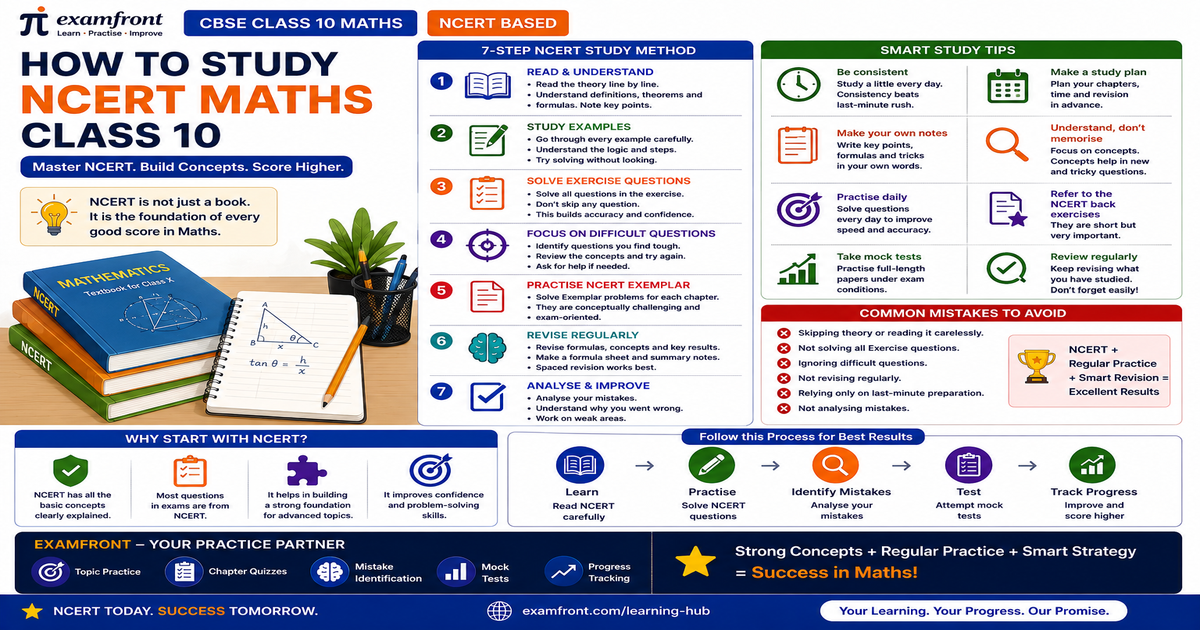
A clear, repeatable way to study Class 10 Maths — chapter by chapter, week by week — so your effort actually turns into marks.
Most students studying Class 10 Maths aren’t short on effort — they’re short on method. They read the textbook, feel like they’ve studied, then freeze when a slightly different question appears in the exam. If that sounds familiar, the problem isn’t you; it’s the approach. This guide gives you a concrete, repeatable method for how to study NCERT Maths Class 10 — one that builds real understanding, not just the feeling of it.
The core method: how to study one chapter
Everything starts here. If you can study one chapter well, you can study all fourteen — because you just repeat the same cycle. Here’s the method, step by step:
1. Learn the concept first — properly. Read the concept section slowly, and make sure you understand why it works, not just the steps. If a definition or formula doesn’t make sense, that’s a flag to pause and clear it up before moving on. Building on a shaky concept just means re-learning it later.
2. Study the solved examples — actively. Don’t just read them. Cover the solution, try the example yourself, then check. The solved examples are the bridge between “I understand the idea” and “I can do a question” — skipping them is the single most common reason students get stuck on the exercises.
3. Solve the exercises — this is the real work. Working through the exercise questions yourself, by hand, is where actual learning happens. Getting some wrong is part of it. When you do, don’t just look up the answer — figure out where your method went wrong. That diagnosis is worth more than ten correct answers.
4. Self-test with the book closed. After finishing a chapter, try a few questions with no notes and no examples in front of you. This is the honest test of whether you’ve actually learned it — and it’s completely different from the comfortable feeling of following along with the book open.
5. Revisit the weak spots. Note the question types you struggled with and come back to them a few days later. This is where shaky topics become solid ones.
That’s the whole method. Simple, but powerful — because it’s built on doing, not reading.
Why the method starts with NCERT — and where CBSE comes in
The cycle above works on any textbook. The reason it’s built around NCERT specifically is that NCERT is the book CBSE writes the paper from — so studying it well isn’t just good learning, it’s targeted exam preparation. Four things are worth knowing before you start.
The NCERT book is the CBSE syllabus. Class 10 Maths is 14 chapters grouped into seven units, and those chapters are the scope of the board paper — nothing outside them is examinable. That’s why “finish NCERT properly” is a complete plan rather than a starting point. (Constructions used to be a chapter and was removed in the rationalised syllabus, so a fifteen-chapter list you find online is out of date.) Our NCERT Class 10 Maths guide and the full chapter list both lay this out.
CBSE gives you 80 marks to win with it. The board paper is 38 questions, 80 marks, three hours, and the remaining 20 marks come from internal assessment — 80 + 20 = 100. Knowing the paper’s shape tells you what “finished a chapter” has to mean: see the CBSE Class 10 Maths exam pattern for the section-by-section breakdown.
Step 4 should mirror how CBSE asks. Your closed-book self-test is far more useful if the questions look like board questions. CBSE uses six formats — MCQ, Assertion–Reason, Very Short Answer, Short Answer, Long Answer and Case-based — and the same concept can be asked in all six. Set your self-test as a small mix of them rather than five questions of the same shape; the question types guide shows one topic asked six different ways.
Marks sit in units, not chapters. CBSE publishes the 80 marks by unit: Algebra 20, Geometry 15, Trigonometry 12, Statistics & Probability 11, Mensuration 10, Number Systems 6, Coordinate Geometry 6 — which sums to 80. Chapter-level mark figures circulating online are unofficial estimates, so plan your weeks against the units. The unit-wise weightage guide has the detail, and the syllabus page maps every chapter to its unit.
Building a weekly rhythm
A method only works if it’s sustainable. Rather than an intense, rigid timetable you’ll abandon after a week, aim for a steady rhythm:
Roughly one chapter a week. This pace gets you through all fourteen chapters with time to spare before the exam, without burning out. Bigger chapters (like the Algebra and Geometry topics) may need a little more; smaller ones less.
A little every day beats a lot once a week. Forty focused minutes daily builds far more than a single exhausting Sunday session. Maths rewards consistency — the ideas need time to settle.
Build in a weekly “catch-up and revisit” slot. One session a week with no new material, just returning to the questions you found hard. This is the habit that quietly separates strong students from stressed ones.
For a sensible order to move through the chapters, see our chapter list, and to focus your energy where the marks are, the unit-wise weightage guide.
How to revise so it actually sticks
Revision is where most students waste the most time — because they re-read, which feels productive but builds almost no lasting recall. Here’s what works instead:
Use active recall. Close the book and try to write out a concept, formula, or worked method from memory. Struggling to remember is exactly what strengthens the memory — comfortable re-reading doesn’t.
Space it out. Revisit a chapter a few days after finishing it, then again a couple of weeks later. Each spaced revisit locks the learning in deeper than cramming it all at once.
Revise with a pen, not just your eyes. For Maths especially, revision means doing questions, not reading solutions. Keep the formula sheet beside you and practise applying each formula, rather than just looking at it.
Signs it’s working — and signs to adjust
How do you know your method is actually improving your Maths? A few honest signals:
It’s working when you can solve exercise questions with the book closed, when you can explain a method to someone else, and when unfamiliar questions feel like puzzles to work out rather than walls.
It’s time to adjust when you can follow solutions but can’t produce them yourself, when you keep making the same type of mistake, or when you feel you “know” a chapter but score poorly when tested. Each of these points to the same fix: more solving, less reading — and closer attention to where exactly you go wrong.
That last point is the missing piece in most study plans. It’s easy to know that you got a question wrong; it’s much harder, on your own, to see the pattern in your mistakes — that you consistently slip on sign errors, or forget a particular formula, or misread a certain question type. examfront is built exactly for this: it turns your practice into a clear picture of where your marks are leaking, so your study time goes straight to the topics that will lift your score most. A good method plus honest feedback is what real improvement looks like. Start with a quick diagnostic on examfront and see where to focus first.
The most common study mistakes
Most struggling students share the same few habits — avoid these and you’re already ahead:
- Reading instead of solving — the number-one trap. It feels like studying; it isn’t.
- Skipping the solved examples and then feeling stuck on the exercises.
- Never self-testing with the book closed, so “I understand it” is never actually verified.
- Repeating the same mistakes without stopping to understand why they happen.
- Cramming just before the exam instead of steady weekly progress.
📄 Download the 2-page summary (PDF) — the five-step cycle, the CBSE unit map and a worked chapter, on one printable sheet.
Frequently asked questions
What is the best way to study NCERT Maths Class 10? Study one chapter at a time using a fixed cycle: learn the concept, work through the solved examples yourself, solve the exercises by hand, self-test with the book closed, then revisit your weak spots. Consistency — roughly a chapter a week — matters more than long, occasional sessions.
Is reading NCERT enough to score well in Maths? No. Reading builds familiarity, but Maths marks come from solving. You have to work through questions by hand, get some wrong, and understand why — that’s what builds real ability.
How many hours a day should I study Class 10 Maths? Consistency beats quantity. A focused 40–60 minutes most days, with regular revision, builds more than occasional marathon sessions. The key is doing questions, not just reading.
How do I stop making the same mistakes in Maths? Track where you go wrong, not just that you did. When you spot a recurring pattern — sign errors, a forgotten formula, a misread question type — target it directly with focused practice until it’s fixed.
Is the NCERT textbook enough for the CBSE Class 10 Maths board exam? For the concepts, yes — CBSE builds the Class 10 Maths course from the NCERT syllabus, and the 14 chapters sit in seven units worth 80 theory marks plus 20 internal assessment. What NCERT does not give you is exam practice in CBSE’s six question formats, so pair the textbook cycle with sample papers and timed tests. Also note that CBSE publishes marks by unit, not by chapter — chapter-level mark figures circulating online are unofficial estimates.
A good method plus honest feedback is how Maths marks are built. Start with examfront →