Based on the official CBSE Mathematics (Code 041 & 241) curriculum for Class X, 2026-27.
If you only had time to learn one thing before planning your Maths preparation, it would be this: where the marks actually sit. The CBSE Class 10 Maths unit-wise weightage tells you exactly how the 80 theory marks are divided across the seven units — and once you can see that clearly, you can spend your study time where it earns the most. This page lays out the official marks distribution and, more importantly, how to use it to prepare smarter.
CBSE Class 10 Maths unit-wise weightage (2027)
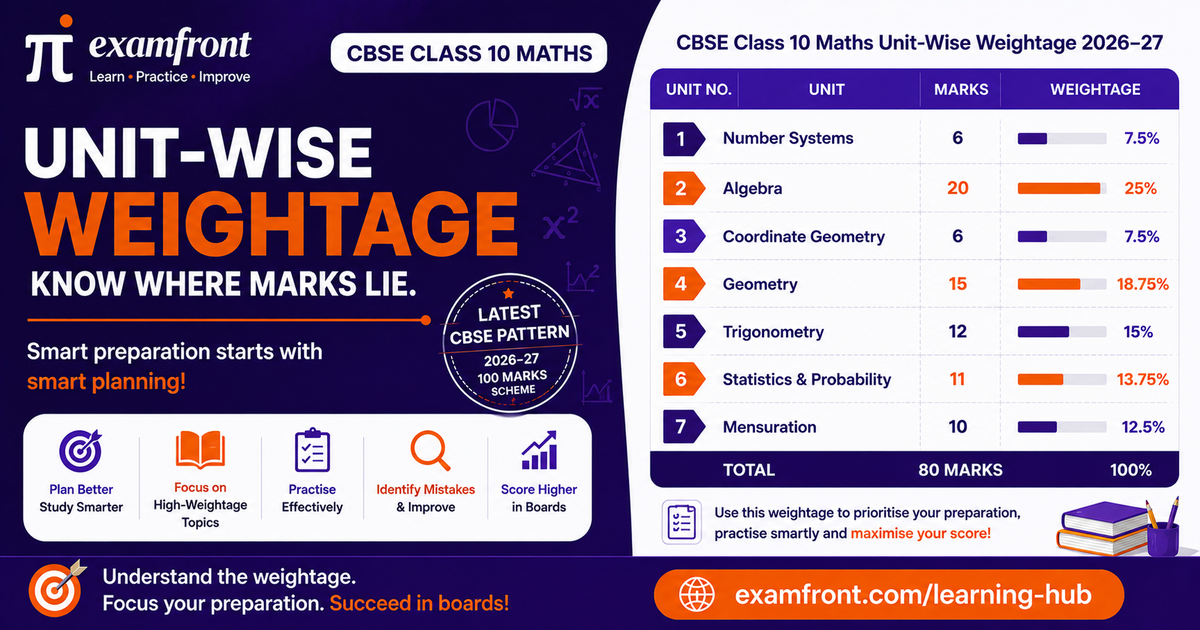
Here is the official marks distribution for the 80-mark theory paper:
| Unit | Marks |
|---|---|
| Algebra | 20 |
| Geometry | 15 |
| Trigonometry | 12 |
| Statistics & Probability | 11 |
| Mensuration | 10 |
| Number Systems | 6 |
| Coordinate Geometry | 6 |
| Total (Theory) | 80 |
(Units above are ordered by marks, highest first. The official curriculum lists them by unit number.)
Where the marks actually sit
Two units carry the weight. Algebra alone is worth 20 marks — a full quarter of the theory paper — and Geometry adds another 15. Together, those two units account for 35 of the 80 theory marks, almost 44% of the written exam. That single fact should shape how you plan.
The middle band — Trigonometry (12), Statistics & Probability (11), and Mensuration (10) — makes up another solid chunk of marks and rewards steady, methodical preparation. The two smallest units, Number Systems and Coordinate Geometry, are 6 marks each.
High-weight vs low-weight units — how to think about it
It’s tempting to read a weightage table as “study the big units, skip the small ones.” That’s the wrong lesson, and it costs students marks. Here’s a more useful way to think about it:
High-weight units deserve your deepest preparation. Algebra and Geometry are where thorough mastery pays off most — every extra hour of solid Algebra practice has more marks riding on it than almost anything else on the paper.
Low-weight units are your easy, reliable marks — don’t skip them. Number Systems and Coordinate Geometry are only 6 marks each, but they’re often among the most self-contained and scoring topics on the paper. Six marks you can bank reliably are worth more than six marks you gamble on in a harder unit. Skipping a small unit to spend more time on a big one is usually a false economy.
The goal is coverage with emphasis, not coverage or emphasis. Prepare everything; go deepest where the marks — and your own weak spots — are.
A quick word on “chapter-wise” weightage
Many students search for chapter-wise weightage, hoping for an exact mark value per chapter. It’s worth being clear: CBSE officially assigns marks by unit, not by individual chapter. So there’s no official “Quadratic Equations = X marks” figure — that chapter sits inside the Algebra unit, which is worth 20 marks in total.
What you can do is use the unit weightage to see which chapters live in the high-value units. The Algebra unit (20 marks) contains Polynomials, Pair of Linear Equations, Quadratic Equations and Arithmetic Progressions. The Geometry unit (15 marks) contains Triangles and Circles. Those are the chapters sitting inside your two heaviest units — a good signal of where deep preparation compounds. You can explore any of them from the full chapter list, or see all 14 chapters grouped under their units in the Class 10 Maths syllabus.
How weightage connects to the question paper
Weightage tells you which units the marks come from. The official 2026-27 question paper design tells you what kind of thinking earns them — and reading the two together is genuinely powerful:
| Type of question | Marks | Approx. weightage |
|---|---|---|
| Remembering & Understanding | 43 | 54% |
| Applying | 19 | 24% |
| Analysing, Evaluating & Creating | 18 | 22% |
More than half the paper (54%) rewards remembering and understanding your concepts. So the highest-return preparation isn’t just “do the big units” — it’s “know the big units well enough to recall and explain them cleanly.” A student with rock-solid Algebra and Geometry fundamentals is aimed squarely at the largest, most accessible share of the marks. For the full breakdown of the paper structure, see CBSE Class 10 Maths syllabus 2027.
A smart way to prioritise your revision
Turning this table into a study plan is simpler than it looks:
Anchor your schedule on Algebra and Geometry. They’re 35 marks between them; give them your best, most consistent hours and revisit them often.
Lock in the low-weight units early. Number Systems and Coordinate Geometry are quick wins — get them solid and secure those marks so they’re never a worry.
Keep the middle band ticking. Trigonometry, Statistics & Probability, and Mensuration reward regular practice; don’t leave them to the end.
Let your weak spots override the table. Weightage is one input; your own problem areas are the other. A 6-mark unit you keep getting wrong may deserve more attention than a 20-mark unit you’ve already mastered.
That last point is exactly where a personalised approach beats a generic plan. examfront looks at both the weightage and your actual performance, then focuses your practice on the high-value areas where you stand to gain the most marks — so you’re never guessing whether to revise Algebra again or shore up a weaker topic. Explore the Learning Hub and let your practice target the marks that matter.
📥 Download the 2-page unit-wise weightage summary (PDF) — the full marks table, the priority bands, and a worked “where do my marks come back fastest?” example in one printable sheet.
Frequently asked questions
Which unit has the highest weightage in Class 10 Maths? Algebra, at 20 marks, is the highest-weighted unit, followed by Geometry at 15. Together they make up 35 of the 80 theory marks.
Is there official chapter-wise weightage for Class 10 Maths? No — CBSE assigns marks by unit, not by individual chapter. Chapter-level mark values circulating online are unofficial estimates. Use the official unit weightage instead.
Should I skip low-weight units like Number Systems? No. Low-weight units are often the most scoring and self-contained topics — they’re reliable marks you can bank. Prepare everything; simply go deepest on the high-weight units and your own weak areas.
Where does this weightage come from? This reflects the official CBSE Mathematics (Code 041 & 241) curriculum for Class X, 2026-27. Always confirm against the latest official CBSE document for your exam year.
Want your practice aimed at the highest-value marks for you? Start with examfront →