A student’s map to the NCERT Class 10 Maths book — what it covers, how it maps to your board exam, and how to work through it well.
If the NCERT Class 10 Maths book feels like a lot to get through, here’s the reassuring truth: it’s a finite, well-organised, and completely conquerable set of just fourteen chapters. Once you see how the whole book is laid out and how it connects to your board exam, “get through NCERT” stops being a vague worry and becomes a clear, tickable plan. This NCERT Class 10 Maths guide is your map — what’s in the book, how it’s structured, how long it takes, and the smartest way to work through it.
Your NCERT journey, at a glance
Before the detail, here’s the whole path from opening the book to being exam-ready:
NCERT Class 10 Maths: what the book covers
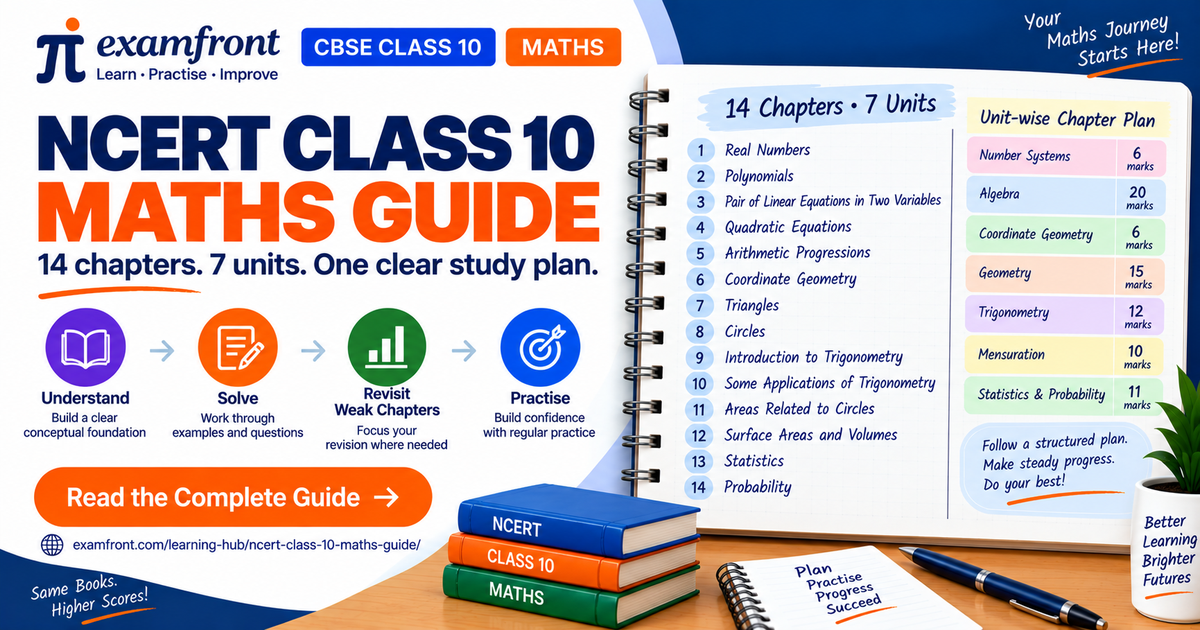
The NCERT Class 10 Maths textbook is the single most important book for your board exam — it’s the officially prescribed text, and the board paper is built directly from it. The entire course is fourteen chapters, organised into seven units, adding up to the 80-mark theory paper.
That’s worth sitting with for a second: the whole of your Class 10 Maths board preparation rests on fourteen chapters. Not fifty. Not a hundred. Fourteen well-defined chapters, each of which you can understand, practise, and master one at a time. The book isn’t a mountain — it’s a staircase.
How NCERT maps to your board exam
Here’s what many students don’t realise early enough: the board exam doesn’t test anything outside NCERT. The questions are drawn from the same concepts, examples, and exercise types you’ll find in the textbook. That’s why “finish NCERT properly” is genuinely the core of board preparation.
The book maps onto the exam in a clear way — each unit carries a fixed share of the 80 marks. Algebra and Geometry are the heaviest, so the chapters inside them reward the deepest work. For the full mark-by-mark picture, see our unit-wise weightage guide, and for how the paper itself is structured, the exam pattern guide. Reading NCERT with the exam structure in mind is far more effective than reading it cover to cover with no map.
The 14 chapters, unit by unit
Here is the whole book in one view — all fourteen chapters, grouped by their units, with each chapter’s number in the textbook:
📘 Number Systems (6 marks) Real Numbers (Ch. 1)
📗 Algebra (20 marks — the biggest unit) Polynomials (Ch. 2) · Pair of Linear Equations in Two Variables (Ch. 3) · Quadratic Equations (Ch. 4) · Arithmetic Progressions (Ch. 5)
📐 Coordinate Geometry (6 marks) Coordinate Geometry (Ch. 7)
📙 Geometry (15 marks) Triangles (Ch. 6) · Circles (Ch. 10)
📈 Trigonometry (12 marks) Introduction to Trigonometry (Ch. 8) · Some Applications of Trigonometry (Ch. 9)
📊 Mensuration (10 marks) Areas Related to Circles (Ch. 11) · Surface Areas and Volumes (Ch. 12)
🎲 Statistics & Probability (11 marks) Statistics (Ch. 13) · Probability (Ch. 14)
Notice that the chapter numbers don’t run straight down that list — and that’s the single most useful thing on this page. The units group chapters by what they test; the textbook numbers them in teaching order. So Triangles is Chapter 6 in the book but sits in the Geometry unit next to Chapter 10, Circles. Coordinate Geometry is Chapter 7 but is a whole unit on its own. Both views are correct and you need both: the unit tells you what a chapter is worth, the number tells you where to find it. If you ever see a list that numbers the chapters 1 to 14 in unit order, it is not the numbering printed in your book — open Chapter 8 expecting Circles and you’ll find Introduction to Trigonometry.
You can explore all of these from the full chapter list, your launch point into each chapter. (If you’ve seen an older list with Constructions as a fifteenth chapter, that’s from a previous edition — it’s no longer part of the current syllabus.)
How long does it take to finish NCERT Maths?
A fair question every student asks. As a rough guide — not an official figure — most students working consistently cover the fourteen chapters in about 12 to 16 weeks, at a pace of roughly one chapter a week with time built in for revision. Bigger chapters like the Algebra and Geometry topics may take a little longer; smaller ones move faster.
The exact timeline matters less than the principle: steady, regular progress beats intense last-minute cramming every time. A chapter a week, done properly, gets you through the whole book with room to spare before the exam.
How to actually work through NCERT
Owning the book isn’t the same as working through it well. Here’s a sensible approach that keeps you moving without getting stuck:
Read the concept, then the solved examples, then the exercises — in that order. NCERT is designed this way for a reason. The solved examples bridge the gap between “I understand the idea” and “I can do a question.” Don’t skip them to rush to the exercises.
Treat the exercises as the real work. The exercises at the end of each section are where actual learning happens. Reading a solved example feels productive, but it’s solving problems yourself — getting some wrong, understanding why, and trying again — that builds real ability.
Follow a sensible chapter order. Many students find it works well to build the Algebra chapters solidly early (they connect to each other and carry the most marks), then move through Geometry and Trigonometry, keeping the self-contained Statistics & Probability chapters as reliable marks along the way. Your school’s sequence and your comfort level matter too. There’s a fuller routine in our guide to how to study NCERT Maths in Class 10.
Don’t just do a chapter once and move on. The chapters you found hard the first time are exactly the ones to return to. A quick second pass a couple of weeks later turns shaky topics into solid ones.
Use NCERT Exemplar for the tougher stuff. If you’re aiming high, the NCERT Exemplar book offers harder, more application-focused questions once your basics are solid.
Common NCERT mistakes to avoid
Most students who struggle with NCERT aren’t lacking ability — they’re falling into a few avoidable habits:
- Skipping the solved examples and jumping straight to exercises, then feeling stuck.
- Reading solutions instead of solving — it feels like studying, but your hand never learns the method.
- Never revisiting hard chapters, so shaky topics stay shaky right up to the exam.
- Ignoring the smaller units because they’re “only” 6 marks — when they’re often the easiest marks to secure.
- Working from an older edition without checking what was rationalised out — you can spend a fortnight on a method that is no longer examinable.
Avoiding these five does more for most students than any amount of extra material.
The NCERT and CBSE numbers worth knowing
NCERT tells you what to study. CBSE tells you what it’s worth and how it will be asked. Both sets of numbers are official, both are short, and knowing them changes how you use the book.
NCERT sets the scope. Fourteen chapters, seven units, and nothing outside them is examinable. The chapter numbering above is the book’s own, and it is worth learning because every exercise reference you’ll ever meet uses it — “Ex 4.3” means Chapter 4, third exercise. Watch one trap: a topic’s section number and its exercise number don’t always match. The graphical method of solving linear equations is Section 3.2 but its questions are in Exercise 3.1; heights and distances is Section 9.2 with a single Exercise 9.1 of 16 questions; the geometrical meaning of zeroes is Section 2.2 with Exercise 2.1. Search for the wrong number online and you’ll land on solutions for a different topic.
Check your edition. The rationalised syllabus removed real material, and older books and older solution sites still carry it. Constructions is gone as a whole chapter. So are Euclid’s division lemma from Real Numbers, the division algorithm from Polynomials, cross-multiplication and equations reducible to linear form from Pair of Linear Equations, completing the square as an examinable solving method from Quadratic Equations, and area of a triangle from coordinates from Coordinate Geometry. Every one of those is still all over the internet. Our 2027 syllabus page has the current scope in full.
CBSE sets the shape of the paper. Theory is 80 marks, internal assessment is 20, and they add to 100. The theory paper is 38 questions in three hours with no overall choice, split across five sections:
| Section | Questions | Marks each | Total |
|---|---|---|---|
| A | 20 | 1 | 20 |
| B | 5 | 2 | 10 |
| C | 6 | 3 | 18 |
| D | 4 | 5 | 20 |
| E | 3 | 4 | 12 |
| 38 | 80 |
That works out to 2.25 minutes per mark, and CBSE gives you 15 minutes of reading time on top of the three hours. The six question formats — MCQ, assertion–reason, very short answer, short answer, long answer and case-based — are covered in our question types guide.
CBSE sets priority by unit, not by chapter. The seven unit totals are Number Systems 6, Algebra 20, Coordinate Geometry 6, Geometry 15, Trigonometry 12, Mensuration 10, Statistics & Probability 11 — 80 in all. There is no official chapter-wise mark allocation, so the chapter percentage tables and pie charts circulating online are unofficial estimates, however confident they look. Plan by unit.
And CBSE marks your method, not just your answer. Working through NCERT exercises in full, writing every step, is what earns the method marks — a right answer with no working loses most of them, and a wrong answer with correct working still earns several. That’s covered in how CBSE maths answers are marked.
NCERT alone, versus NCERT plus practice
NCERT builds your foundation beautifully — but there’s an honest gap worth naming. Reading and working through the book tells you what you’ve learned. It doesn’t always tell you where you’re still going wrong, or which topics need another round before the exam. That’s the difference between covering the syllabus and being genuinely exam-ready. Once the book is done, CBSE sample papers are the natural next step for testing it under exam conditions.
This is exactly where focused practice takes over. examfront picks up where NCERT leaves off: it turns each chapter into targeted practice, shows you precisely where your mistakes cluster, and points you to the topics that will lift your marks most. NCERT for the foundation, examfront for the mastery. Start practising with examfront and turn the chapters you’ve studied into marks you can rely on.
What to read next
- Full chapter list — your launch point into every chapter
- Unit-wise weightage — where the marks actually sit
- Exam pattern — how the paper is structured
- Full syllabus — the complete course map
📄 Download the 2-page NCERT Class 10 Maths summary (PDF) — the 14 chapters with their numbers, the unit marks, the paper shape, and a worked chapter plan on one printable sheet.
Frequently asked questions
How many chapters are there in NCERT Class 10 Maths? There are fourteen chapters, organised into seven units, covering the full 80-mark theory syllabus. (Older editions had fifteen, including Constructions, which is no longer part of the current syllabus.)
Is NCERT enough for the Class 10 Maths board exam? NCERT is the core and the board paper is built from it, so a thoroughly-worked NCERT is the foundation of a strong result. For top marks, pair it with regular practice and harder questions (like NCERT Exemplar) to be fully exam-ready.
How long does it take to complete NCERT Class 10 Maths? As a rough guide, most students working consistently take about 12 to 16 weeks — roughly a chapter a week with revision time built in. Steady progress matters more than the exact number.
In what order should I study NCERT Maths chapters? Building the Algebra chapters solidly early works well for many students, since they connect and carry the most marks — then Geometry, Trigonometry, and the scoring Statistics & Probability chapters. Your school’s sequence and comfort matter too.
Does the NCERT book follow the CBSE Class 10 Maths syllabus exactly? Yes — the current NCERT book is the prescribed text and its fourteen chapters are exactly the examinable scope, which is why nothing outside it appears in the paper. Two things to watch. First, CBSE assigns its 80 marks by unit (Number Systems 6, Algebra 20, Coordinate Geometry 6, Geometry 15, Trigonometry 12, Mensuration 10, Statistics & Probability 11), not chapter by chapter, so chapter-wise percentage tables online are unofficial estimates. Second, an older copy of the book will contain rationalised material that is no longer examinable — Constructions as a whole chapter, Euclid’s division lemma, the polynomial division algorithm, cross-multiplication, and completing the square among them.
Ready to turn NCERT chapters into marks you can rely on? Start with examfront →