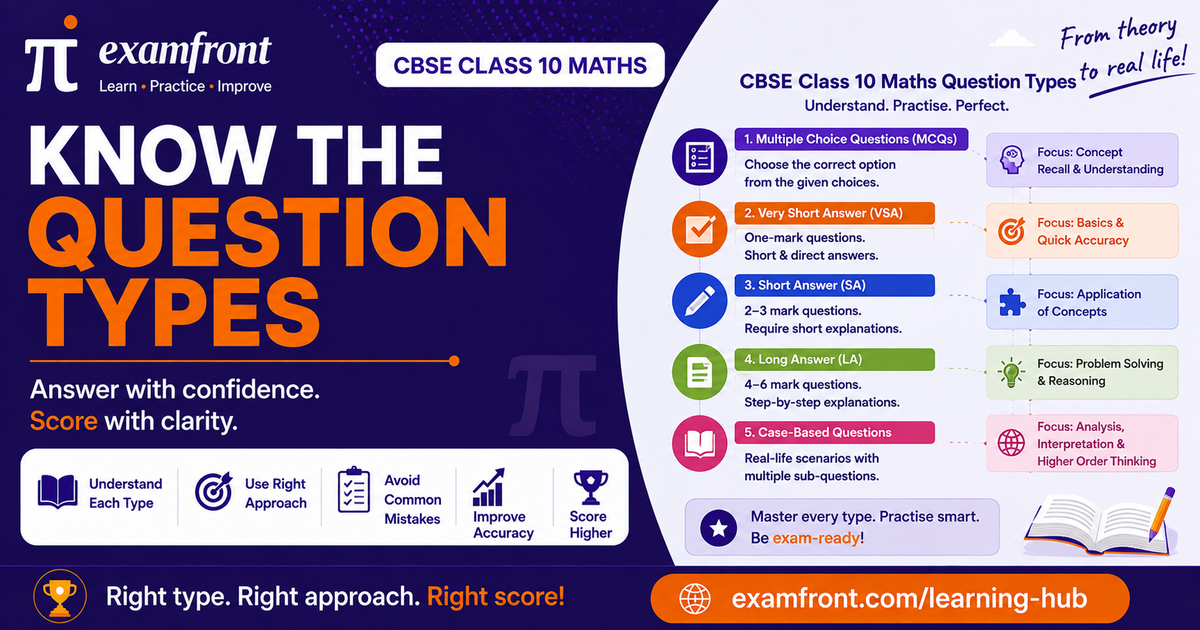
The complete guide to the question types in your Class 10 Maths paper — what each one tests, and how to approach it with confidence.
Here’s something that makes the board exam far less intimidating: the paper isn’t a mystery box. Every question in your CBSE Class 10 Maths exam belongs to one of a small, known set of question types — and once you understand what each type is really asking of you, you can prepare for each one deliberately instead of hoping for the best. This guide walks through every question type in the paper, what it tests, and how to approach it.
The three levels of question (the ladder of demand)
Before the details, here’s the mental model that makes the whole paper click — the six question formats sit at three levels of demand:
The question types at a glance
Here are all six formats mapped to their sections and marks:
| Question type | Section | Marks each | How many |
|---|---|---|---|
| MCQs | A | 1 | 18 |
| Assertion–Reason | A | 1 | 2 |
| Very Short Answer | B | 2 | 5 |
| Short Answer | C | 3 | 6 |
| Long Answer | D | 5 | 4 |
| Case-Based | E | 4 | 3 |
(For the full paper structure — sections, internal choices, and timing — see the exam pattern guide. Here we focus on the question types themselves and how to tackle each.)
The objective questions: MCQs and Assertion–Reason
Section A opens the paper with 20 one-mark objective questions, and they set the tone for your whole exam.
Multiple Choice Questions (MCQs) give you four options and one correct answer. They look easy, and the maths often is — but the marks are won or lost on accuracy under speed. A small slip in a calculation gives a wrong option that looks perfectly plausible. The way to master MCQs is to practise enough that the underlying steps become quick and automatic, so you’re not burning time (or making rushed errors) on what should be your fastest marks. Learn more in our dedicated MCQ questions guide.
⚠ Common mistake: reading the question or options too quickly and picking the “obvious” answer that’s actually a trap. Slow down for the two seconds it takes to read fully.
Assertion–Reason questions are the format students most often misjudge. You’re given two statements — an Assertion (A) and a Reason (R) — and asked to decide whether each is true, and crucially, whether the Reason correctly explains the Assertion. The trap is that both statements can be true while the Reason still doesn’t explain the Assertion — and there’s a fixed set of options to match that logic. Once you understand how the options work, these become reliable marks. Our assertion–reason guide breaks the logic down.
The answer-based questions: Very Short, Short and Long
The heart of the paper — Sections B, C and D — is made of questions where you show your working. This is where the majority of your marks live, and where how you write matters as much as the final answer.
Very Short Answer (2 marks, Section B) questions are focused and direct — usually one clear concept or a short calculation. They reward precision: get to the point, show the key step, state the answer.
Short Answer (3 marks, Section C) questions need a few connected steps. Here, presenting your working clearly starts to matter — examiners award marks for the method, not just the final number, so a well-laid-out solution protects your marks even if you slip at the last step.
Long Answer (5 marks, Section D) questions are the most substantial. They often combine ideas or require a multi-step solution or a proof. The skill is structure: work through it logically, show each step, and don’t skip the “obvious” lines — those lines are often where the method marks are.
💡 Remember this: method marks are real marks. A student who writes clear, complete working consistently out-scores one who does the maths in their head and writes only answers. How CBSE maths answers are marked rewards shown working — so build the habit of writing full solutions while you practise.
Case-based questions: the newest type
Section E’s case-based questions are the type students worry about most — and understanding why they exist takes a lot of that worry away. Rather than asking maths in the abstract, a case-based question gives you a real-world scenario — a situation, some data, maybe a diagram — and then asks a few connected questions based on it.
They feel harder because there’s more to read, and the maths is wrapped inside a context you have to unpack first. But the underlying maths is from the same syllabus you already know. The skill being tested is translation: reading a real situation and spotting which concept applies. That’s a learnable skill, not a talent — and it’s exactly what our case study questions guide is built to help you practise, because these carry 12 marks and reward a calm, methodical approach.
⚠ Common mistake: diving into the sub-questions before understanding the scenario. Read the whole case first, get clear on what’s happening, then answer.
Which question type is easiest?
A question students ask constantly — and the honest answer is: it depends on you. For many students, MCQs and Very Short Answer questions are the quickest marks to secure, because they focus on direct recall and straightforward calculations. Case-based questions tend to feel hardest because of the reading involved. But every student’s strengths are different — the only reliable way to find your easiest and hardest formats is to practise each and see where your marks come easily and where they leak.
How much effort each type needs
Different types reward different approaches. Here’s how to think about each:
| Question type | How to approach it |
|---|---|
| MCQ | Quick and accurate — practise for automatic speed |
| Assertion–Reason | Learn the fixed option logic; read both statements carefully |
| 2-mark (VSA) | Keep it concise — one clear step and the answer |
| 3-mark (SA) | Show every step; method marks matter |
| 5-mark (LA) | Structure your solution; don’t skip lines |
| Case-based | Read the scenario first, solve second |
How to prepare for every question type
Knowing the types is step one. Getting genuinely comfortable with each is what turns that knowledge into marks:
Practise by type, not just by chapter. Doing “ten MCQs,” then “a few case studies,” builds a different fluency than working through a chapter. Each type has its own rhythm, and practising the type directly is how you learn it.
Match your practice to the marks. The objective questions (20 marks) reward speed drills; the answer-based questions (48 marks) reward writing full, clean solutions; the case-based questions (12 marks) reward reading-and-translating practice. Spread your effort to match.
Always show your working on the subjective questions. Make it a habit from day one of practice, not something you “switch on” in the exam.
💡 An examfront insight: many students think they’re “weak at Maths” when in fact they’re only weak at one question format. A student who loses marks on case-based questions but is solid everywhere else doesn’t have a maths problem — they have a translation-practice problem, and that’s very fixable. Identifying which format is costing you marks is often the fastest way to lift your score.
That’s exactly what examfront is built to do: it lets you practise by question type and shows you which formats are leaking marks — so your effort goes straight to the type that will improve your score most. Explore the Learning Hub and start practising the types that matter most for you.
Download the 2-page summary
Want all six formats, their marks, and one concept asked four different ways on a single sheet you can keep beside you while you practise? Download the 2-page question types summary (PDF)
Frequently asked questions
What types of questions come in the CBSE Class 10 Maths exam? There are six formats: Multiple Choice Questions (MCQs), Assertion–Reason, Very Short Answer, Short Answer, Long Answer, and Case-Based questions — spread across the paper’s five sections.
Which is the hardest question type in Class 10 Maths? Many students find case-based (Section E) questions the most challenging, because they wrap familiar maths inside a real-world scenario you have to interpret first. The underlying maths, though, is from the same syllabus.
Which question type is easiest to score in Class 10 Maths? For many students, MCQs and Very Short Answer questions are the quickest marks, since they focus on direct recall and short calculations. But every student is different — use practice to find which formats need the most attention.
How many MCQs are there in Class 10 Maths? Section A contains 20 one-mark objective questions — 18 MCQs and 2 Assertion–Reason questions.
Do I get marks for working even if my answer is wrong? Yes — on the subjective questions (Sections B, C and D), examiners award method marks for correct steps, so clear, complete working protects your marks even if you slip on the final answer.
Ready to master every question type? Practise by type with examfront →