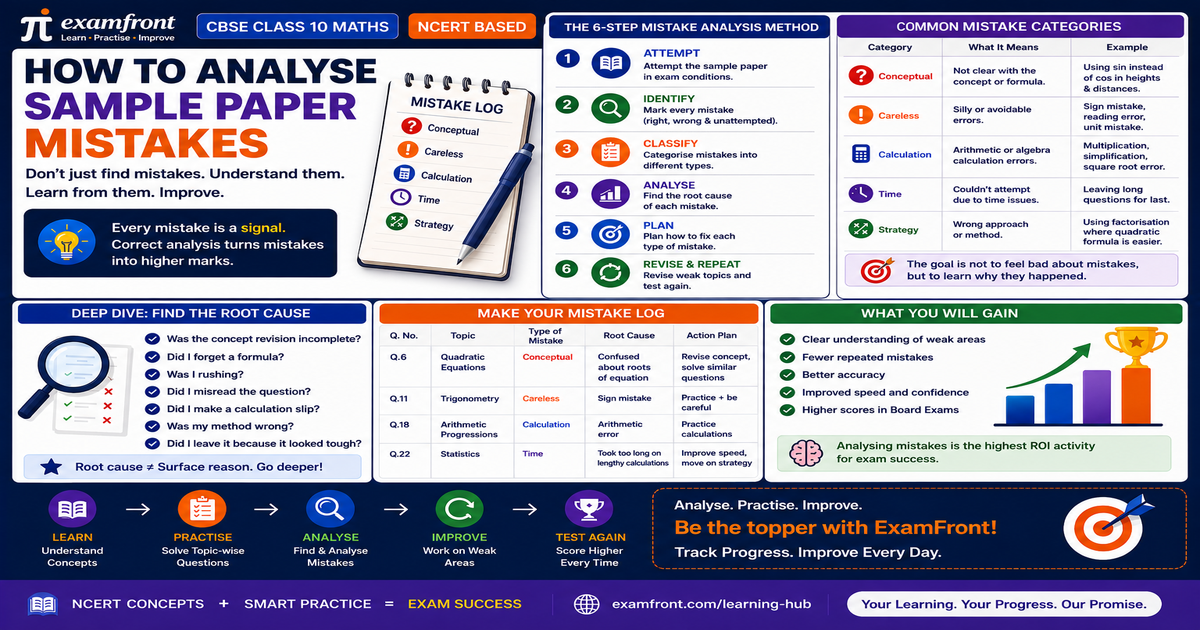
Why analysing your mistakes — not solving more papers — is what actually raises your score, and exactly how to do it.
Here’s a frustration almost every Class 10 student hits: “I keep solving sample papers, but my score isn’t improving.” If that’s you, the problem usually isn’t effort, and it isn’t the number of papers — it’s that solving a paper and learning from it are two different things. The score comes from the second one. This guide shows you how to analyse your sample paper mistakes using a simple framework, so every paper you solve tells you exactly what to fix next. The core idea is one worth remembering: every mistake is information.
If you’re still building the habit of sitting a full paper properly, start with how to solve sample papers — this guide picks up at the moment you put your pen down.
Why analysing beats solving more
Imagine two students who each solve ten sample papers. The first checks the score, sighs at the wrong answers, and moves to the next paper. The second spends twenty minutes after each paper working out why each mark was lost. After ten papers, the second student has improved dramatically and the first has barely moved — despite identical effort.
The difference is that solving a paper only tells you your score. Analysing it tells you your reasons — and reasons are what you can actually act on. A wrong answer isn’t a verdict on your ability; it’s a piece of information pointing at the one specific thing to fix.
The examfront Mistake Framework
Every wrong answer in a maths paper falls into one of six types. Learning to sort your mistakes into these categories is the single most useful analysis skill you can build — because each type needs a completely different fix.
Here are the six types — and how to recognise each in your own paper:
🟦 Concept — “I didn’t know how to start.” You didn’t understand the underlying idea well enough to begin. The gap is in your understanding of the topic itself.
🟩 Method — “I used the wrong approach.” You understood the topic but chose the wrong theorem, equation, or strategy — right toolbox, wrong tool.
🟨 Calculation — “My working was right until one slip.” A sign error, a decimal, a fraction, an arithmetic mistake — the method was sound but the numbers went wrong.
🟧 Question Reading — “I solved a different question.” You misread the question, missed a given value, or answered what you thought was asked rather than what was actually asked.
🟥 Time Management — “I ran out of time.” You knew how to do it but didn’t get to it, or rushed it, because of pacing.
🟪 Presentation — “My answer was hard to follow.” You had the right method but lost marks because your working was incomplete, skipped steps, or was too messy for the examiner to award full marks.
Notice what is deliberately not on that list: “careless”. It feels like a category, but it isn’t one — it’s a shrug. “Be more careful” is not a fix anybody can practise. Split every careless-feeling mistake into Calculation, Question Reading or Presentation, and each one turns into something you can actually do on Monday morning.
Mistake → Cause → Fix
Sorting a mistake into a type is only useful because each type points to a specific, different fix. This is the heart of the method:
| Mistake type | Likely cause | The fix |
|---|---|---|
| Concept | Weak understanding of the topic | Relearn the chapter from the basics |
| Method | Wrong approach or theorem chosen | Solve several similar questions to learn the right approach |
| Calculation | Careless arithmetic under pressure | Build a slow, deliberate final-check habit |
| Question Reading | Skipped a keyword or given value | Underline the data and what’s asked before solving |
| Time Management | Poor pacing across the paper | Practise full papers under a strict clock |
| Presentation | Missing or unclear steps | Show complete, ordered working every time |
Notice how different these fixes are. Solving more papers helps none of them directly — but knowing which one is your problem tells you exactly where to aim your effort.
Which mistakes are actually costing you marks?
Here’s an insight that surprises most students: the biggest mark-drain is usually not Concept. Students assume “I’m bad at Maths” (a concept problem), when in reality they often lose 10–15 marks a paper to Calculation, Question Reading, and Presentation — small, fixable slips on questions they actually knew how to do.
That’s genuinely good news. Concept gaps take real study to close. But careless calculation, misreading, and messy presentation are habit problems — and habits change fast once you’ve spotted them. A student losing 12 marks to careless slips can often recover most of them in a couple of weeks, without learning a single new piece of maths.
Where NCERT and CBSE fit into your mistake analysis
The six types tell you what kind of mistake you made. NCERT and CBSE tell you what it costs — and that is what turns a tally into a plan.
NCERT sets the scope. Every CBSE sample paper is set on the rationalised NCERT syllabus: seven units, fourteen chapters, with Constructions no longer part of the course. Nothing outside it can be asked, which has a very practical consequence for analysis — a Concept mistake always traces back to a named NCERT chapter, so the fix is that chapter’s own exercises and solved examples, not a new reference book. If your Concept pile keeps landing in the same chapter, work through it with the NCERT Class 10 Maths guide and the method in how to study NCERT Maths.
CBSE sets the shape — and the clock. The theory paper is 80 marks over 3 hours, plus 20 marks of internal assessment. Those 80 marks come from 38 questions in five sections: Section A 20 × 1, Section B 5 × 2, Section C 6 × 3, Section D 4 × 5 and Section E 3 × 4, with no overall choice. That structure is what makes a Time Management mistake measurable rather than vague: 180 minutes for 80 marks is 2.25 minutes per mark, so a 5-mark question you left blank was an 11-minute decision, not bad luck. Knowing which section each lost mark came from is half the analysis — see the CBSE exam pattern and the question formats for the full shape.
CBSE marking is why Presentation is a real type, not fussiness. CBSE awards marks for method and steps, not only for the final answer — which means an incomplete or unordered solution loses marks even when the answer is right, and a wrong answer with correct working still earns some. If your Presentation pile is growing, read how CBSE Maths answers are marked before you write another paper.
Tally by unit as well as by type. CBSE assigns marks by unit, not by individual chapter: Number Systems 6, Algebra 20, Coordinate Geometry 6, Geometry 15, Trigonometry 12, Mensuration 10, and Statistics & Probability 11 — 80 in total. So a Concept cluster sitting in Algebra is worth more attention than the same cluster in Number Systems, simply because there are 20 marks behind one and 6 behind the other. Two columns in your log — type and unit — turn your mistakes into a ranked list. The unit-wise weightage guide has the full breakdown.
Don’t count mistakes — count patterns
This is the shift that changes everything. Most students track their number of mistakes:
Paper 1: 8 wrong. Paper 2: 7 wrong. Paper 3: 6 wrong.
That looks like progress. But it hides the thing that actually matters. Look at the types instead:
Paper 1: Concept. Paper 2: Concept. Paper 3: Concept.
The count went down, but the pattern never changed — the same weakness is costing marks every time. The number is noise; the pattern is the signal. When you track types across several papers, your mistakes cluster into a clear shape — and that shape is your learning pattern: where you’re improving, where you’re stuck, and exactly where to focus next.
A simple way to track it
You don’t need anything fancy to start. After each paper, for every mark you lost, jot down which of the six types it was and which unit it came from. After three or four papers, tally them up. The category with the biggest pile — weighted by the marks behind it — is your highest-value target. Fix that first, and you’ll see your score move more than from any amount of extra solving. You’ll need a steady supply of papers to run this on; the CBSE Class 10 Maths sample papers guide is where to get them.
Doing this by hand is powerful — but it’s also slow and easy to abandon, and it’s genuinely hard to stay objective about your own patterns. This is exactly what examfront is built to do, continuously and automatically. The article teaches you the process; examfront performs it for you — tagging every mistake by type as you practise, surfacing your learning pattern, and pointing you straight to the fix that will lift your marks most. You focus on learning; it handles the analysis. See your learning pattern on examfront and turn every mistake into your next mark gained.
📄 Download the 2-page summary PDF — the six types, the fix for each, and a worked mistake log you can copy, on two printable pages.
Frequently asked questions
How do I analyse my mistakes in a Class 10 Maths sample paper? For every mark you lose, identify which of six types it was — Concept, Method, Calculation, Question Reading, Time Management, or Presentation — then apply the specific fix for that type. Track the types across several papers to find your pattern.
Why isn’t my score improving even though I solve lots of papers? Because solving a paper only shows your score, not your reasons. Without analysing why you lose marks, you keep repeating the same mistakes. Analysing and fixing your most common mistake type is what actually raises your score.
What are the most common mistakes in Class 10 Maths? Many students lose more marks to Calculation slips, misreading questions, and poor presentation than to genuine concept gaps — which is encouraging, because those are fast habits to fix.
Should I focus on the number of mistakes or the type? The type. A falling mistake count can still hide the same unchanged weakness. Tracking the type of mistake reveals your real pattern and where to focus.
Is the CBSE Class 10 Maths sample paper based on the NCERT syllabus? Yes. Every CBSE sample paper is set on the rationalised NCERT syllabus — seven units and fourteen chapters, with Constructions no longer included. That is why a Concept mistake always traces back to a named NCERT chapter, and why the fix is that chapter’s own exercises rather than a new book.
Every mistake is information. See your learning pattern on examfront →