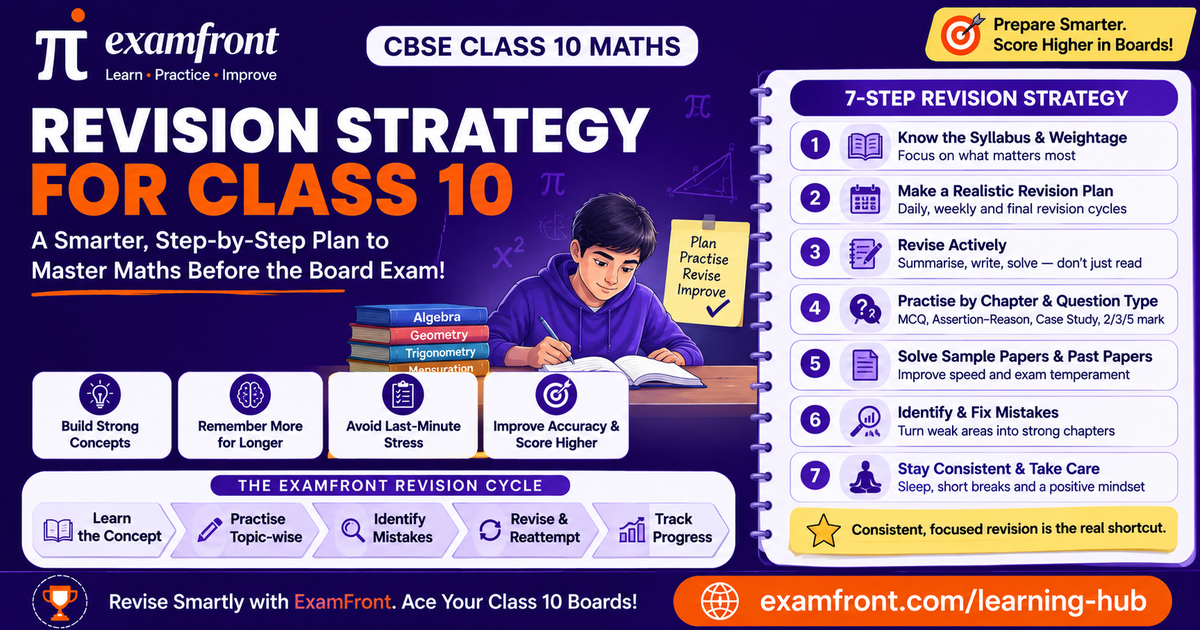
Revision isn’t re-reading everything — it’s a targeted, active process. Here’s how to revise Class 10 Maths so your effort actually sticks.
There’s a big difference between studying maths and revising it — and most students accidentally do the first when they mean to do the second. Re-reading your notes and nodding along feels like revision, but it barely moves your marks. Real revision is active, targeted, and spaced. This guide shows you how to revise Class 10 Maths the smart way — so the effort you put in during those crucial weeks before the exam actually pays off.
Revising is not the same as studying
When you study a topic, you’re learning it for the first time. When you revise, you already know it — your job now is to consolidate it and fix the weak spots. That means revision should look different from first-time study: quicker, more active, and aimed squarely at what you don’t yet have solid. (If you’re still learning topics for the first time, that’s the Build phase of your study plan — revision comes after.)
Three principles make revision genuinely effective: active recall, prioritising weak areas, and spacing. Here’s each.
Principle 1 — Revise actively, not passively
The single biggest revision mistake is passive revision — re-reading notes and worked examples until they feel familiar. Familiarity isn’t mastery. The fix is active recall: making your brain retrieve and produce the answer, not just recognise it.
- Solve problems from memory — cover the solution and work it yourself, rather than reading along.
- Recall formulas before checking — write out what you remember, then verify against the formula sheet.
- Explain a method aloud — if you can teach it, you know it; if you stumble, you’ve found a gap.
Active recall feels harder than re-reading — and that difficulty is exactly why it works.
Principle 2 — Prioritise your weak areas
Revising everything equally is comfortable but inefficient — you end up spending time on topics you’ve already mastered. Smart revision is weighted toward your weak spots.
The trick is knowing which areas are weak — and that’s where your practice pays off. Your mistakes across practice and sample papers are a precise map of what to revise. Use mistake analysis to identify your recurring weak areas by type, then aim the bulk of your revision there. Combine that with the high-value, high-weightage topics, and your revision is pointed exactly where it changes your marks most.
Principle 3 — Space it out
Cramming a topic once, the night before, is the weakest way to revise. Memory strengthens when you revisit material with gaps in between — a concept revised three times over three weeks sticks far better than the same time spent in one block.
- Revisit each topic more than once, spread across your revision period.
- Let a little time pass between passes — the small “forgetting” between them is what strengthens recall.
- Keep later passes shorter — you’re refreshing, not relearning.
A simple revision cycle
Put the three principles together into a repeatable cycle for each topic:
- Recall — attempt problems and formulas from memory first.
- Check — see what you got wrong or blanked on.
- Target — revise those specific gaps, not the whole topic.
- Return — come back to the topic again after a gap to confirm it stuck.
Run this across your weak areas and high-value topics, and your revision becomes a precise tool rather than a vague re-read.
Make your revision self-directing
The hardest part of revision is being honest about what you don’t know — it’s natural to revise what feels comfortable. This is where examfront makes revision efficient: it shows you exactly which concepts are still weak and keeps serving you practice on them, so your revision is always aimed at the areas that need it — not the ones you already have. Revise smarter with examfront and spend every revision session where it counts.
For the final stretch, see our guide on the last 7 days before the exam.
Download the 2-page revision strategy summary (PDF) — the three principles, the four-step cycle and a worked recall example on one printable sheet.
Frequently asked questions
How should I revise Class 10 Maths? Revise actively, not passively — solve problems from memory rather than re-reading solved examples, prioritise your weak areas over topics you already know, and revisit each topic more than once with gaps in between.
What’s the difference between studying and revising maths? Studying is learning a topic for the first time; revising is consolidating what you’ve already learned and fixing weak spots before the exam. Revision should be quicker, more targeted, and more active than first-time study.
How many times should I revise a topic? More than once, with spacing. Revisiting a topic a few times over days or weeks — rather than once in a long session — makes it stick far better, thanks to how memory works.
Should I revise everything equally? No. Prioritise your weak areas and high-value topics. Spending equal time on what you already know and what you don’t is inefficient — aim your revision where it changes your marks most.
Revise where it counts. Start with examfront →