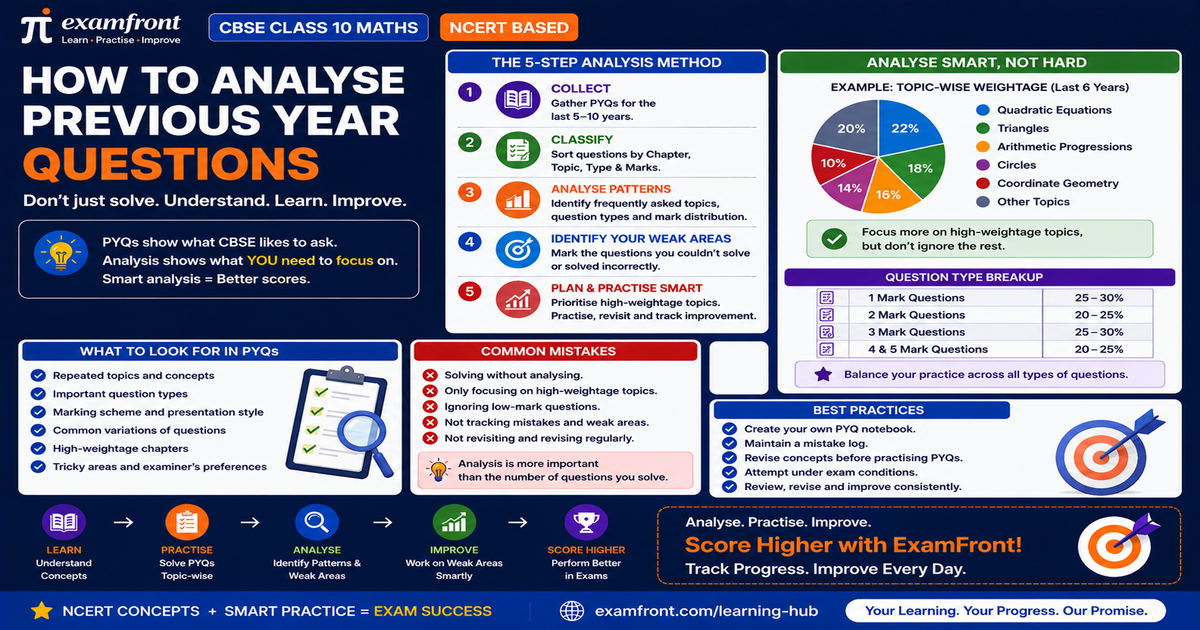
The actual technique for reading past papers like a strategist — finding the concepts CBSE tests again and again, so your preparation aims exactly where it counts.
You already know the big idea: in Class 10 Maths, concepts repeat, not questions. But knowing that and being able to see the patterns yourself are two different things. This guide gives you the actual method — how to take a stack of past papers and systematically analyse previous year questions to find which concepts keep coming up, and how they get reframed each year. It’s a genuine skill, and once you have it, past papers turn into a precise map of what to study.
What you’re really looking for
Before the method, get the target clear: you are not hunting for questions that might repeat. You’re hunting for concepts that recur. A question is the surface — the story, the numbers, the wording. The concept is what’s underneath — the piece of maths being tested. Your whole analysis is about learning to look past the first to see the second.
This is the deep-dive on the Compare and Identify steps of the Pattern Recognition Framework — the part where the real insight happens.
Step 1 — Collect questions by chapter
Start by collecting questions from several years of past papers — one year tells you nothing about patterns; the pattern only appears across many. Then sort them by chapter or topic, not by year. Put all the trigonometry questions together, all the quadratic questions together, and so on.
This regrouping is the quiet secret of good analysis. Papers are organised by section and difficulty; you need them organised by concept. Once every topic’s questions sit in one pile, the patterns almost jump out at you.
Step 2 — Strip the wording, find the concept
This is the core skill. For each question, mentally peel away the story and ask two questions: what maths is actually being tested here? — and then, thinking like an exam-setter, why did CBSE choose to test this concept?
Take three questions from different years: one asks for the height of a tower, one the height of a tree, one the height of a kite in the air. On the surface, three different questions. Strip the wording, and they’re identical — each gives you an angle and a distance and asks for a height using trigonometry. Different story, same concept — master the concept, and you answer them all.
Do this for every question in a topic pile. Label each with its underlying concept, ignoring the story entirely. You’ll quickly find a handful of concepts account for most of the questions.
Step 3 — Spot what recurs, how it’s reframed, and where it trips people up
Now the patterns show themselves. Look across your labelled piles and notice three things:
Which concepts appear most often. If “heights and distances” shows up in almost every year, that’s a concept the board clearly considers essential — a high-priority target.
How each concept gets reframed. Notice the variety of disguises a single concept wears — the contexts, the way data is presented, the twist in the question. This prepares you for the new form it’ll take in your exam.
Where that concept usually trips students up. For each recurring concept, ask what mistake it commonly causes. Quadratic questions, for instance, often catch students out on method selection — factorise or use the formula? Knowing the typical mistake tells you what to drill. This links straight to the examfront Mistake Framework — recurring concept plus its typical mistake is a precise practice target.
Step 4 — Turn patterns into priorities
Analysis is only useful if it changes what you do. Combine two signals: recurrence (how often a concept appears in past papers, from your analysis) and weightage (how many marks its unit carries, from the unit-wise weightage guide). Here’s how they combine into a priority:
| Recurrence | Weightage | Priority |
|---|---|---|
| High | High | ⭐⭐⭐ Deepest focus |
| High | Low | ⭐⭐ Worth solid practice |
| Low | High | ⭐⭐ Don’t neglect — marks matter |
| Low | Low | ⭐ Cover, but don’t over-invest |
A concept that’s both high-recurrence and high-weightage is where your preparation earns the most — that’s not guesswork, it’s a data-informed priority built from real past papers and the official marks distribution. Focus your deepest work there, while still covering everything.
Common mistakes when analysing PYQs
Avoid these, or your analysis will mislead you:
- Counting identical wording instead of concepts — the wording is the disguise; the concept is the pattern.
- Looking at only one year’s paper — patterns need several years to appear.
- Ignoring low-frequency but high-weightage topics — recurrence isn’t the only signal; marks matter too.
- Treating recurrence as prediction — it guides focus, it doesn’t forecast the paper.
- Forgetting the official weightage — always cross-check patterns against the real marks distribution.
- Practising a concept that has since left the syllabus — older papers predate the NCERT rationalisation, so check every recurring concept against the current contents page before you build practice around it.
What this analysis can — and can’t — do
A quick honesty check, so you use this well. Pattern analysis guides your focus; it does not predict the paper. The board can always ask a familiar concept in an unfamiliar way, or emphasise something that was quiet in recent years. So:
- Use patterns to prioritise, never to gamble — don’t skip a topic because it “hasn’t come recently.”
- Prepare the whole syllabus; let patterns tell you where to go deepest, not what to ignore.
Where NCERT and CBSE fit into your analysis
Your own analysis of past papers is one input. It becomes reliable only when you check it against the two official documents that actually govern the exam — the NCERT textbook and the CBSE paper design. Read them as three anchors.
NCERT sets the scope. NCERT is the prescribed textbook, and the rationalised Class 10 Maths syllabus runs to fourteen chapters across seven units — Constructions is no longer part of it. That matters directly for PYQ analysis: a concept that recurs handsomely across older papers may simply have been removed. Before you turn any pattern into practice, check it against the current NCERT contents page. The NCERT Class 10 Maths guide covers what is in and out, and how to study NCERT Maths covers the exercise-first habit that makes a recurring concept stick.
CBSE sets the shape. The theory paper is 80 marks alongside 20 marks of internal assessment, and carries 38 questions in five sections — Section A’s twenty one-mark questions (eighteen MCQs and two assertion–reason), Section B’s five two-mark questions, Section C’s six three-mark questions, Section D’s four five-mark questions, and Section E’s three four-mark case studies. When you record a recurring concept, record the mark value it usually carries too. “Heights and distances, usually five marks” is a far more useful pattern than “heights and distances, comes often” — it tells you how much working the examiner expects. The exam pattern guide has the full section-by-section breakdown.
CBSE sets the priority — by unit, not by chapter. The seven units carry fixed marks: Number Systems 6, Algebra 20, Coordinate Geometry 6, Geometry 15, Trigonometry 12, Mensuration 10, and Statistics & Probability 11, totalling 80. Note carefully that CBSE publishes these per unit, not per chapter. The chapter-wise percentage tables and pie charts that circulate online are unofficial estimates, not board figures — useful as somebody’s rough count, useless as a plan. Your own recurrence data plus the official unit marks is the honest version of that chart, and it is exactly what Step 4 above builds.
Your complete preparation journey
This analysis is one link in a chain. Here’s how it fits together:
Understand patterns (this guide) → identify the important concepts → rehearse with sample papers → analyse your own mistakes → improve.
And here’s the thing: the framework you’ve just learned is exactly how examfront thinks about questions. Instead of manually comparing years of papers, examfront continuously identifies the recurring concepts and directs your practice straight toward them — so you get the full benefit of deep pattern analysis without spending hours doing it by hand. See the patterns with examfront and put your energy into mastering the concepts, not hunting for them.
Download the 2-page summary (PDF) — the method, the priority grid and a worked example on one printable sheet.
Frequently asked questions
How do I find patterns in previous year question papers? Collect questions from several years, regroup them by chapter, then strip away the wording of each to identify the underlying concept. Concepts that recur across many years — especially in high-weightage units — are your priorities.
How many years of papers should I analyse? Several — patterns only emerge across multiple years. A single paper can’t show you what recurs; a spread of years reveals which concepts the board keeps returning to.
Can analysing past papers predict the exam questions? No. It reveals which concepts the board tests repeatedly, which helps you prioritise — but it can’t predict the exact questions. Always prepare the full syllabus and use patterns to decide where to go deepest.
What’s the difference between recurring questions and recurring concepts? The exact question rarely repeats. The concept beneath it does — often reframed with a new context or twist. Analysing for concepts (not questions) is what makes past papers genuinely useful.
Do CBSE previous year questions still match the current NCERT syllabus? Not all of them. The NCERT Class 10 Maths syllabus was rationalised and now runs to fourteen chapters, with Constructions no longer part of it. Older papers can contain questions on material that has since been removed, so check every recurring concept you find against the current NCERT contents page before you build practice around it.
Different story, same concept — master the concept. Practise with examfront →