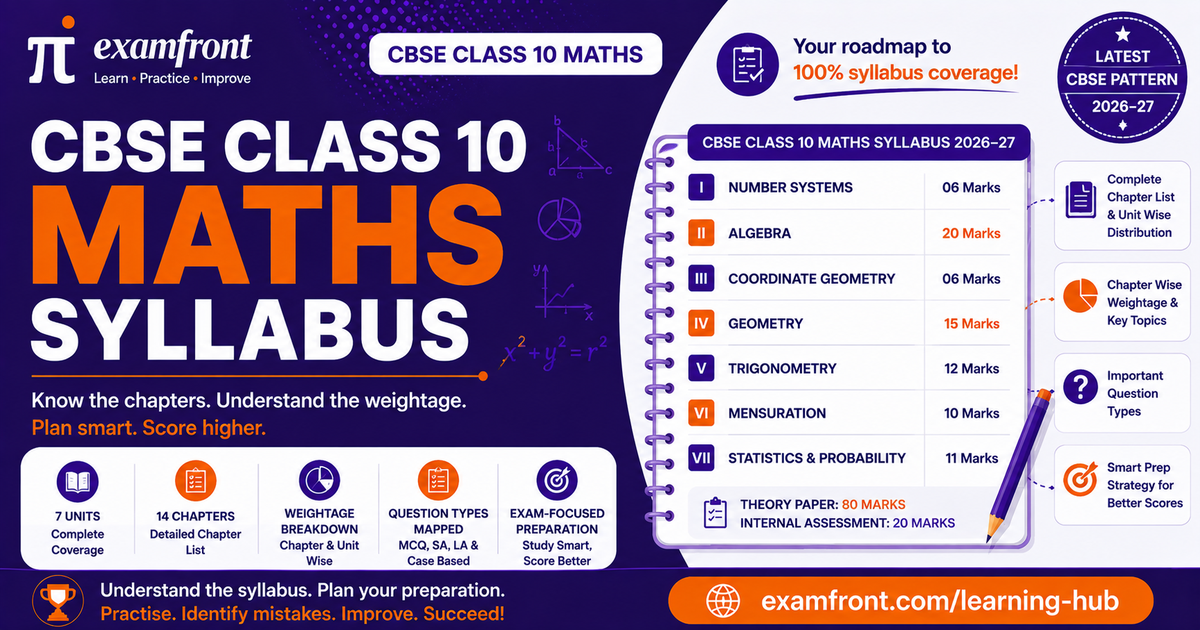
The CBSE Class 10 Maths syllabus is really just a map. It tells you exactly what you’ll be tested on, how many marks each part carries, and where to focus your energy. Once you can see the whole map, the subject stops feeling like a pile of random chapters and starts feeling like a plan you can work through, one step at a time.
This page lays out that full map: every unit, all fourteen chapters, how the 100 marks are split, and how to turn it into a study approach that actually fits you.
Who should read this page? Students — to see the full course at a glance and decide where to start. Parents — to understand what your child is preparing for and how it’s marked. Teachers — for a quick, accurate reference on unit structure and weightage.
The syllabus at a glance: 14 chapters, 7 units, 80 marks
Here’s the whole subject in one picture before we go deeper.
CBSE Class 10 Mathematics carries 100 marks in total: an 80-mark theory paper you sit at the board exam, and 20 marks of internal assessment handled through the year by your school. The 80 theory marks are spread across seven units, which together contain fourteen chapters. That’s the entire structure — everything else is detail inside these boxes.
One thing worth knowing up front: whether you take Standard or Basic Mathematics, the syllabus you study is the same. The only difference is the difficulty level of the question paper — not the content on this page.
The units at a glance
This is the single most useful table on the page. It shows how the 80 theory marks are distributed across the seven units — in other words, where the marks actually live.
| Unit | Marks |
|---|---|
| Number Systems | 6 |
| Algebra | 20 |
| Coordinate Geometry | 6 |
| Geometry | 15 |
| Trigonometry | 12 |
| Mensuration | 10 |
| Statistics & Probability | 11 |
| Total (Theory) | 80 |
Two things stand out. Algebra is the largest unit at 20 marks — a full quarter of the theory paper — and Geometry is next at 15. Together they make up a big share of your marks, so it’s useful to know early where that weight sits. This isn’t a rule about what to study first; it’s simply the shape of the paper. For a mark-by-mark breakdown of what this means for revision, see our guide on unit-wise weightage.
Chapter-by-chapter breakdown
Here are all fourteen chapters, grouped under the seven official units. This grouping is the part most syllabus lists skip — but it’s what helps you see why a chapter matters, not just that it exists.
Number Systems (6 marks)
- Real Numbers
Algebra (20 marks) 2. Polynomials 3. Pair of Linear Equations in Two Variables 4. Quadratic Equations 5. Arithmetic Progressions
Coordinate Geometry (6 marks) 6. Coordinate Geometry
Geometry (15 marks) 7. Triangles 8. Circles
Trigonometry (12 marks) 9. Introduction to Trigonometry 10. Some Applications of Trigonometry
Mensuration (10 marks) 11. Areas Related to Circles 12. Surface Areas and Volumes
Statistics & Probability (11 marks) 13. Statistics 14. Probability
If you’ve seen an older list with Constructions as a fifteenth chapter, that’s from an earlier edition — it is not part of the current CBSE Mathematics syllabus. Always trust the latest official CBSE curriculum document for your exam year over older lists online.
You can explore any chapter in more depth from our full chapter list, where each one links to a focused, exam-facing guide.
How the 100 marks are distributed
There are two halves to your final mark, and students often forget the second one until late:
Theory — 80 marks. This is the written board exam. All seven units above are tested here, and the paper follows a fixed design (how many one-mark, short-answer, long-answer, and case-study questions appear). That paper structure is covered in our exam pattern guide.
Internal Assessment — 20 marks. These are earned through the year at school and count towards your final result just as much as any theory mark. Because they’re spread across the year, they’re some of the most achievable marks in the whole course — which is exactly why they shouldn’t be an afterthought.
Add them together and you have your 100.
What stays the same, and what changes each year
The overall shape of the syllabus — the seven units, the fourteen chapters, the 80+20 split — is stable and changes rarely. What CBSE sometimes adjusts from one cycle to the next are the finer details: the exact question-paper design, small content rationalisations, or specific instructions for that year’s exam.
That’s why this page is your evergreen map, and why we keep the year-specific details on a separate, regularly-updated page. For the specifics confirmed for the upcoming board exam, read CBSE Class 10 Maths syllabus 2027, which we refresh each cycle against the official release.
How to actually use this syllabus to plan
A syllabus you only read doesn’t change your marks. A syllabus you use does. Here’s a simple way to turn this map into a plan:
Start with the shape, not the chapters. Before touching any single topic, make sure you can picture the seven units and roughly what each is worth. That mental map stops you from over-spending time on a small unit and under-preparing a large one.
Sequence sensibly. Many students find it natural to build the Algebra chapters early — they connect to each other and carry the most marks — then layer in Geometry and Trigonometry, keeping Statistics & Probability, which are self-contained and very scoring, as reliable marks locked in along the way. If you’d like that turned into dates and weeks, our Class 10 Maths study plan does exactly that.
Track by unit, not by mood. Measure progress against the seven units so you always know what’s solid and what’s still open. “I’ve done Algebra and Coordinate Geometry; Geometry is half-done” is far more useful than “I’ve studied a bit.”
Practise, don’t just revise. Reading the syllabus tells you what to learn; only solving questions tells you whether you actually have. That gap — between recognising a topic and being able to answer it under exam conditions — is where marks are won or lost.
This is where a personalised approach helps. examfront takes this same syllabus map and turns it into a study plan built around your strengths and weak spots — so instead of guessing what to revise next, you always know. Explore the Learning Hub and start turning this map into your own plan.
Download the 2-page summary
Want the whole map on paper? Download the 2-page CBSE Class 10 Maths syllabus summary (PDF) — every unit, all fourteen chapters, the 80+20 split, and a worked example showing how to read your own progress off the map.
Frequently asked questions
How many chapters are there in CBSE Class 10 Maths? There are fourteen chapters in the current CBSE Class 10 Mathematics syllabus, grouped under seven units. (Older editions listed fifteen, including Constructions, which is no longer part of the current syllabus.)
How many marks is the CBSE Class 10 Maths exam? 100 marks in total — an 80-mark theory board paper plus 20 marks of internal assessment conducted by your school.
Which unit has the highest weightage in Class 10 Maths? Algebra, at 20 marks, is the highest-weighted unit, followed by Geometry at 15. For the full mark-by-mark picture, see our unit-wise weightage guide.
Is the Class 10 Maths syllabus the same for Standard and Basic? Yes — the syllabus content is the same for both Standard and Basic Mathematics. The difference is in the difficulty level of the question paper, not what you study.
Where can I find the official syllabus? Always use the official CBSE curriculum document released for your exam year as the final source of truth for chapters, units, and marks. This page reflects that curriculum and is updated when CBSE revises it.
Ready to turn this syllabus into a plan built around you? Start with examfront →