What the Pair of Linear Equations chapter covers, how CBSE tests it, the mistakes to avoid, and how to turn it into strong marks.
Pair of Linear Equations in Two Variables is a dependable, high-scoring chapter in Class 10 Maths. It sits in the Algebra unit — the paper’s biggest — and its methods are clean and systematic: once you can solve a pair of equations confidently, the marks follow reliably. This guide orients you on what it covers, how much it’s worth, how the board tests it, the common traps, and how to master it.
Chapter snapshot
| Unit | Algebra |
| Official unit weightage | 20 marks (CBSE assigns marks per unit, not per chapter) |
| NCERT chapter | Chapter 3 — three exercises (3.1, 3.2, 3.3) |
| Difficulty | Moderate ⭐⭐⭐☆☆ |
| Practice priority | High (reliable, systematic marks) |
| Prerequisites | Linear equations in one variable, basic graphing, algebra |
| Estimated study time | 2–3 focused sessions |
(Difficulty and study time are a preparation guide, not official CBSE figures.)
What this chapter covers
The chapter is built on a systematic set of ideas:
- Graphical representation — drawing two linear equations as lines and reading their solution from the graph. (the graphical method, step by step)
- Solving by substitution — expressing one variable in terms of the other and substituting. (the substitution method)
- Solving by elimination — adding or subtracting equations to eliminate a variable. (the elimination method)
- Conditions for solutions — when a pair has a unique solution, no solution, or infinitely many (consistency and the coefficient ratios). (consistent and inconsistent pairs)
- Word problems — translating real situations into a pair of equations and solving them. (linear equations word problems)
The methods are procedural and reliable — which is exactly what makes this chapter so scoreable.
The three cases, and the ratios that tell them apart
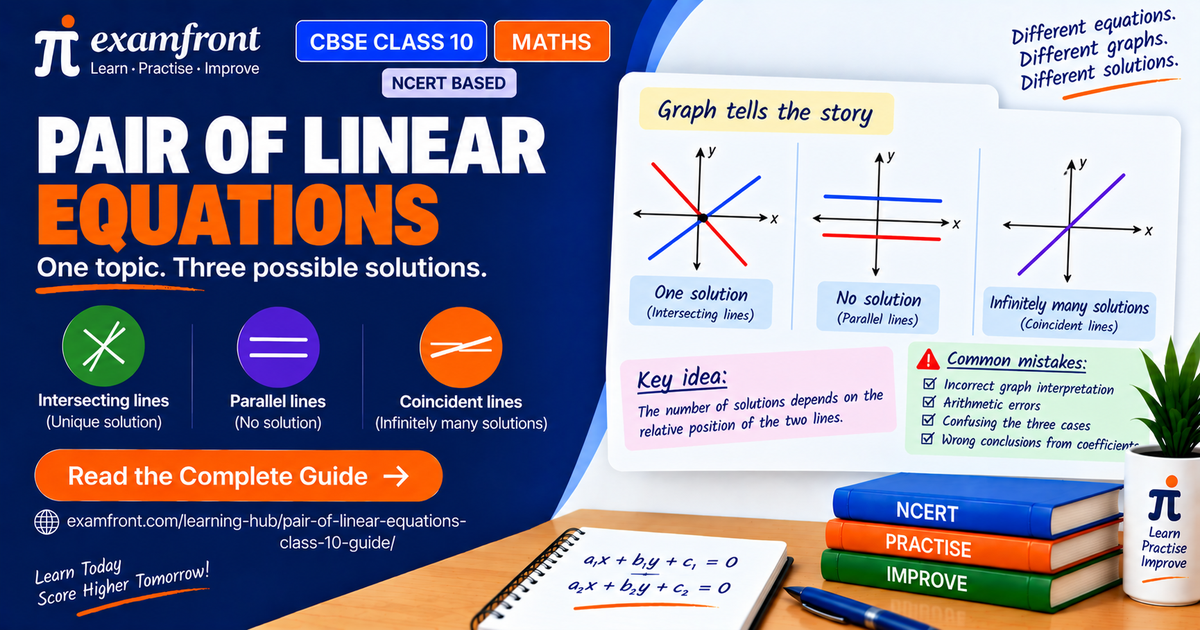
Everything in this chapter rests on one idea: two straight lines in a plane can only do three things. Write both equations in the standard form a₁x + b₁y + c₁ = 0 and a₂x + b₂y + c₂ = 0, compare the three ratios, and you know the answer before you solve anything.
| Compare the ratios | The lines | Solutions | The word for it |
|---|---|---|---|
| a₁/a₂ ≠ b₁/b₂ | Intersecting — they cross once | Exactly one | Consistent |
| a₁/a₂ = b₁/b₂ ≠ c₁/c₂ | Parallel — they never meet | None | Inconsistent |
| a₁/a₂ = b₁/b₂ = c₁/c₂ | Coincident — the same line twice | Infinitely many | Consistent (dependent) |
Two things are worth fixing in your head now, because both are examined and both are regularly got wrong.
Coincident does not mean “crossing”. Intersecting lines meet at one point; coincident lines lie exactly on top of each other, so every point on one is also on the other. That is why there are infinitely many solutions. If you picture two lines crossing at a shallow angle, you have pictured the unique-solution case, not this one.
The third ratio is what separates parallel from coincident. The first two ratios being equal only tells you the lines have the same direction. It is c₁/c₂ that decides whether they sit apart (no solution) or on top of each other (infinitely many). Skipping that check is the single most common way students give the wrong one-mark answer here.
You can see all three in one NCERT question — Exercise 3.1, Question 2, where part (i) gives 5/7 ≠ −4/6 (intersecting), part (ii) gives 9/18 = 3/6 = 12/24 (coincident) and part (iii) gives 6/2 = −3/−1 but 10/9 ≠ 3 (parallel).
Why this chapter matters
This chapter builds core algebraic fluency that carries forward:
Linear equations → simultaneous solving → coordinate geometry → higher algebra
The substitution and elimination skills, and the graphical thinking, feed directly into coordinate geometry and later algebra. It’s also one of the more predictable chapters — the methods rarely surprise you — so it’s a place to bank marks confidently. If the underlying idea of a single linear equation in two variables still feels shaky, start with linear equations in two variables before coming back here.
How much is Pair of Linear Equations worth?
This chapter is part of the Algebra unit, worth 20 marks — the highest-weighted unit in the paper (see the unit-wise weightage guide). CBSE assigns weightage by unit, not by individual chapter, so it contributes to that 20-mark total. Sitting in the paper’s biggest unit, with clean and reliable methods, it’s a strong priority for locking in marks.
How CBSE tests Pair of Linear Equations
The board tests the same core skills in familiar formats:
| Common question type | Skill tested |
|---|---|
| Solve by substitution or elimination | Procedure |
| Solve graphically | Concept |
| Determine the type of solution (consistency) | Reasoning |
| Word problem forming two equations | Application |
These appear as MCQs, short-answer, and long-answer questions (the full list of formats is in the question types guide). The wording changes yearly while the skills repeat (the idea behind analysing previous year questions).
Common mistakes in Pair of Linear Equations
A few classic traps cost students marks here:
- Arithmetic slips in elimination — sign errors when adding or subtracting equations.
- Substitution errors — mistakes when expressing and replacing a variable.
- Misreading consistency conditions — muddling the coefficient ratios for unique / no / infinite solutions.
- Stopping after two ratios — checking a₁/a₂ = b₁/b₂ and calling it parallel, without testing c₁/c₂ to rule out coincident.
- Reading a graph carelessly — taking the intersection off the grid in the wrong order, or reading it from lines that were never ruled properly.
- Word-problem setup errors — forming the wrong pair of equations from the situation.
Most are calculation and application mistakes rather than concept gaps — exactly what the examfront Mistake Framework helps you pinpoint and fix.
Where this sits in the NCERT and CBSE syllabus
NCERT sets the scope. This is Chapter 3, Pair of Linear Equations in Two Variables, and in the rationalised textbook it has three exercises: Exercise 3.1 (the graphical method, 7 questions), Exercise 3.2 (substitution) and Exercise 3.3 (elimination). Note the numbering offset that catches students out — the graphical section is 3.2 but its exercise is 3.1, because section 3.1 is a bare introduction with no exercise. It is the same trap as Chapter 2 (§2.2 → Ex 2.1) and Chapter 9 (§9.2 → Ex 9.1). The NCERT Class 10 Maths guide and how to study NCERT Maths cover the habit of working the exercises in order.
Two methods were removed, and you should not spend time on them. The rationalised syllabus drops the cross-multiplication method and equations reducible to a pair of linear equations. Older textbooks, and a lot of the solution sites, still carry them as Exercises 3.5 and 3.6. Substitution and elimination are the only two algebraic methods CBSE now examines.
CBSE sets the wording. The syllabus scope for this chapter reads, verbatim:
“Pair of linear equations in two variables and graphical method of their solution, consistency/inconsistency. Algebraic conditions for number of solutions. Solution of a pair of linear equations in two variables algebraically – by substitution, by elimination. Simple situational problems.”
The clause that belongs to this chapter and to no other is “Algebraic conditions for number of solutions” — that is the three-ratio test above, named in the syllabus itself. It is not a shortcut someone invented; it is examinable content, which is why a one-mark “how many solutions?” question is fair game and why the ratio line is worth writing out.
CBSE sets the priority by unit, not by chapter. The seven units are worth 6, 20, 6, 15, 12, 10 and 11 marks, totalling 80, with Algebra the largest at 20 (see the full syllabus). Chapter-level percentage tables and pie charts circulating online are unofficial estimates — CBSE does not publish them.
How it is actually asked. The paper is 38 questions over 80 marks in three hours, five sections, no overall choice (the exam pattern guide has the full split). A bare “how many solutions” or “find k” item lands as a 1-mark Section A question or a 2-mark VSA; solving a pair by substitution or elimination is typically 3 marks; “solve graphically” and the situational word problems run to 5 marks, and on a graphical question the table of values and the ruled, labelled lines are part of the answer, not rough work.
Skills you’ll build
Master this chapter and you’ll be able to:
- ✓ Solve a pair of equations by substitution and elimination
- ✓ Solve a pair graphically and read the solution
- ✓ Determine whether a pair has a unique, no, or infinite solution
- ✓ Translate word problems into a pair of equations and solve them
Your roadmap to full marks
Understanding the methods is quick; mastering this chapter comes from practice — making substitution and elimination automatic, and building the word-problem setup skill that only comes from seeing many varied situations.
That’s where examfront turns understanding into marks. You get targeted, chapter-wise adaptive practice across every question type — substitution, elimination, graphical, consistency, and word problems — with instant feedback that pinpoints exactly where you slip (a sign error? a faulty setup?) so you fix it fast. The adaptive practice serves the right questions at the right level, and mistake-tracking reveals your patterns. Practise Pair of Linear Equations on examfront and lock in these reliable marks.
Before moving on
Before you move to the next chapter, make sure you can:
- ✓ Solve a pair of equations by both substitution and elimination
- ✓ Solve a pair graphically
- ✓ Identify the type of solution from the coefficients
- ✓ Set up and solve a word problem with two equations
Continue your journey
← Previous: Polynomials · Next: Quadratic Equations →
Or browse the full chapter list to plan your path.
⬇ Download the 2-page Pair of Linear Equations summary (PDF) — the three cases, the ratio test, the NCERT and CBSE scope, and a worked Exercise 3.1 question.
Frequently asked questions
Is Pair of Linear Equations an important chapter in Class 10 Maths? Yes — it’s part of the Algebra unit (20 marks, the highest), and its methods and word problems are tested reliably. It’s a strong, scoreable chapter once the solving methods are automatic.
What are the main topics in Pair of Linear Equations Class 10? Representing linear equations graphically, solving by substitution and elimination, the conditions for consistency (unique, no, or infinite solutions), and word problems.
Why do students lose marks in Pair of Linear Equations? Usually through arithmetic slips in substitution or elimination, misreading the consistency conditions, or setting up word problems incorrectly — avoidable with practice.
How do I get full marks in Pair of Linear Equations? Master substitution and elimination until they’re automatic, learn the conditions for the types of solutions, and practise word problems so the setup becomes second nature — showing full working.
Is Pair of Linear Equations part of the NCERT and CBSE Class 10 Maths syllabus? Yes. It is Chapter 3 of the NCERT Class 10 Maths textbook, with three exercises — Exercise 3.1 (graphical, 7 questions), Exercise 3.2 (substitution) and Exercise 3.3 (elimination). The CBSE syllabus lists it under Unit II Algebra, worth 20 marks, and names graphical solution with consistency/inconsistency, algebraic conditions for the number of solutions, substitution, elimination and simple situational problems. Cross-multiplication and equations reducible to linear form were removed in the rationalised syllabus and are no longer examined.
Turn Pair of Linear Equations into strong marks. Practise on examfront →