Elimination Method to Solve a Pair of Linear Equations (Class 10)
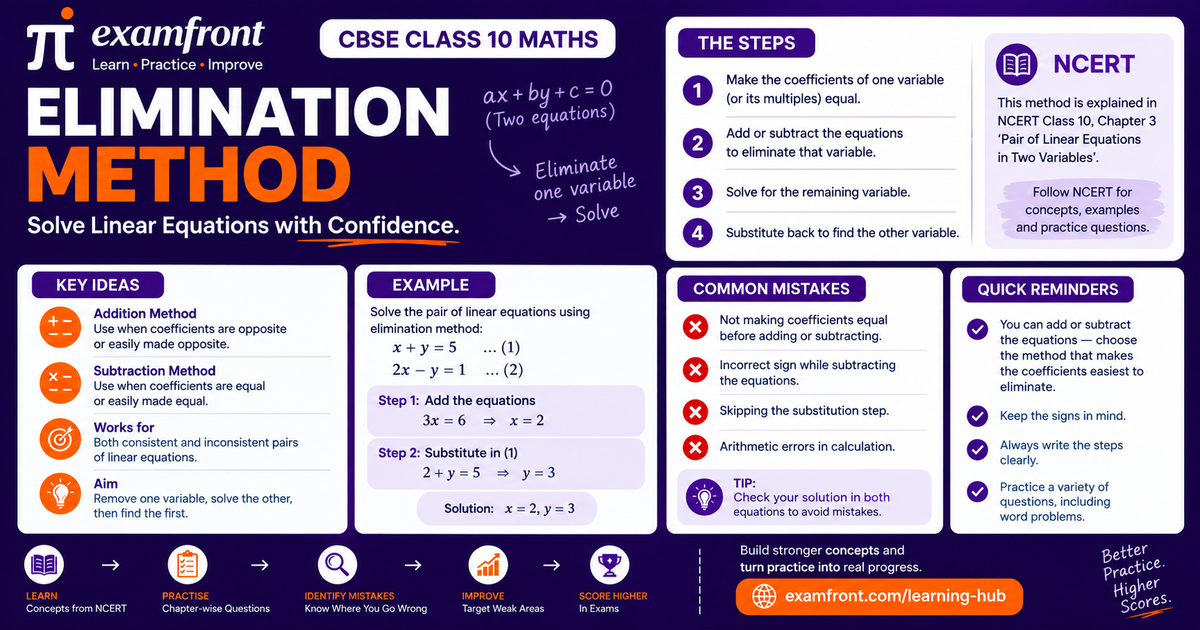
In one line: the elimination method solves a pair of linear equations by making the coefficients of one variable equal, then adding or subtracting the equations so that variable is removed, leaving one equation in one variable.
A pair of linear equations in two variables is two equations of the form ax + by + c = 0, and solving them means finding the x and y that satisfy both. The elimination method is the second algebraic method in NCERT Class 10 Maths Chapter 3, Pair of Linear Equations in Two Variables (Section 3.3 — the first is the substitution method). It is often the faster of the two when the coefficients are awkward, because you never have to deal with fractions until the very end.
Here is the whole idea in four steps: (1) multiply one or both equations so the coefficient of one variable matches in size; (2) add or subtract to eliminate that variable; (3) solve the single equation that remains; (4) substitute back to find the other variable. Then verify. The rest of this guide works through each step, shows the add-vs-subtract rule, and covers the “no solution” and “infinitely many solutions” cases.
▶️ Watch the 30-second reel: Can you spot the sign trick to eliminate y? ⚡
What is the elimination method?
The elimination method is an algebraic method for solving a pair of linear equations by eliminating (removing) one variable so that a single-variable equation is left. The word “eliminate” is the key: you engineer the equations so that when you combine them, one variable disappears.
Why use it? Like the substitution method, it gives the exact answer even when the solution has non-integer coordinates that the graphical method cannot read accurately. Elimination is especially handy when neither variable has a coefficient of 1, because it avoids the fractions that substitution would create in that situation.
The 4 steps of the elimination method
Use these four steps for every elimination problem. Keep the terms consistent: “coefficient” is the number in front of a variable; “eliminate” means make one variable cancel.
- Make coefficients equal. Multiply one or both equations by suitable non-zero numbers so the coefficients of one variable (either x or y) are numerically equal.
- Add or subtract to eliminate. If the matched coefficients have the same sign, subtract one equation from the other; if they have opposite signs, add. The chosen variable cancels.
- Solve. You now have one equation in one variable — solve it.
- Back-substitute. Put that value into either original equation to find the second variable. Then verify in both equations.
Exam tip — the sign rule: same signs → subtract, opposite signs → add. A quick way to remember it: “SASS — Same Add? No, Same Subtract.”
Where the elimination method sits in the NCERT and CBSE syllabus
This topic is NCERT Class 10 Maths Chapter 3, Pair of Linear Equations in Two Variables, under the CBSE unit Algebra — the heaviest unit in the paper at 20 of the 80 theory marks. Chapter 3 gives you three ways to solve a pair: the graphical method, then the two algebraic methods, substitution and elimination.
Two things about the rationalised NCERT syllabus are worth knowing before you revise:
- Cross-multiplication is no longer in the syllabus. Older books and guides teach it as a third algebraic method. It was removed, so substitution and elimination are the two methods CBSE can ask you to use by name.
- “Solve by elimination” is a named instruction. If the question says solve by the elimination method, method marks are only awarded for elimination — a correct answer reached by substitution can still lose marks. Working through the NCERT exercises exactly as written is the cheapest way to build that habit; the how to study NCERT Maths guide sets out a routine for it.
In the CBSE paper this chapter shows up as short-answer solving, as a word problem, and as the “find the value of k” style condition question. The question-types guide shows how the same concept is asked at 1, 2, 3 and 5 marks, and the NCERT Class 10 Maths guide maps every chapter to what the board actually asks from it.
Worked example 1 — coefficients already equal (subtract)
Solve: 2x + 3y = 12 and 2x − y = 4.
The coefficient of x is already 2 in both equations, and the signs are the same (both +2x), so we subtract.
- Step 2 (eliminate): (2x + 3y) − (2x − y) = 12 − 4 → 2x − 2x + 3y + y = 8 → 4y = 8 → y = 2.
- Step 4 (back-substitute): put y = 2 into 2x − y = 4: 2x − 2 = 4 → 2x = 6 → x = 3.
- Verify: 2(3) + 3(2) = 6 + 6 = 12 ✓ and 2(3) − 2 = 4 ✓.
Solution: x = 3, y = 2. Notice we did not even need Step 1 here — the coefficients matched already.
Worked example 2 — opposite signs (add)
Solve: 3x + 2y = 16 and 3x − 2y = 8.
The coefficients of y are +2 and −2 — equal in size but opposite in sign — so we add to eliminate y.
- Step 2 (eliminate): (3x + 2y) + (3x − 2y) = 16 + 8 → 6x = 24 → x = 4.
- Step 4 (back-substitute): put x = 4 into 3x + 2y = 16: 12 + 2y = 16 → 2y = 4 → y = 2.
- Verify: 3(4) − 2(2) = 12 − 4 = 8 ✓.
Solution: x = 4, y = 2. Opposite signs make addition cancel the variable cleanly.
Worked example 3 — multiply first, then eliminate
Solve: 2x + 3y = 13 and 3x + 2y = 12.
No coefficient matches yet, so we use Step 1. To eliminate y, make its coefficients equal to 6: multiply the first equation by 2 and the second by 3.
- Step 1 (make equal): 2 × (2x + 3y = 13) → 4x + 6y = 26 … (3); 3 × (3x + 2y = 12) → 9x + 6y = 36 … (4).
- Step 2 (eliminate): signs are the same (+6y in both), so subtract (3) from (4): (9x − 4x) + (6y − 6y) = 36 − 26 → 5x = 10 → x = 2.
- Step 4 (back-substitute): put x = 2 into 2x + 3y = 13: 4 + 3y = 13 → 3y = 9 → y = 3.
- Verify: 3(2) + 2(3) = 6 + 6 = 12 ✓.
Solution: x = 2, y = 3. Choosing to match y (LCM of 3 and 2 is 6) kept the numbers small — picking the easier variable to eliminate is a judgement the Practice Companion on examfront helps you sharpen with more problems.
▶️ Watch the 30-second reel: Can you choose the right multipliers to eliminate y? ⚡
Worked example 4 — a word problem
Problem: 5 pens and 3 pencils cost ₹45. 3 pens and 5 pencils cost ₹43. Find the cost of each.
- Form the equations. Let a pen cost ₹x and a pencil cost ₹y. 5x + 3y = 45 … (1) and 3x + 5y = 43 … (2)
- Step 1 (make equal): to eliminate y, match its coefficient to 15: multiply (1) by 5 → 25x + 15y = 225; multiply (2) by 3 → 9x + 15y = 129.
- Step 2 (eliminate): same sign, so subtract: (25x − 9x) = 225 − 129 → 16x = 96 → x = 6.
- Step 4 (back-substitute): put x = 6 into (1): 5(6) + 3y = 45 → 30 + 3y = 45 → 3y = 15 → y = 5.
- Verify: 3(6) + 5(5) = 18 + 25 = 43 ✓.
A pen costs ₹6 and a pencil costs ₹5. For more on converting a story into equations, see linear-equations word problems, and drill mixed sets on examfront’s Topic Practice.
The special cases: no solution and infinitely many solutions
In Step 2, both variables sometimes vanish. That result is meaningful.
- A true statement with no variable (for example, 0 = 0) means the equations are the same line → infinitely many solutions (dependent, consistent).
- A false statement with no variable (for example, 0 = 9) means the lines are parallel → no solution (inconsistent).
Quick example (no solution): Solve 2x + 3y = 8 and 4x + 6y = 7. Multiply the first by 2: 4x + 6y = 16. Subtract the second: (4x + 6y) − (4x + 6y) = 16 − 7 → 0 = 9, which is false. So there is no solution — the lines are parallel.
You can predict this before solving by comparing the ratios a₁/a₂, b₁/b₂, c₁/c₂ — the shortcut explained in the Pair of Linear Equations chapter guide.
| Result in Step 2 | What it means | Type of pair |
|---|---|---|
| A value for one variable | Lines meet at one point | Unique solution (consistent) |
| True statement (e.g. 0 = 0) | Same line | Infinitely many solutions (dependent) |
| False statement (e.g. 0 = 9) | Parallel lines | No solution (inconsistent) |
▶️ Watch the 30-second reel: Can you tell what 0 = 9 means for the pair? 🤔
Elimination vs substitution — which to choose?
Both methods are exact and give the same answer. Choose by looking at the coefficients:
| Use elimination when… | Use substitution when… |
|---|---|
| Both variables have coefficients other than 1. | A variable has coefficient 1, or is written alone (y = …). |
| Coefficients of one variable are equal or easy to match. | One equation rearranges easily. |
For the other method in full — including how to handle fractions when you isolate a variable — see the substitution method guide. We have kept the harder ratio problems and the equations-reducible-to-linear-form cases light here; the complete example set, tougher variations and personalised help where you slip up are inside examfront.
Key Takeaways
- The elimination method removes one variable by making its coefficients equal and then adding or subtracting the equations.
- Four steps: make coefficients equal, add/subtract to eliminate, solve, back-substitute — then verify.
- Sign rule: same signs → subtract; opposite signs → add.
- It is often faster than substitution when no coefficient is 1, because it delays fractions to the last step.
- A true no-variable statement means infinitely many solutions; a false one means no solution.
Quick Facts
- Elimination method: an algebraic method that removes one variable to solve a pair of linear equations.
- Steps: make coefficients equal → add/subtract → solve → back-substitute → verify.
- Add or subtract: same signs → subtract; opposite signs → add.
- Best when: neither variable has coefficient 1.
- Infinitely many solutions: you reach a true statement (e.g. 0 = 0).
- No solution: you reach a false statement (e.g. 0 = 9).
- NCERT reference: Class 10 Maths Chapter 3, Pair of Linear Equations in Two Variables (Section 3.3) · CBSE unit: Algebra (20 marks).
- Chapter: Pair of Linear Equations · Class: 10 · Subject: Maths · Board: CBSE.
Common Mistakes
- Adding when you should subtract (or vice versa). Getting the sign rule backwards leaves both variables in the equation. Remember: same signs → subtract, opposite signs → add.
- Multiplying only one side of an equation. When you multiply an equation by a number, multiply every term, including the constant on the right. Multiplying 2x + 3y = 13 by 2 gives 4x + 6y = 26, not 4x + 6y = 13.
- Subtracting term by term with sign slips. In (2x + 3y) − (2x − y), the −(−y) becomes +y. Forgetting this double negative is a classic error.
- Making the wrong variable’s coefficients equal. Matching the harder variable creates big numbers. Pick the variable with the smaller LCM of coefficients.
- Stopping after one variable. Finding x but not y (or the reverse) leaves the answer incomplete. Always finish Step 4 and verify both equations.
📄 Download the 2-page summary
Download the Elimination Method 2-page summary (PDF) → — the four steps, the sign rule, the NCERT/CBSE scope note and two fully worked board-style questions on one printable sheet.
FAQ
Q. What is the elimination method in Class 10 Maths? It is an algebraic way to solve a pair of linear equations in two variables. You make the coefficients of one variable numerically equal, then add or subtract the equations so that variable is eliminated, leaving a single equation in one variable to solve.
Q. What are the steps of the elimination method? Step 1: multiply the equations by suitable numbers so one variable’s coefficients become numerically equal. Step 2: add or subtract to eliminate that variable. Step 3: solve the resulting one-variable equation. Step 4: substitute back into either original equation to find the other variable, then verify.
Q. When do you add and when do you subtract? After making the coefficients equal, check the signs of the variable being eliminated. Same signs (both + or both −) → subtract. Opposite signs (one + and one −) → add. Either way the variable cancels.
Q. When should I use elimination instead of substitution? Use elimination when both equations have awkward coefficients, or when one variable’s coefficients are already equal or easy to match. Use substitution when a variable has coefficient 1 or is already written alone.
Q. What if all the variables cancel? A true statement like 0 = 0 means infinitely many solutions (same line). A false statement like 0 = 9 means no solution (parallel lines).
Q. Is the elimination method in the NCERT and CBSE Class 10 syllabus? Yes. It is part of NCERT Class 10 Maths Chapter 3, Pair of Linear Equations in Two Variables, and it is examinable in the CBSE Class 10 Maths board paper. Note that cross-multiplication was removed in the rationalised NCERT syllabus, so substitution and elimination are the two algebraic methods CBSE can ask you to use by name.
Related Concepts
- Substitution Method (Class 10): the sibling algebraic method — express one variable in terms of the other and substitute.
- Linear Equations in Two Variables (Class 10): the basics and the graphical method behind these equations.
- Linear-Equations Word Problems (Class 10): how to turn a story into two equations you can solve.
- Pair of Linear Equations — Chapter Guide: the full chapter roadmap and where the elimination method fits.
- NCERT Class 10 Maths Guide: the whole NCERT book mapped chapter by chapter to what CBSE asks.
Ready to make elimination automatic? Work through a full set on examfront’s Topic Practice, and let the Practice Companion and Mistake Identification catch your sign slips before the exam does. Start on examfront →