Linear Equations Word Problems (Class 10): How to Form a Pair of Linear Equations
In one line: to form a pair of linear equations from a word problem, name the two unknowns as x and y, then turn each stated fact into one linear equation — two facts give you the two equations of the pair.
Every word problem in Chapter 3 hides the same structure: a situation with two unknown quantities and two conditions connecting them. Your job is translation — converting each condition from English into algebra. Once the pair of linear equations is written correctly, the hard part is done; solving is mechanical.
This article gives you a reliable 4-step method, a phrase-to-maths translation table, and worked examples of the problem types that appear again and again. It builds directly on what a pair of linear equations means, so read that first if the term is new.
▶️ Watch the 30-second reel: Can you spot the right equation? 👀
The 4-step method to form a pair of linear equations
Step 1 — Identify the two unknowns. Read the question part first (“find the number of…”, “find the cost of…”). The two things being asked for are your unknowns.
Step 2 — Assign variables in words. Write “Let the number of pencils be x” and “Let the number of erasers be y” — in words, with units. In board answers this defining line earns credit on its own, as the marking-style guide explains.
Step 3 — Translate each condition into one equation. Go sentence by sentence. Each independent fact (a total, a comparison, a relationship) becomes exactly one linear equation.
Step 4 — Check the pair. Confirm each equation is linear (powers of x and y are 1), that you used both facts, and that units match on both sides. You now have a₁x + b₁y + c₁ = 0 and a₂x + b₂y + c₂ = 0 — a pair of linear equations representing the situation.
A memory hook for the four steps: I–A–T–C — “Identify, Assign, Translate, Check.”
Translation table: common phrases → equations
| Phrase in the problem | Becomes | Example |
|---|---|---|
| “sum of the two numbers is 27” | x + y = 27 | — |
| “x is 4 more than y” | x = y + 4 | girls are 4 more than boys |
| “x is 3 less than y” | x = y − 3 | — |
| “twice / double y” | 2y | x = 2y |
| “total cost” | price × quantity, added | 12x + 20y = 88 |
| “difference of the numbers is 3” | x − y = 3 (larger − smaller) | — |
| “three times as old as” | x = 3y | father and son |
Keep this table handy while practising — after a few problems the translations become automatic. The Practice Companion on examfront drills exactly this phrase-by-phrase skill and flags the specific phrase types you mistranslate.
Worked example 1 — cost problem
5 pencils and 3 erasers together cost ₹31, while 2 pencils and 4 erasers together cost ₹18. Represent this situation as a pair of linear equations.
- Identify: the unknowns are the cost of one pencil and the cost of one eraser.
- Assign: let the cost of one pencil be ₹x and the cost of one eraser be ₹y.
- Translate: first fact → 5x + 3y = 31; second fact → 2x + 4y = 18.
- Check: both linear, both facts used, both sides in rupees. ✓
The pair is 5x + 3y = 31 and 2x + 4y = 18. (You can verify that x = 5, y = 2 satisfies both: 25 + 6 = 31 ✓ and 10 + 8 = 18 ✓ — so a pencil costs ₹5 and an eraser ₹2.)
▶️ Watch the 30-second reel: Can you build the bill equation? 🥟
Worked example 2 — comparison / count problem
A class has 42 students, and the number of girls is 6 more than the number of boys. Represent this as a pair of linear equations.
- Assign: let the number of boys be x and the number of girls be y.
- Translate: “42 students in total” → x + y = 42; “girls are 6 more than boys” → y = x + 6.
- Check: two linear equations, both facts used. ✓
The pair is x + y = 42 and y = x + 6. Checking x = 18, y = 24 satisfies both, so the class has 18 boys and 24 girls.
▶️ Watch the 30-second reel: Can you set up the two equations? 🤔
Worked example 3 — age problem
A father is three times as old as his son, and the sum of their ages is 48 years. Represent this as a pair of linear equations.
- Assign: let the father’s present age be x years and the son’s present age be y years.
- Translate: “three times as old” → x = 3y; “sum of ages is 48” → x + y = 48.
- Check: both linear. ✓ The pair is x = 3y and x + y = 48 (father 36, son 12 satisfies both).
▶️ Watch the 30-second reel: Can you spot the age equation? 👀
These three patterns — cost, count-comparison and simple ages — cover the friendly end of the spectrum. The tougher variations (ages “5 years ago / 3 years hence”, two-digit numbers with reversed digits, fractions that change when numerator and denominator are altered, speed–distance setups) use the same I–A–T–C method but need more careful translation. That full set, with graded difficulty and step-by-step feedback, is inside examfront’s Topic Practice — and the Strength & Weakness Analysis tells you which problem type to drill next. Word-problem setups also appear as case-study questions in the board pattern, so this skill pays off in more than one section of the paper.
▶️ Watch the 30-second reel: Can you spot the correct ticket equations? 🎟️
Board answer format: the marks-safe way to write it
For a “represent the situation” question, write these lines in order:
- Let statement: “Let the number of … be x and the number of … be y.”
- Equation 1 with a one-phrase reason: “Since the total is 42: x + y = 42.”
- Equation 2 with its reason: “Since girls are 6 more than boys: y = x + 6.”
- (If asked to solve) the solution and a verification line checking the answer against the original story.
Skipping the “Let” line or the verification is one of the classic ways students lose easy marks — the maths is right but the presentation leaks marks.
Where NCERT and CBSE fit into these word problems
NCERT sets the scope. These problems live in Chapter 3, Pair of Linear Equations in Two Variables — the third of the four chapters that make up the Algebra unit, in a syllabus of 14 chapters across 7 units. The chapter’s numbering catches people out: Section 3.2 is the graphical method, but its exercise is Exercise 3.1. Section 3.3, Algebraic Methods, carries Exercise 3.2 (substitution) and Exercise 3.3 (elimination) — and that is where most of the word problems sit. Two methods that older guides still use were removed in the rationalisation: cross-multiplication and equations reducible to a pair of linear equations. So if a book you are practising from sets word problems by cross-multiplication, that route is no longer examined — substitution and elimination are the two algebraic methods you need. A quick pass through the NCERT guide and how to study NCERT Maths is worth it before you buy extra practice: the textbook’s own exercises already cover every problem type CBSE asks.
CBSE sets the shape. The theory paper is 80 marks, with 20 more from internal assessment. It runs to 38 questions in five sections over three hours, with no overall choice, and CBSE gives you 15 minutes of reading time before the clock starts. The full exam pattern is:
| Section | Questions × marks | Total |
|---|---|---|
| A | 20 × 1 | 20 |
| B | 5 × 2 | 10 |
| C | 6 × 3 | 18 |
| D | 4 × 5 | 20 |
| E | 3 × 4 | 12 |
| Total | 38 questions | 80 |
That works out to 180 minutes for 80 marks — about 2¼ minutes per mark — which is the number to keep in mind when a word problem tempts you into ten minutes of re-reading.
CBSE sets priority by unit, not by chapter. The unit-wise weightage is Algebra 20, Geometry 15, Trigonometry 12, Statistics & Probability 11, Mensuration 10, Number Systems 6, Coordinate Geometry 6 — 80 in total. Algebra is the largest unit at 25% of the paper, and Chapter 3 is one of its four chapters. Chapter-level percentage tables and pie charts circulating online are unofficial estimates; CBSE does not publish marks per chapter.
How this topic is actually asked. Across the six question formats you will meet this skill three ways: as a 2-mark VSA that only says “represent the situation as a pair of linear equations”; as a 3-mark or 5-mark question that asks you to represent and solve; and as part of a 4-mark case study in Section E, where a real-life passage hides the same two conditions. In every version, the “Let” line and the verification line are part of the answer, not decoration.
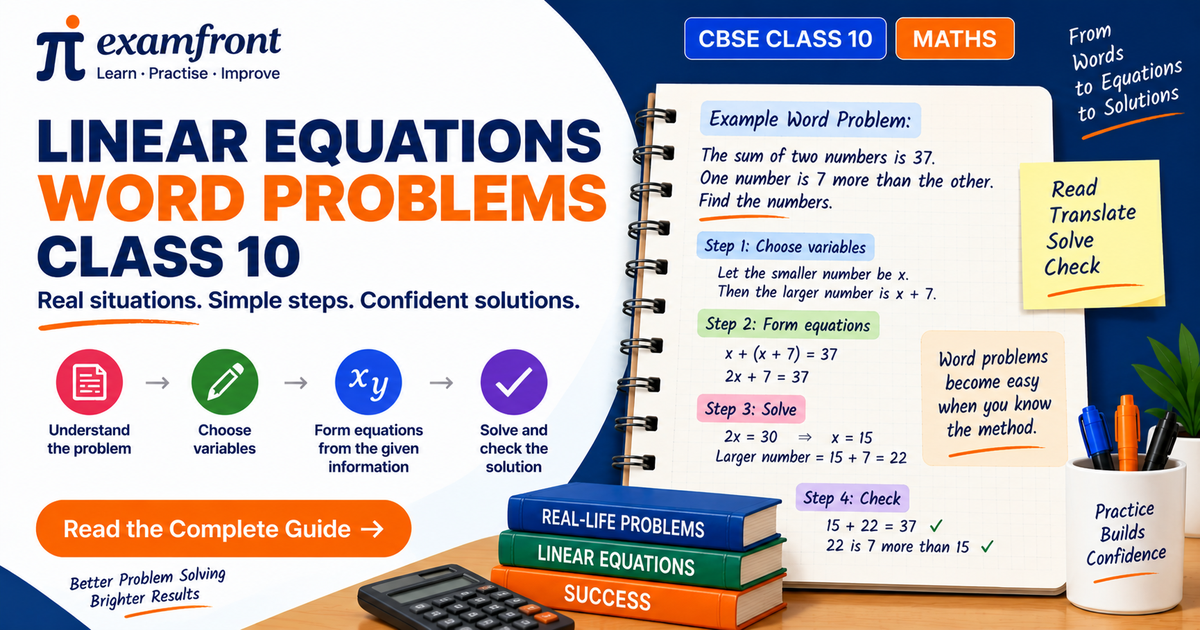
One thing to be careful of when you compare solutions online. A worked solution that says “let the smaller number be x, so the larger is x + 7” and then writes the single equation 2x + 7 = 37 is a perfectly correct single-variable solve — but it is not a pair of linear equations. It uses the second condition to eliminate a variable before that condition is ever written down as an equation, so the second equation never appears on the page and the marks attached to it are not there to be earned. When the question says in two variables, or as a pair, you need two named unknowns and two written equations.
Key Takeaways
- A word problem with two unknowns and two conditions always yields a pair of linear equations.
- Follow I–A–T–C: Identify unknowns → Assign variables in words → Translate each condition into one equation → Check the pair.
- Each independent fact becomes exactly one equation; you need both.
- Always write the “Let x = …, y = …” line — it defines your equations and carries marks.
- Verify any solution against the original story, not just the equations.
- Two unknowns means two variables. Folding the second condition into the first (writing the larger number as x + 7 instead of naming it y) turns a pair into a single equation — correct arithmetic, wrong answer to the question asked.
Quick Facts
- Unknowns per problem: 2 → variables x and y.
- Conditions per problem: 2 → one equation each.
- Method: I–A–T–C (Identify, Assign, Translate, Check).
- “4 more than y”: y + 4 · “twice x”: 2x · “total cost”: price × quantity summed.
- Common types: cost problems, count comparisons, age problems (harder: digits, fractions, speed–distance).
- Chapter: Pair of Linear Equations in Two Variables (Ch. 3) · Class: 10 · Subject: Maths · Board: CBSE.
- NCERT exercises: 3.1 graphical (under Section 3.2), 3.2 substitution, 3.3 elimination (both under Section 3.3). Cross-multiplication removed.
- Unit: Algebra — 20 of 80 marks, the largest unit in the CBSE paper.
Common Mistakes
- Not defining the variables. Jumping straight to equations without “Let x = …” — the equations become ambiguous and the defining mark is lost.
- Reversing a comparison. “Girls are 6 more than boys” is y = x + 6, not x = y + 6. Read who has more, then add 6 to the smaller side.
- Cramming both facts into one equation. Each condition is its own equation; merging them (or using only one) leaves the pair incomplete.
- Mixing units. Putting rupees on one side and counts on the other, or ages with totals of money. Both sides of an equation must measure the same thing.
- Verifying against the equations only. A calculation slip can satisfy your (wrong) equations. Always check the final answer against the original sentences of the problem.
📄 Download the 2-page summary PDF — the I–A–T–C method, the translation table, the NCERT and CBSE numbers, and a full board-style worked example on two pages you can print.
FAQ
Q. How do you form a pair of linear equations from a word problem? Identify the two unknowns, assign x and y to them in words, translate each stated condition into one linear equation, and check that both equations are linear and both facts are used. The two equations are your pair.
Q. How do I decide what x and y should be? Choose the two quantities the question asks you to find, and write them out: “Let the number of … be x.” Defining variables in words first keeps the translation honest and earns presentation marks.
Q. How many equations do I need for two unknowns? Two independent equations. One equation in two variables has infinitely many solutions, so a single condition can never determine both unknowns.
Q. What does “twice as many” or “6 more than” become in an equation? “x is twice y” → x = 2y. “y is 6 more than x” → y = x + 6. Translate one phrase at a time using a small phrase-to-maths table until it is automatic.
Q. Do I also have to solve the equations? For Section 3.1, representing the situation is the skill. In full board questions you usually solve the pair too — graphically or algebraically — and then verify the answer against the story.
Q. Are linear equations word problems part of the NCERT and CBSE Class 10 syllabus? Yes. They sit in NCERT Chapter 3, Pair of Linear Equations in Two Variables, one of the four chapters of the Algebra unit — the largest unit in the paper at 20 of 80 marks. CBSE asks them as a 2-mark “represent the situation” question, as a 3-mark or 5-mark represent-and-solve question, and as a 4-mark case study in Section E. Cross-multiplication and equations reducible to linear form were removed in the rationalised syllabus, so substitution and elimination are the two algebraic methods examined.
Related Concepts
- Linear Equations in Two Variables — what a pair means: the definitions and general form these word problems produce.
- Pair of Linear Equations Class 10 — chapter guide: the solving methods you apply after forming the pair.
- Case-Study Questions Class 10 Maths: the board-exam format where these real-life setups most often appear.
- Why students lose easy marks: the presentation habits (Let lines, verification) that protect your score.
Want the harder problem types — digits, fractions, ages with time shifts? Work the full graded set with Mistake Identification on examfront, and let your Personalized Learning Path queue the next drill. Start on examfront →