Substitution Method to Solve a Pair of Linear Equations (Class 10)
In one line: the substitution method solves a pair of linear equations by writing one variable in terms of the other from one equation, then substituting that into the second equation so you are left with a single equation in one variable.
A pair of linear equations in two variables is two equations of the form ax + by + c = 0, and “solving” them means finding the values of x and y that satisfy both at the same time. The substitution method is one of the two algebraic methods in Section 3.3 (the other is the elimination method). It is exact — unlike the graphical method, it works perfectly even when the answer is a fraction such as x = 49/29.
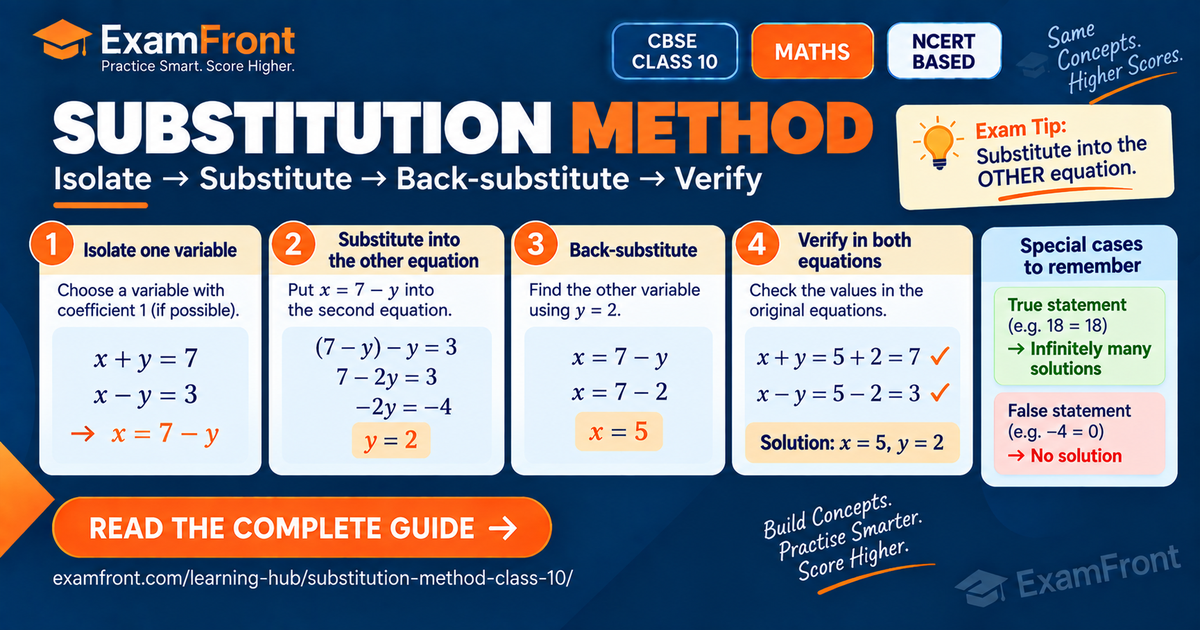
Here is the whole idea in three steps: (1) from one equation, express a variable like x as x = (something with y); (2) put that expression into the other equation, so only y remains, and solve for y; (3) substitute that y back to get x. Then verify. The rest of this guide walks through each step with worked examples, and shows what happens in the special “no solution” and “infinitely many solutions” cases.
▶️ Watch the 30-second reel: Which variable would you isolate first? 🤔
What is the substitution method?
The substitution method is an algebraic method for solving a pair of linear equations in two variables without drawing a graph. The name comes from its key action: you substitute (replace) one variable with an equivalent expression in the other variable.
Why do we need it? The graphical method is great for seeing whether lines intersect, but it is unreliable when the solution point has non-integer coordinates like (−1.75, 3.3) — you simply cannot read those accurately off a graph. Algebraic methods give the exact answer every time, which is why they are the go-to methods in the board exam.
The 3 steps of the substitution method
Use these three steps for every substitution problem. Keep the terminology consistent: “isolate” means write one variable alone on one side; “substitute” means replace it in the other equation.
- Isolate one variable. From either equation (pick the easier one), write one variable in terms of the other — for example, x = 3 − 2y. Choose the variable whose coefficient is 1 if possible, so no fractions appear.
- Substitute and solve. Put that expression into the other equation. Now only one variable is left, so solve that ordinary equation.
- Back-substitute. Put the value you found into the Step-1 expression to get the second variable. Finally, verify by checking both original equations.
Many teachers and revision cards write the check as its own fourth box — isolate → substitute → back-substitute → verify. It is the same routine; the point is that the verify line is never optional.
Exam tip: Always substitute into the equation you did not use in Step 1. Substituting back into the same equation just gives you 0 = 0 and no new information.
Worked example 1 — a clean start
Solve: x + y = 7 and x − y = 3.
- Step 1 (isolate): From the first equation, x + y = 7, write x = 7 − y.
- Step 2 (substitute & solve): Put x = 7 − y into the second equation x − y = 3: (7 − y) − y = 3 → 7 − 2y = 3 → −2y = −4 → y = 2.
- Step 3 (back-substitute): x = 7 − y = 7 − 2 = 5.
- Verify: 5 + 2 = 7 ✓ and 5 − 2 = 3 ✓.
Solution: x = 5, y = 2. Notice how choosing the variable with coefficient 1 kept every line free of fractions.
▶️ Watch the 30-second reel: Can you isolate x correctly? 👀
Worked example 2 — when a variable is already isolated
Solve: y = 2x − 3 and 3x + 2y = 8.
Here the first equation already gives y in terms of x, so Step 1 is done for us. This is exactly the situation where substitution is fastest.
- Step 2 (substitute & solve): Put y = 2x − 3 into 3x + 2y = 8: 3x + 2(2x − 3) = 8 → 3x + 4x − 6 = 8 → 7x = 14 → x = 2.
- Step 3 (back-substitute): y = 2x − 3 = 2(2) − 3 = 1.
- Verify: 3(2) + 2(1) = 6 + 2 = 8 ✓.
Solution: x = 2, y = 1. Whenever one equation looks like “y = …” or “x = …”, reach for substitution first — this is the kind of quick decision the Practice Companion on examfront helps you make automatically as you drill more problems.
Worked example 3 — a word problem
Problem: The cost of 2 notebooks and 1 pen is ₹80. The cost of 1 notebook and 1 pen is ₹50. Find the cost of each.
- Form the equations. Let one notebook cost ₹x and one pen cost ₹y. 2x + y = 80 … (1) and x + y = 50 … (2)
- Step 1 (isolate): From (2), y = 50 − x.
- Step 2 (substitute & solve): Put into (1): 2x + (50 − x) = 80 → x + 50 = 80 → x = 30.
- Step 3 (back-substitute): y = 50 − 30 = 20.
- Verify: 2(30) + 20 = 80 ✓ and 30 + 20 = 50 ✓.
A notebook costs ₹30 and a pen costs ₹20. Turning a word problem into two equations is a skill on its own — see linear-equations word problems for the full framing method, and practise mixed sets on examfront’s Topic Practice so the setup becomes second nature.
The special cases: no solution and infinitely many solutions
Sometimes, during Step 2, both variables disappear. Do not panic — this is telling you something important about the pair of lines.
- If you get a true statement with no variable (for example, 18 = 18), the two equations are really the same line, so the pair has infinitely many solutions (it is dependent and consistent).
- If you get a false statement with no variable (for example, −4 = 0), the lines are parallel, so the pair has no solution (it is inconsistent).
Quick example (no solution): Solve x + 2y − 4 = 0 and 2x + 4y − 12 = 0. From the first, x = 4 − 2y. Substitute into the second: 2(4 − 2y) + 4y − 12 = 0 → 8 − 4y + 4y − 12 = 0 → −4 = 0, which is false. So there is no solution — the lines are parallel.
You can predict these outcomes in advance by comparing coefficient ratios (a₁/a₂, b₁/b₂, c₁/c₂), a shortcut covered in the Pair of Linear Equations chapter guide and explained case by case in consistent and inconsistent linear equations.
| Outcome in Step 2 | What it means | Type of pair |
|---|---|---|
| One clear value (e.g. y = 2) | Lines meet at one point | Unique solution (consistent) |
| True statement (e.g. 18 = 18) | Same line | Infinitely many solutions (dependent) |
| False statement (e.g. −4 = 0) | Parallel lines | No solution (inconsistent) |
▶️ Watch the 30-second reel: What does 18 = 18 tell you? 🤔
Substitution vs elimination — which to choose?
Both are exact algebraic methods, and both give the same answer. Pick based on how the equations look:
| Use substitution when… | Use elimination when… |
|---|---|
| A variable has coefficient 1, or is already written alone (y = …). | Coefficients are larger/awkward on both variables. |
| One equation is easy to rearrange. | Coefficients of one variable are equal or easy to make equal. |
For a full walkthrough of the other method — including when to add and when to subtract — see the elimination method guide. We have kept the harder mixed problems and the trickier fraction-based equations light here; the full practice set, harder variations and personalised help where you slip up live inside examfront.
Where this sits in the NCERT and CBSE syllabus
NCERT sets the scope. The substitution method lives in Chapter 3, Pair of Linear Equations in Two Variables, of the NCERT Class 10 textbook. It is taught in Section 3.3 (Algebraic Methods) and practised in Exercise 3.2. That numbering is a trap worth knowing: the section is 3.3 but the exercise is 3.2, because Section 3.1 is a bare introduction with no exercise. The rationalised chapter has three exercises — Ex 3.1 graphical method, Ex 3.2 substitution, Ex 3.3 elimination. If you want the full map of the book, the NCERT Class 10 Maths guide lays it out chapter by chapter.
Exercise 3.2 is small, and every question type in it is on this page. It has just three questions:
| Question | What it asks | Where you have seen it here |
|---|---|---|
| Q1 (six pairs) | Solve by substitution — including fractions, decimals and √2, √3 coefficients | The 3 steps; Worked examples 1–2 |
| Q2 | Solve 2x + 3y = 11 and 2x − 4y = −24, and hence find m for which y = mx + 3 | Back-substitution: the answer (−2, 5) gives m = −1 |
| Q3 (six word problems) | Numbers, supplementary angles, bats and balls, taxi fares, a fraction, ages | Worked example 3 |
Q1(iii), 3x − y = 3 and 9x − 3y = 9, is the textbook’s built-in special case: substituting y = 3x − 3 leaves a true statement, so the pair has infinitely many solutions — exactly the 18 = 18 situation above.
Check your edition. The rationalised syllabus removed the cross-multiplication method and equations reducible to a pair of linear equations, so substitution and elimination are the only algebraic methods you are examined on. Older books and many solution sites still carry the seven-exercise chapter, where substitution appears as “Exercise 3.3”. If a site sends you to Exercise 3.3 for substitution, it is using the old book. How to study NCERT Maths for Class 10 covers how to work through an exercise like this one.
CBSE sets the wording. The CBSE Class 10 Maths syllabus names the method directly: “Solution of a pair of linear equations in two variables algebraically – by substitution, by elimination. Simple situational problems.” That last phrase is why word problems like the taxi-fare and ages questions are fair game.
CBSE sets the priority by unit, not by chapter. Pair of Linear Equations is part of the Algebra unit, worth 20 of the 80 theory marks — the largest unit in the paper, shared with Polynomials, Quadratic Equations and Arithmetic Progressions. Chapter-by-chapter percentages you see online are unofficial estimates; the unit-wise weightage guide shows the official split.
How it is asked. The method is rarely the whole question — it is usually the engine inside one. A bare “solve by substitution” pair suits a short-answer question, while a situational problem asks you to form the two equations first, and a case-study question can wrap the same pair in a story. Across all of these, CBSE’s step marking rewards the working you show: the isolate line, the substituted equation and the verify line each carry weight, so write them out even when you could do the arithmetic in your head. The question types guide shows every format the paper uses.
Key Takeaways
- The substitution method solves a pair of linear equations by replacing one variable with an expression in the other, leaving a single-variable equation.
- Three steps: isolate one variable, substitute into the other equation and solve, then back-substitute — and always verify.
- Choose the variable with coefficient 1 to avoid fractions; if a variable is already written alone, substitution is the fastest choice.
- A true no-variable statement means infinitely many solutions; a false one means no solution.
- The method is exact, so it works even when the answer is a fraction — unlike reading a graph.
- In NCERT it is Chapter 3, Exercise 3.2 (taught in Section 3.3), and the CBSE syllabus names it explicitly alongside elimination.
Quick Facts
- Substitution method: an algebraic method to solve a pair of linear equations in two variables.
- Steps: isolate → substitute → back-substitute → verify.
- Best when: a variable’s coefficient is 1 or a variable is already isolated.
- Unique solution: you get a single value for each variable.
- Infinitely many solutions: variables cancel to a true statement (e.g. 18 = 18).
- No solution: variables cancel to a false statement (e.g. −4 = 0).
- NCERT: Chapter 3, Section 3.3 → Exercise 3.2 (3 questions). Cross-multiplication is no longer in the syllabus.
- CBSE weight: part of the Algebra unit, 20 of 80 theory marks.
- Chapter: Pair of Linear Equations · Class: 10 · Subject: Maths · Board: CBSE.
Common Mistakes
- Substituting back into the same equation. After isolating from equation (1), students plug the expression back into (1) and get 0 = 0. Always substitute into the other equation.
- Dropping a sign while transposing. Writing x = 3 − 2y as x = 3 + 2y (or forgetting the minus on a substituted term) changes the whole answer. Move terms carefully.
- Not multiplying the whole bracket. In 3x + 2(2x − 3), forgetting to multiply the −3 by 2 gives a wrong equation. Distribute across every term inside the bracket.
- Forgetting to find the second variable. Some students find y and stop. The solution needs both x and y — finish Step 3.
- Misreading the special cases. Treating “18 = 18” as “no solution” (or “−4 = 0” as a value) reverses the answer. True = infinitely many; false = no solution.
Take the summary with you
Download the Substitution Method summary (PDF) — the three steps with the trap inside each, the special cases, the NCERT Exercise 3.2 map and a fully worked board-style word problem, on two pages.
FAQ
Q. What is the substitution method in Class 10 Maths? It is an algebraic way to solve a pair of linear equations in two variables. You express one variable in terms of the other from one equation, substitute that into the second equation to get a single-variable equation, solve it, and back-substitute to find the other variable.
Q. What are the steps of the substitution method? Step 1: from one equation, write one variable in terms of the other. Step 2: substitute this into the second equation and solve the single-variable equation. Step 3: put that value back into the Step-1 expression to find the other variable. Then verify in both original equations.
Q. When should I use substitution instead of elimination? Use substitution when one variable has a coefficient of 1 or is already written alone (like y = 2x − 3), because isolating it is quick and fraction-free. If both equations have awkward coefficients, elimination is usually faster.
Q. What does a statement like 18 = 18 or −4 = 0 mean? If the variables cancel and you get a true statement (18 = 18), the pair has infinitely many solutions (same line). If you get a false statement (−4 = 0), the pair has no solution (parallel lines).
Q. Do I need to verify my answer? Yes. Substitute your x and y back into both original equations; if both hold, the solution is correct. Verification catches the sign and arithmetic slips that most often cost marks.
Q. Is the substitution method part of the NCERT and CBSE Class 10 syllabus? Yes. In NCERT it is taught in Chapter 3 under Section 3.3 (Algebraic Methods) and practised in Exercise 3.2 — three questions: six pairs to solve, one solve-and-hence question, and six word problems. The CBSE 2026-27 syllabus names it directly: solving a pair of linear equations algebraically by substitution and by elimination. The chapter sits in the Algebra unit, worth 20 of the 80 theory marks. Cross-multiplication has been removed, so substitution and elimination are the two algebraic methods you are examined on.
Related Concepts
- Elimination Method (Class 10): the sibling algebraic method — add or subtract the equations to remove a variable.
- Linear Equations in Two Variables (Class 10): the basics and the graphical method behind these equations.
- Linear-Equations Word Problems (Class 10): how to turn a story into two equations you can solve.
- Pair of Linear Equations — Chapter Guide: the full chapter roadmap and where the substitution method fits.
Ready to make substitution automatic? Work through a full set on examfront’s Topic Practice, and let the Practice Companion and Mistake Identification show you exactly where your sign slips happen. Start on examfront →