Linear Equations in Two Variables (Class 10): What a Pair of Linear Equations Means
In one line: a pair of linear equations in two variables is simply two linear equations using the same two variables, and “solving the pair” means finding the values of both variables that make both equations true at the same time.
A linear equation in two variables is an equation of the form ax + by + c = 0, where a, b, c are real numbers and a, b are not both zero. You met these in Class 9: each such equation, drawn on a graph, is a straight line (“linear” literally means line-like). In Class 10, Chapter 3 takes the next step — instead of one equation, you work with two of them together, because most real situations put two conditions on two unknown quantities.
That is the whole idea of Section 3.1: real life gives you two facts about two unknowns, you turn each fact into a linear equation, and the two equations together form a pair whose common solution answers the question. This article makes that idea completely clear before you touch any solving method in the rest of the Pair of Linear Equations Class 10 chapter.
▶️ Watch the 30-second reel: Which one is linear? 🤔
What is a linear equation in two variables? (quick recap)
A linear equation in two variables is any equation that can be written as
ax + by + c = 0
- Meaning in plain words: a rule connecting two unknown quantities, x and y, where each appears only to the power 1 (no x², no xy, no 1/x).
- Variables defined: x and y are the unknowns; a, b, c are fixed real numbers (a and b not both zero).
- When it applies: whenever one condition links two quantities in a straight-line (proportional-plus-constant) way.
Worked example. Is 2x + 3y = 12 a linear equation in two variables? Rewrite it as 2x + 3y − 12 = 0. Here a = 2, b = 3, c = −12 — all real numbers, powers of x and y both 1. Yes, it is linear in two variables. One solution is x = 3, y = 2, because 2(3) + 3(2) = 6 + 6 = 12. But so is x = 0, y = 4, and x = 6, y = 0 — a single linear equation has infinitely many solutions, one for every point on its line.
That “infinitely many” is exactly why one equation is not enough to find definite values — and why Chapter 3 exists.
▶️ Watch the 30-second reel: How many solutions? 🤔
What is a pair of linear equations in two variables?
A pair of linear equations in two variables is two linear equations considered together, in the same two variables x and y. The general form of the pair is:
a₁x + b₁y + c₁ = 0 a₂x + b₂y + c₂ = 0
- Meaning in plain words: two straight-line rules that x and y must obey simultaneously.
- Variables defined: x, y are the common unknowns; a₁, b₁, c₁ are the coefficients of the first equation and a₂, b₂, c₂ of the second (in each equation, the two leading coefficients are not both zero).
- When it applies: whenever a situation gives you two independent conditions on two unknown quantities.
The subscripts 1 and 2 just label which equation each coefficient belongs to — you will use the ratios a₁/a₂, b₁/b₂ and c₁/c₂ heavily in the next section of the chapter, so getting comfortable with this notation now pays off immediately.
Worked example. The equations x − 2y = 0 and 3x + 4y − 20 = 0 form a pair: same variables x and y, both linear. Comparing with the general form: a₁ = 1, b₁ = −2, c₁ = 0 and a₂ = 3, b₂ = 4, c₂ = −20. Identifying coefficients like this is a one-mark skill that appears in MCQ-style questions — a quick round of Topic Practice on examfront makes it automatic.
Why do real situations need a pair of equations?
Because one condition cannot fix two unknowns. Here is the kind of situation Chapter 3 opens with, in a fresh example:
At the school canteen, a samosa costs ₹12 and a juice costs ₹20. Aman bought twice as many samosas as juices and spent ₹88 in total. How many of each did he buy?
You could guess and check — but algebra is faster. Let the number of samosas be x and the number of juices be y. Each fact becomes one equation:
- “twice as many samosas as juices” → x = 2y
- “spent ₹88 in total” → 12x + 20y = 88
Together, x = 2y and 12x + 20y = 88 are a pair of linear equations in two variables that completely captures the situation. Translating the words into the equations is a skill on its own — we teach the full step-by-step method in How to form linear equations from word problems.
Check a solution. Try x = 4, y = 2. First equation: 4 = 2(2) ✓. Second: 12(4) + 20(2) = 48 + 40 = 88 ✓. Since (4, 2) satisfies both equations, it is a solution of the pair: Aman bought 4 samosas and 2 juices. Notice that x = 6, y = 3 satisfies the first equation but not the second (72 + 60 = 132 ≠ 88) — satisfying only one equation is not enough.
▶️ Watch the 30-second reel: Can you spot the equation trap? ✏️
What does “solution of a pair of linear equations” mean?
A solution of a pair of linear equations is a pair of values (x, y) that satisfies both equations simultaneously — substituting the values makes each equation a true statement.
Geometrically, each equation is a straight line, so a solution is a point common to both lines. How many such common points can there be? That depends on how the two lines sit — they may intersect, be parallel, or coincide — and that is precisely what the graphical method in the next section of the chapter explores. Chapter 3 then gives you three ways to find the solution: the graphical method, substitution and elimination.
We are keeping this article to the Section 3.1 foundations. The intersecting/parallel/coincident cases, the ratio conditions a₁/a₂, b₁/b₂, c₁/c₂, and every solving method are worked through step by step — with the harder variations and a full drill set — inside examfront, where the Practice Companion and Mistake Identification show you exactly which condition or step you slip on. The chapter’s exam weightage and question mix are mapped in the unit-wise weightage guide.
▶️ Watch the 30-second reel: Can you test both equations? 🤔
Where this sits in the NCERT and CBSE syllabus
Knowing where Section 3.1 sits stops you from over-preparing the definition and under-preparing what is actually asked.
NCERT sets the scope. The rationalised NCERT Class 10 Maths course is 7 units and 14 chapters — Constructions was removed altogether, and the full list is in our Class 10 Maths chapter list. This topic is Chapter 3, Pair of Linear Equations in Two Variables, and what you have just read is its Section 3.1 Introduction. Two numbering points are worth fixing in your head now, because students lose time hunting for the wrong exercise: the graphical method is Section 3.2 but its questions are Exercise 3.1, and the algebraic methods sit together under Section 3.3, with Exercise 3.2 for substitution and Exercise 3.3 for elimination. Also note what left the chapter: cross-multiplication and equations reducible to a pair of linear equations were both removed, so substitution and elimination are the only algebraic methods you will be examined on. Working straight from the textbook is the right move here — our guide on how to study NCERT Maths for Class 10 and the NCERT Class 10 Maths guide both show how to use the examples before the exercises.
CBSE sets the shape. The board paper is 38 questions, 80 marks, three hours, with no overall choice, split across five sections: A 20 × 1, B 5 × 2, C 6 × 3, D 4 × 5 and E 3 × 4 = 80. The full breakdown is in the CBSE Class 10 Maths exam pattern, and the complete syllabus shows how the chapters group into units.
CBSE sets priority by unit, not by chapter. The seven units carry Number Systems 6, Algebra 20, Coordinate Geometry 6, Geometry 15, Trigonometry 12, Mensuration 10 and Statistics & Probability 11 = 80. Chapter 3 sits inside Algebra, the largest unit in the paper — which is why the chapter repays early work. Be careful with the chapter-wise percentage tables and pie charts that circulate online: CBSE publishes marks by unit only, and any chapter-level figure you see is an unofficial estimate.
How this section is actually asked. Section 3.1 itself is objective territory: deciding whether an equation is linear in two variables, reading off a, b and c after moving everything to one side, or checking whether a given (x, y) satisfies a pair. Those are 1-mark Section A items — MCQ or assertion–reason — and the question types guide shows all six formats. The chapter’s bigger marks come later, when you solve the pair.
One habit that belongs here, because it is the single most common way marks are lost on this chapter’s diagrams: when you draw the line of an equation, every point in your own table must lie on the line you have drawn. Make the table, plot the points, rule the line through them, and then check one point back in the equation. A graph whose marked points float above or below the ruled line is telling you the plotting went wrong, not the algebra — and a picture that disagrees with its own table earns no marks.
Key Takeaways
- A linear equation in two variables has the form ax + by + c = 0 (a, b not both zero); its graph is a straight line and it alone has infinitely many solutions.
- A pair of linear equations is two such equations in the same variables: a₁x + b₁y + c₁ = 0 and a₂x + b₂y + c₂ = 0.
- Real situations produce a pair because they state two conditions about two unknowns.
- A solution of the pair is a value pair (x, y) that satisfies both equations — geometrically, a point lying on both lines.
- Chapter 3 gives three methods to find that solution: graphical, substitution and elimination — all built on this section’s foundation.
- In the NCERT and CBSE syllabus this is Chapter 3, Section 3.1, inside Algebra — 20 of the 80 theory marks, the largest unit in the paper.
Quick Facts
- Linear equation (two variables): ax + by + c = 0, a and b not both zero; degree 1; graph = straight line.
- Pair (general form): a₁x + b₁y + c₁ = 0 and a₂x + b₂y + c₂ = 0.
- One equation alone: infinitely many solutions.
- Solution of a pair: (x, y) satisfying both equations; a common point of the two lines.
- Prerequisite: Linear Equations in Two Variables (Class 9).
- NCERT numbering: Section 3.2 (graphical) → Exercise 3.1; Section 3.3 (algebraic) → Exercise 3.2 substitution, Exercise 3.3 elimination.
- Removed from this chapter: cross-multiplication, and equations reducible to a pair of linear equations.
- Chapter: Pair of Linear Equations in Two Variables (Ch. 3) · Class: 10 · Subject: Maths · Board: CBSE.
Common Mistakes
- Treating one equation as enough. A single linear equation in two variables has infinitely many solutions; you need the second condition to pin down unique values.
- Checking a solution in only one equation. A solution of the pair must satisfy both equations — always substitute into both before ticking it.
- Mixing up the subscript notation. a₁, b₁, c₁ belong to equation 1 and a₂, b₂, c₂ to equation 2; swapping them wrecks the ratio comparisons used later in the chapter.
- Calling non-linear equations “linear.” If any term has x², y², xy or a variable in the denominator, it is not a linear equation in two variables.
- Forgetting to move everything to one side. The general form is “= 0” — rewrite 2x + 3y = 12 as 2x + 3y − 12 = 0 before reading off c, or you’ll take c = 12 instead of −12.
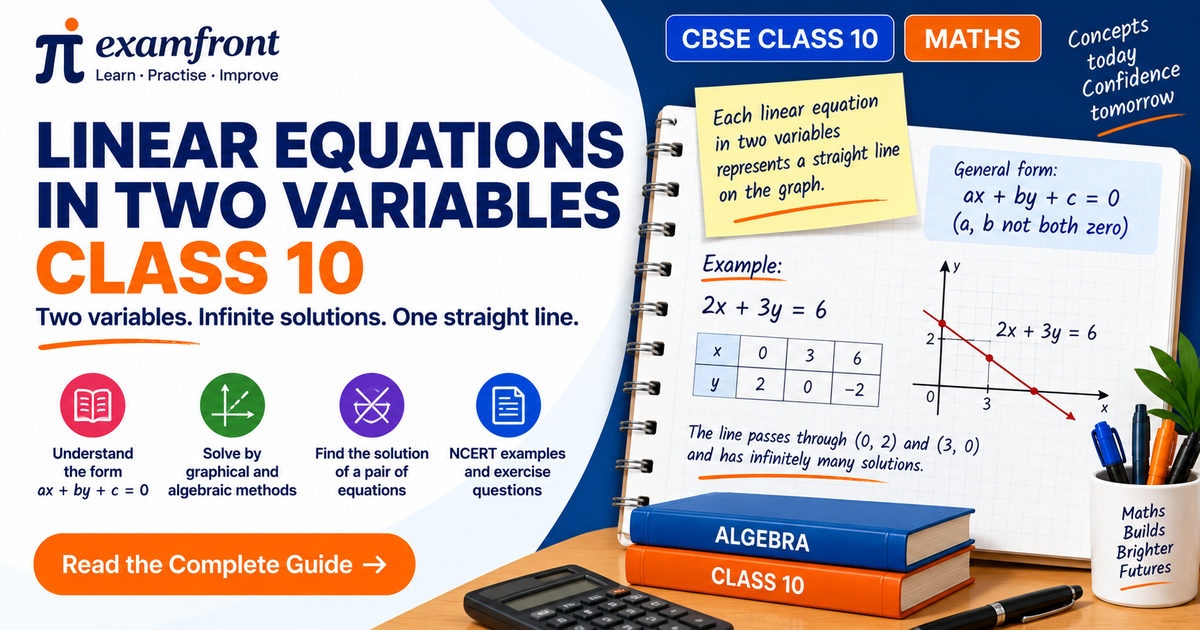
- Drawing a line that misses its own table. If you plot (0, 2), (3, 0) and (6, −2) for 2x + 3y = 6, all three must sit exactly on the ruled line. A marked point floating off the line means the plotting slipped — re-read the scale before you draw anything else.
📄 Download the 2-page summary PDF — the general forms, the solution check and a worked example, in examfront brand style.
FAQ
Q. What is a linear equation in two variables? An equation of the form ax + by + c = 0, where a, b, c are real numbers and a, b are not both zero. Both variables have power 1, and its graph is a straight line. Example: 2x + 3y − 12 = 0.
Q. What is a pair of linear equations in two variables? Two linear equations in the same two variables taken together: a₁x + b₁y + c₁ = 0 and a₂x + b₂y + c₂ = 0. Chapter 3 of Class 10 Maths is about finding values of x and y that satisfy both.
Q. Why do we need two equations to find two variables? One equation gives infinitely many (x, y) possibilities — every point on its line. A second independent condition narrows those possibilities, generally down to a single pair of values.
Q. What does a solution of a pair of linear equations mean? A pair (x, y) that makes both equations true when substituted. On a graph, it is a point lying on both lines.
Q. Is this chapter new, or a repeat of Class 9? Class 9 covered a single linear equation in two variables. Class 10 works with a pair and teaches graphical and algebraic methods to solve them together — so the Class 9 idea is the prerequisite, not a repeat.
Q. Is Pair of Linear Equations part of the NCERT and CBSE Class 10 Maths syllabus? Yes. It is Chapter 3 of the NCERT Class 10 Maths textbook and sits inside Unit II Algebra, which carries 20 of the 80 theory marks — the largest unit in the paper. The rationalised syllabus has 7 units and 14 chapters (Constructions was removed), and within Chapter 3 the cross-multiplication method and equations reducible to linear form were also removed, so the examined algebraic methods are substitution and elimination only. The CBSE paper is 38 questions, 80 marks, three hours, with no overall choice.
Related Concepts
- How to Form Linear Equations from Word Problems: the translation skill that turns a situation into a pair of equations.
- Pair of Linear Equations Class 10 — chapter guide: the full chapter roadmap, methods and exam relevance.
- Class 10 Maths — all formulas: the general forms and conditions from this chapter in one revision sheet.
- CBSE Class 10 Maths unit-wise weightage: where Algebra (and this chapter) sits in the marks distribution.
Solid on the basics? Lock them in with a quick Chapter Quiz on examfront — Progress Tracking will show you when you’re ready to move on to the graphical method. Start on examfront →