Consistent and Inconsistent Pair of Linear Equations (Class 10)
In one line: a pair of linear equations is consistent if it has at least one solution and inconsistent if it has no solution — and you can tell which case you are in without drawing anything, just by comparing the three ratios a₁/a₂, b₁/b₂ and c₁/c₂.
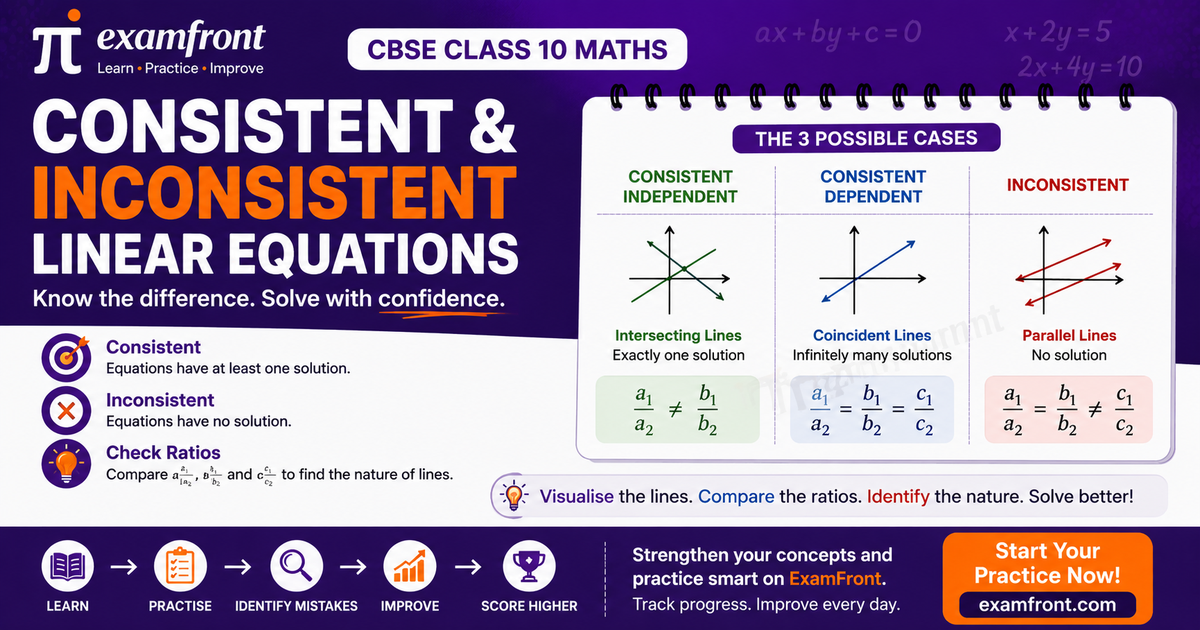
Take any pair of linear equations written in the general form a₁x + b₁y + c₁ = 0 and a₂x + b₂y + c₂ = 0, where a₁, b₁, c₁ are the coefficients and constant of the first equation and a₂, b₂, c₂ those of the second. Each equation is a straight line, so the pair behaves in exactly one of three ways: the lines intersect (one solution), coincide (infinitely many solutions) or run parallel (no solution). The first two situations are called consistent; the parallel case is called inconsistent; and the coincident case has its own extra name, a dependent pair.
This article defines all three terms precisely, gives you the ratio-comparison table that decides the case in seconds, and works one full example of each type. It is the algebraic partner of the graphical method of solving a pair of linear equations — the graph shows you the picture; the ratios predict it.
▶️ Watch the 30-second reel: Can you name the type with no solution? 🤔
What do consistent, inconsistent and dependent mean?
Three definitions to learn word-perfectly — they are direct definition-question material:
- A consistent pair of linear equations is a pair that has a solution (one or many). Graphically, the lines intersect at a point or coincide.
- An inconsistent pair of linear equations is a pair that has no solution. Graphically, the lines are parallel.
- A dependent pair of linear equations is a pair whose two equations are equivalent (one is a multiple of the other), so they draw the same line and share infinitely many solutions. Every dependent pair is automatically consistent.
A memory hook: consistent pairs “get along” (they agree on at least one point); inconsistent pairs “never agree” (no common point); dependent pairs are “clones” (same line twice).
The ratio conditions: a₁/a₂, b₁/b₂ and c₁/c₂
Here is the formula-level result of this section, stated fully:
The condition: for the pair a₁x + b₁y + c₁ = 0 and a₂x + b₂y + c₂ = 0 (with a₂, b₂, c₂ non-zero so the ratios are defined):
| Compare the ratios | Lines look like | Number of solutions | Name of the pair |
|---|---|---|---|
| a₁/a₂ ≠ b₁/b₂ | Intersecting | Exactly one (unique) | Consistent |
| a₁/a₂ = b₁/b₂ = c₁/c₂ | Coincident | Infinitely many | Dependent (consistent) |
| a₁/a₂ = b₁/b₂ ≠ c₁/c₂ | Parallel | None | Inconsistent |
In plain words: the ratios a₁/a₂ and b₁/b₂ compare the directions of the two lines. If those ratios differ, the lines point different ways and must cross once. If they match, the lines point the same way — and then c₁/c₂ decides whether they are literally the same line (all three ratios equal) or two parallel copies (constant ratio different).
Condition of use: both equations must first be written in the general form with everything on one side (= 0). If an equation is given as, say, 2x + 5y = 10, rewrite it as 2x + 5y − 10 = 0 before reading off c — sign mistakes here are the number-one source of wrong answers.
Notice the unique-solution row never mentions c₁/c₂ at all: once the direction ratios differ, the lines must cross, regardless of the constants.
▶️ Watch the 30-second reel: Can you spot the unique-solution condition? 🎯
How to apply the test — step by step
- Write both equations in the form ax + by + c = 0 (watch the signs when moving terms).
- Identify a₁, b₁, c₁ from equation 1 and a₂, b₂, c₂ from equation 2.
- Compute a₁/a₂ and b₁/b₂. If they are unequal → unique solution, consistent. Stop.
- If they are equal, compute c₁/c₂. All three equal → infinitely many solutions (dependent); c-ratio different → no solution (inconsistent).
Now one worked example per case.
Worked Example 1 — unique solution (consistent)
Question: Determine the nature of the pair: 4x − 3y = 7 and 3x + 2y = 5.
Solution: Rewrite: 4x − 3y − 7 = 0 and 3x + 2y − 5 = 0.
So a₁ = 4, b₁ = −3, c₁ = −7 and a₂ = 3, b₂ = 2, c₂ = −5.
- a₁/a₂ = 4/3
- b₁/b₂ = −3/2
Since 4/3 ≠ −3/2, we have a₁/a₂ ≠ b₁/b₂: the lines intersect at exactly one point.
Answer: the pair is consistent with a unique solution. (To actually find that solution you would use the graphical method or, faster, an algebraic method from Section 3.3.)
Worked Example 2 — no solution (inconsistent)
Question: Check whether the pair 2x + 5y = 10 and 4x + 10y = 30 has a solution.
Solution: Rewrite: 2x + 5y − 10 = 0 and 4x + 10y − 30 = 0.
So a₁ = 2, b₁ = 5, c₁ = −10 and a₂ = 4, b₂ = 10, c₂ = −30.
- a₁/a₂ = 2/4 = 1/2
- b₁/b₂ = 5/10 = 1/2
- c₁/c₂ = −10/−30 = 1/3
Here a₁/a₂ = b₁/b₂ ≠ c₁/c₂ — the lines are parallel.
Answer: the pair has no solution; it is inconsistent.
▶️ Watch the 30-second reel: Can you identify the type of solution? 🎯
Worked Example 3 — infinitely many solutions (dependent)
Question: Show that the pair 3x − y + 4 = 0 and 6x − 2y + 8 = 0 has infinitely many solutions.
Solution: Both equations are already in general form.
a₁ = 3, b₁ = −1, c₁ = 4 and a₂ = 6, b₂ = −2, c₂ = 8.
- a₁/a₂ = 3/6 = 1/2
- b₁/b₂ = −1/−2 = 1/2
- c₁/c₂ = 4/8 = 1/2
All three ratios are equal: a₁/a₂ = b₁/b₂ = c₁/c₂. The second equation is just the first multiplied by 2 — the same line drawn twice.
Answer: the pair is dependent (and therefore consistent) with infinitely many solutions.
▶️ Watch the 30-second reel: Can you catch the minus-sign trap? 👀
A taste of the classic exam twist: finding an unknown k
Boards love reversing this test: instead of checking a given pair, you are given a pair containing an unknown k and asked for which values of k the pair has a unique solution, no solution or infinitely many.
Mini example: For what values of k does the pair kx + 2y = 5 and 3x + y = 1 have a unique solution?
Rewrite: kx + 2y − 5 = 0 and 3x + y − 1 = 0, so a₁/a₂ = k/3 and b₁/b₂ = 2/1.
Unique solution needs a₁/a₂ ≠ b₁/b₂, i.e. k/3 ≠ 2, i.e. k ≠ 6. For every real k except 6, the pair has exactly one solution.
▶️ Watch the 30-second reel: Can you find the value of k? 🎯
The harder versions — where k appears in both coefficients, or where you must find k for “no solution” and separately test the c-ratio — follow the same logic but reward careful case-work. Work through the complete graded set of these k-value problems inside examfront, where Topic Practice sequences them from this mini example up to full board-level difficulty, and Performance Analytics tells you which case (unique / none / infinite) you slip on.
Key Takeaways
- Consistent = at least one solution (intersecting or coincident lines); inconsistent = no solution (parallel lines); dependent = same line, infinitely many solutions, always consistent.
- The three-ratio test decides everything: a₁/a₂ ≠ b₁/b₂ → unique; all three ratios equal → infinitely many; a₁/a₂ = b₁/b₂ ≠ c₁/c₂ → none.
- Always convert both equations to the general form (= 0) first — sign errors in c are the most common failure point.
- For a unique solution, c₁/c₂ is irrelevant; it only matters once the first two ratios match.
- The same test powers the popular find-the-value-of-k exam questions.
Quick Facts
- Consistent pair: has one or infinitely many solutions.
- Inconsistent pair: has zero solutions; condition a₁/a₂ = b₁/b₂ ≠ c₁/c₂.
- Dependent pair: equations are equivalent; condition a₁/a₂ = b₁/b₂ = c₁/c₂; always consistent.
- Unique solution condition: a₁/a₂ ≠ b₁/b₂.
- Topic location: Chapter 3, Pair of Linear Equations in Two Variables, CBSE Class 10 Mathematics — see the chapter guide for exam relevance and the full formula list.
Common Mistakes
- Reading c with the wrong sign — for 2x + 5y = 10 the value of c is −10 (after moving 10 across), not +10.
- Testing c₁/c₂ when it is not needed — if a₁/a₂ ≠ b₁/b₂, the answer is already “unique solution”; the c-ratio adds nothing.
- Confusing dependent with inconsistent — both have a₁/a₂ = b₁/b₂, but dependent pairs also match on c₁/c₂ (same line), while inconsistent pairs do not (parallel lines).
- Calling an infinitely-many-solutions pair “inconsistent” — it is the opposite: infinitely many solutions is the most consistent a pair can be.
- Dropping minus signs in the ratios — −1/−2 equals +1/2; a lost sign flips your conclusion from coincident to intersecting.
If any of these feel familiar, that is precisely what examfront’s Mistake Identification exists for — it spots the exact ratio step you get wrong across attempts and feeds it into your Revision Planning.
📄 Download the 2-page summary PDF — the three ratio conditions, all three cases and a full k-value worked example on one printable sheet.
FAQ
What is a consistent pair of linear equations? A pair with at least one solution. The lines either intersect at one point (unique solution) or coincide (infinitely many solutions).
What is an inconsistent pair of linear equations? A pair with no solution — the lines are parallel. Its ratio condition is a₁/a₂ = b₁/b₂ ≠ c₁/c₂.
What is a dependent pair of linear equations? A pair whose equations are equivalent, representing the same line with infinitely many common solutions. It satisfies a₁/a₂ = b₁/b₂ = c₁/c₂ and is always consistent.
How do you check consistency without a graph? Put both equations in the form ax + by + c = 0 and compare a₁/a₂, b₁/b₂ and c₁/c₂ against the three-row conditions table.
Is a pair with infinitely many solutions consistent? Yes — consistency only demands at least one solution, and such a pair has infinitely many.
Related Concepts
- Graphical Method of Solving a Pair of Linear Equations — the pictures behind these three conditions
- Pair of Linear Equations in Two Variables — the basics
- Linear Equations Word Problems (Class 10)
- Pair of Linear Equations — Chapter 3 Guide
- MCQ Questions for Class 10 Maths — ratio-condition MCQs are a board favourite
Want the ratio test to become reflex? Drill all three cases plus every k-value variation with instant feedback, Chapter Quizzes and Exam Readiness tracking on examfront — so on exam day, one glance at the coefficients tells you the answer.