Standard Form of a Quadratic Equation (Class 10) — Definition & Examples
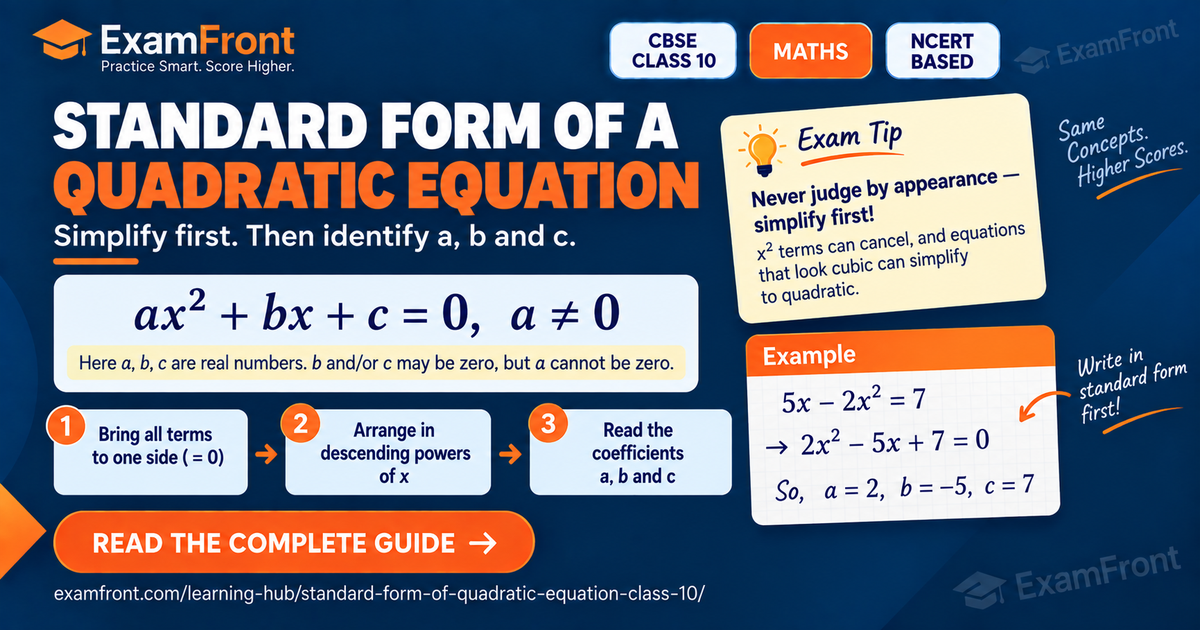
In one line: the standard form of a quadratic equation is ax² + bx + c = 0, where a, b, c are real numbers and a ≠ 0 — the terms are written in descending order of the powers of x.
A quadratic equation in the variable x is any equation that can be rewritten in this form. It comes directly from Chapter 2: a quadratic polynomial is an expression of the form ax² + bx + c (degree 2), and when you equate that polynomial to zero, you get a quadratic equation. So 2x² − 5x + 3 = 0, x² − 49 = 0 and 3x² + 7x = 0 are all quadratic equations, while 4x − 9 = 0 is not (its degree is 1, so it is a linear equation).
The two skills this article builds are the ones every later question in the chapter assumes: (1) recognise the standard form and read off the coefficients a, b and c correctly (including their signs), and (2) decide whether a given equation is really quadratic — which always means simplify first, judge after, because equations frequently disguise themselves. Skill (2) is exactly what NCERT Exercise 4.1 Q1 asks, eight times over.
▶ Watch: Can you spot the quadratic equation? 🤔
What is a quadratic equation? (Definition)
A quadratic equation in the variable x is an equation of the form
ax² + bx + c = 0, where a, b, c are real numbers and a ≠ 0.
Each part of the definition matters:
- a, b, c are real numbers — they can be positive, negative, fractions, even irrational numbers like √2.
- a ≠ 0 — this is the non-negotiable condition. If a were 0, the x² term would vanish and the equation would collapse into the linear equation bx + c = 0. The condition a ≠ 0 is what makes the degree (the highest power of x) equal to 2.
- b and c are allowed to be 0. So x² − 16 = 0 (here b = 0) and 5x² + 2x = 0 (here c = 0) are both perfectly valid quadratic equations.
Equivalently: any equation p(x) = 0, where p(x) is a polynomial of degree 2, is a quadratic equation.
Connection to Chapter 2: the zeroes of the quadratic polynomial ax² + bx + c and the roots of the quadratic equation ax² + bx + c = 0 are the same numbers. Since a quadratic polynomial has at most two zeroes, a quadratic equation has at most two roots.
What does “standard form” mean?
An equation is in standard form when all terms are moved to one side (leaving 0 on the other) and written in descending order of degree: the x² term first, then the x term, then the constant.
Worked example — rewrite in standard form. Write 5x − 2x² = 7 in standard form and identify a, b, c.
- Bring every term to one side: 5x − 2x² − 7 = 0.
- Arrange in descending powers: −2x² + 5x − 7 = 0.
- (Optional but tidy) multiply through by −1: 2x² − 5x + 7 = 0.
Reading off the coefficients from 2x² − 5x + 7 = 0: a = 2, b = −5, c = 7. Notice that b carries its sign — writing b = 5 here is one of the most common mark-losing slips, and it is exactly the kind of error examfront’s Mistake Identification flags for you the moment you make it in practice.
How to check whether an equation is quadratic (the golden rule)
Golden rule: simplify first, judge after. Expand all brackets, cancel like terms across the equals sign, bring everything to one side — and only then look at the highest surviving power of x.
There are two classic disguises:
- Looks quadratic, isn’t. The x² terms on both sides cancel.
- Looks cubic, is quadratic. The x³ terms on both sides cancel.
Worked example 1 — a genuine quadratic
Is (x − 3)² + 2 = 4x − 5 a quadratic equation?
- Expand the left side: (x − 3)² + 2 = x² − 6x + 9 + 2 = x² − 6x + 11.
- So the equation is x² − 6x + 11 = 4x − 5.
- Bring all terms to one side: x² − 6x + 11 − 4x + 5 = 0 → x² − 10x + 16 = 0.
- Highest power of x is 2 and a = 1 ≠ 0 → yes, it is a quadratic equation.
Worked example 2 — looks quadratic, isn’t
Is x(x + 2) + 6 = (x + 3)(x − 3) a quadratic equation?
- Left side: x(x + 2) + 6 = x² + 2x + 6. Right side: (x + 3)(x − 3) = x² − 9.
- So x² + 2x + 6 = x² − 9. The x² terms cancel:
- 2x + 6 + 9 = 0 → 2x + 15 = 0.
- The highest surviving power of x is 1 → not a quadratic equation (it is linear).
Worked example 3 — looks cubic, is quadratic
Is (x + 1)³ = x³ + 5 a quadratic equation?
- Expand: (x + 1)³ = x³ + 3x² + 3x + 1.
- So x³ + 3x² + 3x + 1 = x³ + 5. The x³ terms cancel:
- 3x² + 3x + 1 − 5 = 0 → 3x² + 3x − 4 = 0.
- Degree 2 with a = 3 ≠ 0 → yes, it is a quadratic equation.
Exam tip: In “check whether quadratic” questions, the marks are in the simplification, not the final yes/no. Show the expansion, the cancellation and the final standard form. Drill a full mixed set of these on examfront’s Topic Practice until the disguises stop fooling you.
▶ Watch: Which value makes it non-quadratic? 🤔
Quadratic equation vs quadratic polynomial vs linear equation
Keeping these three terms separate prevents a lot of confusion later in the chapter:
| Object | Form | What it is |
|---|---|---|
| Quadratic polynomial | ax² + bx + c (a ≠ 0) | An expression — nothing is being solved |
| Quadratic equation | ax² + bx + c = 0 (a ≠ 0) | A degree-2 equation — we look for its roots |
| Linear equation | bx + c = 0 (b ≠ 0) | A degree-1 equation — exactly one root |
A quadratic equation has at most two roots; a linear equation bx + c = 0 (b ≠ 0) has exactly one, x = −c/b. (The linear equations in two variables of Chapter 3 are a different object again — each one on its own has infinitely many solutions.) This “at most two” fact becomes central when you study the nature of roots later in the chapter — the Quadratic Equations chapter guide maps out where each section leads.
Where quadratic equations come from
Quadratic equations are not an invention for exams — they appear whenever a real quantity depends on the square of another. The classic setup: a hall’s area is 300 m² and its length is one metre more than twice its breadth. Calling the breadth x makes the length 2x + 1, and area gives (2x + 1)x = 300, i.e. 2x² + x − 300 = 0 — a quadratic equation whose root is the breadth. Historically, mathematicians from the Babylonians to Brahmagupta and Sridharacharya developed methods for exactly such problems, and the quadratic formula you will meet later in the chapter is known in Indian textbooks as Sridharacharya’s formula.
Translating situations like this into equations is a full skill of its own — the step-by-step framework, with area, number and cost examples, is in the companion article How to Form a Quadratic Equation from a Word Problem. We have kept the harder identification cases here light — equations with fractions and radicals that reduce (or fail to reduce) to quadratics are part of the full practice set inside examfront, where the Practice Companion walks you through the ones you miss.
Where this sits in the NCERT and CBSE syllabus
NCERT sets the scope. Standard form is where Chapter 4, Quadratic Equations, of the NCERT Class 10 Maths textbook begins its teaching, and it is drilled in Exercise 4.1, which has just two questions. Q1 gives you eight equations and asks whether each is quadratic — and it is built out of exactly the two disguises on this page. Five of the eight simplify to quadratics and three do not:
- The x² terms cancel in (x − 2)(x + 1) = (x − 1)(x + 3), leaving 3x − 1 = 0, and in x² + 3x + 1 = (x − 2)², leaving 7x − 3 = 0 — both linear.
- The x³ terms cancel in x³ − 4x² − x + 1 = (x − 2)³, leaving 2x² − 13x + 9 = 0 — quadratic, despite the cubes.
- The x³ terms do not cancel in (x + 2)³ = 2x(x² − 1), which stays cubic — so “it has cubes on both sides” is not a reason to expect a quadratic either. Simplify first, every time.
Q2 asks you to represent four situations as quadratic equations — the skill covered in forming quadratic equations and finished in quadratic equation word problems. The rationalised chapter has three exercises in all: 4.1 (standard form), 4.2 (solving by factorisation) and 4.3 (nature of roots). If a book or website shows four exercises, it is an older edition — completing the square was removed.
CBSE sets the shape. The 2026-27 CBSE Class 10 Maths syllabus lists this topic first in the chapter, word for word: “Standard form of a quadratic equation ax² + bx + c = 0, (a ≠ 0).” The second line is solving by factorisation and by the quadratic formula — and both of those start by reading a, b and c off the standard form, signs included. Quadratic Equations sits in the Algebra unit, worth 20 of the 80 theory marks, the largest unit in the paper. CBSE sets marks by unit, not by chapter, so chapter-wise percentages you see online are unofficial estimates.
How it is asked. On its own, “is this equation quadratic?” is usually a short objective question — see the CBSE question types. But standard form is inside every longer quadratic question too: a wrong sign on b changes the discriminant and the formula, and every mark after it. In a written answer, show the expansion and the cancellation — how CBSE maths answers are marked explains why that working earns marks even when a final step slips.
Key Takeaways
- A quadratic equation is any equation expressible as ax² + bx + c = 0 with a, b, c real and a ≠ 0.
- Standard form means every term on one side, arranged in descending powers: x² term, x term, constant.
- a ≠ 0 is compulsory (it keeps the degree at 2); b and c may be 0.
- To test whether an equation is quadratic, simplify fully first — x² terms can cancel (leaving a linear equation) and x³ terms can cancel (revealing a quadratic).
- The roots of ax² + bx + c = 0 are the same as the zeroes of the polynomial ax² + bx + c, so a quadratic equation has at most two roots.
- In NCERT this is Exercise 4.1, and the CBSE 2026-27 syllabus names standard form ax² + bx + c = 0, (a ≠ 0) as the chapter’s first content point.
Quick Facts
- Standard form: ax² + bx + c = 0, a ≠ 0.
- Degree of a quadratic equation: 2.
- Maximum number of roots: 2.
- b = 0 allowed? Yes (e.g. x² − 16 = 0). c = 0 allowed? Yes (e.g. 5x² + 2x = 0). a = 0 allowed? No.
- Coefficients in 2x² − 5x + 7 = 0: a = 2, b = −5, c = 7.
- Chapter: Quadratic Equations · Class: 10 · Subject: Maths · Board: CBSE.
- NCERT exercise: 4.1 — Q1 checks eight equations (five are quadratic), Q2 represents four situations.
- CBSE unit: Algebra, 20 of 80 theory marks.
Common Mistakes
- Judging by appearance instead of simplifying. Equations with x² on both sides may not be quadratic, and cubic-looking equations may be. Always expand, cancel and then decide.
- Dropping the sign of b or c. In 2x² − 5x + 7 = 0, b is −5, not 5. Read coefficients with their signs from the standard form.
- Forgetting the condition a ≠ 0. Writing “ax² + bx + c = 0 is always quadratic” loses the key idea — if a = 0 it is linear.
- Thinking b or c must be non-zero. x² = 49 is a quadratic equation (b = 0, c = −49 once rearranged). Only a has a restriction.
- Not bringing all terms to one side. Identifying a, b, c from x² − 6x + 11 = 4x − 5 before rearranging gives wrong coefficients. Standard form first, coefficients second.
Take the summary with you
Download the 2-page Standard Form of a Quadratic Equation summary (PDF) → — the definition, reading a, b, c with signs, the simplify-first test, and NCERT Exercise 4.1 Q1 worked on one printable sheet.
FAQ
Q. What is the standard form of a quadratic equation? It is ax² + bx + c = 0, where a, b, c are real numbers and a ≠ 0, with terms in descending order of degree — x² term, then x term, then constant. Example: 2x² − 5x + 3 = 0 with a = 2, b = −5, c = 3.
Q. What is a quadratic equation in Class 10 Maths? Any equation that can be written as ax² + bx + c = 0 with a ≠ 0. It has degree 2 — the highest power of the variable is 2 — and it is what you get by equating a quadratic polynomial to zero.
Q. Why must a ≠ 0? Because if a = 0 the x² term disappears and the equation becomes bx + c = 0, which is linear (degree 1). The condition a ≠ 0 is what guarantees the equation is genuinely quadratic. b and c are free to be zero.
Q. How do I check whether an equation is quadratic? Expand and simplify fully, bring everything to one side, then check the highest surviving power of x. If the result is ax² + bx + c = 0 with a ≠ 0, it is quadratic. Watch for cancelling x² terms (leaves linear) and cancelling x³ terms (reveals quadratic).
Q. How many roots can a quadratic equation have? At most two, because its roots are exactly the zeroes of the quadratic polynomial ax² + bx + c, and a degree-2 polynomial has at most two zeroes.
Q. Is the standard form of a quadratic equation part of the NCERT and CBSE Class 10 syllabus? Yes. It opens Chapter 4, Quadratic Equations, in the NCERT Class 10 textbook and is drilled in Exercise 4.1, whose first question asks you to check whether eight equations are quadratic. The CBSE 2026-27 syllabus lists it first in the chapter: standard form ax² + bx + c = 0, (a ≠ 0). Quadratic Equations belongs to the Algebra unit, worth 20 of the 80 theory marks.
Related Concepts
- How to Form a Quadratic Equation from a Word Problem (Class 10): turning real situations into equations in standard form.
- Quadratic Equations — Chapter Guide: the full chapter roadmap — factorisation, the quadratic formula and nature of roots.
- Zeroes of a Polynomial (Class 10): why roots of the equation = zeroes of the polynomial.
- Polynomials — Chapter Guide: the Chapter 2 foundation this chapter builds on.
Confident with standard form? Test yourself with a quick Chapter 4 quiz on examfront — Chapter Quizzes and Progress Tracking show you instantly whether the disguised-equation traps still catch you. Start on examfront →