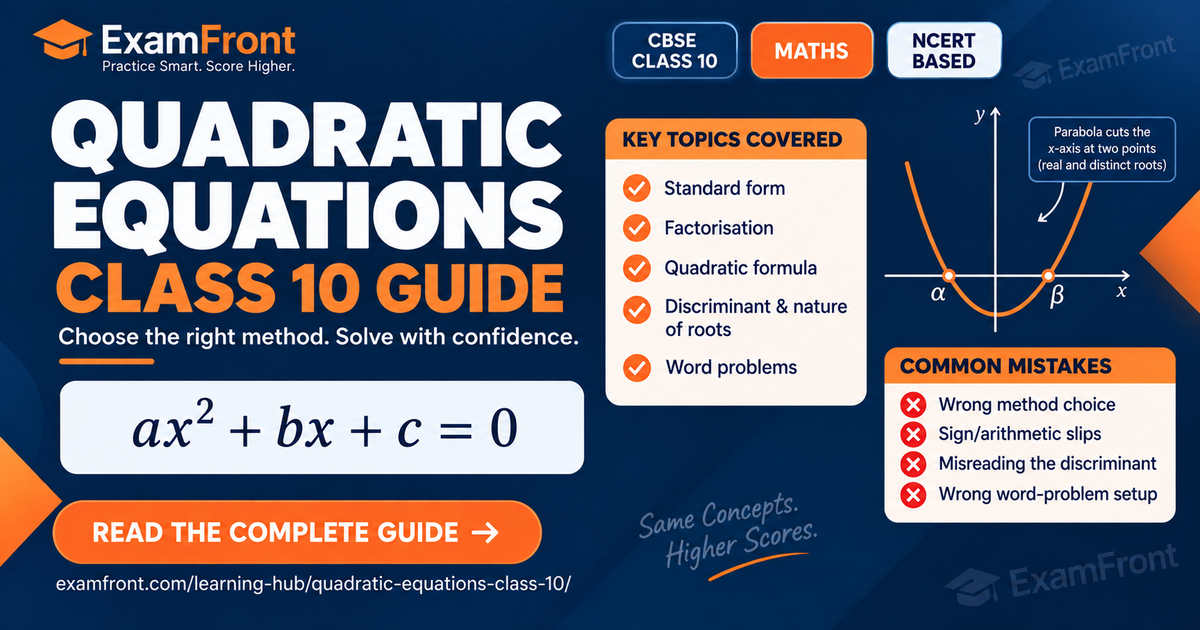
What the Quadratic Equations chapter covers, how CBSE tests it, the mistakes to avoid, and how to turn it into strong marks.
Quadratic Equations is one of the most important chapters in Class 10 Maths — high-yield, heavily tested, and a genuine turning point in your algebra. It sits in the Algebra unit (the paper’s biggest), it connects backward to Polynomials and forward to almost everything, and the board tests it every single year. Master it and you’ve secured some of the most reliable marks in the paper. This guide orients you on what it covers, how it’s tested, the traps, and how to master it.
Chapter snapshot
| Unit | Algebra |
| Official unit weightage | 20 marks (CBSE assigns marks per unit, not per chapter) |
| Difficulty | Moderate ⭐⭐⭐☆☆ |
| Practice priority | Very high (heavily tested, foundational) |
| Prerequisites | Polynomials, factorisation, basic algebra |
| Estimated study time | 3–4 focused sessions |
(Difficulty and study time are a preparation guide, not official CBSE figures.)
What this chapter covers
Quadratic Equations builds on a set of connected, powerful ideas:
- Standard form — recognising and writing a quadratic equation as ax² + bx + c = 0.
- Solving by factorisation — finding roots by splitting the middle term.
- Solving by the quadratic formula — the reliable method that works for any quadratic.
- The discriminant and nature of roots — using b² − 4ac to decide whether roots are real, equal, or not real.
- Word problems — translating real situations into quadratic equations and solving them, which starts with forming the equation correctly.
The chapter rewards knowing which method to reach for — that judgement is much of the skill.
The two things you must know cold
Everything in this chapter runs through two pieces of algebra. Learn them to the point where you can write them without thinking, because almost every mark in the chapter passes through one of them.
The quadratic formula. For any ax² + bx + c = 0 with a ≠ 0:
x = (−b ± √(b² − 4ac)) / 2a
It always works. Factorisation is faster when it works, but the formula never fails you, so it is the method to fall back on the moment splitting the middle term starts to feel like guesswork.
The discriminant. The quantity under the root, D = b² − 4ac, decides the nature of the roots before you solve anything:
| Discriminant | Nature of the roots | What the graph does |
|---|---|---|
| D is positive | Two distinct real roots | The parabola meets the x-axis at two points |
| D is zero | Two equal real roots | The parabola just touches the x-axis |
| D is negative | No real roots | The parabola never meets the x-axis |
Notice the wording in the middle row: two equal real roots, not “one root”. CBSE marks that distinction, and writing “one root” is one of the cheapest marks to lose in the whole chapter.
Why this chapter matters
Quadratic Equations is one of the highest-return chapters you’ll study:
Polynomials → Quadratic Equations → Coordinate Geometry → Higher Algebra
It draws on Polynomials and feeds forward into graphs, coordinate geometry, and the algebra of higher classes. Because it’s tested reliably and heavily, and because its methods recur throughout maths, time spent mastering this chapter pays back more than almost any other in the paper.
How much is Quadratic Equations worth?
Quadratic Equations is part of the Algebra unit, worth 20 marks — the highest-weighted unit in the paper (see the unit-wise weightage guide). CBSE assigns weightage by unit, not by individual chapter, so this chapter contributes to that 20-mark total rather than carrying a fixed figure of its own. In practice, it’s one of the most frequently and thoroughly tested chapters in that unit — which makes it a priority target.
How CBSE tests Quadratic Equations
The board tests the same core skills in familiar formats:
| Common question type | Skill tested |
|---|---|
| Solve by factorisation | Concept |
| Solve using the quadratic formula | Procedure |
| Find the nature of roots (discriminant) | Reasoning |
| Word problem forming a quadratic | Application |
These appear as MCQs, short-answer, and full long-answer questions — including case-study and word-problem forms. The wording changes yearly; the skills repeat (the idea behind analysing previous year questions).
Common mistakes in Quadratic Equations
A few classic traps cost students marks here:
- Choosing the wrong method — attempting to factorise something that needs the formula, and wasting time.
- Sign and arithmetic slips in the formula — especially under the square root, where b² − 4ac errors are common.
- Misreading the discriminant — muddling the conditions for real, equal, and non-real roots.
- Word-problem translation errors — setting up the wrong equation from the situation (the hardest part is often the setup, not the solving).
Many of these are method-selection and calculation mistakes — exactly the kind the examfront Mistake Framework helps you identify and fix.
Where this sits in the NCERT and CBSE syllabus
NCERT sets the scope. Quadratic Equations is Chapter 4 of the NCERT Class 10 Maths textbook, and the rationalised chapter runs across four short sections:
| Section | What it covers | Exercise |
|---|---|---|
| 4.1 Introduction | Sets the scene | (no exercise) |
| 4.2 Quadratic Equations | Standard form; representing situations | Exercise 4.1 — 2 questions |
| 4.3 Solution by Factorisation | Splitting the middle term | Exercise 4.2 — 6 questions |
| 4.4 Nature of Roots | The discriminant, and the formula in use | Exercise 4.3 — 5 questions |
Two things in that table trip students up. First, the section numbers and the exercise numbers do not line up — §4.2 gives you Exercise 4.1, §4.3 gives you Exercise 4.2, and so on, because §4.1 is a bare introduction with no exercise attached. If a teacher says “do Exercise 4.2”, they mean the factorisation set, not the standard-form set. Second, the whole chapter is three exercises and thirteen questions — which sounds small until you notice that Exercise 4.1’s second question alone contains four full word problems.
What was removed. Completing the square, which used to carry its own exercise, is gone from the rationalised chapter. Older textbooks and older solution sites still print it, so if you are working from a second-hand book, check the “Rationalised” watermark before you spend an evening on an exercise the board will not ask you. What remains, and what the exam expects, is factorisation and the quadratic formula — which is exactly why reading the NCERT chapter properly before touching a reference book is worth the hour.
CBSE sets the shape. The paper is 80 theory marks plus 20 internal assessment, 38 questions across five sections in three hours, with no overall choice (the full picture is in the exam pattern guide). Quadratic Equations sits inside the Algebra unit, 20 of those 80 marks — the largest of the seven units. You will meet the chapter in almost every question format the paper uses: a 1-mark MCQ asking for the nature of the roots, a 2-mark question asking for a value of k, a 3-mark solve-this, and a 5-mark word problem. Be wary of chapter-wise percentage tables you find online — CBSE publishes marks by unit, and every chapter-level figure circulating is an unofficial estimate.
How it is actually asked. Almost always as a descriptive question, which means the working is the answer. A discriminant question that ends in a bare “no real roots” with no D = b² − 4ac line will not earn full marks; a word problem that finds x = 6 and quietly drops x = −8 without saying why has thrown away the rejection mark. Write the step that shows the decision.
Skills you’ll build
Master this chapter and you’ll be able to:
- ✓ Solve any quadratic by factorisation or the formula, and pick the right one
- ✓ Use the discriminant to determine the nature of the roots
- ✓ Translate word problems into quadratic equations and solve them
- ✓ Recognise and write quadratics in standard form
Your roadmap to full marks
Understanding the methods is quick; mastering Quadratic Equations comes from practice — especially building the instinct for which method to use and getting fast, accurate execution of the formula. Word problems in particular reward repetition, because the setup skill only comes from seeing many varied situations.
That’s where examfront turns understanding into marks. You get targeted, chapter-wise adaptive practice across every question type — factorisation, formula, discriminant, and word problems — with instant feedback that pinpoints exactly where you slip (wrong method? a sign error under the root? a faulty setup?) so you fix it fast. The adaptive practice serves the right questions at the right level, and mistake-tracking reveals your patterns. Practise Quadratic Equations on examfront and lock in these high-value marks.
Before moving on
Before you move to the next chapter, make sure you can:
- ✓ Solve a quadratic by both factorisation and the formula
- ✓ Use the discriminant to find the nature of the roots
- ✓ Form and solve a quadratic from a word problem
- ✓ Choose the most efficient method for a given equation
Continue your journey
← Previous: Polynomials · Next: Arithmetic Progressions →
Or browse the full chapter list to plan your path.
📄 Download the Quadratic Equations Class 10 summary (2-page PDF) — the formula, the discriminant table, and worked NCERT questions on one printable sheet.
Frequently asked questions
Is Quadratic Equations an important chapter in Class 10 Maths? Very — it’s part of the Algebra unit (20 marks, the highest), it’s tested reliably every year, and its methods recur throughout later maths. It’s one of the highest-return chapters to master.
What are the main topics in Quadratic Equations Class 10? Standard form, solving by factorisation, solving by the quadratic formula, the discriminant and nature of roots, and word problems that form quadratic equations.
Why do students lose marks in Quadratic Equations? Often through choosing the wrong solving method, sign or arithmetic slips in the formula, misreading the discriminant conditions, or setting up word problems incorrectly.
How do I get full marks in Quadratic Equations? Practise both solving methods until choosing between them is instinctive, master the discriminant, and do plenty of word problems so the setup becomes second nature — showing complete working for method marks.
Is Quadratic Equations part of the NCERT and CBSE Class 10 syllabus? Yes. It is Chapter 4 of the NCERT Class 10 Maths textbook and sits in CBSE’s Algebra unit, worth 20 of the 80 theory marks. The rationalised chapter has three exercises — 4.1, 4.2 and 4.3 — and completing the square, which used to have its own exercise, was removed. Factorisation and the quadratic formula are the two methods the exam expects.
Turn Quadratic Equations into strong marks. Practise on examfront →