Solving Quadratic Equations by Factorisation (Class 10)
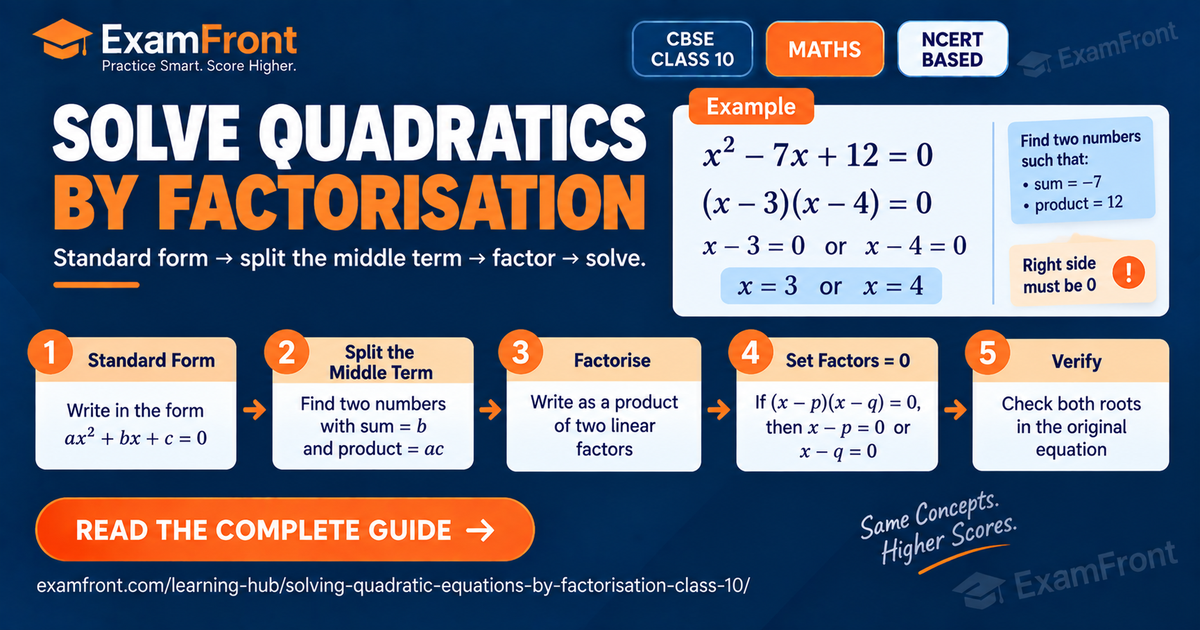
In one line: to solve a quadratic equation by factorisation, write it in standard form ax² + bx + c = 0, split the middle term so the left side breaks into two linear factors, then set each factor equal to zero — the two values of x you get are the roots of the equation.
A root of the quadratic equation ax² + bx + c = 0 (with a ≠ 0) is a real number α for which aα² + bα + c = 0. In other words, a root is a value of x that makes the equation true. Because a quadratic polynomial has at most two zeroes, a quadratic equation has at most two roots — and the roots of the equation ax² + bx + c = 0 are exactly the same values as the zeroes of the polynomial ax² + bx + c.
The whole method rests on one simple fact called the zero-product rule: if the product of two quantities is zero, at least one of them must be zero. So once you write the equation as (linear factor) × (linear factor) = 0, each factor hands you one root. This guide shows you how to do that reliably, including the trickier cases where the coefficient of x² is not 1 and where both roots turn out to be equal.
🎬 Watch — 30-sec Short: Can you spot the root in 10 seconds? 👀
What is a root of a quadratic equation?
A root (also called a solution) of the quadratic equation ax² + bx + c = 0 is any real number that satisfies the equation — substituting it for x makes the left-hand side exactly 0.
Worked check: is 2 a root of x² − 5x + 6 = 0?
Substitute x = 2: (2)² − 5(2) + 6 = 4 − 10 + 6 = 0. Yes — 2 is a root.
Is 1 a root of the same equation? Substitute x = 1: 1 − 5 + 6 = 2 ≠ 0. No — 1 is not a root.
Two facts worth memorising:
- Roots = zeroes. The roots of the equation ax² + bx + c = 0 and the zeroes of the polynomial ax² + bx + c are the same numbers. If you studied zeroes of a polynomial in Chapter 2, you already know what a root is.
- At most two roots. A quadratic polynomial has at most two zeroes, so a quadratic equation has at most two roots.
Substitution checks like the one above appear as 1-mark questions in the board exam. If quick checks like these slow you down, a few rounds of Topic Practice on examfront will make them automatic.
The zero-product rule — why factorisation works
The zero-product rule states: if p × q = 0, then p = 0 or q = 0 (or both).
That is the entire engine of this method. If we can rewrite ax² + bx + c = 0 as
(linear factor 1) × (linear factor 2) = 0,
then each factor gives one root when set to zero. Important condition: the rule only works when the product equals exactly zero. If (x − 3)(x − 4) = 2, you cannot say x − 3 = 2 or x − 4 = 2 — the equation must first be rearranged into standard form with 0 on the right.
How to split the middle term
Splitting the middle term means rewriting the middle term bx as a sum of two terms so the quadratic factorises by grouping.
The rule: for ax² + bx + c, find two numbers whose sum is b and whose product is a × c. Then write bx using those two numbers and factor by grouping.
Worked Example 1 — coefficient of x² is 1
Solve x² − 7x + 12 = 0 by factorisation.
Here a = 1, b = −7, c = 12, so a × c = 12. We need two numbers with sum −7 and product 12: they are −3 and −4.
x² − 7x + 12 = x² − 3x − 4x + 12 = x(x − 3) − 4(x − 3) = (x − 3)(x − 4)
So (x − 3)(x − 4) = 0, which gives x − 3 = 0 or x − 4 = 0.
Roots: x = 3 and x = 4.
Verify: 3² − 7(3) + 12 = 9 − 21 + 12 = 0 ✓ and 4² − 7(4) + 12 = 16 − 28 + 12 = 0 ✓
Worked Example 2 — coefficient of x² is not 1
Solve 3x² + 10x − 8 = 0 by factorisation.
Here a = 3, b = 10, c = −8, so a × c = −24. We need two numbers with sum 10 and product −24: they are 12 and −2.
3x² + 10x − 8 = 3x² + 12x − 2x − 8 = 3x(x + 4) − 2(x + 4) = (x + 4)(3x − 2)
So (x + 4)(3x − 2) = 0, which gives x + 4 = 0 or 3x − 2 = 0.
Roots: x = −4 and x = 2/3.
Verify x = 2/3: 3(4/9) + 10(2/3) − 8 = 4/3 + 20/3 − 24/3 = 0 ✓
Notice the fraction root 2/3 — factorisation handles fractional roots perfectly, as long as you solve each linear factor carefully (3x − 2 = 0 gives x = 2/3, not x = 3/2).
🎬 Watch — 30-sec Short: Can you split the middle term correctly? 🧮
Worked Example 3 — rearrange first, then factorise
Solve x(2x + 5) = 3.
The right side is not 0, so the zero-product rule cannot be used yet. Expand and rearrange into standard form:
2x² + 5x − 3 = 0
Now a × c = −6; two numbers with sum 5 and product −6 are 6 and −1.
2x² + 6x − x − 3 = 2x(x + 3) − 1(x + 3) = (x + 3)(2x − 1)
So x + 3 = 0 or 2x − 1 = 0. Roots: x = −3 and x = 1/2.
This “rearrange first” habit is exactly the simplify first, judge after rule from the standard-form article — the two skills always work together in exam questions.
Repeated roots — when both factors are the same
Sometimes the two linear factors turn out identical. The equation then has a repeated root (also called equal roots): one value that occurs twice.
Worked Example 4 — equal roots
Solve 4x² − 12x + 9 = 0.
a × c = 36; two numbers with sum −12 and product 36 are −6 and −6.
4x² − 6x − 6x + 9 = 2x(2x − 3) − 3(2x − 3) = (2x − 3)(2x − 3) = (2x − 3)²
So 2x − 3 = 0 twice. Roots: x = 3/2 and x = 3/2 (a repeated root).
🎬 Watch — 30-sec Short: Can you spot the perfect-square quadratic? 👀
In the board exam, write both roots — “the roots are 3/2 and 3/2” — rather than “the root is 3/2”. This idea returns later in the chapter under nature of roots (NCERT Exercise 4.3), where equal roots connect to the discriminant.
Equations with radical coefficients (like ones involving √3 or √5) also often hide repeated roots and are a favourite tricky variant in exams — the full set of these harder factorisations is ready for you inside examfront’s Chapter Practice, with Mistake Identification showing you exactly which step went wrong when a split fails.
Quick method summary
| Step | What you do | Watch out for |
|---|---|---|
| 1 | Write the equation in standard form ax² + bx + c = 0 | Right side must be exactly 0 |
| 2 | Find two numbers: sum = b, product = a × c | Use a × c, not just c |
| 3 | Split bx and factorise by grouping | Both groups must share the same bracket |
| 4 | Set each factor to 0 and solve | 3x − 2 = 0 → x = 2/3, mind the division |
| 5 | Verify by substituting back | Catches sign slips before the examiner does |
A short timed set on this 5-step routine — mixed a = 1 and a ≠ 1 cases — is available as Topic Practice on examfront, and your Progress Tracking will show how your speed improves attempt over attempt.
Where this sits in the NCERT and CBSE syllabus
NCERT sets the questions. Factorisation is taught in Chapter 4, Quadratic Equations, and its practice questions are Exercise 4.2 — six questions. Watch the numbering: the chapter has three exercises (4.1 represent and check, 4.2 factorisation, 4.3 nature of roots, thirteen questions in all), so students who go looking for factorisation in “Exercise 4.3” land on the discriminant instead. The NCERT Class 10 Maths guide maps every chapter the same way.
Every case on this page is in Exercise 4.2:
- Q1 gives five equations to factorise. Part (iii), √2x² + 7x + 5√2 = 0, is the radical-coefficient type: a × c = 10, so split 7x as 5x + 2x to get (√2x + 5)(x + √2) = 0 and roots −5/√2 and −√2.
- Q1 (iv) and (v) — 2x² − x + 1/8 = 0 and 100x² − 20x + 1 = 0 — both have equal roots (1/4 twice and 1/10 twice), exactly the Worked Example 4 case.
- Q2 to Q6 are situations to solve: marbles and toys in Q2, then two numbers with sum 27 and product 182, consecutive positive integers whose squares add to 365, a right triangle with hypotenuse 13 cm, and pottery articles costing Rs 90 in total. Each ends with roots to check against the story, and often one to reject, which is the skill in quadratic equation word problems.
CBSE sets what is examined. The 2026-27 CBSE curriculum lists, verbatim: “Standard form of a quadratic equation ax² + bx + c = 0, (a ≠ 0). Solutions of quadratic equations (only real roots) by factorization, and by using quadratic formula.” So factorisation and the quadratic formula are the two methods you are examined on — completing the square was removed in the rationalisation, and older editions and some solution sites still carry it. A practical rule: if a quick scan of the factor pairs of a × c finds no pair with sum b, stop and use the formula from the Quadratic Equations chapter guide rather than forcing a split. Full wording for every unit is on the CBSE Class 10 Maths syllabus page.
CBSE sets the marks by unit, not by chapter. Quadratic Equations sits in Algebra, 20 of the 80 theory marks (Number Systems 6, Algebra 20, Coordinate Geometry 6, Geometry 15, Trigonometry 12, Mensuration 10, Statistics & Probability 11). Chapter-wise percentages you see online are unofficial estimates. The paper itself is 38 questions, 80 marks, three hours — see the CBSE Class 10 Maths exam pattern.
How it is asked. A factorisation can be a whole short question (“find the roots of…”) or one step inside a longer word problem or case study. Either way the split line, the two factors and the “x − 3 = 0 or x − 4 = 0” line are the working the examiner reads — how CBSE maths answers are marked explains why writing them out earns method marks even if a final sign slips.
Key Takeaways
- A root of ax² + bx + c = 0 is a value of x that makes the equation true; a quadratic equation has at most two roots.
- Roots of the equation = zeroes of the polynomial — same numbers, different names.
- Factorisation works because of the zero-product rule: a product is 0 only if a factor is 0 — so the right side must be exactly 0 first.
- To split the middle term of ax² + bx + c, find two numbers with sum b and product a × c.
- If both factors are identical, the equation has equal (repeated) roots — state the root twice.
- In NCERT this is Exercise 4.2, and CBSE examines factorisation and the quadratic formula — completing the square is no longer examined.
Quick Facts
- Standard form required before factorising: ax² + bx + c = 0, a ≠ 0.
- Splitting rule: two numbers, sum = b, product = ac.
- Maximum number of roots of a quadratic equation: 2.
- A root is verified by substitution: LHS must equal 0.
- Repeated root example: 4x² − 12x + 9 = 0 → (2x − 3)² = 0 → x = 3/2 (twice).
- Factorisation is one of the methods for solving quadratic equations in CBSE Class 10; it belongs to the Algebra unit of the board blueprint.
- NCERT Chapter 4 exercises: 4.1 represent and check · 4.2 factorisation (6 questions) · 4.3 nature of roots.
- CBSE 2026-27 methods examined: factorisation and the quadratic formula, real roots only.
Common Mistakes
- Applying the zero-product rule when the right side isn’t 0 — e.g. from (x − 3)(x − 4) = 2 concluding x = 5 or x = 6. Always rearrange to standard form first.
- Using product = c instead of product = a × c when a ≠ 1 — the split fails and students think the equation “can’t be factorised”.
- Sign slips while splitting — writing −7x = −3x − 4x correctly but then factorising x² − 3x − 4x + 12 with a wrong sign in the second group.
- Inverting the fraction when solving a factor — 3x − 2 = 0 gives x = 2/3, not 3/2.
- Reporting only one root for a perfect square — (2x − 3)² = 0 has equal roots 3/2 and 3/2; say so explicitly.
(Full explanations with memory tips are in the Common Mistakes section below the article on examfront, and Mistake Identification inside the platform flags which of these five you personally tend to make.)
Take the summary with you
Download the 2-page Solving Quadratic Equations by Factorisation summary (PDF) → — the splitting rule, the five-step method, equal roots, and NCERT Exercise 4.2 questions worked in full on one printable sheet.
FAQ
What is a root of a quadratic equation in Class 10 Maths? A root of ax² + bx + c = 0 is a real number that makes the left-hand side zero on substitution. For example, 2 is a root of x² − 5x + 6 = 0 because 4 − 10 + 6 = 0. A quadratic equation has at most two roots.
How do you solve a quadratic equation by factorisation step by step? Write it in standard form, split the middle term using two numbers whose sum is b and product is ac, factorise by grouping into two linear factors, then set each factor to zero and solve.
Are roots of a quadratic equation the same as zeroes of a quadratic polynomial? Yes — the roots of ax² + bx + c = 0 and the zeroes of the polynomial ax² + bx + c are exactly the same values.
Why do we set each factor equal to zero? Because of the zero-product rule: if a product of two quantities is zero, at least one quantity must be zero. The rule needs the right-hand side to be exactly 0.
Can a quadratic equation have only one root? When both factors are identical, the equation has a repeated (equal) root — one value occurring twice, like x = 3/2 for 4x² − 12x + 9 = 0. We describe this as two equal roots.
Is solving quadratic equations by factorisation part of the NCERT and CBSE Class 10 syllabus? Yes. It is in NCERT Chapter 4, and its questions are Exercise 4.2 (six questions) — not Exercise 4.3, which is nature of roots. The CBSE 2026-27 syllabus examines solutions “by factorization, and by using quadratic formula”; completing the square was removed. Quadratic Equations is part of Algebra, worth 20 of the 80 theory marks.
Related Concepts
- Standard form of a quadratic equation — the form you must reach before factorising.
- Forming quadratic equations from word problems — how the equations you solve here are built.
- Zeroes of a polynomial — the Chapter 2 idea that “root” renames.
- Relationship between zeroes and coefficients — a quick sanity check on your roots.
- Quadratic Equations Class 10 chapter guide — the full chapter picture.
Next step: once the mechanics feel smooth, move on to quadratic equation word problems — where you form the equation and solve it — and try a Chapter Quiz on examfront to see your Exam Readiness for Chapter 4 grow.