Nature of Roots of a Quadratic Equation (Class 10)
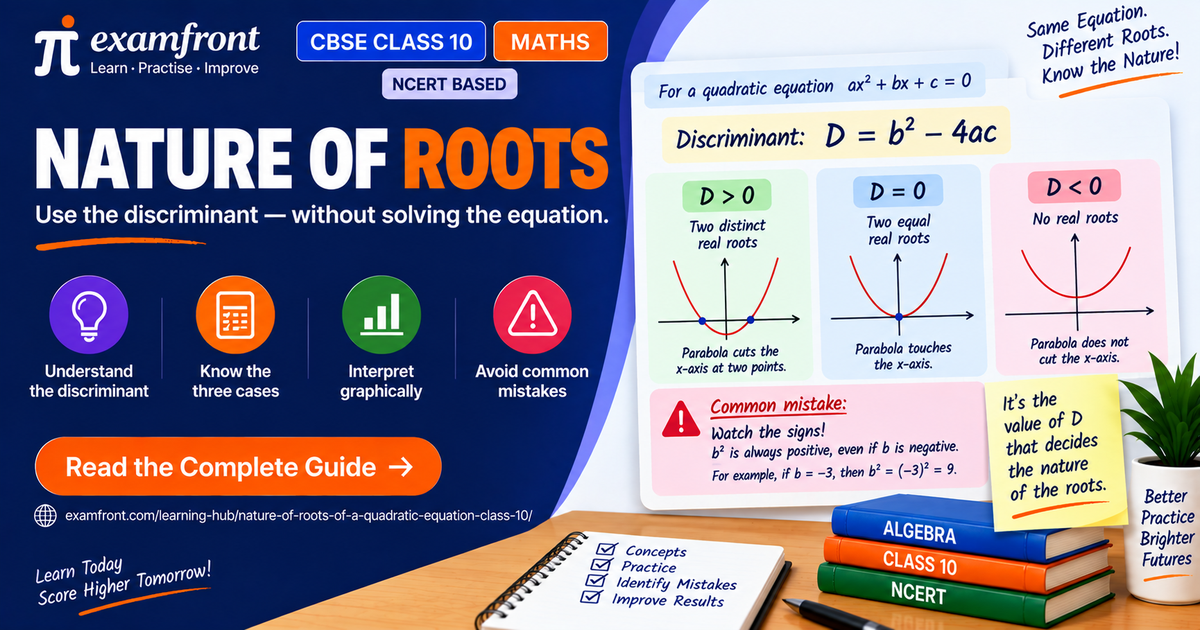
In one line: to find the nature of roots of a quadratic equation ax² + bx + c = 0, calculate its discriminant D = b² − 4ac and read its sign — D > 0 means two distinct real roots, D = 0 means two equal real roots, and D < 0 means no real roots.
The discriminant is the expression b² − 4ac — the part that sits under the square-root sign in the quadratic formula. Its great power is that it tells you what kind of roots an equation has without actually solving it. You just plug in a, b and c, work out b² − 4ac, and look at whether the answer is positive, zero, or negative.
Here is the whole idea. The roots of ax² + bx + c = 0 come from the quadratic formula x = (−b ± √(b² − 4ac)) / 2a. Everything depends on the number inside the square root, b² − 4ac: if it is positive you get two different real answers (from the ± ), if it is zero the ± disappears and both answers collapse into one repeated value, and if it is negative you cannot take the square root of a negative number, so there are no real roots. The rest of this guide works through each case with examples and shows how to use the D = 0 condition to find unknown values.
🎥 5-second challenge: How many real roots does this quadratic have? 🤔 Work out the discriminant, then comment your answer.
What is the discriminant?
The discriminant of the quadratic equation ax² + bx + c = 0 (with a ≠ 0) is the number
D = b² − 4ac.
It is called the discriminant because it lets us discriminate (tell apart) the three possible cases for the roots. It is exactly the quantity under the square root in the quadratic formula:
x = (−b ± √(b² − 4ac)) / 2a.
Because you cannot take the real square root of a negative number, the sign of b² − 4ac controls everything about the roots. Define your terms carefully before using the formula: a is the coefficient of x², b is the coefficient of x, and c is the constant term, all taken from the standard form. The condition a ≠ 0 is part of the definition, not a footnote — if a is zero the x² term vanishes, the equation is not quadratic, and there is no discriminant to compute. If your equation is not yet in standard form, rearrange it first — see standard form of a quadratic equation.
The three cases: what b² − 4ac tells you
A quadratic equation ax² + bx + c = 0 has one of exactly three types of roots, decided entirely by the discriminant:
| Discriminant D = b² − 4ac | Nature of roots | Meaning |
|---|---|---|
| D > 0 | Two distinct real roots | The parabola cuts the x-axis at two points |
| D = 0 | Two equal real roots (coincident) | The parabola just touches the x-axis at one point; both roots = −b/2a |
| D < 0 | No real roots | The parabola never meets the x-axis |
Keep the wording precise in the exam: “two equal real roots” (not “one root”) when D = 0, and “no real roots” (not “no roots”) when D < 0. These exact phrases earn the marks. The link between roots and where the graph meets the x-axis mirrors what you saw for polynomials in geometrical meaning of zeroes of a polynomial.
The 3 steps to find the nature of roots
- Write standard form. Rearrange the equation to ax² + bx + c = 0 and read off a, b, c (with correct signs).
- Compute the discriminant. Calculate D = b² − 4ac carefully — mind the signs, since b² is never negative but −4ac can be either sign.
- Read the sign. D > 0 → two distinct real roots; D = 0 → two equal real roots; D < 0 → no real roots. If real roots exist and you need them, use the quadratic formula.
Exam tip: b² means (b)², so a negative b still gives a positive b². For b = −4, b² = 16, not −16. This single sign-care point prevents most discriminant errors.
Worked example 1 — two distinct real roots (D > 0)
Find the nature of the roots of 2x² − 6x + 3 = 0, and find them if they are real.
- Step 1 (standard form): a = 2, b = −6, c = 3.
- Step 2 (discriminant): D = b² − 4ac = (−6)² − 4(2)(3) = 36 − 24 = 12.
- Step 3 (read the sign): D = 12 > 0, so the equation has two distinct real roots.
- Find them: x = (−b ± √D) / 2a = (6 ± √12) / 4 = (6 ± 2√3) / 4 = (3 ± √3) / 2.
So the roots are (3 + √3)/2 ≈ 2.37 and (3 − √3)/2 ≈ 0.63 — two different real numbers. Notice these roots are irrational, which is exactly why factorisation would not have worked neatly here and the quadratic formula is the right tool. This equation is not a made-up one: it is NCERT Exercise 4.3, Question 1(iii).
Worked example 2 — two equal real roots (D = 0)
Find the nature of the roots of 9x² − 6x + 1 = 0.
- Step 1 (standard form): a = 9, b = −6, c = 1.
- Step 2 (discriminant): D = (−6)² − 4(9)(1) = 36 − 36 = 0.
- Step 3 (read the sign): D = 0, so the equation has two equal real roots.
- The repeated root: x = −b / 2a = 6 / 18 = 1/3 (counted twice).
Both roots are 1/3. When D = 0, the ± in the formula adds and subtracts zero, so the two roots merge into one value. This is the same “repeated root” idea you meet when a quadratic factors as a perfect square like (3x − 1)² = 0.
Worked example 3 — no real roots (D < 0)
Find the nature of the roots of 2x² − 4x + 3 = 0.
- Step 1 (standard form): a = 2, b = −4, c = 3.
- Step 2 (discriminant): D = (−4)² − 4(2)(3) = 16 − 24 = −8.
- Step 3 (read the sign): D = −8 < 0, so the equation has no real roots.
There is no real number whose square is −8, so the quadratic formula cannot give a real answer. In graph terms, the parabola y = 2x² − 4x + 3 floats entirely above the x-axis and never touches it.
Using the D = 0 condition to find an unknown
A favourite exam question gives you an equation with an unknown letter (often k) and says the roots are equal — your job is to use b² − 4ac = 0.
Find the value of k for which kx(x − 2) + 6 = 0 has two equal roots.
- Standard form: expand → kx² − 2kx + 6 = 0, so a = k, b = −2k, c = 6.
- Equal-roots condition: D = 0 → (−2k)² − 4(k)(6) = 0 → 4k² − 24k = 0 → 4k(k − 6) = 0.
- Solve for k: k = 0 or k = 6. But k ≠ 0 (otherwise it is not a quadratic — the x² term vanishes), so k = 6.
Check: with k = 6 the equation is 6x² − 12x + 6 = 0, i.e. 6(x − 1)² = 0, whose equal roots are x = 1. Rejecting k = 0 is the marks-earning step — always discard a value that destroys the x² term. This is NCERT Exercise 4.3, Question 2(ii); part (i) of the same question, 2x² + kx + 3 = 0, is worked in the summary PDF below and has two valid answers rather than one. Work more of these “find k” variations (including the D > 0 and D < 0 conditions) on examfront’s Topic Practice, where the Practice Companion checks each condition you set up.
Using the discriminant to test if a design is possible
The discriminant also answers real-world “is it possible?” questions: form the quadratic, then check whether real roots exist.
Is it possible to design a rectangular mango grove whose length is twice its breadth and whose area is 800 m²?
Let the breadth be x m, so the length is 2x m. Area = length × breadth: 2x · x = 800 → 2x² = 800 → x² − 400 = 0. Here a = 1, b = 0, c = −400, so D = 0² − 4(1)(−400) = 1600 > 0. Real roots exist, so the design is possible: x² = 400 gives x = 20 (reject −20), so breadth = 20 m and length = 40 m. When a real-life problem gives D < 0, it means the design is not possible — a genuinely useful answer. The first half of a question like this is pure translation, so if the set-up is where you lose time, start with forming quadratic equations from word problems. For the full set of feasibility and word problems, see quadratic equation word problems and practise the harder ones inside examfront.
🎥 Try it yourself: Can you find the value of k for equal roots? 🔑 Set b² − 4ac = 0 and see how many values you get.
Quick method summary
| Step | What you do | Example (2x² − 4x + 3 = 0) |
|---|---|---|
| 1. Standard form | Identify a, b, c | a = 2, b = −4, c = 3 |
| 2. Discriminant | D = b² − 4ac | 16 − 24 = −8 |
| 3. Read the sign | > 0 / = 0 / < 0 | −8 < 0 → no real roots |
We have covered the core of the nature-of-roots topic here. Trickier “find k” problems that use D > 0 or D < 0, feasibility questions where the answer turns out to be not possible, and longer application questions are the natural next step — work through the complete graded set and get personalised help where you slip on examfront, where Mistake Identification points to the exact sign or substitution step that tripped you.
🎥 Spot check: Can you identify the type of roots from the discriminant? 🤔 Read the sign of D and decide — comment your reasoning.
Where this sits in the NCERT and CBSE syllabus
NCERT sets the scope. The nature of roots is the last teaching section of Chapter 4, Quadratic Equations, coming after the factorisation section, and it is drilled in Exercise 4.3, which has 5 questions. The chapter now has three exercises in all: Exercise 4.1 (2 questions — is this equation quadratic, and represent this situation), Exercise 4.2 (6 questions — solve by factorisation) and Exercise 4.3 (5 questions — nature of roots and feasibility). Note the offset that trips students up: the section on nature of roots is the fourth section of the chapter but its exercise is numbered 4.3, because Section 4.1 is the introduction and carries no exercise. The same one-behind pattern shows up in other chapters too — see the Class 10 Maths chapter list — so it is this textbook’s habit rather than a misprint. One deletion matters here: solving a quadratic equation by completing the square was removed in the rationalisation, so factorisation and the quadratic formula are the only two algebraic methods you will be examined on — do not spend revision time on completing the square. If you are working straight from the textbook, how to study NCERT maths in Class 10 and the NCERT Class 10 Maths guide show how to use the exercises in order.
CBSE sets the wording, and it is unusually helpful here. The syllabus entry for this chapter reads: “Standard form of a quadratic equation ax² + bx + c = 0, (a ≠ 0). Solutions of quadratic equations (only real roots) by factorization, and by using quadratic formula. Relationship between discriminant and nature of roots.” Two things follow directly. The bracket (a ≠ 0) is in the syllabus itself, which is why rejecting k = 0 in a “find k” question is a real marks-earning step and not pedantry. And “only real roots” is why “no real roots” is a complete and correct Class 10 answer when D < 0 — you are not expected to say anything about imaginary or complex roots, and writing about them earns nothing.
CBSE sets the shape of the paper. The theory paper is 80 marks over 38 questions in three hours, with no overall choice, split as Section A 20 × 1, B 5 × 2, C 6 × 3, D 4 × 5 and E 3 × 4 = 80; internal assessment adds 20 for a total of 100. The full breakdown is in the CBSE Class 10 Maths exam pattern and the syllabus guide.
CBSE sets priority by unit, not by chapter. The seven units carry Number Systems 6, Algebra 20, Coordinate Geometry 6, Geometry 15, Trigonometry 12, Mensuration 10 and Statistics & Probability 11 = 80. Quadratic Equations sits inside Algebra, the largest unit at 20 marks, alongside Polynomials, Pair of Linear Equations and Arithmetic Progressions — which is exactly why a topic you can settle in two lines is worth securing. Be careful with the chapter-wise percentage tables and pie charts you will find online: CBSE publishes marks per unit only, and every chapter-level figure is an unofficial estimate. See unit-wise weightage for what is actually published.
How this topic is actually asked. Most often as a 1-mark Section A objective (“the nature of the roots of … is”) or a 2-mark VSA (“find the discriminant and hence the nature of the roots”). The “find k for equal roots” variation is usually 2 or 3 marks, and the feasibility questions — the mango grove, the park, the two friends’ ages — appear as 3-markers in Section C or inside a case study. In every one of those, the line where you write D = b² − 4ac and substitute is itself a mark: an answer that names the nature but never shows the discriminant is not a complete answer.
Key Takeaways
- The discriminant is D = b² − 4ac; its sign decides the nature of the roots without solving the equation.
- D > 0 → two distinct real roots; D = 0 → two equal real roots (both = −b/2a); D < 0 → no real roots.
- The discriminant is the part under the square root in the quadratic formula x = (−b ± √(b² − 4ac)) / 2a.
- For equal roots, set b² − 4ac = 0 — this is the go-to condition for “find the value of k” questions.
- Always compute b² as a non-negative value, and in word problems reject any value (like k = 0) that removes the x² term.
- This is NCERT Chapter 4, Exercise 4.3 (5 questions), inside Algebra, 20 of the 80 theory marks; CBSE restricts the chapter to real roots only, so “no real roots” is a full answer.
Quick Facts
- Discriminant: D = b² − 4ac, from ax² + bx + c = 0 (a ≠ 0).
- Two distinct real roots: D > 0.
- Two equal real roots: D = 0; repeated root = −b/2a.
- No real roots: D < 0.
- Quadratic formula: x = (−b ± √(b² − 4ac)) / 2a, valid when D ≥ 0.
- Equal-roots condition: b² − 4ac = 0 (used to find unknown coefficients).
- NCERT reference: Chapter 4, Quadratic Equations — nature of roots is the last teaching section, Exercise 4.3, 5 questions.
- Removed in the rationalisation: solving by completing the square — factorisation and the quadratic formula are the only examined algebraic methods.
- Chapter: Quadratic Equations · Class: 10 · Subject: Maths · Board: CBSE · Unit: Algebra (20 of 80).
Common Mistakes
- Squaring a negative b wrongly. For b = −4, b² = 16, not −16. Always treat b² as (b)² — never a negative value.
- Sign slip in −4ac. With c negative (say c = −60), −4ac becomes +240, not −240. Track the sign of the product a×c before multiplying by −4.
- Saying “one root” when D = 0. The correct exam phrase is “two equal real roots.” Write it that way to secure the mark.
- Confusing “no real roots” with “no roots.” When D < 0 the roots are simply not real; say “no real roots,” not “no solution/no roots.”
- Forgetting to reject k = 0. In “find k for equal roots,” a value that makes a = 0 turns the equation non-quadratic and must be discarded — the syllabus itself writes the condition as (a ≠ 0).
- Skipping the discriminant line. Jumping straight to the roots, or writing only “two distinct real roots” with no working, throws away the mark for D = b² − 4ac and the substitution. Write the line even when you can see the answer.
📄 Download the 2-page Nature of Roots summary PDF (Class 10) — the discriminant, the three cases, and three NCERT Exercise 4.3 questions worked in full.
FAQ
Q. How do you find the nature of roots of a quadratic equation? Put the equation in standard form ax² + bx + c = 0 and compute the discriminant D = b² − 4ac. If D > 0 there are two distinct real roots; if D = 0 there are two equal real roots; if D < 0 there are no real roots. You do not need to solve the equation to know the nature of its roots.
Q. What is the discriminant of a quadratic equation? It is the quantity b² − 4ac from ax² + bx + c = 0 — the part under the square root in the quadratic formula. Its sign decides whether the roots are real and distinct, equal, or not real, which is why it is called the discriminant.
Q. What is the condition for a quadratic equation to have equal roots? The discriminant must be zero: b² − 4ac = 0. In that case both roots are equal and each is −b/2a. This condition is commonly used to find an unknown coefficient k that makes the roots equal.
Q. What does it mean when b² − 4ac is negative? It means no real number squared gives that negative value, so the equation has no real roots and its parabola never meets the x-axis. In Class 10 we simply state that the equation has no real roots.
Q. Is the discriminant the same as the quadratic formula? No. The quadratic formula, x = (−b ± √(b² − 4ac)) / 2a, gives the actual roots; the discriminant is only the inside part b² − 4ac. The discriminant tells you the nature of the roots quickly, while the full formula gives their exact values.
Q. Is the nature of roots part of the NCERT and CBSE Class 10 Maths syllabus? Yes. It is the last teaching section of NCERT Class 10 Maths Chapter 4, Quadratic Equations, and it is drilled in Exercise 4.3, which has 5 questions. The CBSE syllabus lists it as “Relationship between discriminant and nature of roots” and restricts the chapter to “Solutions of quadratic equations (only real roots) by factorization, and by using quadratic formula” — so “no real roots” is a complete Class 10 answer, and completing the square is no longer an examinable method after the rationalisation. Quadratic Equations sits inside Unit II Algebra, the largest unit at 20 of the 80 theory marks.
Related Concepts
- Quadratic Equations — Chapter Guide: the full chapter roadmap, including the quadratic formula and all solving methods.
- Solving Quadratic Equations by Factorisation (Class 10): the other main method — best when the equation factors neatly.
- Standard Form of a Quadratic Equation (Class 10): how to get a, b and c right before computing the discriminant.
- Geometrical Meaning of Zeroes of a Polynomial (Class 10): why D decides how many times the parabola meets the x-axis.
Ready to make the discriminant automatic? Work through a full graded set on examfront’s Topic Practice, and let the Practice Companion and Mistake Identification catch your sign and substitution slips before the exam does. Start on examfront →