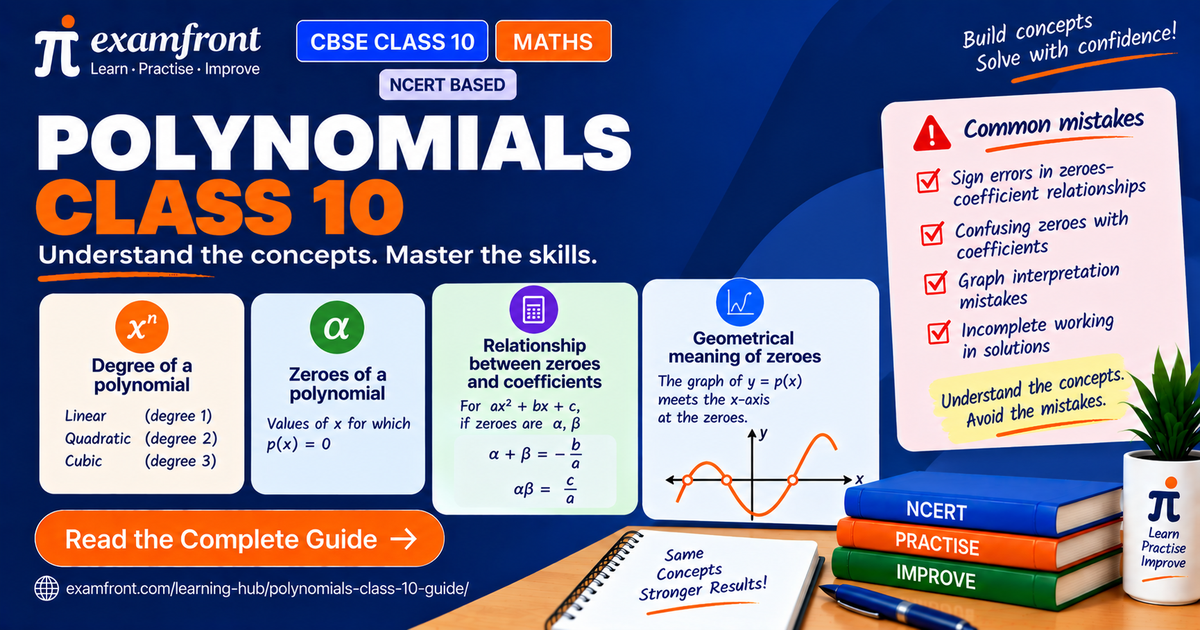
What the Polynomials chapter covers, how CBSE tests it, the mistakes to avoid, and how to turn it into strong marks.
Polynomials is the second chapter of Class 10 Maths, and it sits inside the most important unit in the whole paper — Algebra. It’s a chapter that rewards clear understanding: the concepts are logical and connected, and once they click, the questions become very manageable. This guide orients you on what the chapter covers, how much it’s worth, how the board tests it, the common traps, and how to master it.
Chapter snapshot
| Unit | Algebra |
| Official unit weightage | 20 marks (CBSE assigns marks per unit, not per chapter) |
| Difficulty | Moderate ⭐⭐⭐☆☆ |
| Practice priority | High (foundational for Algebra) |
| Prerequisites | Real Numbers, basic algebra, working with linear expressions |
| Estimated study time | 2–3 focused sessions |
(Difficulty and study time are a preparation guide, not official CBSE figures.)
What this chapter covers
Polynomials builds on a small set of connected ideas:
- Degree of a polynomial — linear, quadratic, cubic, and what the degree tells you.
- Zeroes of a polynomial — the values at which a polynomial equals zero.
- Relationship between zeroes and coefficients — for a quadratic, how the sum and product of the zeroes connect to the coefficients.
- Geometrical meaning of zeroes — what the zeroes look like on a graph (where the curve meets the x-axis).
These ideas link together neatly, which is what makes the chapter satisfying once it clicks.
The one relationship you must know cold
If you memorise nothing else from this chapter, memorise this. For a quadratic polynomial ax² + bx + c with zeroes α and β:
α + β = − b/a and αβ = c/a
Two things make this worth knowing cold. First, it lets you check an answer you found by factorising — which is free marks. Second, CBSE asks it in reverse: given the sum and product, form the quadratic polynomial x² − (sum)x + (product).
Take NCERT’s own Exercise 2.2 Q1(i), x² − 2x − 8. It factorises as (x − 4)(x + 2), so the zeroes are 4 and −2. Now verify: the sum is 4 + (−2) = 2, and −b/a = −(−2)/1 = 2 ✓. The product is 4 × (−2) = −8, and c/a = −8/1 = −8 ✓.
Notice where the sign trap sits: the sum formula carries a minus and the product formula does not. Most lost marks in this chapter come from that one minus sign, not from the factorising.
Why this chapter matters
Polynomials isn’t a standalone topic — it’s a gateway. The ideas here feed directly into much of the maths that follows:
Polynomials → Quadratic Equations → Graphs → Higher Algebra
Get comfortable with zeroes and the zeroes-coefficient relationships now, and the next chapter (Quadratic Equations) and later algebra become far easier. Skipping past Polynomials leaves a gap you’ll feel repeatedly — which is exactly why it’s worth mastering properly.
How much is Polynomials worth?
Polynomials is part of the Algebra unit, worth 20 marks — the highest-weighted unit in the paper (see the unit-wise weightage guide). CBSE assigns weightage by unit, not by individual chapter, so Polynomials contributes to that 20-mark total rather than carrying a fixed figure of its own. What matters for you: it sits in the unit where the most marks live, so strong Algebra fundamentals — starting here — have an outsized effect on your score.
How CBSE tests Polynomials
The board tests the same core skills in familiar formats:
| Common question type | Skill tested |
|---|---|
| Find the zeroes of a polynomial | Concept |
| Form a polynomial from given zeroes | Application |
| Relationship between zeroes & coefficients | Algebra |
| Interpret the graph of a polynomial | Reasoning |
These appear as MCQs, short-answer, and longer questions — the full range of CBSE question types. As always, the exact wording changes but the underlying skills repeat — so master the skills, not specific questions (the idea behind analysing previous year questions).
Common mistakes in Polynomials
A few classic traps cost students marks here:
- Sign errors in the zeroes-coefficient relationships — a single sign slip flips the whole answer. The sum carries the minus; the product does not.
- Confusing zeroes with coefficients — mixing up what the question is actually asking for.
- Graph-interpretation slips — misreading where a curve meets the x-axis, counting turning points instead of crossings, or reading the y-intercept as a zero.
- Incomplete working — jumping to an answer without showing the steps that earn method marks.
Most of these are calculation and presentation mistakes rather than concept gaps — very fixable once you know to watch for them (exactly what the examfront Mistake Framework helps you spot).
Where this sits in the NCERT and CBSE syllabus
NCERT sets the scope. Polynomials is Chapter 2 of the NCERT Class 10 Maths textbook, and after rationalisation it runs to just three sections of content: 2.1 Introduction, 2.2 Geometrical Meaning of the Zeroes of a Polynomial, 2.3 Relationship between Zeroes and Coefficients of a Polynomial, then the Summary. Work from the current edition rather than an older one, and use it the way the NCERT guide recommends — reading the worked examples before the exercises.
Watch the numbering. Section 2.1 is a bare introduction with no exercise attached, so every exercise number sits one behind its section: the geometrical meaning in §2.2 is examined in Exercise 2.1, and the zeroes-coefficient relationship in §2.3 is examined in Exercise 2.2. If a solution site tells you Exercise 2.1 is about coefficients, it has the mapping backwards.
This is the smallest exercise set in the book — and that is a trap. The rationalised chapter has only two exercises and three questions in total: Exercise 2.1 is a single question with six graphs to read, and Exercise 2.2 has two questions with six parts each. Finishing the exercises in an afternoon does not mean you have finished the chapter. It sits in the 20-mark unit, and the exam will ask the same three skills in wordings NCERT never printed.
Two things were removed, and older books still print them. The division algorithm for polynomials (the old Section 2.4 and Exercise 2.3) and the old optional Exercise 2.4 are both out of the syllabus. If your textbook or a solutions website shows an Exercise 2.3 or 2.4 for this chapter, it is the pre-rationalisation edition — skip it. One subtlety worth knowing: the textbook still prints the cubic relationship and a worked Example on it, but it is footnoted “not from the examination point of view”. CBSE examines the relationship for quadratic polynomials only.
CBSE sets what is asked. The 2026-27 curriculum lists the content for Polynomials as exactly two lines — “Zeros of a polynomial” and “Relationship between zeros and coefficients of quadratic polynomials” — with the stated competency that you “develop a relationship between algebraic and graphical methods of finding the zeroes of a polynomial.” Read that competency literally: the board wants you able to move between the picture and the algebra, which is why a graph-reading question and a factorising question are testing the same idea.
Where the marks sit. Algebra carries 20 of the 80 theory marks; the full split is Number Systems 6, Algebra 20, Coordinate Geometry 6, Geometry 15, Trigonometry 12, Mensuration 10, and Statistics & Probability 11. CBSE publishes marks per unit only — any chapter-wise percentage table or pie chart you find online is an unofficial estimate, not a board figure. In practice Polynomials shows up as 1-mark objective questions (how many zeroes does this graph have?), 2-mark questions (find the zeroes and verify the relationship), and as a step inside longer Algebra questions. See the exam pattern and the full syllabus for how the paper is built.
Skills you’ll build
Master this chapter and you’ll be able to:
- ✓ Find the zeroes of a polynomial reliably
- ✓ Use the relationship between zeroes and coefficients
- ✓ Form a polynomial when given its zeroes
- ✓ Interpret polynomial graphs and read off zeroes
Your roadmap to full marks
Understanding Polynomials is quick; mastering it comes from practice. Once the four core ideas click, the marks come down to doing enough varied problems that finding zeroes and applying the coefficient relationships become automatic — accurate and fast under exam pressure.
That’s where examfront turns understanding into marks. Instead of a handful of textbook questions, you get targeted, chapter-wise adaptive practice on every Polynomials concept — with instant feedback that pinpoints exactly where you slip (a sign error? a graph misread?) so you fix it fast. The adaptive practice keeps serving the right questions at the right level, and mistake-tracking reveals your patterns. Practise Polynomials on examfront and turn Algebra into your strongest unit.
Before moving on
Before you move to the next chapter, make sure you can:
- ✓ Find the zeroes of a polynomial
- ✓ Form a polynomial from given zeroes
- ✓ Apply the zeroes-coefficient relationships correctly
- ✓ Interpret a polynomial’s graph
Continue your journey
← Previous: Real Numbers · Next: Pair of Linear Equations →
Or browse the full chapter list to plan your path.
📄 Download the Polynomials Class 10 summary (2-page PDF) — key definitions, the zeroes-coefficient relationship, a worked NCERT example and the mistakes to avoid, on two printable pages.
Frequently asked questions
Is Polynomials an important chapter in Class 10 Maths? Yes — it’s part of the Algebra unit, the highest-weighted unit at 20 marks, and it’s foundational for Quadratic Equations and later algebra. Mastering it pays off well beyond its own questions.
What are the main topics in Polynomials Class 10? The degree of a polynomial, zeroes of a polynomial, the relationship between zeroes and coefficients, and the geometrical (graphical) meaning of zeroes.
Why do students lose marks in Polynomials? Usually through sign errors in the zeroes-coefficient relationships, confusing zeroes with coefficients, or misreading graphs — avoidable slips rather than deep concept gaps.
How do I get full marks in Polynomials? Master finding zeroes and the zeroes-coefficient relationships, practise forming polynomials from given zeroes, and get comfortable interpreting polynomial graphs — showing complete working throughout.
Is Polynomials part of the NCERT and CBSE Class 10 syllabus? Yes. It is Chapter 2 of the NCERT Class 10 Maths textbook, with two exercises after rationalisation — Exercise 2.1 on reading zeroes from a graph and Exercise 2.2 on the zeroes-coefficient relationship. The division algorithm for polynomials and the old optional exercise have been removed, so ignore Exercise 2.3 and Exercise 2.4 in older books. CBSE examines the zeroes-coefficient relationship for quadratic polynomials only, inside the 20-mark Algebra unit.
Turn Polynomials into strong marks. Practise on examfront →