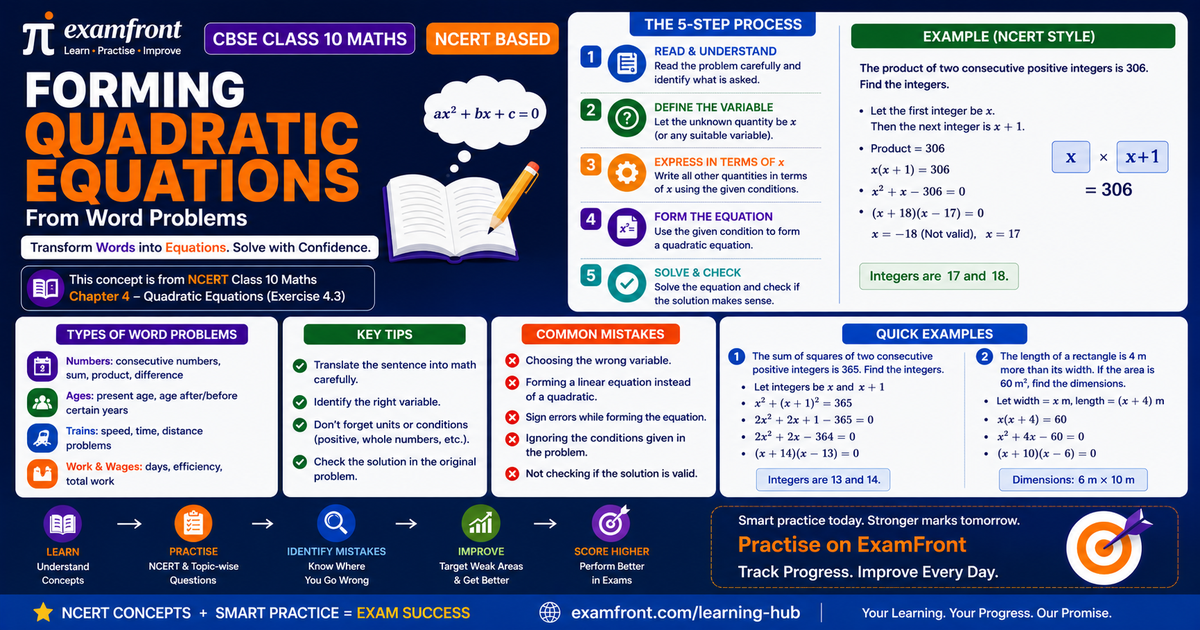
How to Form a Quadratic Equation from a Word Problem (Class 10)
In one line: to form a quadratic equation from a word problem, let x be the quantity you must find, write every other quantity in terms of x, translate the given condition into an equation, and simplify it into standard form ax² + bx + c = 0.
This skill — the NCERT calls it representing situations mathematically — is the first thing Chapter 4 asks of you, and it is tested directly (“represent the following situations in the form of quadratic equations”) before any solving begins. A quadratic equation appears whenever the condition in the problem multiplies two expressions that both contain x — an area (length × breadth), a product of two numbers, or a total cost (items × price each). That multiplication creates the x² term. If you want a refresher on what standard form means, see Standard Form of a Quadratic Equation first.
Here is the whole method in four steps: (1) Let x be what the question asks for → (2) Express the other quantities in terms of x → (3) Translate the condition into an equation → (4) Simplify to standard form. The worked examples below apply these same four steps to the three situation types the board exam loves most: area, product of numbers, and cost.
▶ Watch: Can you form the correct area equation? 🧮
The 4-step translation method
Use the same four steps for every problem, in the same order:
- Let. Choose x = the quantity the question asks you to find (breadth, number, count of items). Write the “Let” statement explicitly — it earns a mark and anchors everything else.
- Express. Write every other quantity in the problem in terms of x. “Length is one more than twice the breadth” becomes length = 2x + 1.
- Translate. Turn the numerical condition into an equation: area = 480, product = 252, total cost = 216.
- Simplify. Expand the brackets, bring all terms to one side, and write the result in standard form ax² + bx + c = 0 with descending powers.
Exam tip: In “represent mathematically” questions, the final line should always be the standard-form equation. Stopping at x(2x + 2) = 480 leaves the last mark on the table — finish the simplification.
Worked example 1 — an area problem
Problem: The area of a rectangular garden is 480 m². Its length (in metres) is two more than twice its breadth. Represent this situation as a quadratic equation.
- Let the breadth be x metres.
- Express: the length is (2x + 2) metres.
- Translate: area = length × breadth, so x(2x + 2) = 480.
- Simplify: 2x² + 2x = 480 → 2x² + 2x − 480 = 0 → dividing by 2, x² + x − 240 = 0.
The breadth of the garden satisfies the quadratic equation x² + x − 240 = 0. (Quick sense-check: a breadth of 15 m gives a length of 32 m and area 15 × 32 = 480 m² ✓ — so the equation is consistent with the story.)
Notice the last move: when every coefficient shares a common factor, divide it out. Smaller coefficients make the later factorisation step far friendlier.
Worked example 2 — a product-of-numbers problem
Problem: Meena and Ravi together have 40 stamps. Each of them gives away 4 stamps, and the product of the numbers of stamps they now have is 252. Represent this situation as a quadratic equation.
- Let Meena originally have x stamps.
- Express: Ravi has (40 − x) stamps. After giving away 4 each, Meena has (x − 4) and Ravi has (36 − x).
- Translate: (x − 4)(36 − x) = 252.
- Simplify: 36x − x² − 144 + 4x = 252 → −x² + 40x − 144 = 252 → −x² + 40x − 396 = 0 → multiplying by −1, x² − 40x + 396 = 0.
Meena’s original number of stamps satisfies x² − 40x + 396 = 0. Two habits shown here save marks everywhere: multiply the final equation by −1 so the x² term is positive, and expand (x − 4)(36 − x) term by term rather than by memory — sign slips inside such products are exactly what examfront’s Mistake Identification catches most often in this chapter.
Worked example 3 — a cost problem
Problem: A juice stall sells a certain number of cups in a day. The price of each cup (in ₹) is 30 minus the number of cups sold that day. On a day when the total collection was ₹216, represent the situation as a quadratic equation.
- Let the number of cups sold that day be x.
- Express: the price of each cup is ₹(30 − x).
- Translate: total collection = (cups) × (price each), so x(30 − x) = 216.
- Simplify: 30x − x² = 216 → −x² + 30x − 216 = 0 → x² − 30x + 216 = 0.
The number of cups sold satisfies x² − 30x + 216 = 0.
A quicker one to try yourself: the product of two consecutive positive integers is 182. Let the smaller be x; the next is x + 1; then x(x + 1) = 182 → x² + x − 182 = 0. If your equation matches, the 4-step method is settling in — a timed mixed set on examfront’s Topic Practice will make it automatic.
▶ Watch: Can you build the correct equation for consecutive even numbers? 🧮
Why these situations always produce x²
Each condition above multiplies two brackets that both contain x:
| Situation type | Condition used | Where the x² comes from |
|---|---|---|
| Area | length × breadth = area | x × (2x + 2) |
| Product of numbers | first × second = product | (x − 4) × (36 − x) |
| Cost / collection | items × price each = total | x × (30 − x) |
Contrast this with the word problems of Chapter 3, where conditions like “cost of 2 notebooks and 1 pen is ₹80” only add multiples of the variables — producing linear equations, not quadratics. The moment a problem multiplies two x-dependent quantities, expect degree 2.
Age problems (“the product of their ages 3 years from now…”) and speed–distance–time problems (“if the speed had been 8 km/h less…”) follow the same four steps but need an extra layer — shifted expressions like (x + 3) for future ages, or time written as distance/speed, which brings fractions into Step 3. We have deliberately kept those heavier variations out of this guide: the full set of age, speed and two-condition problems, with step-by-step personalised help where your translation goes wrong, lives inside examfront, and the Practice Companion is built for exactly that jump in difficulty.
▶ Watch: Can you turn the reciprocal relation into a quadratic? 🧮
Where this sits in the NCERT and CBSE syllabus
This is not a side skill — it is the opening exercise of the chapter. In NCERT Class 10 Maths, Chapter 4 (Quadratic Equations) introduces the standard form in Section 4.2 and then examines the translation immediately: Exercise 4.1, Question 2 is worded “Represent the following situations in the form of quadratic equations”, and its four parts are exactly the shapes above plus the two harder ones — an area of a rectangular plot, a product of two consecutive positive integers, an age problem and a train-speed problem. Worked examples 1 and 2 on this page follow the first two; the age and speed variants are the extra layer described in the section above.
Three things worth knowing before the board paper:
- Where the marks live. Quadratic Equations sits in Unit II — Algebra, which carries 20 of the 80 theory marks in the CBSE Class 10 Maths paper. Algebra is the single heaviest unit, and this chapter contributes to it every year.
- How it is asked. When the question stops at “represent the situation mathematically”, the standard-form equation is the whole answer, and it typically appears as a short objective or very-short-answer item. More often the translation is the first line of a longer 3- or 5-mark question whose remaining parts ask you to solve and interpret — so a wrong equation costs every mark that follows it, not just the first one. The six question formats in the CBSE paper are a useful map of where each version shows up.
- Stay inside the NCERT text. Every situation CBSE sets is built on the rationalised NCERT syllabus, so the fastest preparation is the textbook’s own exercises rather than a new book. If your NCERT reading is unstructured, how to study NCERT Maths in Class 10 and the NCERT Class 10 Maths guide show how to work an exercise so the method sticks.
Key Takeaways
- Forming a quadratic equation from a word problem is a 4-step translation: Let → Express → Translate → Simplify to standard form.
- Always let x = the quantity the question asks for, and write every other quantity in terms of x.
- Area, product-of-numbers and cost conditions all multiply two x-dependent expressions, which is what creates the x² term.
- Finish every answer in standard form ax² + bx + c = 0 — divide out common factors and make the x² coefficient positive.
- “Represent mathematically” questions award full marks for the correct equation; solving comes later in the chapter.
- The skill is examined from the very first exercise of NCERT Chapter 4, inside the 20-mark Algebra unit.
Quick Facts
- Method: Let → Express → Translate → Simplify (4 steps).
- Choose x as: the quantity to be found.
- x² appears when: the condition multiplies two expressions containing x.
- Final answer format: standard form ax² + bx + c = 0, descending powers, positive x² coefficient preferred.
- Typical situation types: area of a rectangle, product of two numbers, total cost/collection.
- NCERT reference: Chapter 4, Section 4.2 and Exercise 4.1 Question 2.
- CBSE unit: Algebra — 20 of 80 theory marks.
- Chapter: Quadratic Equations · Class: 10 · Subject: Maths · Board: CBSE.
Common Mistakes
- Letting x be the wrong quantity. Choosing x = length when the question asks for breadth doubles the algebra and invites errors. Let x be what is asked; express the rest in terms of it.
- Translating the comparison backwards. “Length is two more than twice the breadth” is 2x + 2, not 2(x + 2). Translate word by word: twice the breadth (2x), two more (+ 2).
- Sign slips while expanding brackets like (x − 4)(36 − x). The −x × −4 and cross terms are where marks vanish. Expand term by term and combine carefully.
- Stopping before standard form. Leaving the answer as x(30 − x) = 216 is incomplete. Expand, bring everything to one side, and write ax² + bx + c = 0.
- Forgetting units and the “Let” statement. “Let the breadth be x metres” earns presentation marks and prevents unit confusion; omitting it makes the solution harder to follow.
📄 Download the 2-page summary (PDF) — the 4-step method, the three situation types and a full worked example on one printable sheet.
FAQ
Q. How do you form a quadratic equation from a word problem? Four steps: let x be the quantity to find; express every other quantity in terms of x; translate the given condition (area, product, total cost) into an equation; then expand and simplify into standard form ax² + bx + c = 0.
Q. Which quantity should I take as x? The one the question asks for — the breadth, the number, the count of items. Then build the other quantities from it (length = 2x + 2, the other number = 40 − x). One well-chosen variable keeps the whole translation direct.
Q. Why do area and product problems give quadratic equations? Because the condition multiplies two expressions that each contain x — length × breadth or number × number — creating an x² term, so the equation has degree 2.
Q. Do I have to solve the equation after forming it? Only if asked. “Represent the situation mathematically” questions give full marks for the correct standard-form equation. Solving by factorisation is the next section of the chapter — see the chapter guide for the roadmap.
Q. How do I check my equation is correct? Re-read the problem and verify each expression matches its phrase, then re-derive the condition line and redo the expansion once. A quick consistency check (do sensible numbers fit?) catches most translation errors.
Q. Is forming a quadratic equation from a word problem part of the NCERT and CBSE Class 10 syllabus? Yes — it is the first thing NCERT Chapter 4 asks you to do. Exercise 4.1, Question 2 is worded exactly “Represent the following situations in the form of quadratic equations”. Quadratic Equations sits inside Unit II, Algebra, worth 20 of the 80 theory marks, so the translation step is examined every year — sometimes on its own, more often as the opening line of a longer question.
Related Concepts
- Standard Form of a Quadratic Equation (Class 10): the definition and the a ≠ 0 condition your final line must satisfy.
- Quadratic Equations — Chapter Guide: where forming fits before factorisation and the quadratic formula.
- Linear-Equations Word Problems (Class 10): the degree-1 cousin — compare which conditions stay linear.
- Polynomials — Chapter Guide: the quadratic polynomial behind every quadratic equation.
Can you translate any story into ax² + bx + c = 0 without hesitation? Prove it with a Chapter Quiz on examfront — and let Strength & Weakness Analysis show whether translation or expansion is costing you marks. Start on examfront →