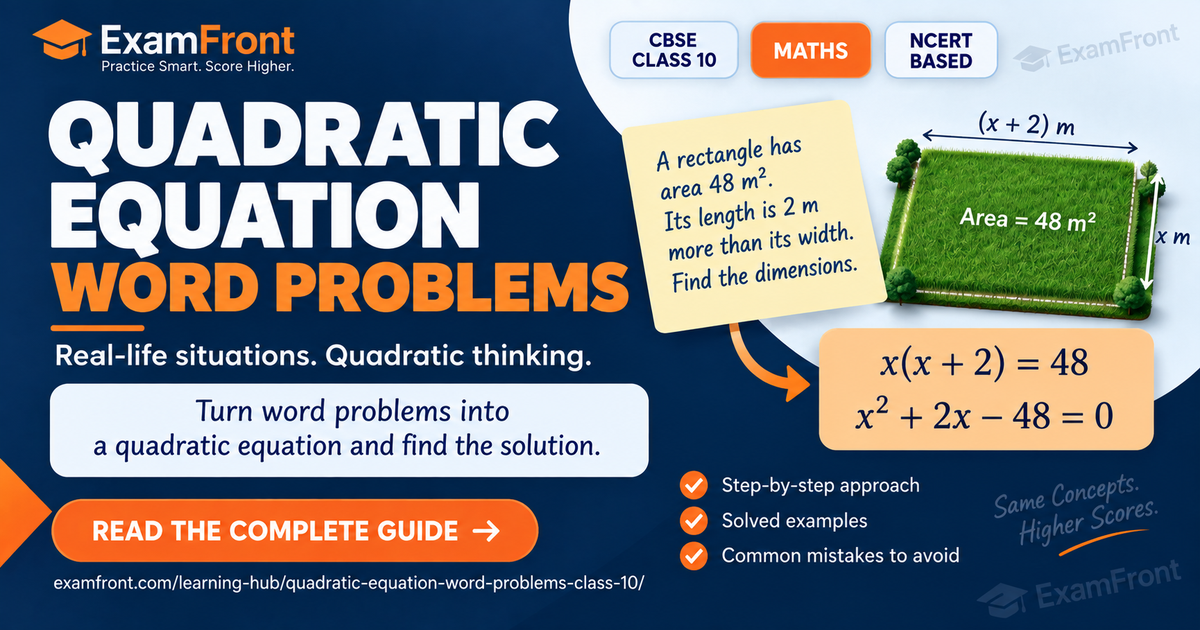
Quadratic Equation Word Problems (Class 10) — Step-by-Step Method
In one line: every quadratic equation word problem is solved in three phases — Form the equation (let the unknown be x, translate the condition into ax² + bx + c = 0), Solve it (usually by factorisation), and Check each root against the real situation, rejecting any root that is impossible.
A quadratic equation word problem is a real-life situation — about numbers, areas, ages, or speeds — whose condition, when translated into algebra, produces a quadratic equation. Because a quadratic equation can have two roots, word problems add a step that plain equations don’t have: validity checking. The algebra hands you up to two candidate answers; the story decides which of them actually make sense.
That final judgement — “x = −16 is rejected because the integers are positive” — is where board marks are most often won or lost. This guide works through the three most common problem types (numbers, area, ages) with the full three-phase method, and shows you exactly how to write the rejection line examiners look for.
🎬 Watch — 30-sec Short: Can both roots represent a physical breadth? 🤔
The 3-phase method: Form → Solve → Check
Phase 1 — Form. Let the quantity you’re asked for be x. Express every other quantity in terms of x. Translate the given condition into an equation, then rearrange it into standard form ax² + bx + c = 0. (This phase is covered in depth in forming quadratic equations from word problems.)
Phase 2 — Solve. Find the roots, usually by factorisation: split the middle term with two numbers whose sum is b and product is a × c, factorise, and set each factor to zero.
Phase 3 — Check. Test each root against the situation. Reject any root that violates a real-world condition — negative length, negative age, fractional count of people — and write the rejection explicitly. Then answer in words, with units.
Type 1 — Consecutive numbers
Worked Example 1
The product of two consecutive positive integers is 240. Find the integers.
Form. Let the smaller integer be x. Then the next integer is x + 1. Condition:
x(x + 1) = 240 → x² + x − 240 = 0
Solve. a × c = −240; two numbers with sum 1 and product −240 are 16 and −15.
x² + 16x − 15x − 240 = x(x + 16) − 15(x + 16) = (x + 16)(x − 15) = 0
So x = −16 or x = 15.
Check. The problem says positive integers, so x = −16 is rejected. Thus x = 15.
Answer: the integers are 15 and 16. Verify against the story: 15 × 16 = 240 ✓
Type 2 — Area and dimensions
Worked Example 2
The length of a rectangular garden is 5 m more than its breadth, and its area is 84 m². Find its dimensions.
Form. Let the breadth be x m. Then the length is (x + 5) m. Area condition:
x(x + 5) = 84 → x² + 5x − 84 = 0
Solve. a × c = −84; two numbers with sum 5 and product −84 are 12 and −7.
x² + 12x − 7x − 84 = x(x + 12) − 7(x + 12) = (x + 12)(x − 7) = 0
So x = −12 or x = 7.
Check. Breadth is a length and cannot be negative, so x = −12 is rejected. Thus x = 7.
Answer: breadth = 7 m, length = 7 + 5 = 12 m. Verify: 7 × 12 = 84 m² ✓
Dimension problems are the most common exam appearance of this topic — and their harder cousins (right-triangle sides with a given hypotenuse, borders and paths around gardens) follow the same three phases with one extra setup idea. The complete set of those variants is waiting in examfront’s Topic Practice, where Mistake Identification will tell you whether your errors happen in Form, Solve, or Check.
🎬 Watch — 30-sec Short: Can you form the correct quadratic from consecutive integers? 🧮
Type 3 — Ages
Worked Example 3
A father is 27 years older than his son. The product of their present ages is 90. Find their present ages.
Form. Let the son’s present age be x years. Then the father’s age is (x + 27) years. Condition:
x(x + 27) = 90 → x² + 27x − 90 = 0
Solve. a × c = −90; two numbers with sum 27 and product −90 are 30 and −3.
x² + 30x − 3x − 90 = x(x + 30) − 3(x + 30) = (x + 30)(x − 3) = 0
So x = −30 or x = 3.
Check. Age must be positive, so x = −30 is rejected. Thus x = 3.
Answer: the son is 3 years old and the father is 3 + 27 = 30 years old. Verify: 3 × 30 = 90 ✓ and 30 − 3 = 27 ✓
Age problems that shift the condition into the future or past (“the product of their ages 4 years from now…”) add one translation step but keep the same skeleton; you can drill that variant, along with speed–distance–time problems (the classic hardest type of this exercise), inside examfront’s Practice Companion with hints at each phase.
How to write the rejection line (and why examiners want it)
When one root is invalid, don’t silently drop it. Write one clear sentence:
“Since x represents the breadth of the garden, x cannot be negative. Therefore x = −12 is rejected, and x = 7.”
This single line shows the examiner you checked both roots deliberately. Also be careful of the opposite trap: don’t auto-reject every negative root. If a problem simply says “find two numbers whose product is…”, a negative number may be a perfectly valid answer — judge each root against the exact wording.
Check yourself: the sum of the squares of two consecutive positive odd numbers is 130. Find the numbers. (Answer: 7 and 9 — form x² + (x + 2)² = 130, simplify to x² + 2x − 63 = 0, factorise, reject the negative root.) If your simplification or split went wrong anywhere, a Chapter Quiz on examfront will pinpoint the exact phase to strengthen, and Strength & Weakness Analysis tracks it across the whole Algebra unit.
🎬 Watch — 30-sec Short: Can you build the correct quadratic from consecutive even numbers? 🧮
Where this sits in the NCERT and CBSE syllabus
NCERT sets the scope. Word problems are Chapter 4, Quadratic Equations. Watch the numbering: the topic is introduced in Section 4.2, but the questions sit in Exercise 4.1 — the same section-versus-exercise offset that catches students in Chapters 2, 3 and 9. Exercise 4.1 Q2 is the word-problem set, and it is worth knowing by name: the 528 m² rectangular plot, the two consecutive positive integers whose product is 306, Rohan’s ages three years from now multiplying to 360, and the 480 km train that would take 3 hours longer at 8 km/h less. Notice what Q2 actually asks — represent the following situations in the form of quadratic equations. It stops at Phase 1. Exercise 4.2 (six questions, factorisation) is where the same situations get solved, including the two consecutive integers whose squares sum to 365 and the cottage-industry cost problem. Exercise 4.3 (five questions) is the nature of roots.
The rationalised chapter has three exercises, 4.1 to 4.3 — the old Exercise 4.3 on completing the square was removed and nature of roots renumbered into its place. If a book or a website shows you four exercises for this chapter, it is out of date; the NCERT Class 10 Maths guide and how to study NCERT maths both cover working from the current edition.
CBSE sets the shape. Quadratic Equations belongs to the Algebra unit, worth 20 of the 80 theory marks — the largest unit in the paper, as the syllabus sets out. The paper itself is 38 questions, 80 marks, three hours, five sections, no overall choice (the full breakdown is in the exam pattern). Word problems almost never appear as 1-markers, because there is nothing to award: they land as 3-mark short answers in Section C or 5-mark long answers in Section D, and occasionally inside a 4-mark case study. The question types guide maps each format.
How it is actually asked. Read the command word first. “Represent the situation in the form of a quadratic equation” wants Phase 1 only, finished in standard form — solving it earns nothing extra. “Find the dimensions / the integers / their present ages” wants all three phases, ending in a sentence with units. And because CBSE marks the method, not just the answer, the rejection line is not politeness — it is a step the marking scheme credits, exactly like the “Let” statement at the start.
Key Takeaways
- Every quadratic word problem follows Form → Solve → Check.
- The algebra can give two roots; the situation decides which are valid.
- Reject impossible roots (negative lengths, negative ages, fractional counts) in writing — examiners award the reasoning.
- Never auto-reject negative roots; pure number problems may accept them.
- Always verify your final answer against the original story, not just the equation.
- The command word decides how far to go: represent stops at the equation, find wants the checked answer in words.
Quick Facts
- Method: Form → Solve → Check (three phases).
- Solving tool used at this stage: factorisation (splitting the middle term).
- A quadratic word problem yields at most two candidate answers; validity checking filters them.
- Standard rejection reasons: negative length/breadth, negative age, non-whole count of objects/people.
- Most frequent exam types: numbers, area/dimensions, ages; hardest common type: speed–distance–time.
- NCERT placement: Chapter 4, Section 4.2, Exercise 4.1 Q2 — a section-versus-exercise offset worth remembering.
- This topic sits in the Algebra unit of the CBSE blueprint and quadratic word problems appear regularly in previous year questions.
Common Mistakes
- Skipping the Check phase — presenting both roots as the answer even when one is impossible.
- Auto-rejecting the negative root in problems where a negative number is valid.
- Forming the equation with the wrong expression — e.g. writing the length as x − 5 when it is “5 more than” the breadth.
- Arithmetic slips while simplifying to standard form — especially forgetting to divide through by a common factor (2x² + 4x − 126 = 0 → x² + 2x − 63 = 0).
- Answering with x alone — the problem asked for both integers, both dimensions, or both ages; state the complete answer in words with units.
- Ignoring the command word — solving in full when the question only said represent the situation, or stopping at the equation when it said find the dimensions. Match the work to what is asked.
📄 Download the 2-page summary (PDF) — the three phases, three worked types and the rejection line, on one printable sheet.
FAQ
How do you solve a quadratic equation word problem in Class 10? Form the equation (let the unknown be x, translate the condition into standard form), solve it by factorisation, then check each root against the situation and reject any impossible one before answering in words.
Why do we reject one root in quadratic word problems? Because the situation adds real-world conditions the equation doesn’t contain — lengths and ages must be positive, counts must be whole numbers. A root that breaks these is rejected with a written reason.
Are both roots ever valid in a quadratic word problem? Sometimes, yes — especially in pure number problems with no positivity condition. Judge each root against the exact wording.
What types of quadratic word problems come in the CBSE exam? Number problems, area/dimension problems, and age problems are the common core; speed–distance–time problems are the usual harder variant.
Do I need to verify my answer? Yes — substitute the final answer back into the original story (e.g. 15 × 16 = 240), which catches both algebra slips and wrongly kept roots.
Are quadratic equation word problems part of the NCERT and CBSE Class 10 syllabus? Yes — NCERT Chapter 4, introduced in Section 4.2 with the questions in Exercise 4.1 Q2, then solved through Exercise 4.2. The rationalised chapter has three exercises; the old Exercise 4.3 on completing the square was removed, so a four-exercise book is out of date. Quadratic Equations sits in the Algebra unit, 20 of the 80 theory marks.
Related Concepts
- Forming quadratic equations from word problems — Phase 1 in full detail.
- Solving quadratic equations by factorisation — Phase 2 in full detail.
- Standard form of a quadratic equation — the form every translation must reach.
- Linear equations word problems — the Chapter 3 counterpart, useful for comparing translation styles.
- Quadratic Equations Class 10 chapter guide — the full chapter picture.
Next step: once numbers, areas and ages feel comfortable, take a timed mixed set on examfront — its Performance Analytics will show your accuracy per problem type and build your Exam Readiness for the Algebra unit.