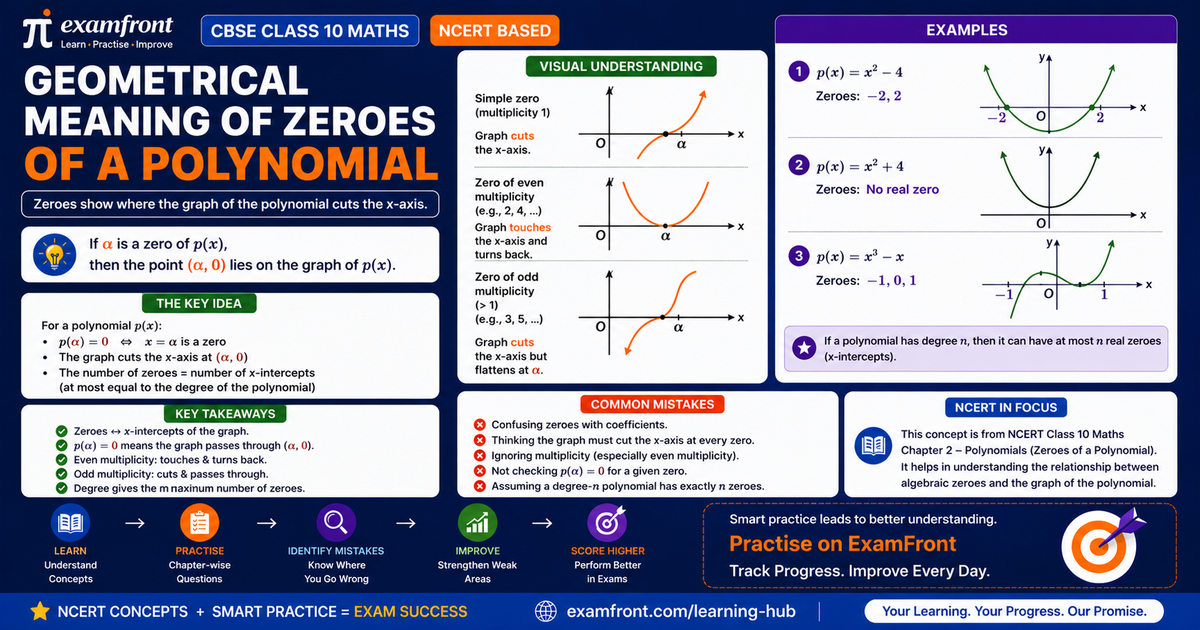
Geometrical Meaning of the Zeroes of a Polynomial (Class 10)
In one line: the zeroes of a polynomial are the x-coordinates of the points where the graph of y = p(x) meets the x-axis.
A zero of a polynomial p(x) is a value of x, say k, for which p(k) = 0. Geometrically, that same idea has a picture: if you draw the graph of y = p(x), then every place the curve touches or crosses the x-axis gives you a zero. The x-value at that meeting point is the zero, because along the entire x-axis the y-value (the value of the polynomial) is 0.
So “finding the zeroes” and “finding where the graph cuts the x-axis” are two ways of describing the same thing — one algebraic, one geometrical. This single idea is the heart of Section 2.2 of your NCERT chapter, and it is what makes the rest of the Polynomials Class 10 chapter click into place.
▶️ Watch the 30-second reel: Which axis has the zeroes? 🤔
What is a zero of a polynomial? (quick recap)
A zero of a polynomial p(x) is a real number k such that p(k) = 0.
For example, take p(x) = x² − 3x − 4. Putting x = −1 gives p(−1) = (−1)² − 3(−1) − 4 = 1 + 3 − 4 = 0, and putting x = 4 gives p(4) = 16 − 12 − 4 = 0. Since both results are 0, the numbers −1 and 4 are the zeroes of this polynomial.
That is the algebraic definition (covered fully in Zeroes of a Polynomial — meaning and how to find). Now let us see what it looks like as a picture.
What does the “geometrical meaning of zeroes” actually mean?
The geometrical meaning of a zero is this: when you plot y = p(x), the zeroes are precisely the x-coordinates of the points where the graph intersects the x-axis.
Here is why. Every point on the x-axis has y = 0. The graph of y = p(x) shows all the points (x, p(x)). So a point of the graph lies on the x-axis exactly when p(x) = 0 — and a value of x with p(x) = 0 is, by definition, a zero. Therefore each x-axis crossing corresponds to one zero, and each zero corresponds to one x-axis crossing.
A useful way to remember it: a zero is where the curve “lands” on the x-axis. The number of landings tells you the number of (real) zeroes.
Quick check: if a graph never touches the x-axis, the polynomial has no real zero. If it touches at exactly one point, there is one zero. If it crosses at three separate points, there are three zeroes.
Once you can read this from a graph, spotting the number of zeroes becomes almost instant — a skill worth drilling with a few Chapter Quizzes on examfront so it becomes automatic before the exam.
Geometrical meaning for a linear polynomial
A linear polynomial is a degree-1 polynomial of the form ax + b, where a and b are real numbers and a ≠ 0. Its graph, y = ax + b, is always a straight line. (For a refresher on degrees, see Types of Polynomials — linear, quadratic, cubic.)
A straight line (that is not horizontal) crosses the x-axis at exactly one point, so a linear polynomial has exactly one zero — the x-coordinate of that single crossing point, which works out to x = −b/a.
Worked example. Consider y = 2x + 3, so a = 2 and b = 3.
- The zero is x = −b/a = −3/2 = −1.5.
- Check: p(−1.5) = 2(−1.5) + 3 = −3 + 3 = 0. ✓
- On the graph, the line crosses the x-axis at the point (−1.5, 0). The x-coordinate of that point, −1.5, is exactly the zero.
So for a linear polynomial the story is simple: one line, one crossing, one zero.
Geometrical meaning for a quadratic polynomial
A quadratic polynomial is a degree-2 polynomial of the form ax² + bx + c, where a, b, c are real numbers and a ≠ 0. Its graph, y = ax² + bx + c, is a parabola — a smooth U-shaped curve. The parabola opens upwards when a > 0 and opens downwards when a < 0.
The zeroes of the quadratic are the x-coordinates of the points where the parabola meets the x-axis.
Worked example. Consider y = x² − 3x − 4 (here a = 1 > 0, so the parabola opens upwards). Making a small table of values:
| x | −2 | −1 | 0 | 1 | 2 | 3 | 4 | 5 |
|---|---|---|---|---|---|---|---|---|
| y = x² − 3x − 4 | 6 | 0 | −4 | −6 | −6 | −4 | 0 | 6 |
The curve dips below the x-axis and comes back up, touching the x-axis where y = 0 — that is at x = −1 and x = 4. Those two x-coordinates are exactly the zeroes we found algebraically earlier. So the graph confirms the algebra.
▶️ Watch the 30-second reel: Downward parabola — what must be true?
The three cases for a quadratic graph
Because a parabola can sit in different positions relative to the x-axis, exactly three cases are possible:
- Two distinct zeroes — the parabola cuts the x-axis at two different points. Example: y = x² − 3x − 4 crosses at x = −1 and x = 4.
- One zero (two equal zeroes) — the parabola just touches the x-axis at a single point. Example: y = x² − 4x + 4 = (x − 2)², which touches at x = 2 only.
- No real zero — the parabola lies entirely above or entirely below the x-axis and never meets it. Example: y = x² + 1, which stays above the x-axis for every value of x.
▶️ Watch the 30-second reel: Parabola touches once — how many zeroes?
▶️ Watch the 30-second reel: How many real zeroes?
This is why the rule “a quadratic polynomial has at most two zeroes” is true: a parabola can meet a straight line (the x-axis) in at most two points. Working through mixed graphs where you must decide which of the three cases applies is exactly the kind of practice the Topic Practice sets on examfront are built for.
What about cubic and higher polynomials?
The same idea keeps working as the degree grows. The graph of a cubic polynomial (degree 3, form ax³ + bx² + cx + d with a ≠ 0) can meet the x-axis at up to three points, so a cubic has at most three zeroes.
More generally, for a polynomial p(x) of degree n, the graph of y = p(x) can intersect the x-axis at at most n points, so p(x) has at most n zeroes. A quick summary:
| Type of polynomial | Degree | Graph shape | Maximum number of zeroes |
|---|---|---|---|
| Linear | 1 | Straight line | 1 |
| Quadratic | 2 | Parabola | 2 |
| Cubic | 3 | Curve with up to 2 turns | 3 |
| Degree n | n | — | n |
▶️ Watch the 30-second reel: 3 x-axis cuts — minimum degree? 🤔
We are keeping the cubic and higher-degree graph cases brief here. The full set of cubic graph shapes, harder “how many zeroes” variations and step-by-step graph-reading drills are worked through in depth inside examfront — the Practice Companion there walks you through each graph and flags exactly where you slip up, which is the fastest way to master this beyond the basics. The natural next step after this topic is the relationship between zeroes and coefficients, which turns these zeroes into formulas.
Where this sits in the NCERT and CBSE syllabus
This topic is not a side note in the textbook — it is a whole numbered section of it.
The NCERT source. It is Chapter 2 (Polynomials), Section 2.2, whose title is literally Geometrical Meaning of the Zeroes of a Polynomial. The section works through the linear, quadratic and cubic cases in exactly the order used above. Exercise 2.1 then consists of a single question — you are given several graphs of y = p(x) and asked to find the number of zeroes in each case. That one exercise is the entire practical skill this page teaches, which is why it is worth over-practising rather than reading once. If you are not sure how to work an NCERT section properly, start with how to study NCERT Maths in Class 10 and the NCERT Class 10 Maths guide.
Where the marks sit. Polynomials belongs to Unit II — Algebra, which carries 20 of the 80 theory marks, the largest single unit in the CBSE Class 10 Maths paper. It shares that unit with Pair of Linear Equations in Two Variables, Quadratic Equations and Arithmetic Progressions.
What is in scope, and what is not. The current CBSE syllabus line for this chapter is short: zeroes of a polynomial, and the relationship between zeroes and coefficients of quadratic polynomials. Two consequences worth knowing before you revise:
- The division algorithm for polynomials is not part of the current course — it was removed in the rationalised syllabus, so do not spend time on it.
- The zeroes-and-coefficients formulas are examinable for quadratic polynomials. The cubic graphs above are there to make the “at most n zeroes” idea concrete, not because you will be asked to plot one.
- Reading a graph is in scope. Plotting a quadratic or cubic graph is not.
How CBSE actually asks it. Almost always as a one-mark objective question in Section A: a graph is printed and you are asked how many zeroes p(x) has. It also turns up as the opening line of a longer Algebra question, or inside a case-based question where a curve models something real. Because it is a one-mark question, the whole mark hinges on counting x-axis meetings correctly — there are no method marks to fall back on. For how each format is set and marked, see the CBSE Class 10 Maths question types guide.
Key Takeaways
- A zero of p(x) is a value k with p(k) = 0; geometrically, it is an x-coordinate where the graph of y = p(x) meets the x-axis.
- Number of real zeroes = number of points where the graph touches or crosses the x-axis.
- A linear polynomial has exactly 1 zero (its line crosses the x-axis once).
- A quadratic polynomial’s graph is a parabola and has two, one, or no real zeroes.
- A polynomial of degree n has at most n zeroes.
- You mainly need to read graphs in the exam, not plot quadratic or cubic graphs yourself.
- NCERT reference: Chapter 2, Section 2.2, with Exercise 2.1 devoted entirely to counting zeroes from graphs; Polynomials sits in the 20-mark CBSE Algebra unit.
Quick Facts
- Zero (geometrical): x-coordinate of an x-axis intersection point of y = p(x).
- Linear graph: straight line; 1 zero at x = −b/a.
- Quadratic graph: parabola; opens up if a > 0, down if a < 0; at most 2 zeroes.
- Cubic graph: at most 3 zeroes.
- Degree n: at most n zeroes.
- No-zero case: parabola lies fully above or below the x-axis (e.g., x² + 1).
- NCERT reference: Class 10 Maths, Chapter 2 (Polynomials), Section 2.2 and Exercise 2.1.
- CBSE unit: Unit II — Algebra, 20 of 80 theory marks.
- Chapter: Polynomials · Class: 10 · Subject: Maths · Board: CBSE.
Common Mistakes
- Reading the y-intercept as a zero. The zero is where the graph meets the x-axis, not the y-axis. The point where the curve crosses the y-axis gives p(0), not a zero.
- Assuming every quadratic has two zeroes. A parabola can touch the x-axis once (one zero) or miss it entirely (no real zero). Always check how the curve sits relative to the x-axis.
- Confusing “touches” with “crosses.” If the parabola only touches the x-axis at one point, that is one zero (two equal zeroes), not two.
- Thinking a curve with no x-axis crossing is “invalid.” If a graph never meets the x-axis, the polynomial simply has no real zero — that is a valid, complete answer.
- Counting turns instead of crossings. The number of zeroes is the number of x-axis intersections, not the number of bends or turning points in the curve.
Download the 2-page summary
📄 Download the 2-page geometrical meaning of zeroes summary (PDF) — the definitions, the three quadratic cases and a worked NCERT-style graph question, on two printable pages.
FAQ
Q. What is the geometrical meaning of the zeroes of a polynomial? The zeroes are the x-coordinates of the points where the graph of y = p(x) meets or crosses the x-axis. At those points the value of the polynomial is 0.
Q. How many zeroes can a polynomial of degree n have? At most n. The graph can meet the x-axis at most n times, so linear ≤ 1, quadratic ≤ 2, cubic ≤ 3, and degree n ≤ n zeroes.
Q. Why does a quadratic polynomial sometimes have no zero? Its graph is a parabola. If the parabola lies completely above or completely below the x-axis, it never meets the x-axis, so there is no real zero — for example, x² + 1.
Q. Is the zero of a polynomial the same as the x-intercept of its graph? Yes. Each real zero is an x-intercept. The zero is the x-value, and the x-intercept is the point (zero, 0) on the graph.
Q. Do I have to draw quadratic or cubic graphs in the Class 10 exam? No. Plotting quadratic and cubic graphs is not required or evaluated. You mainly need to read graphs — for example, finding the number of zeroes from a given graph.
Q. Is the geometrical meaning of the zeroes of a polynomial part of the NCERT and CBSE Class 10 syllabus? Yes. It is Section 2.2 of NCERT Class 10 Maths Chapter 2 (Polynomials), and Exercise 2.1 is built entirely on it — a single question that gives you several graphs of y = p(x) and asks for the number of zeroes in each. Polynomials sits in Unit II Algebra, which carries 20 of the 80 theory marks, and this topic is usually examined as a one-mark objective question that shows a graph.
Related Concepts
- Zeroes of a Polynomial — meaning and how to find: the algebraic side of what a zero is and how to compute it.
- Number of Zeroes of a Polynomial from a Graph: the exam skill of counting zeroes by reading a given graph.
- Types of Polynomials — linear, quadratic, cubic: the degree-based classification behind these graph shapes.
- Polynomials Class 10 — how to approach the chapter: the full chapter roadmap and where this topic fits.
Ready to make this automatic? Try a few graph-based questions in the Chapter Quizzes on examfront, and let the Practice Companion show you exactly where to focus. Start on examfront →