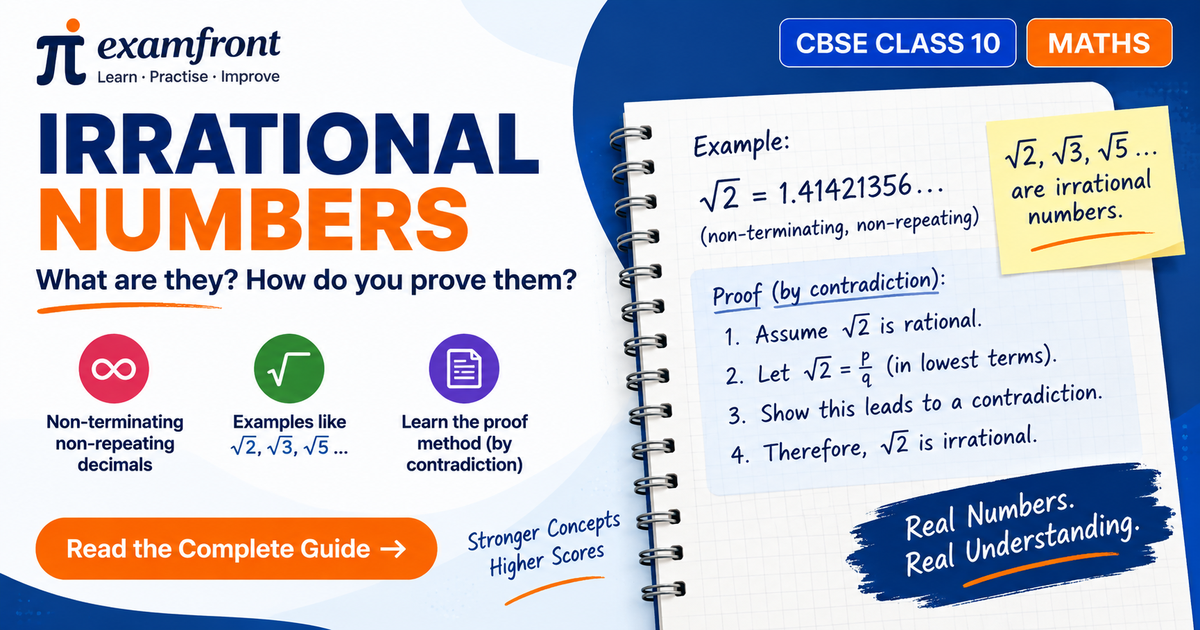
Irrational Numbers Class 10: Meaning, Proofs & Exam Guide (Real Numbers 1.3)
If the words “prove that √2 is irrational” make you nervous, you’re in exactly the right place. Irrational numbers class 10 (Section 1.3 of Real Numbers, “Revisiting Irrational Numbers”) looks scary because it’s one of the first places you’re asked to prove something instead of just calculate it. The good news: there are really only three ideas here, and once they click, every question in this section starts to look the same. Let’s make it easy.
By the end of this guide you’ll know what an irrational number actually is, the one tool that unlocks all the proofs, exactly how the √2 proof works in plain English, and the common traps that cost students easy marks. If you want the bird’s-eye view of the whole chapter first, start with our Real Numbers Class 10 chapter guide and then come back here for the deep dive on 1.3.
What Section 1.3 is really about
In Class 9 you met irrational numbers and even placed them on the number line — but you never proved they were irrational. Section 1.3 — Revisiting Irrational Numbers — fixes that, and it’s the part of the irrational numbers topic in NCERT Class 10 that trips most students up. It uses one powerful idea from earlier in the chapter (the Fundamental Theorem of Arithmetic) to prove that numbers like √2, √3 and √5 genuinely cannot be written as neat fractions.
So this section is proof-heavy, not calculation-heavy. That’s actually great news: proofs follow a fixed recipe. Learn the recipe once and you can reproduce it for √2, √3, √5, or a surd you’ve never seen before.
Idea 1 — What makes a number “irrational”
A quick refresher, because every proof depends on this definition.
- A rational number can be written as a fraction p/q, where p and q are integers and q ≠ 0 (e.g. 3, −7, ½, 0.75, 0.333…).
- An irrational number cannot be written that way. Its decimal expansion is non-terminating and non-repeating — it never stops and never settles into a repeating block.
| Rational | Irrational |
|---|---|
| 4 = 4/1 | √2 = 1.41421356… |
| 0.5 = 1/2 | √3 = 1.73205… |
| 0.666… = 2/3 | π = 3.14159… |
| √4 = 2 | √5, √7, √10 … |
Exam-ready shortcut: √(a perfect square) is rational (√9 = 3). √(not a perfect square) is irrational (√8, √12). Spotting this instantly saves time in MCQs — and you’ll meet plenty of them in our MCQ practice for Class 10 Maths.
Rational or irrational? Quick reference:
| Number | Rational? |
|---|---|
| √4 | ✅ (= 2) |
| √9 | ✅ (= 3) |
| √8 | ❌ irrational |
| π | ❌ irrational |
| 0.75 | ✅ (= 3/4) |
| 22/7 | ✅ (it’s a fraction — not π) |
A fast way to test whether you’ve truly got this distinction is a short mixed “rational or irrational?” set — the kind of instant-feedback drilling you get from topic practice on examfront, which keeps serving them until the pattern becomes automatic.
🎬 Watch the 30-second reel: Can you find the irrational number?
Idea 2 — The one tool behind every proof
Before proving anything, Section 1.3 gives you a helper result. In plain words:
If a prime number p divides a², then that same prime p must divide a.
Why does this matter? Because it comes straight from the Fundamental Theorem of Arithmetic — the fact that every number has exactly one prime factorisation. When you square a number, you don’t create any new prime factors; you just double the ones already there. So if a prime shows up in a², it had to be hiding in a all along.
Quick sense-check: 6 = 2 × 3, and 6² = 36 = 2² × 3². The primes in 36 are still just 2 and 3 — nothing new appeared. That’s the whole idea. (Prime factorisation feels shaky? It’s worth a quick refresh from the Fundamental Theorem of Arithmetic guide or the Real Numbers chapter guide before moving on.)
You’ll use this result (with p = 2, then p = 3, then p = 5) in almost every proof in this section. Memorise it as your master key — this single result opens every “prove it’s irrational” proof in the section.
Idea 3 — Why √2 is irrational (the proof, in plain English)
This is the famous proof and a very common exam question, and it’s your first real taste of proof by contradiction in Class 10. The idea: assume the opposite of what you want, then follow the logic until it reaches a contradiction.
Why does proof by contradiction work? If assuming something leads to an impossible situation, then the assumption itself must have been false. So when we assume “√2 is rational” and it forces something impossible, the only way out is that √2 is not rational. That’s the whole engine — no magic.
Here’s the reasoning, step by step in everyday language (not a formula dump):
- Assume the opposite. Suppose √2 is rational. Then we can write √2 = a/b, where a and b are integers with no common factor — the fraction is fully reduced, i.e. in lowest terms (you may also see this called coprime). CBSE uses all three phrasings for the same idea, so recognise them.
- Square both sides. That gives 2 = a²/b², so a² = 2b². This tells us a² is even.
- Use the master key. Since 2 (a prime) divides a², it must divide a. So a is even — write a = 2c.
- Substitute back. Then (2c)² = 2b² → 4c² = 2b² → b² = 2c². So b² is even too, which means b is even.
- Spot the contradiction. Now both a and b are even — they share a factor of 2. But in step 1 we said they had no common factor. That’s impossible.
- Conclude. The only thing that could be wrong is our assumption. So √2 is not rational — it is irrational. ∎
Notice the shape: assume rational → reach “both share a factor” → contradiction → therefore irrational. That’s the reusable recipe.
The √2 proof at a glance
Assume √2 is rational
        ↓
Write √2 = a/b   (lowest terms)
        ↓
Square:  a² = 2b²
        ↓
a is even
        ↓
b is even
        ↓
Both divisible by 2
        ↓
Contradiction  (they had NO common factor)
        ↓
√2 is irrational
How to remember the order
Five beats, easy to recall under exam pressure:
A → S → E → E → C
Assume · Square · a Even · b Even · Contradiction
How to write it in the exam (board answer format)
Students always ask, “exactly how do I prove root 2 is irrational, Class 10 board style?” Here’s the clean layout examiners expect:
Prove that √2 is irrational.

Assume, to the contrary, that √2 is rational.
Then √2 = a/b, where a, b are integers, b ≠ 0,
and a, b are coprime (lowest terms).

Squaring:   2 = a²/b²
        ⇒   a² = 2b²                    … (1)
        ⇒   2 divides a²  ⇒  2 divides a
Let a = 2c.

Substitute in (1):
    (2c)² = 2b²  ⇒  4c² = 2b²  ⇒  b² = 2c²
        ⇒   2 divides b²  ⇒  2 divides b

So 2 divides both a and b.
But a and b are coprime — contradiction.

∴ our assumption is wrong.
Hence, √2 is irrational.
Write those lines in that order and you tick every box in the marking scheme. If you’re not sure which of those lines actually carries a mark, our guide to how CBSE Maths answers are marked shows you where step marks sit.
Students rarely get √2 wrong — they lose marks by skipping the justification steps (like why a is even). Working through model answers with step-by-step feedback, the way examfront’s practice companion does it, trains you to write exactly the lines the examiner is looking for.
🎬 Watch the 30-second reel: √2 is irrational — where is the contradiction?
Same recipe: √3, √5 and √p
To prove √3 is irrational, run the identical recipe with the prime 3 instead of 2: assume √3 = a/b (coprime) → 3b² = a² → 3 divides a → a = 3c → b² = 3c² → 3 divides b → both share 3 → contradiction → √3 is irrational.
Swap in 5 and you’ve proved √5 is irrational. In general, √p is irrational for any prime p. If you can do √2, you can do all of them — only the number changes.
Because the method is identical and only the prime changes, this is a perfect topic for spaced revision. A quick chapter quiz — like the ones built into examfront — lets you rotate through √2, √3 and √5 so the recipe sticks under exam pressure. You’ll also spot these framed as reasoning questions in CBSE Class 10 Maths previous year questions.
🎬 Watch the 30-second reel: What is the product of √2 × √8?
Combinations: rational ± irrational, and rational × irrational
The second half of 1.3 tests whether you understand two facts:
- Rational ± irrational = irrational (e.g. 5 − √3, 2 + √7)
- Non-zero rational × irrational = irrational (e.g. 3√2, √5⁄2)
The proof trick is short and always the same: assume the whole expression is rational, then rearrange to isolate the irrational part.
Example — show 5 − √3 is irrational: Assume 5 − √3 is rational. Rearranging gives √3 = 5 − (that rational number). But “rational minus rational” is rational, which would make √3 rational — and we already proved it isn’t. Contradiction → 5 − √3 is irrational.
Example — show 3√2 is irrational: Assume 3√2 is rational. Then √2 = (that rational)/3, which is rational — contradicting that √2 is irrational. So 3√2 is irrational.
Same engine every time: isolate the surd, and the contradiction appears.
Mixing up these rules (“is 5 + √3 rational or irrational?”) is a classic slip. A tool that flags exactly this kind of rule-confusion — like the mistake identification on examfront — helps you fix it before the exam, not after.
🎬 Watch the 30-second reel: Evaluate (2 + √3) + (2 − √3)
How this section shows up in the exam
Section 1.3 is proof-based, so most “irrational numbers proof” Class 10 questions appear as short “prove that … is irrational” tasks and as reasoning-style MCQs (e.g. “Which of these is irrational?”). The three things examiners reward:
- Stating the assumption clearly (“Let us assume, to the contrary…”).
- Justifying each step, especially why a number is even/divisible.
- Naming the contradiction at the end and concluding.
Knowing your weak spots matters more than doing 50 random sums. A strength & weakness view — the kind examfront builds automatically — shows whether you’re losing marks on the definition, the proof steps, or the combination rules, so your revision targets the real gap. For focused practice, our guide to identifying important questions in Class 10 Maths is a good next stop.
Where this sits in the NCERT and CBSE syllabus
Two different documents govern this topic, and they answer two different questions. NCERT decides what you can be asked. CBSE decides how much it is worth and in what shape it arrives. Knowing both turns “revise irrational numbers” into a much smaller, much more finishable job.
NCERT sets the scope. This is Chapter 1, Real Numbers, which after the syllabus rationalisation runs as 1.1 Introduction, 1.2 The Fundamental Theorem of Arithmetic, 1.3 Revisiting Irrational Numbers, plus the summary. Euclid’s division lemma, which older editions taught first, is no longer part of the chapter — so if you’re revising from a borrowed or second-hand book, check the contents page before you spend an evening on it. The NCERT Class 10 Maths guide has the current chapter list, and how to study NCERT Maths covers working through a proof-based section rather than skimming it.
Watch the numbering trap: the topic is Section 1.3, but its practice questions are in Exercise 1.2. Students routinely turn to “Exercise 1.3”, find nothing, and assume the book is wrong. Exercise 1.2 is short and it is exactly this page’s content — prove √5 is irrational; prove 3 + 2√5 is irrational; then prove 1/√2, 7√5 and 6 + √2 are irrational. That last question is precisely the “combinations” idea from two sections up. The same trap exists elsewhere in the book (Section 3.2 with Exercise 3.1, Section 9.2 with Exercise 9.1), so it’s worth recognising once.
CBSE narrows it further — and this is the most useful line on the page. The syllabus for Unit I names the requirement almost word for word: the Fundamental Theorem of Arithmetic, stated after reviewing earlier work, and proofs of irrationality of √2, √3 and √5. Three surds, named. If you can produce those three proofs cleanly and handle a rational-plus-surd combination, you have covered what the board has said it will ask. Use it as a self-check the way you’d use a formula sheet.
CBSE sets the priority by unit, not by chapter. Real Numbers sits in Unit I, Number Systems, worth 6 of the 80 theory marks. The full split is Number Systems 6, Algebra 20, Coordinate Geometry 6, Geometry 15, Trigonometry 12, Mensuration 10, Statistics & Probability 11 — 80 in total, with internal assessment adding 20 to make 100. Note what that means: the board publishes marks per unit, never per chapter. Any table or pie chart online that tells you “Real Numbers is worth 4.5% of the paper” is somebody’s estimate, not an official figure — the unit-wise weightage guide and the CBSE Class 10 Maths syllabus have the numbers that actually exist.
How it is actually asked. The paper is 38 questions, 80 marks, three hours, five sections with no overall choice — Section A 20 × 1, B 5 × 2, C 6 × 3, D 4 × 5, E 3 × 4. An irrationality proof almost always arrives as a 2-mark Section B or 3-mark Section C question, occasionally as a 1-mark MCQ or assertion–reason item asking you to identify an irrational number rather than prove one. That mark value is the whole reason justification matters: on a 3-mark proof there is no single “answer” to score — the marks live in the assumption line, the “2 divides a² so 2 divides a” line, and the contradiction. Skip those and a correct conclusion still lands you 1 out of 3. The question types guide shows what each of the six formats expects.
Six marks is a small unit, but it is the most reliable six marks in the paper: the concepts are few, the proofs are fixed, and nothing here depends on a diagram you might draw badly.
Quick common traps (full breakdown in the mistakes section)
- Thinking √4 or √9 is irrational — perfect-square roots are rational.
- Writing √2 = a/b but forgetting to say a and b are coprime — the whole proof depends on it.
- Saying “a² is even so a² is divisible by 2, therefore… “ but skipping why a itself is even.
- Assuming irrational + irrational is always irrational (√2 + (−√2) = 0, which is rational!).
- Turning to “Exercise 1.3” for practice because the section is numbered 1.3 — the questions are in Exercise 1.2.
Fixing these traps alone can lift your Real Numbers score. Track your progress on them over time with the progress dashboard on examfront so you can see the improvement week by week.
Once 1.3 feels solid, keep the momentum going into the next chapter with our Polynomials Class 10 guide, or grab every key result in one place from the Class 10 Maths formula sheet. If you’d like to see where Real Numbers sits among the fourteen chapters, the Class 10 Maths chapter list lays them all out.
📄 Download the 2-page Irrational Numbers summary (PDF) — definitions, the master key, the full √2 proof in board format, and a worked 3-mark question.
Frequently Asked Questions
What is an irrational number in Class 10? A real number that cannot be written as p/q (integers, q ≠ 0). Its decimal never terminates and never repeats. Examples: √2, √3, √5, π.
How do you prove √2 is irrational? By contradiction: assume √2 = a/b in lowest terms, show both a and b turn out even, which contradicts “lowest terms.” So √2 is irrational.
Is √4 irrational? No — √4 = 2 is a whole number, so it’s rational. Only roots of non-perfect-squares are irrational.
Why is 5 − √3 irrational? If it were rational, rearranging would force √3 to be rational, which is false. So 5 − √3 is irrational.
Which theorem is used to prove roots are irrational? The result “if a prime p divides a², then p divides a,” which comes from the Fundamental Theorem of Arithmetic.
Is proving √2 irrational part of the NCERT and CBSE Class 10 syllabus? Yes. It sits in NCERT Chapter 1, Real Numbers, Section 1.3 “Revisiting Irrational Numbers”, with the practice questions in Exercise 1.2 — note that the section is 1.3 but the exercise is 1.2. The CBSE syllabus names the required proofs explicitly: proofs of irrationality of √2, √3 and √5. Chapter 1 sits in Unit I, Number Systems, worth 6 of the 80 theory marks.
Related Resources
- Real Numbers Class 10 — full chapter guide
- Fundamental Theorem of Arithmetic — Class 10
- Class 10 Maths — all formulas
- CBSE Class 10 Maths — previous year questions
- Class 10 Maths — full chapter list
Ready to make Section 1.3 automatic?
You’ve got the recipe — now lock it in. Try a short set of Real Numbers proofs and reasoning MCQs, and let examfront point you to your exact weak spot so your revision actually moves the needle.