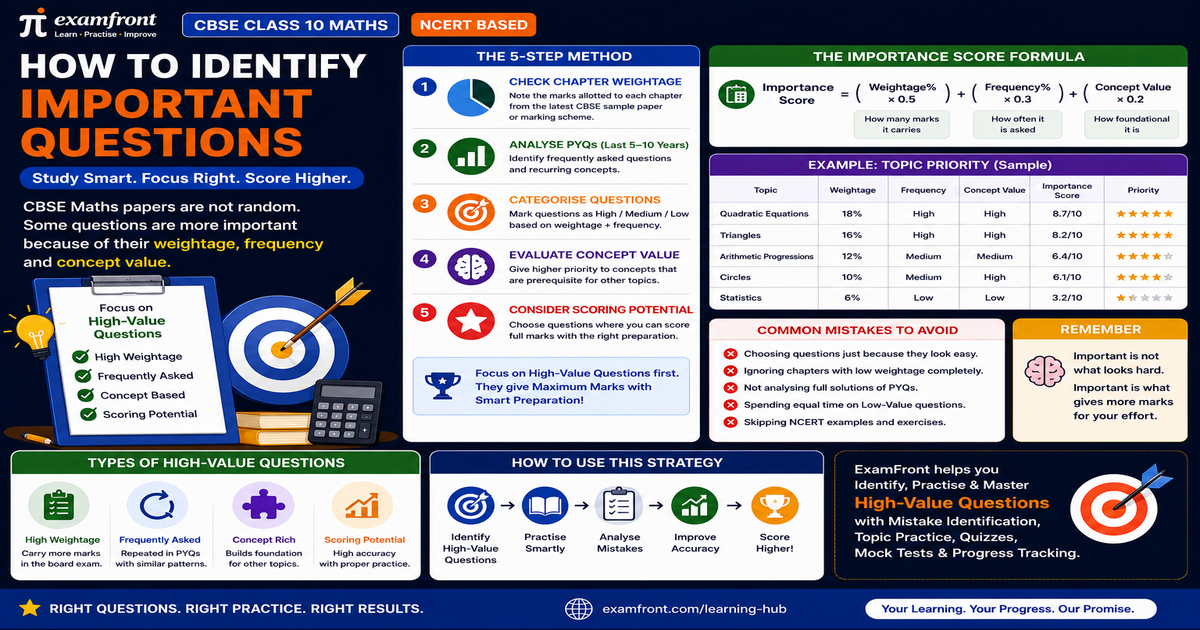
Stop searching for someone’s list of “important questions” — learn to judge importance yourself, using five clear signals, so you always know exactly where to focus.
Every student wants to know which questions are “important” — and the internet is full of lists claiming to tell you. But a handed-down list can’t explain why something matters, and it can’t help you when the exam reframes it. Far more powerful is learning to judge important questions in Class 10 Maths for yourself. This guide gives you a simple framework of five signals — so instead of trusting someone’s list, you can look at any topic and know how much it deserves your attention.
Importance isn’t a list — it’s something you can work out
Here’s the shift: “important” isn’t a fixed set of questions someone hands you. It’s a judgement you can make, using signals that are all available to you. A topic is important to the degree that it carries marks, unlocks other topics, recurs in past papers, appears in many forms, and tends to cost students marks. Learn to read those five signals, and you’ll never again wonder what to prioritise.
We call this the examfront Importance Framework.
The examfront Importance Framework: five signals
Importance comes from five different sources — and it helps to see what kind of importance each one represents:
They’re ordered deliberately — from the most official and objective signal to the most personal. Here’s each one.
1. Weightage — official importance
The most objective signal: how many marks does the topic’s unit carry? This comes straight from CBSE. The Algebra unit is worth 20 marks, Geometry 15 — so topics inside them start with a strong claim on your attention. Check any topic against the unit-wise weightage guide. Marks are the currency of the exam, so this is where importance begins.
One caution worth internalising, because it is the single most common mistake in “important questions” lists online: CBSE publishes weightage by unit, not by chapter. There is no official figure saying Quadratic Equations is worth 18% or Triangles 16% of the paper. Every chapter-level percentage circulating online is somebody’s estimate — and the plausible-looking ones often don’t even add up, because two chapters in the same unit can’t between them claim more marks than the unit holds. Use the seven official unit figures as your weightage signal, and treat chapter percentages as guesswork.
2. Concept Coverage — educational importance
Some topics matter far beyond their own questions, because mastering them unlocks many others. Quadratic Equations is the classic example:
Quadratic Equations → graphs → nature of roots → word problems → higher-order application questions
Get quadratics solid, and a whole chain of other questions becomes accessible. A topic that many other topics depend on is important even if its own weightage is modest — because your return on mastering it is multiplied across everything it unlocks. Foundational topics like this deserve early, deep attention.
3. Frequency — historical importance
How often has the concept appeared in past papers? This is the signal you get from analysing previous year questions — and it’s exactly one input here, not the whole story. A concept the board returns to year after year is clearly one it values. Frequency confirms importance, but it works best combined with the other signals rather than alone. If you don’t yet have a set of papers to read, start with the CBSE Class 10 Maths previous year questions collection.
4. Question Variety — assessment importance
Does the topic appear in many different forms — as an MCQ, a short answer, a case study, a long proof? A concept that shows up across question types is one you need to master flexibly, not just in a single format. High variety means the topic is important and that you need broader practice on it to be ready for however it’s asked.
5. Error Frequency — learning importance
The most personal signal, and a genuinely powerful one: where do students repeatedly lose marks? Some topics aren’t conceptually hard, yet they bleed marks through calculation slips, sign errors, or messy presentation. A topic that’s a known mark-loser is important to secure precisely because it’s costing marks unnecessarily. This connects directly to the examfront Mistake Framework — the errors you (and students generally) keep making flag exactly what to shore up.
The self-check: five questions
To judge any topic, just ask yourself five questions:
| Signal | Ask yourself |
|---|---|
| Weightage | Does this unit carry many marks? |
| Concept Coverage | Does mastering this help elsewhere? |
| Frequency | Does it appear often in PYQs? |
| Question Variety | Does it appear in many forms? |
| Error Frequency | Do students often lose marks here? |
The more “yes” answers, the more important the topic — and the higher it should sit in your study plan.
Where NCERT and CBSE fit into judging importance
Three of the five signals are anchored in documents you can actually check, so it’s worth knowing exactly what each one gives you.
NCERT sets the scope. CBSE sets the paper on the rationalised NCERT syllabus — seven units and fourteen chapters, with Constructions no longer part of it. Nothing outside that can be important, and nothing inside it can be safely ignored. It also means your first pass at any “important” topic should be the NCERT exercises and examples for that chapter, not a new book — see the NCERT Class 10 Maths guide and how to study NCERT Maths.
CBSE sets the weightage — by unit. The 80 theory marks are divided Algebra 20, Geometry 15, Trigonometry 12, Statistics & Probability 11, Mensuration 10, Number Systems 6 and Coordinate Geometry 6. That is your weightage signal in full, and it is official. Chapter-level percentages are not.
CBSE also sets the variety. The paper is 38 questions across five sections in three hours, with no overall choice: Section A is 20 one-mark questions, B is 5 two-markers, C is 6 three-markers, D is 4 five-markers and E is 3 four-mark case studies. A topic that can be asked as a one-mark MCQ and as a five-mark long answer is scoring high on question variety — which is why the question types and the exam pattern are worth reading alongside the weightage table.
One more official number is worth carrying: the question paper design allocates 43 marks to Remembering & Understanding, 19 to Applying, and 18 to Analysing, Evaluating & Creating. More than half the paper rewards knowing your concepts cleanly — so “important” usually means secure the fundamentals of a high-weightage unit, not chase the hardest question in it.
From importance to priority
Importance is only useful when it changes what you do first. Turn your signals into a simple priority level:
- 🔴 High priority — scores high on several signals (e.g. high weightage and high coverage and frequent). Give these your deepest, earliest attention.
- 🟡 Medium priority — strong on one or two signals. Solid practice, but after the high-priority topics.
- 🟢 Low priority — modest across the signals. Still cover them — just don’t over-invest.
Priority tells you the order and depth of your effort — a far more actionable idea than a flat “important / not important” split.
Can an “unimportant” chapter still appear in the exam?
Yes — and this matters, so let’s be clear. Every chapter is examinable. A topic scoring low on these signals can still show up in your paper. Importance never means “skip this”; it means “invest more effort here first.” You prepare the whole syllabus regardless — the framework simply tells you where your deepest work earns the most, and what order to tackle things in. Used this way, it focuses your effort without ever leaving you exposed.
Let the signals be weighed for you
Judging five signals across every topic — and keeping them balanced — is a lot to do by hand. This is exactly how examfront thinks: it continuously combines these same signals to decide which concepts deserve your attention first, then points your practice straight at them. You get a live, personalised priority list — official weightage, concept links, historical frequency, and your own error patterns, all weighed together. See what deserves your attention on examfront and study in priority order, automatically.
Download the 2-page summary
Want the five signals, the self-check and a worked priority example on one printable sheet? Download the 2-page summary PDF.
Frequently asked questions
How do I know which questions are important in Class 10 Maths? Judge a topic against five signals: how many marks its unit carries (weightage), whether it unlocks other topics (concept coverage), how often it appears in past papers (frequency), how many forms it takes (question variety), and how often students lose marks on it (error frequency). Topics scoring high on several are your priorities.
Which are the most important chapters in Class 10 Maths? Rather than a fixed list, use the five signals to judge for yourself — but the Algebra unit (20 marks) and Geometry (15 marks) score high on weightage, and topics like Quadratic Equations and Trigonometry score high on concept coverage and frequency too.
Can an unimportant chapter still appear in the exam? Yes. Every chapter is examinable. Importance tells you where to invest more effort — it never tells you what to skip. Prepare everything; go deepest on the high-priority topics.
Should I only study the important questions? No. Importance guides how deeply to study each topic and in what order — not whether to study it at all. Cover the whole syllabus and give your best effort to the high-priority areas.
Are important questions in CBSE Class 10 Maths based on the NCERT textbook? Yes. CBSE sets the paper on the rationalised NCERT syllabus — seven units and fourteen chapters — so nothing outside NCERT can be important. Note that CBSE publishes weightage by unit, not by chapter: any chapter-wise percentage you see online is an unofficial estimate.
Study in priority order. See what matters most with examfront →