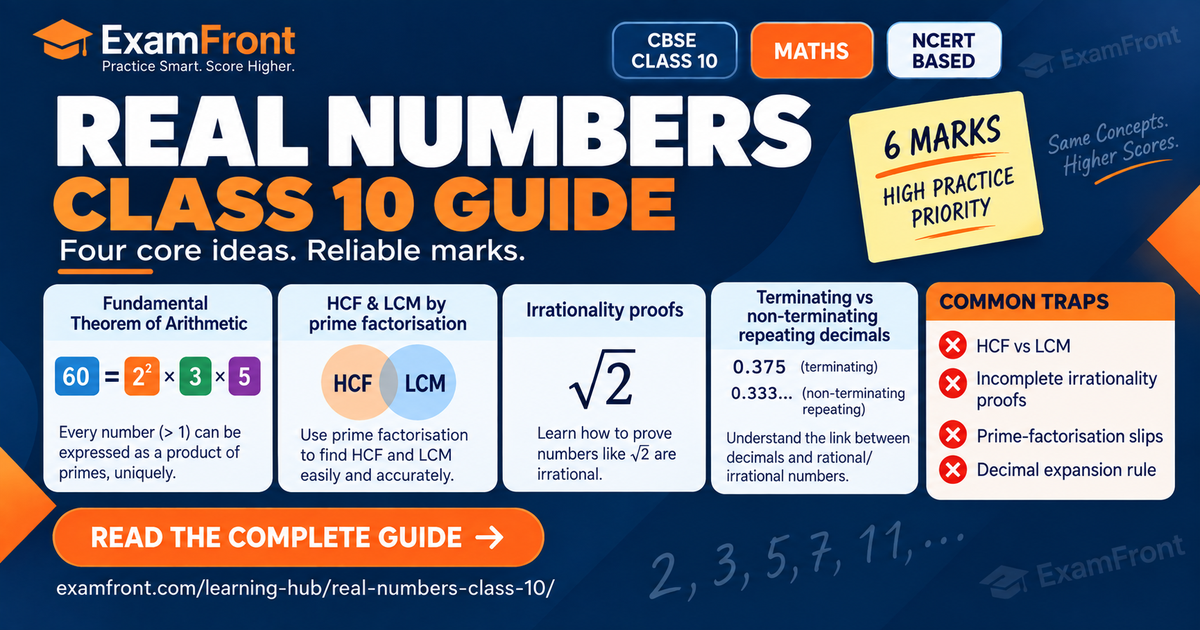
What the Real Numbers chapter covers, how CBSE tests it, the mistakes to avoid, and how to turn it into guaranteed marks.
Real Numbers is the opening chapter of Class 10 Maths — and it’s often underestimated. It looks simple, but it hides a handful of concepts that CBSE tests reliably every year, and it’s one of the most scoring chapters if you get the fundamentals right. This guide orients you: what the chapter covers, how much it’s worth, how the board tests it, the common traps, and the smartest way to master it.
Chapter snapshot
| Unit | Number Systems |
| Weightage | 6 marks |
| Difficulty | ⭐⭐☆☆☆ (relatively easy) |
| Practice priority | High (quick, reliable marks) |
| Prerequisites | Prime numbers, factors, multiples, basic fractions |
| Estimated study time | 2–3 focused sessions |
(Difficulty and study time are a preparation guide, not official CBSE figures.)
What this chapter covers
Real Numbers is built on a small set of powerful ideas. At Class 10 level, the key concepts are:
- The Fundamental Theorem of Arithmetic — every composite number is a unique product of primes, apart from the order of the factors. This underpins much of the chapter.
- HCF and LCM through prime factorisation — writing each number as a product of primes, then reading the HCF off the common factors and the LCM off all of them.
- The HCF × LCM relationship — for two numbers, HCF × LCM = the product of the numbers, so either one gives you the other. It is a genuine shortcut and a genuine trap, because it does not extend to three numbers.
- Irrational numbers and irrationality proofs — proving that numbers like √2, √3 and √5 are irrational by contradiction, the chapter’s classic exam favourite.
Notice how few core ideas there are. That’s what makes Real Numbers so scoreable — master these, and you’ve covered the whole chapter.
Why this chapter matters
Real Numbers isn’t just its own six marks. The ideas here — prime factorisation, rational and irrational numbers, working cleanly with number properties — reappear throughout Algebra, in later number work, and in higher classes. Building a solid foundation in this first chapter genuinely makes the maths that follows easier, so it’s worth doing properly rather than rushing past.
How much is Real Numbers worth?
Real Numbers sits in the Number Systems unit, worth 6 marks in the theory paper (see the unit-wise weightage guide for the full picture). That’s a smaller share than the big units like Algebra or Geometry — but don’t let that fool you into skipping it. Because the concepts are few and well-defined, Real Numbers is a chapter where you can secure nearly every available mark with modest effort. It’s high return, even if it’s not high weightage — exactly the kind of reliable marks you want banked.
How CBSE tests Real Numbers
The board returns to the same core concepts, dressed in familiar forms. You’ll typically see Real Numbers appear as:
- Objective questions — MCQs on HCF/LCM, prime factorisation, or the HCF × LCM relationship (see question types).
- Short-answer problems — finding HCF and LCM, or applying the Fundamental Theorem of Arithmetic to explain why a number is composite, or why 6ⁿ can never end in 0.
- Irrationality proofs — a recurring short-answer question, where you prove a given number is irrational.
As with every chapter, the exact questions change but the concepts repeat — so the winning approach is to master these concept types rather than memorise specific problems. (That’s the whole idea behind analysing previous year questions.)
Common mistakes in Real Numbers
This chapter has a few classic traps that cost students easy marks:
- Mixing up HCF and LCM — knowing which one a problem asks for, and not confusing the methods. The HCF is built from the common prime factors taken to the lowest power; the LCM from all the prime factors taken to the highest power.
- Incomplete irrationality proofs — skipping steps in the proof by contradiction, which loses method marks even when the conclusion is right. The line that earns the mark is “let √2 = p/q where p and q are coprime” — without coprime, there is no contradiction to reach.
- Prime-factorisation slips — small arithmetic errors in breaking a number into primes that derail the whole answer.
- Stretching HCF × LCM to three numbers — the relationship HCF × LCM = the product holds for two numbers only. For 12, 15 and 21 the HCF is 3 and the LCM is 420, so HCF × LCM = 1260 while the product of the three numbers is 3780. Use it as a check on a two-number answer, never on a three-number one.
Most of these are presentation and calculation mistakes rather than concept gaps — which means they’re very fixable once you know to watch for them (this is exactly the kind of pattern the examfront Mistake Framework helps you spot).
Where this sits in the NCERT and CBSE syllabus
This is the shortest chapter in the book, and after the NCERT rationalisation it is shorter still — which is precisely why it is worth being exact about what is left.
NCERT sets the scope. Real Numbers is Chapter 1, and it now has just two content sections: Section 1.2, The Fundamental Theorem of Arithmetic (which is also where HCF and LCM by prime factorisation live) and Section 1.3, Revisiting Irrational Numbers. Watch the numbering: Section 1.1 is a bare Introduction with no exercise, so every exercise number runs one behind its section — Section 1.2 is examined by Exercise 1.1 and Section 1.3 by Exercise 1.2. There are only two exercises in the whole chapter, 7 questions in Exercise 1.1 and 3 in Exercise 1.2 — ten questions in total. That is a short list, and doing all ten properly is a realistic afternoon’s work. The NCERT Class 10 Maths guide and how to study NCERT maths cover how to work through a chapter’s exercises without just reading the solutions.
Two topics were removed, and they are the ones you will still find online. Euclid’s division lemma and division algorithm (the old Section 1.2 and old Exercise 1.1) are gone, and so is “Revisiting Rational Numbers and Their Decimal Expansions” (the old Section 1.4 and old Exercise 1.4) — the terminating versus non-terminating repeating rule based on whether the denominator is of the form 2ⁿ5ᵐ. Both are still printed in older textbook editions and are still served as current by several popular solution sites. Understanding decimal expansions is useful background for telling a rational number from an irrational one, but it is not on the Class 10 syllabus, and you should not spend exam preparation time drilling it.
CBSE sets the shape. The syllabus clause for this chapter reads, in full: “Fundamental Theorem of Arithmetic - statements after reviewing work done earlier and after illustrating and motivating through examples, Proofs of irrationality of √2, √3, √5.” Note how specific the second half is — the board names √2, √3 and √5, so those three proofs and their close relatives (3 + 2√5, 7√5, 1/√2, 6 + √2) are the ones to have cold. The full picture of the paper is in the CBSE Class 10 Maths syllabus and the exam pattern guides.
CBSE sets the priority by unit, not by chapter. The seven units carry 6, 20, 6, 15, 12, 10 and 11 marks, adding to the 80-mark theory paper, with 20 more for internal assessment. Number Systems is that first 6, and Real Numbers is the only chapter in it — so this is one of the very few places where a unit’s marks and a chapter’s marks are the same number. Chapter-wise percentage tables and pie charts circulating online are unofficial estimates; the unit table is the official one.
How it is actually asked. Expect a 1-mark MCQ on HCF/LCM or prime factorisation, a 2-mark question in Section B on finding an LCM from a given HCF, and a 3-mark irrationality proof in Section C. On that proof, the working is the answer: the assumption line, the coprime condition, the algebra, and the closing sentence that names the contradiction each carry marks, which is why how CBSE maths answers are marked matters more here than the arithmetic does.
Skills you’ll build
Master this chapter and you’ll be able to:
- ✓ Find HCF and LCM quickly and accurately by prime factorisation
- ✓ Recognise and prove numbers irrational, with complete working
- ✓ Use HCF × LCM = the product to find one from the other — and know when that shortcut does not apply
- ✓ Apply the Fundamental Theorem of Arithmetic with confidence
Your roadmap to full marks
Here’s the honest truth about this chapter: understanding it takes an afternoon; mastering it takes practice. The concepts are few, so once you grasp the four core ideas, the marks come down to doing enough problems that HCF/LCM, prime factorisation, and irrationality proofs become automatic — quick, accurate, and second nature under exam pressure.
That’s where examfront turns understanding into marks. Instead of solving a handful of textbook questions and hoping, you get targeted, chapter-wise adaptive practice on every Real Numbers concept — with instant feedback that shows you exactly where you slip (a prime-factorisation error? an incomplete proof?) so you fix it fast. The adaptive practice keeps giving you the right questions at the right level, and mistake-tracking reveals your patterns, taking you from “I understand Real Numbers” to “I never lose a mark on it.” Practise Real Numbers on examfront and lock in these marks.
Continue to the next chapter
Once Real Numbers is solid, move on to Polynomials — the next chapter in your Class 10 Maths journey. Or browse the full chapter list to plan your path.
📄 Download the Real Numbers summary (2-page PDF) — the definitions, the formulas, a worked HCF/LCM question and a full irrationality proof, on two printable pages.
Frequently asked questions
Is Real Numbers an important chapter in Class 10 Maths? It carries 6 marks as part of the Number Systems unit — a smaller weightage, but it’s one of the most scoreable chapters because the concepts are few and well-defined. It’s reliable, high-return marks worth securing fully.
What are the main topics in Real Numbers Class 10? The Fundamental Theorem of Arithmetic, finding HCF and LCM by prime factorisation, the HCF × LCM relationship, and proving numbers like √2 irrational. Those are the two NCERT sections the CBSE syllabus examines.
Why do students lose marks in Real Numbers? Usually through avoidable slips — confusing HCF and LCM, incomplete irrationality proofs, or prime-factorisation errors — rather than not understanding the concepts. Careful practice fixes these quickly.
How do I get full marks in Real Numbers? Understand the four core concepts, then practise them until they’re automatic — especially HCF/LCM problems and irrationality proofs, showing complete working for full method marks.
Are decimal expansions and Euclid’s division lemma still part of the NCERT and CBSE Class 10 Real Numbers syllabus? No. Both were removed in the NCERT rationalisation. Euclid’s division lemma was the old Section 1.2 and old Exercise 1.1, and “Revisiting Rational Numbers and Their Decimal Expansions” was the old Section 1.4 and old Exercise 1.4. The chapter now has two content sections and two exercises — Exercise 1.1 with 7 questions and Exercise 1.2 with 3 questions. Older textbook editions and many solution websites still print the removed material, so check the edition before you practise from it.
Turn Real Numbers into guaranteed marks. Practise on examfront →