If you have ever broken a number down into its “building blocks,” you already understand the heart of the Fundamental Theorem of Arithmetic. In Class 10 Maths, this is one of the first big ideas in the Real Numbers chapter — and the good news is that it is far easier than its long name suggests.
In this guide you will learn what the theorem actually says, how to express any number as a product of primes, and how to use that skill to find the HCF and LCM by prime factorisation quickly and confidently in your board exam. Let’s break it down, step by step.
📘 NCERT Location This topic is covered in Chapter 1 — Real Numbers, Section 1.2: The Fundamental Theorem of Arithmetic. It forms the mathematical foundation for HCF, LCM and the later ideas in the chapter, such as proving numbers like √2 are irrational. For a bird’s-eye view of the whole chapter, see the Real Numbers chapter guide.
🎁 Chapter 1 is completely free on examfront — all the learning material, chapter quizzes, and mistake identification for Real Numbers are free, with no premium needed. So you can learn this topic and practise it end to end at no cost.
What is the Fundamental Theorem of Arithmetic?
Here is the theorem in one line:
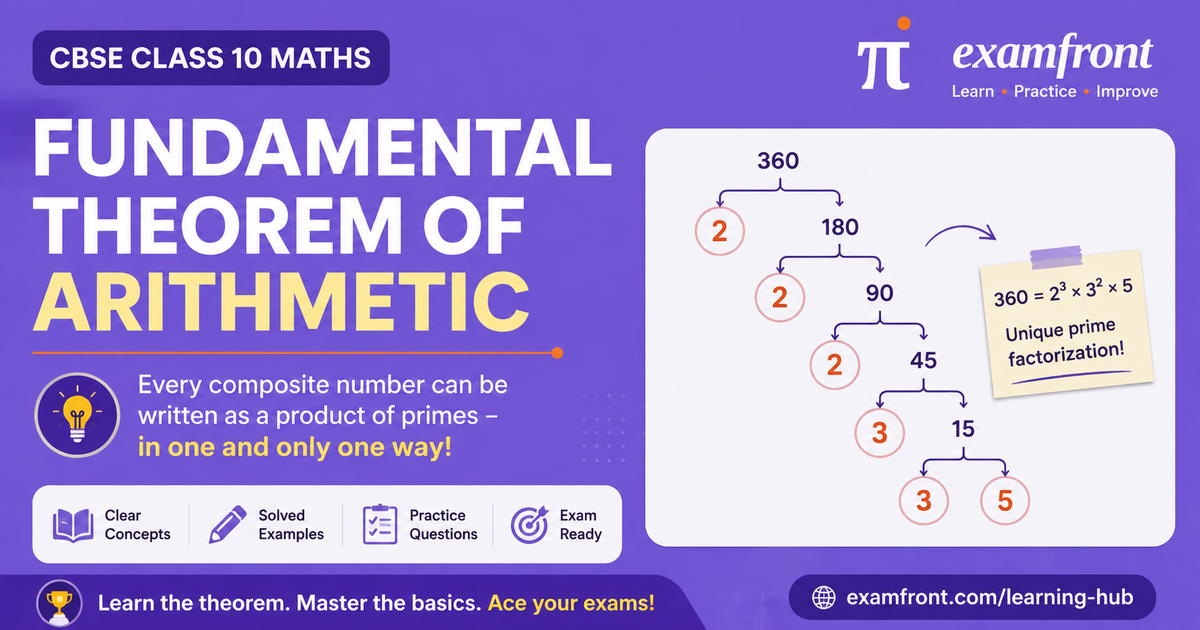
Every composite number can be expressed as a product of prime numbers, and this factorisation is unique — apart from the order in which the primes occur.
Two ideas are hiding inside that sentence:
- Every composite number is a product of primes. Just like every wall is made of bricks, every composite number can be expressed by multiplying prime numbers together.
- There is only one recipe. No matter how you start factorising, you always end up with the same set of primes. The order might change, but the primes never do.
A quick but important clarification: prime numbers already consist of a single prime factor (themselves). The theorem mainly explains how every composite number can be broken into prime numbers in one unique way.
For example:
| Number | Product of primes | Powers of primes |
|---|---|---|
| 12 | 2 × 2 × 3 | 2² × 3 |
| 84 | 2 × 2 × 3 × 7 | 2² × 3 × 7 |
| 360 | 2 × 2 × 2 × 3 × 3 × 5 | 2³ × 3² × 5 |
Whether you write 2 × 3 × 5 or 5 × 3 × 2, it is the same factorisation of 30. That “only one answer” property is exactly what makes the theorem so powerful — and why it is called Fundamental: nearly everything else about integers is built on it.
Quick recap — what is a prime number? A prime number has exactly two factors: 1 and itself (2, 3, 5, 7, 11, 13, …). A composite number has more than two factors (4, 6, 8, 9, 12, …). The number 1 is neither prime nor composite.
🎥 Watch — 60-second Short: Neither prime nor composite?
How to write a number as a product of primes
The easiest method is the factor tree. You keep splitting the number into smaller factors until every branch ends in a prime.
Example: Factorise 84
        84
       /  \
      2    42
          /  \
         2    21
             /  \
            3    7
Reading off the leaves: 84 = 2 × 2 × 3 × 7 = 2² × 3 × 7.
NCERT-style repeated division: Factorise 140
NCERT often shows the same idea as repeated division by the smallest prime that fits:
140 = 2 × 70
    = 2 × 2 × 35
    = 2 × 2 × 5 × 7
    = 2² × 5 × 7
Both methods give the identical answer — that’s the theorem in action.
✏️ Exam Tip: Always write your final answer using powers of primes in ascending order (2² × 5 × 7, not 5 × 2 × 2 × 7). It looks cleaner, is easier to compare when finding HCF/LCM, and prevents silly counting mistakes.
Once you can factorise smoothly, the rest of the chapter becomes easy. If you want to lock in the method, topic practice on examfront lets you drill prime factorisation with instant feedback, so the factor tree becomes second nature before the exam — and for Real Numbers, it’s completely free.
The most common factorisation mistake
A lot of marks are lost by stopping too early:
❌ 60 = 4 × 15          (4 and 15 are NOT prime — keep going!)
✅ 60 = 2 × 2 × 3 × 5 = 2² × 3 × 5
Keep splitting until every leaf is a prime. If a branch can still be broken down, you are not finished.
Why “unique” matters
The uniqueness part is the secret weapon behind almost every board question in this section. Because a number has only one prime factorisation, you can make confident statements like “this number can never end in 0” or “this expression must be composite” — simply by looking at which primes are (or aren’t) present. Keep this idea in your back pocket; you’ll use it again and again below.
Application 1: Finding HCF and LCM by prime factorisation
This is where the theorem earns its marks. Once two numbers are written as products of primes, HCF and LCM fall out almost automatically.
The two rules to memorise:
| Quantity | Rule |
|---|---|
| HCF (Highest Common Factor) | Multiply the smallest power of each common prime |
| LCM (Least Common Multiple) | Multiply the greatest power of every prime that appears |
Worked example: Find the HCF and LCM of 12 and 18
- 12 = 2² × 3
- 18 = 2 × 3²
Now line up the primes:
| Prime | In 12 | In 18 | HCF takes… | LCM takes… |
|---|---|---|---|---|
| 2 | 2² | 2¹ | 2¹ (smaller) | 2² (greater) |
| 3 | 3¹ | 3² | 3¹ (smaller) | 3² (greater) |
- HCF = 2 × 3 = 6
- LCM = 2² × 3² = 4 × 9 = 36
A tiny memory trick: HCF → Has to be common and small; LCM → Large, takes every prime at its highest power.
After a couple of these, patterns start jumping out at you. examfront’s mistake identification is handy here — if you accidentally pick the wrong power, it flags exactly where the slip happened instead of just marking the answer wrong (and it’s free for this chapter). If you’d like to see how examiners categorise these slips, our guide on analysing your mistakes breaks it down.
🎥 Watch — 60-second Short: Find the HCF fast!
The handy HCF × LCM shortcut
For any two positive integers a and b:
HCF(a, b) × LCM(a, b) = a × b
Check it with 12 and 18: HCF × LCM = 6 × 36 = 216, and a × b = 12 × 18 = 216. ✓
This is a genuine time-saver. If a question gives you the HCF and asks for the LCM (or vice versa), you don’t need to factorise at all:
Example: Given HCF(24, 36) = 12, find the LCM.
LCM = (24 × 36) ÷ 12 = 864 ÷ 12 = 72.
⚠️ Important warning: This shortcut works for two numbers only. For three numbers, HCF × LCM is not equal to the product of the numbers, so never apply it to three-number problems.
🎥 Watch — 60-second Short: HCF to LCM in seconds!
Application 2: Can a number end in zero?
Here is a classic board-exam favourite that looks tricky but is actually a one-line idea.
Question: Can 15ⁿ ever end with the digit 0 for any natural number n?
A number ends in 0 only if it is divisible by 10 — and 10 = 2 × 5. So the number must contain both a 2 and a 5 in its prime factorisation.
Now, 15 = 3 × 5, so 15ⁿ = 3ⁿ × 5ⁿ. There is no factor of 2 anywhere. By the uniqueness part of the Fundamental Theorem of Arithmetic, no new prime can appear that isn’t already there. So 15ⁿ can never end in 0.
The same logic answers questions like “Can 6ⁿ end in 5?” — 6ⁿ has no factor of 5, so it can’t. Spot the missing prime, and you’ve solved it.
Application 3: Why some expressions are always composite
Sometimes you’ll be asked to explain why a number like 7 × 11 × 13 + 13 is composite.
Factor out the common 13: 7 × 11 × 13 + 13 = 13 × (7 × 11 + 1) = 13 × 78.
Since it can be written as a product of 13 and 78 (both bigger than 1), it has factors other than 1 and itself — so it is composite, not prime. Spotting the common factor is the whole trick.
💡 Did you know? The same “every number has a unique set of prime factors” idea powers modern internet security. Much of online encryption relies on the fact that multiplying two huge primes is easy, but working backwards to find those primes is extremely hard. The theorem you’re learning in Class 10 sits quietly behind the padlock icon in your browser!
Where this sits in the NCERT and CBSE syllabus
Everything on this page comes from one short stretch of the NCERT textbook, and it helps to know exactly which stretch.
NCERT source. Mathematics — Textbook for Class X, Chapter 1: Real Numbers, Section 1.2 — The Fundamental Theorem of Arithmetic, with Exercise 1.1 as its practice set. Every question type on this page comes straight out of that one exercise:
| Exercise 1.1 | What it asks | Covered above in |
|---|---|---|
| Q1 | Express 140, 156, 3825, 5005, 7429 as products of primes | How to write a number as a product of primes |
| Q2 | Find HCF and LCM of pairs, then verify HCF × LCM = product | Application 1 and the shortcut |
| Q3 | HCF and LCM of three numbers | Application 1 (plus the two-numbers-only warning) |
| Q4 | Given HCF(306, 657) = 9, find the LCM | The HCF × LCM shortcut |
| Q5 | Can 6ⁿ end with the digit 0? | Application 2 |
| Q6 | Why is 7 × 11 × 13 + 13 composite? | Application 3 |
What is no longer in this chapter. In the rationalised NCERT syllabus, Euclid’s division lemma and division algorithm were removed from Real Numbers, along with the section on decimal expansions of rational numbers. If you are revising from an older textbook or an old question bank, skip those pages — the current chapter is this theorem plus the proofs that √2, √3 and √5 are irrational. Our guide to studying NCERT Maths shows how to work through a rationalised chapter without losing time on deleted material, and the NCERT Class 10 Maths guide maps the book as it stands now.
CBSE weight and how it is asked. Real Numbers sits in Unit I — Number Systems, worth 6 of the 80 theory marks. That is a small unit, but the skill travels: prime factorisation reappears in irrational-number proofs, and the same careful-with-powers habit shows up all over Algebra. In the paper this topic typically appears as a 1-mark objective question, a 2-mark short-answer question, or a 3-mark HCF/LCM problem — see how each CBSE question format works to know what each one expects from your answer.
Typical Board Questions from this Section
These are the shapes of questions this topic tends to produce, so aim to be comfortable with each:
- Express a number as a product of its prime factors (e.g., prime factorise 756).
- Find the HCF of two or three numbers using prime factorisation.
- Find the LCM using prime factorisation, or use the HCF × LCM shortcut.
- Show that a given number (like 6ⁿ) can or cannot end in a certain digit.
- Explain why an expression such as 7 × 11 × 13 + 13 is composite.
You can pull chapter-tagged versions of exactly these from the previous year questions for Real Numbers, so you practise what the board actually asks.
Quick revision snapshot
| Concept | Key idea |
|---|---|
| Fundamental Theorem of Arithmetic | Every composite number = unique product of primes |
| Prime factorisation | Use a factor tree or repeated division; write as powers of primes |
| HCF | Smallest power of common primes |
| LCM | Greatest power of all primes |
| Two-number rule | HCF × LCM = product of the two numbers |
| Ends in 0? | Needs both 2 and 5 as prime factors |
Keep this table on your revision card, and add these results to your formula sheet. When you’re doing last-minute revision, spacing snapshots like this across your week helps them stick instead of being crammed the night before.
Exam tips & memory tricks
- Divide by the smallest prime first. Starting with 2, then 3, then 5 keeps your factor tree tidy and reduces errors.
- Write factors with exponents. 2³ × 3² is faster to compare than a long chain of primes — and examiners expect the powers-of-primes form.
- HCF is small, LCM is large. If your HCF comes out bigger than the smaller number, you’ve made a mistake.
- Cross-check with the product rule whenever you have two numbers — it’s a free 5-second verification.
- Underline the missing prime in “ending digit” questions; that missing 2 or 5 is the whole answer.
Common Mistakes to Avoid
1. Swapping the HCF and LCM rules. Why it happens: “Highest” in HCF makes students grab the highest powers. Correct approach: HCF uses the smallest power of common primes; LCM uses the greatest power of all primes. Memory tip: HCF = Common + Conservative (small); LCM = Large + Lavish (take everything).
2. Forgetting a prime that’s only in one number when finding the LCM. Why it happens: Students only look at shared primes. Correct approach: LCM must include every prime that appears in either number, even if it’s in just one. Memory tip: “LCM leaves no prime behind.”
3. Applying HCF × LCM = product to three numbers. Why it happens: The two-number rule feels universal. Correct approach: It holds only for two numbers. For three, factorise properly. Memory tip: “Two numbers, two sides — three breaks the rule.”
4. Calling 1 a prime number. Why it happens: 1 has itself as a factor, so it feels prime. Correct approach: A prime needs exactly two distinct factors; 1 has only one, so it’s neither prime nor composite. Memory tip: “1 is the loner — not prime, not composite.”
5. Stopping the factor tree too early. Why it happens: A branch like 4 × 15 is mistaken for a finished answer. Correct approach: Split until every leaf is prime (60 = 2² × 3 × 5). Memory tip: “If it can still split, it isn’t done.”
Try These Yourself 📝
Prime factorise each number (write your answer using powers of primes):
- 96
- 150
- 315
Check your working on examfront — it walks through each step and highlights exactly where you went wrong, so you learn from the attempt, not just the answer. For Real Numbers, all of this practice is free.
Download the 2-page summary
📄 Download the Fundamental Theorem of Arithmetic 2-page summary (PDF) — key definitions, the HCF/LCM rules and a full worked example on one printable sheet.
Frequently Asked Questions
What is the Fundamental Theorem of Arithmetic in Class 10? It states that every composite number can be expressed as a product of prime numbers, and this prime factorisation is unique except for the order of the factors. For example, 12 = 2 × 2 × 3, and no other combination of primes gives 12.
Why is it called the “Fundamental” Theorem of Arithmetic? Because it is the foundation of number theory. HCF, LCM, divisibility, irrational numbers and decimal expansions all rest on the fact that each composite number has exactly one prime factorisation.
Who discovered the Fundamental Theorem of Arithmetic? An equivalent version appears as Proposition 14 in Book IX of Euclid’s Elements. The first complete, rigorous proof was given by Carl Friedrich Gauss in his Disquisitiones Arithmeticae in 1801.
Does the order of the prime factors matter? No. 2 × 3 × 5 and 5 × 2 × 3 count as the same factorisation of 30. The theorem guarantees the same set of primes every time — only the written order can change.
How do you find HCF and LCM using prime factorisation? Write both numbers as products of primes. For the HCF, multiply the smallest power of each common prime. For the LCM, multiply the greatest power of every prime that appears.
What is the formula linking HCF and LCM of two numbers? For any two positive integers a and b, HCF(a, b) × LCM(a, b) = a × b. It works for two numbers only.
Can a number like 6ⁿ or 15ⁿ ever end in the digit 0? No. A number ends in 0 only if it has both 2 and 5 as prime factors. 6ⁿ has no 5 and 15ⁿ has no 2, so neither can ever end in 0.
Is the Fundamental Theorem of Arithmetic important for the board exam? Yes. It underpins the whole Real Numbers chapter and shows up as prime factorisation, HCF/LCM, and “ending digit” questions in the CBSE Class 10 board exam.
Is the Fundamental Theorem of Arithmetic part of the NCERT and CBSE Class 10 syllabus? Yes. It is Section 1.2 of Chapter 1 (Real Numbers) in the NCERT Class 10 Maths textbook, and Exercise 1.1 is its practice set. In the CBSE course it sits in Unit I — Number Systems, worth 6 of the 80 theory marks. Note that Euclid’s division lemma, which used to open this chapter, was removed in the rationalised syllabus.
A Quick Note on This Guide
This guide follows the CBSE Class 10 NCERT Mathematics textbook (Chapter 1 — Real Numbers, Section 1.2) and is designed as an exam-focused companion for revision and practice — helping you understand and apply the concept, then move into targeted practice on examfront.
Keep Going 🚀
The Fundamental Theorem of Arithmetic is one of the most important ideas in Class 10 Mathematics. Once unique prime factorisation clicks, HCF, LCM, irrational numbers and decimal expansions all become much easier — which is why it’s worth mastering early, as you’ll use it throughout the Real Numbers chapter.
Ready to test yourself? Head to examfront to try a quick chapter quiz on Real Numbers, get instant mistake identification, and see your strength and weakness analysis so you know exactly what to revise next — and remember, the entire Real Numbers chapter is free. Small daily practice, big board-exam results.