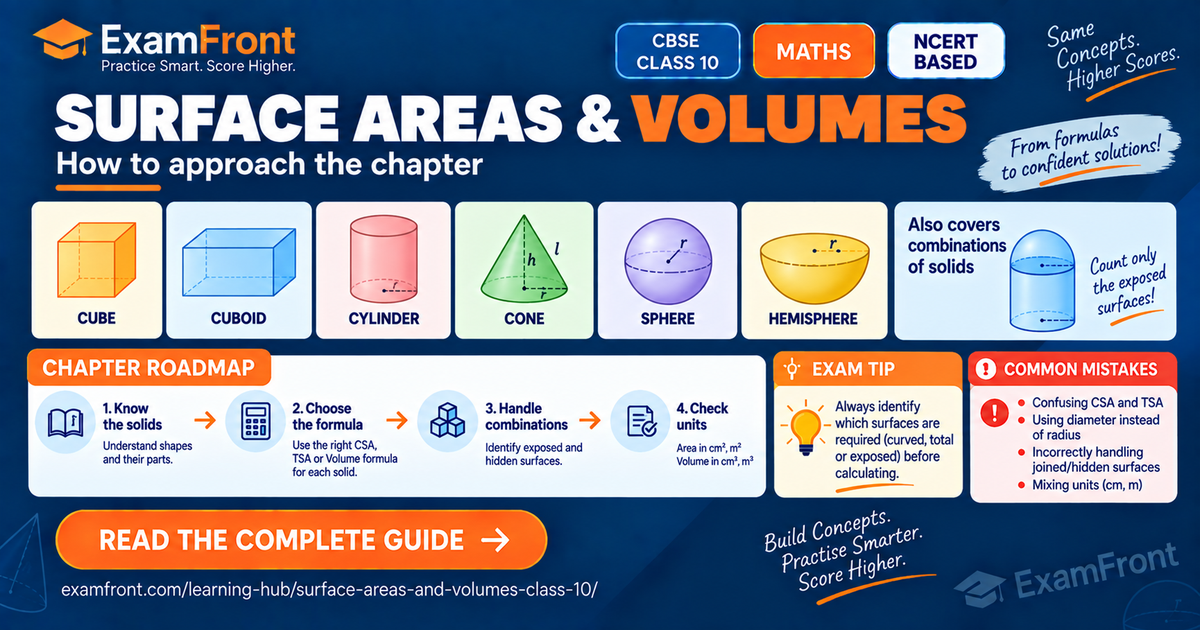
What the Surface Areas and Volumes chapter covers, how CBSE tests it, the mistakes to avoid, and how to turn it into strong marks.
Surface Areas and Volumes is the heart of the Mensuration unit — it’s about the surface areas and volumes of solids, and especially combinations of solids (a cone on a cylinder, a hemisphere on a cube, and so on). It has more formulas than most chapters, so it rewards precision: know your formulas, read the question carefully, and compute cleanly. This guide orients you on what it covers, how it’s tested, the traps, and how to master it.
Chapter snapshot
| Unit | Mensuration |
| Official unit weightage | 10 marks (CBSE assigns marks per unit, not per chapter) |
| Difficulty | Moderate ⭐⭐⭐☆☆ |
| Practice priority | High (frequently tested, formula-rich) |
| Prerequisites | Areas of 2D shapes, basic solids, arithmetic with π |
| Estimated study time | 3–4 focused sessions |
(Difficulty and study time are a preparation guide, not official CBSE figures.)
What this chapter covers
The chapter works with 3D solids and their combinations:
- Standard solids — surface areas and volumes of the cube, cuboid, cylinder, cone, sphere, and hemisphere.
- Three quantities, not one — for the curved solids every question is really asking for one of three things: curved surface area (CSA), the rounded outside only; total surface area (TSA), the curved part plus the flat faces; or volume, the space inside. Naming which one the question wants is the first decision you make. The surface area and volume formulas page has all three for all six solids.
- Combinations of solids — finding the surface area or volume of shapes made by joining solids. Surface areas do not simply add, because the faces at the join are hidden; volumes do. See the surface area of a combination of solids and the volume of a combination of solids guides.
- Cavities and depressions — a hemisphere scooped out of a cube, a conical cavity in a cylinder. Scooping removes a flat face and adds a curved one, so the surface area goes up, not down.
- Choosing surface area vs volume — reading the question to know which is asked.
There are many formulas, but they’re systematic — organised practice makes them stick.
Why this chapter matters
This chapter builds precise, multi-step calculation under real-world framing:
Solid formulas → identify the exposed surfaces → real-world & case-study problems
Combination problems appear frequently, including as case studies, and reward exactly the careful, structured working that senior maths and physics need. Mensuration carries 10 marks, much of it here.
How much is Surface Areas and Volumes worth?
This chapter is part of the Mensuration unit, worth 10 marks (see the unit-wise weightage guide). CBSE assigns weightage by unit, not by individual chapter, so it contributes to that 10-mark total alongside Areas Related to Circles. As a frequent source of long-answer and case-study problems, it’s a high-priority target.
How CBSE tests Surface Areas and Volumes
The board tests the same core skills in familiar formats:
| Common question type | Skill tested |
|---|---|
| Curved or total surface area of a solid | Procedure |
| Volume of a solid | Procedure |
| Combination-of-solids problem | Application |
| Combination with a cavity or depression | Reasoning |
These appear as short-answer, long-answer, and case-study questions — the CBSE question types page explains each format. The wording changes yearly while the skills repeat (the idea behind analysing previous year questions).
Common mistakes in Surface Areas and Volumes
A few classic traps cost students marks here:
- Wrong formula — the biggest risk, given how many formulas the chapter has. CSA and TSA are the pair most often swapped.
- Surface area vs volume confusion — computing one when the question asks the other. The units are the tell: area is cm² or m², volume is cm³ or m³.
- Using the diameter as the radius — measurements are quoted as diameters far more often than you expect.
- Unit errors — mixing units, or forgetting to convert.
- Combination slips — double-counting or missing a hidden surface when solids are joined.
Most are method-selection and calculation mistakes — exactly the kind the examfront Mistake Framework helps you catch and fix.
Where this sits in the NCERT and CBSE syllabus
NCERT sets the scope. This chapter is NCERT Class 10 Chapter 12, and after rationalisation it is short: Section 12.2, Surface Area of a Combination of Solids, examined by Exercise 12.1 (9 questions), and Section 12.3, Volume of a Combination of Solids, examined by Exercise 12.2 (8 questions). Seventeen questions is the whole of what you can be asked. Watch the numbering — Section 12.2 → Exercise 12.1, so the section number and the exercise number never match, a standing trap in this chapter. Exercise 12.1 is worth knowing by name: two cubes joined end to end, the vessel, the cone-on-hemisphere toy, a cube with a hemisphere on top, a hemispherical depression in a cube, a medicine capsule, a tent, a cylinder with a conical cavity, and a wooden article scooped at both ends. For working an NCERT exercise properly, see how to study NCERT maths and the NCERT Class 10 Maths guide.
“Any two” is a self-check you can use in the exam. The CBSE syllabus describes the chapter in one line: “Surface areas and volumes of combinations of any two of the following: cubes, cuboids, spheres, hemispheres and right circular cylinders/cones.” Two things follow. First, conversion of a solid from one shape to another — the melt-and-recast problem — and the frustum of a cone were both removed in the rationalised syllabus, so if an old textbook or a downloaded question bank sets you a melting problem, it is no longer examinable. Second, read “any two” as two kinds of solid, not two pieces: a capsule is a cylinder with a hemisphere at each end, which is three pieces but still only two kinds. If a figure seems to need a third kind, you have misread it. The current scope is on the CBSE Class 10 Maths syllabus page.
CBSE sets the weight, by unit. Surface Areas and Volumes sits in Unit VI Mensuration, worth 10 of the 80 theory marks, shared with Areas Related to Circles. That is worth stating plainly, because CBSE assigns marks by unit, never by chapter — the chapter-wise percentage tables circulating online are unofficial estimates, not a blueprint.
How it is actually asked. Usually a 3-mark question in Section C or a 5-mark question in Section D, and sometimes as a 4-mark case study (the exam pattern page has the full section split). Two page-specific points about the marks: no formula sheet is supplied, so the line where you write the correct formula is itself a mark; and on a combination problem, the line naming which surfaces are exposed is also a mark, because the examiner is marking the decision, not only the arithmetic — see how CBSE maths answers are marked.
Skills you’ll build
Master this chapter and you’ll be able to:
- ✓ Recall and apply the CSA, TSA and volume formulas for each standard solid
- ✓ Find surface areas and volumes of combined solids
- ✓ Handle a cavity or a depression — subtract the hidden flat face, add the curved one
- ✓ Read a question to know whether it wants surface area or volume
Your roadmap to full marks
Understanding this chapter is straightforward; mastering it means making the many formulas reliable and building the care to pick the right one, handle combinations correctly, and keep units clean under pressure.
That’s where examfront turns understanding into marks. You get targeted, chapter-wise adaptive practice on every solid, plus combinations and cavities — with instant feedback that pinpoints exactly where you slip (wrong formula? surface-area/volume mix-up?) so you fix it fast. The adaptive practice serves the right questions at the right level, and mistake-tracking reveals your patterns. Practise Surface Areas and Volumes on examfront and turn Mensuration into strong marks.
Before moving on
Before you move to the next chapter, make sure you can:
- ✓ Recall the CSA, TSA and volume formulas for each solid
- ✓ Solve a combination-of-solids problem
- ✓ Handle a cavity or depression without losing the hidden face
- ✓ Tell whether a question wants surface area or volume
Continue your journey
← Previous: Areas Related to Circles · Next: Statistics →
Or browse the full chapter list to plan your path.
📄 Download the Surface Areas and Volumes 2-page summary (PDF) — the six-solid formula table, the NCERT and CBSE scope, and a worked NCERT question, on one printable sheet.
Frequently asked questions
Is Surface Areas and Volumes an important chapter in Class 10 Maths? Yes — it’s part of the Mensuration unit (10 marks), and combination-of-solids problems are tested reliably, often as long-answer or case-study questions. It’s a high-value chapter.
What are the main topics in Surface Areas and Volumes Class 10? Surface areas and volumes of cubes, cuboids, cylinders, cones, spheres and hemispheres, and combinations of these solids — including shapes with a cavity or a depression, where a hidden face is left out and a curved one added.
Why do students lose marks in Surface Areas and Volumes? Usually through choosing the wrong formula, confusing surface area with volume, using the diameter as the radius, unit errors, or arithmetic slips — the formulas are many, so precision matters.
How do I get full marks in Surface Areas and Volumes? Know the formulas for each solid precisely, be clear on whether a question asks for surface area or volume, handle units carefully, and practise combination problems.
Is Surface Areas and Volumes part of the NCERT and CBSE Class 10 syllabus? Yes. It is NCERT Class 10 Chapter 12, with Section 12.2 on the surface area of a combination of solids (examined by Exercise 12.1, 9 questions) and Section 12.3 on the volume of a combination of solids (examined by Exercise 12.2, 8 questions). It sits in CBSE Unit VI Mensuration, worth 10 of the 80 theory marks, shared with Areas Related to Circles. The rationalised syllabus limits it to combinations of any two of cubes, cuboids, spheres, hemispheres and right circular cylinders or cones — conversion of a solid from one shape to another and the frustum of a cone were both removed.
Turn Surface Areas and Volumes into strong marks. Practise on examfront →