Surface Area of a Combination of Solids Class 10: Method & Examples
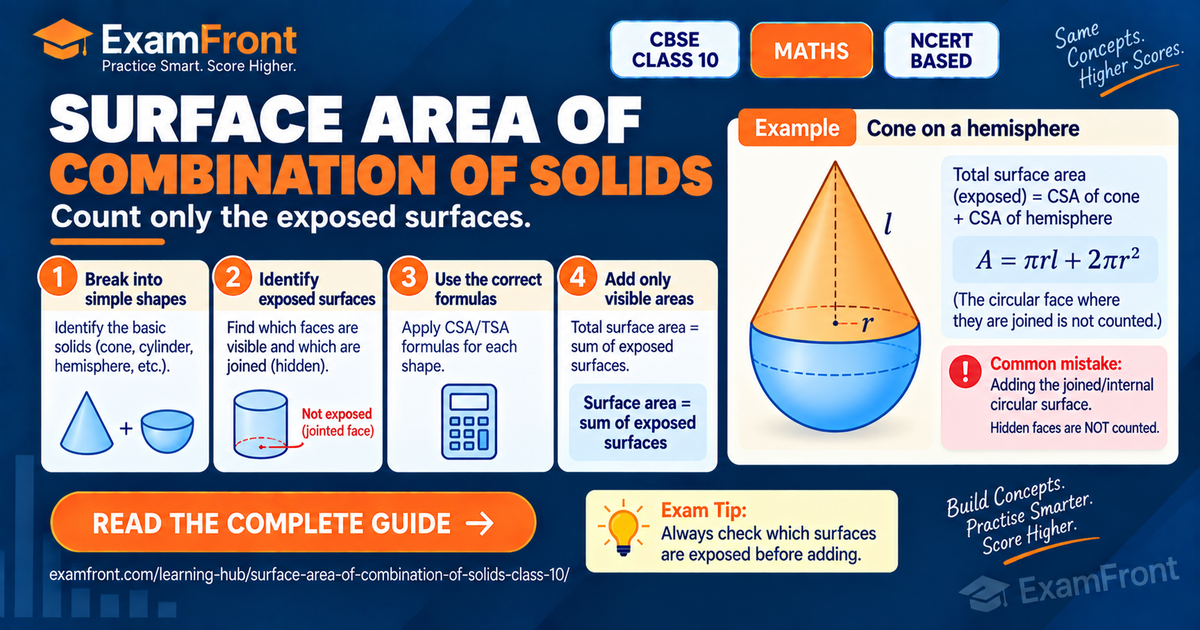
Quick answer: To find the surface area of a combination of solids, add together only the surfaces that stay exposed after the pieces are joined. When two solids are stuck together, the faces that touch are hidden inside the join and are not counted. So the total surface area of a combined solid is always less than the sum of the two solids’ separate surface areas.
A combination of solids is an object made by joining two or more basic solids — a cone, cylinder, sphere, hemisphere, cuboid or cube. Real objects work like this: a test tube is a cylinder plus a hemisphere; a toy top is a cone plus a hemisphere; a truck’s oil container is a cylinder with two hemispherical ends.
This guide gives you one reliable method and worked examples for the exam. It assumes you already know the basic-solid formulas — if you need them, start with the surface area and volume formulas guide. For the harder composite figures (tents, capsules, hollowed cylinders) and full practice, you can go deeper on examfront.
The one rule: add only the exposed surfaces
When you glue two solids together, the two faces that meet disappear from the outside. They are still there, but they are now inside the object, so no paint could ever reach them.
The rule: Surface area of a combined solid = sum of the exposed (visible) surface areas of each part. Never add the hidden faces at the join.
This is why combined-solid problems almost always use Curved Surface Area (CSA). Example: a toy is a cone sitting on a hemisphere. The only surfaces you can see and paint are the curved surface of the cone and the curved surface of the hemisphere. The flat circle where they meet is hidden. So:
Total surface area of the toy = CSA of the cone + CSA of the hemisphere
You do not add the cone’s base or the hemisphere’s flat face — those are the hidden join.
A step-by-step method you can trust
For any surface-area-of-combination problem:
- Identify the basic solids that make up the object (cone, cylinder, hemisphere, cube …).
- Decide which faces are exposed — picture painting the object; only painted faces count.
- Write the surface area as a sum of those exposed pieces (usually CSAs, plus any leftover flat area).
- For a cavity or depression, subtract the flat area it replaces (πr²) and add the curved area it creates (2πr²).
- Substitute the values, keep units square (cm²), and compute.
Worked example 1: a toy (cone on a hemisphere)
Problem. A toy is in the shape of a cone standing on a hemisphere. Both have radius 7 cm, and the cone’s slant height is 25 cm. Find the surface area of the toy. (Use π = 22/7.)
Solution. The exposed surfaces are the curved surface of the hemisphere and the curved surface of the cone.
- CSA of hemisphere = 2πr² = 2 × (22/7) × 7² = 2 × 22 × 7 = 308 cm²
- CSA of cone = πrl = (22/7) × 7 × 25 = 22 × 25 = 550 cm²
- Surface area of toy = 308 + 550 = 858 cm²
Notice we never used the flat faces — the circle where the cone meets the hemisphere is hidden inside the join.
Want to see this with different radii and slant heights until it clicks? examfront’s Topic Practice serves cone-and-hemisphere variations with instant checking.
🎬 Quick challenge: Can you spot what happens to surface area when two solids join?
Worked example 2: a cube with a hemisphere on top
Problem. A wooden block is a cube of edge 7 cm with a hemisphere of the greatest possible diameter fixed on one face. Find the surface area of the solid. (Use π = 22/7.)
Solution. The greatest diameter equals the cube’s edge, so the hemisphere’s diameter = 7 cm and its radius r = 3.5 cm.
The surface = all 6 cube faces, minus the circle the hemisphere covers, plus the hemisphere’s curved surface:
- TSA of cube = 6a² = 6 × 7² = 294 cm²
- Circle covered by the hemisphere = πr² = (22/7) × 3.5² = 38.5 cm² (subtract)
- CSA of hemisphere = 2πr² = 2 × 38.5 = 77 cm² (add)
- Surface area = 294 − 38.5 + 77 = 332.5 cm²
Because we subtract one πr² and add two πr², this neatly simplifies to 6a² + πr² — a handy shortcut for “hemisphere on a cube.”
Depression vs. bump: whether the hemisphere is scooped into the face (a depression) or sits on it (a bump), the surface-area change is the same — remove the flat circle (πr²), add the curved surface (2πr²). Only the volume changes between the two cases.
What’s reserved for deeper practice
The exam also asks these harder combinations: a tent (cylinder + cone, base not covered), a medicine capsule (cylinder + two hemispheres), a cylinder with a conical cavity hollowed out, and articles made by scooping a hemisphere from each end of a cylinder. Each uses the exact same rule — count only the exposed surfaces — but with more pieces to track.
Work the full set of these composite-figure problems, step by step, inside examfront’s Chapter Quizzes, and use Mistake Identification to catch the exact face you keep forgetting to add or subtract.
🎬 Quick challenge: Can you find the surface area of this cone-and-hemisphere toy? 🪀
Where this sits in the NCERT and CBSE syllabus
NCERT sets the scope. This page is Chapter 12, Section 12.2, Surface Area of a Combination of Solids — and it is examined by Exercise 12.1, not by Exercise 12.2. Watch that, because it is a standing trap in this chapter: Section 12.2 → Exercise 12.1 (9 questions) and Section 12.3 → Exercise 12.2 (8 questions), so the section number and the exercise number never match. Nine questions is the whole of what you can be asked on this method, and they are worth knowing by name: two cubes joined end to end; a vessel (a hollow cylinder on a hollow hemisphere); the cone-on-hemisphere toy; a cube with a hemisphere of the greatest diameter on top — which is this guide’s Worked example 2; a hemispherical depression cut into a cube; a medicine capsule; a tent; a cylinder with a conical cavity; and a wooden article with a hemisphere scooped from each end. For the chapter end to end, use the Surface Areas and Volumes chapter guide; for working an NCERT exercise properly, see how to study NCERT maths and the NCERT Class 10 Maths guide.
“Any two” is a self-check you can use in the exam. The CBSE syllabus describes this chapter in a single line: “Surface areas and volumes of combinations of any two of the following: cubes, cuboids, spheres, hemispheres and right circular cylinders/cones.” Conversion of a solid from one shape to another and the frustum of a cone were both removed in the rationalised syllabus, so nothing outside that list can appear. Read “any two” as two kinds of solid, not two pieces — the medicine capsule is a cylinder with a hemisphere at each end, which is three pieces but still only two kinds. If a figure seems to need a third kind of solid, you have misread the figure. The current scope is on the CBSE Class 10 Maths syllabus page.
CBSE sets the weight. Surface Areas and Volumes sits in Unit VI Mensuration, worth 10 of the 80 theory marks — and it shares those 10 marks with Areas Related to Circles. That is worth saying plainly, because CBSE assigns marks by unit, never by chapter: the chapter-wise percentage tables circulating online are unofficial estimates, not a blueprint. The official split is on the unit-wise weightage page.
How it is actually asked. A combination-of-solids question usually lands as a 3-mark question in Section C or a 5-mark question in Section D, and occasionally inside a 4-mark case study; the full shape of the paper is on the exam pattern page. And here is the part students under-rate: the line where you name which surfaces are exposed is itself worth a mark. The examiner is marking the decision, not only the arithmetic, which is why “surface area = CSA of cone + CSA of hemisphere” should be written out in full before a single number goes in — see how CBSE maths answers are marked. You can drill exactly that on examfront.
Key Takeaways
- Surface area of a combined solid = sum of the exposed surfaces only; joined faces are hidden.
- The combined surface area is always less than the sum of the two separate surface areas.
- Combined problems mostly use CSA of each part (πrl for cone, 2πr² for hemisphere, 2πrh for cylinder).
- For a cavity or depression: subtract the flat circle (πr²), add the curved surface (2πr²).
- “Hemisphere on a cube” shortcut: surface area = 6a² + πr².
- Syllabus: NCERT Section 12.2 → Exercise 12.1, 9 questions; CBSE asks combinations of any two kinds of solid, inside Unit VI Mensuration, 10 of 80 marks.
Quick Facts
- CSA of cone = πrl; CSA of hemisphere = 2πr²; CSA of cylinder = 2πrh.
- Toy (cone on hemisphere): surface area = 2πr² + πrl.
- A hemispherical depression changes surface area by +πr² overall (−πr² flat, +2πr² curved).
- Surface area is always in square units (cm², m²).
- The flat face at a join is never part of the surface area.
- NCERT Exercise 12.1 has 9 questions — that is the entire examinable set for this method.
- Frustum of a cone and conversion of a solid from one shape to another are no longer in the Class 10 syllabus.
Common Mistakes
- Adding both solids’ full TSAs — this double-counts the hidden join; add only exposed surfaces.
- Including the flat face at the join — that face is inside the solid, not on the surface.
- Forgetting to subtract the base circle for a depression — remove πr² before adding 2πr².
- Using the cone’s vertical height instead of slant height — CSA needs l = √(r²+h²).
- Leaving the answer in cm instead of cm² — surface area is a squared unit.
📄 Download the 2-page Surface Area of a Combination of Solids summary (PDF) — the rule and the method on page 1, three NCERT Exercise 12.1 questions worked in full on page 2.
FAQ
How do you find the surface area of a combination of solids in Class 10? Add only the surfaces that stay exposed after joining. Hidden faces at the join are not counted. For a cone on a hemisphere, surface area = CSA of cone + CSA of hemisphere = πrl + 2πr².
Why is the surface area of a combined solid not equal to the sum of the two solids’ surface areas? Because the two faces that touch when joined are hidden inside the object. Adding both full surface areas would count these hidden faces, so the true combined surface area is always less than the simple sum.
What is the surface area of a toy that is a cone on a hemisphere? For a cone on a hemisphere of the same radius r, surface area = 2πr² + πrl, where l is the cone’s slant height. The flat faces where they meet are hidden and not counted.
How do you handle a hemispherical depression or cavity when finding surface area? Remove the flat circle it covers (πr²) and add the curved surface it creates (2πr²). A cube with a hemisphere on one face has surface area = 6a² − πr² + 2πr² = 6a² + πr².
Do you use total surface area or curved surface area for combined solids? Mostly curved surface area (CSA) of each exposed part, plus any flat face that stays visible. Any flat face hidden at the join is left out.
Is surface area of a combination of solids part of the NCERT and CBSE Class 10 syllabus? Yes. It is NCERT Class 10 Chapter 12, Section 12.2, Surface Area of a Combination of Solids, and it is examined by Exercise 12.1 — 9 questions in total. Watch the numbering: Section 12.2 is tested by Exercise 12.1, not by Exercise 12.2. The chapter sits in CBSE Unit VI Mensuration, worth 10 of the 80 theory marks, shared with Areas Related to Circles. The CBSE syllabus restricts you to combinations of any two of: cubes, cuboids, spheres, hemispheres and right circular cylinders/cones — conversion of a solid from one shape to another and the frustum of a cone were both removed in the rationalised syllabus. It is usually asked as a 3-mark question in Section C or a 5-mark question in Section D.
Related Concepts
- Surface Area and Volume Formulas (12.1) — the six basic-solid formulas this method combines; see the formula sheet.
- Volume of a Combination of Solids (12.3) — where volumes simply add up; see the volume of a combination guide.
- Area of Sector and Segment of a Circle (Chapter 11) — the circle-area foundation for πr² faces; see the area of sector and segment guide.
- Class 10 Maths All Formulas — the complete cross-chapter formula reference; see the Class 10 Maths all formulas page.
Ready to test yourself? Start with examfront’s Surface Areas and Volumes quiz, track which combined shapes trip you up with Progress Tracking, and get personalised help exactly where you slip.