Surface Area and Volume Formulas Class 10: All Solids (Chapter 12)
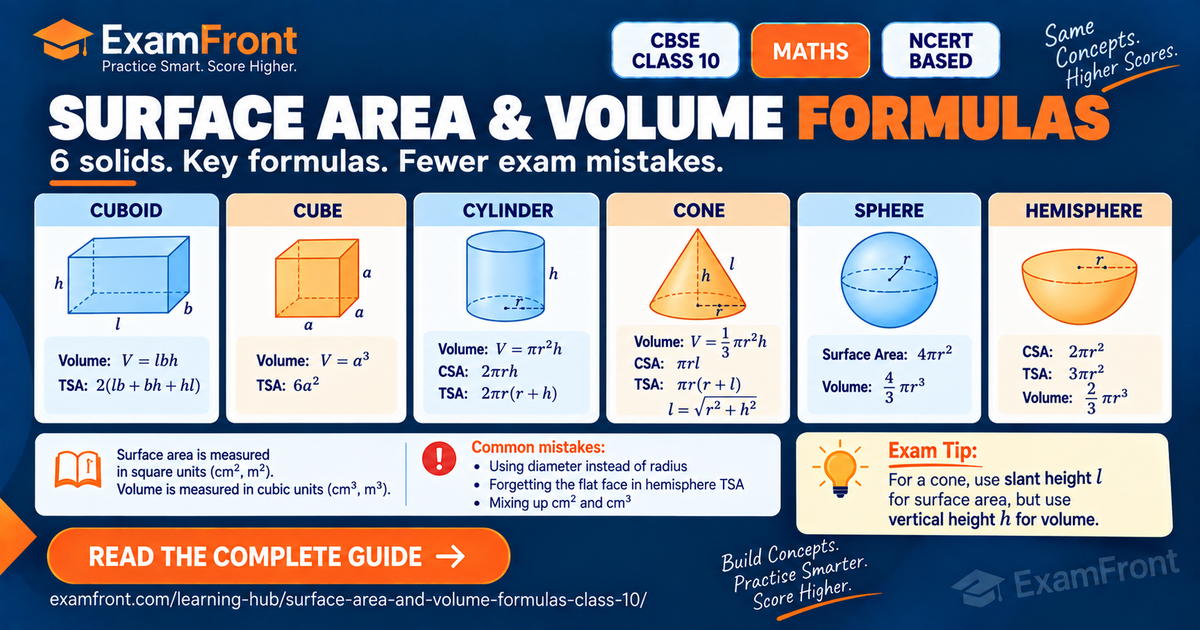
Quick answer: Every question in Chapter 12 (Surface Areas and Volumes) is built from six basic solids. Their key formulas are: cuboid — volume = l×b×h, TSA = 2(lb+bh+hl); cube — volume = a³, TSA = 6a²; cylinder — volume = πr²h, CSA = 2πrh, TSA = 2πr(r+h); cone — volume = (1/3)πr²h, CSA = πrl (with l = √(r²+h²)); sphere — surface area = 4πr², volume = (4/3)πr³; hemisphere — CSA = 2πr², TSA = 3πr², volume = (2/3)πr³.
Surface area is the area of the outer covering of a solid, measured in square units (cm², m²). Volume is the amount of space a solid occupies, measured in cubic units (cm³, m³). Getting these two ideas separate is the whole game: surface area is about covering a shape, volume is about filling it.
This guide is your Class 10 formula sheet for Chapter 12. Every formula comes with what it means, what each letter stands for, the condition it needs, and one worked example — the exact toolkit for solving combination-of-solids problems later. When you want the harder mixed problems and full practice sets, you can work through them on examfront.
Two key terms: CSA, LSA and TSA
Before the formulas, fix three labels that appear everywhere in this chapter:
- Curved Surface Area (CSA) — the area of only the curved face of a round solid (the side of a cylinder or cone).
- Lateral Surface Area (LSA) — the area of the side faces of a flat-faced solid (the four walls of a cuboid or cube, leaving out top and bottom).
- Total Surface Area (TSA) — the area of every face added together: the curved/side faces plus the flat faces.
One-line rule: TSA = CSA (or LSA) + the flat faces. If a shape is “open” (like a pipe or a bucket without a lid), you leave out the missing face.
Cuboid and cube formulas
A cuboid is a box-shaped solid with length l, breadth b and height h. A cube is a special cuboid where all edges are equal to a.
| Solid | Lateral SA | Total SA | Volume |
|---|---|---|---|
| Cuboid (l, b, h) | 2h(l+b) | 2(lb+bh+hl) | l×b×h |
| Cube (edge a) | 4a² | 6a² | a³ |
- Meaning: a cuboid has 6 rectangular faces; TSA adds all of them. Volume = area of base × height.
- Variables: l = length, b = breadth, h = height, a = edge length. All in the same unit.
- Condition: all measurements must be in one unit before you calculate.
Worked Example 1. A cuboid measures 10 cm × 8 cm × 5 cm. Find its total surface area and volume.
- TSA = 2(lb+bh+hl) = 2(10×8 + 8×5 + 5×10) = 2(80+40+50) = 2×170 = 340 cm²
- Volume = l×b×h = 10×8×5 = 400 cm³
Cylinder formulas
A cylinder is a solid with two equal circular ends joined by a curved surface — think of a tin can. Let r be the base radius and h the height.
- CSA (curved side only): 2πrh
- TSA (closed cylinder): 2πrh + 2πr² = 2πr(r+h)
- Volume: πr²h
Here πr² is the area of one circular end, and there are two of them (top and bottom). Volume = area of the circular base × height.
Worked Example 2. A cylinder has radius 7 cm and height 10 cm. Find its CSA, TSA and volume. (Use π = 22/7.)
- CSA = 2πrh = 2 × (22/7) × 7 × 10 = 440 cm²
- TSA = 2πr(r+h) = 2 × (22/7) × 7 × (7+10) = 2 × 22 × 17 = 748 cm²
- Volume = πr²h = (22/7) × 7² × 10 = 22 × 7 × 10 = 1540 cm³
Once you can pull the right formula instantly, mixed problems get easy. examfront’s Topic Practice for Surface Areas and Volumes gives you graded questions the moment you finish a concept.
🎬 Quick challenge: Can you find the volume ratio of a cone to a cylinder? 🥤
Cone formulas
A cone has a circular base of radius r, a vertical height h (from the tip straight down to the centre of the base), and a slant height l (from the tip to the edge of the base along the surface). These three are linked by the Pythagoras theorem:
l = √(r² + h²)
- CSA (curved surface): πrl
- TSA (with base): πrl + πr² = πr(r+l)
- Volume: (1/3)πr²h
Watch the height you use: CSA and TSA use the slant height l; volume uses the vertical height h. Mixing them up is the single most common cone mistake.
Worked Example 3. A cone has base radius 7 cm and vertical height 24 cm. Find its slant height, CSA, TSA and volume. (Use π = 22/7.)
- Slant height l = √(7² + 24²) = √(49+576) = √625 = 25 cm
- CSA = πrl = (22/7) × 7 × 25 = 550 cm²
- TSA = πr(r+l) = (22/7) × 7 × (7+25) = 22 × 32 = 704 cm²
- Volume = (1/3)πr²h = (1/3) × (22/7) × 49 × 24 = 1232 cm³
Sphere and hemisphere formulas
A sphere is a perfectly round solid (a ball) of radius r. A hemisphere is exactly half of a sphere, so it has one flat circular face.
| Solid | Curved SA | Total SA | Volume |
|---|---|---|---|
| Sphere (radius r) | 4πr² | 4πr² | (4/3)πr³ |
| Hemisphere (radius r) | 2πr² | 3πr² | (2/3)πr³ |
- Meaning: a sphere has no flat face, so its CSA and TSA are the same (4πr²). A hemisphere’s TSA adds the flat circular face πr² to its curved 2πr², giving 3πr².
- Variables: r = radius. The volume of a hemisphere is half the sphere’s, which is why it is (2/3)πr³.
Worked Example 4. Find the total surface area and volume of a hemisphere of radius 7 cm. (Use π = 22/7.)
- CSA = 2πr² = 2 × (22/7) × 49 = 308 cm²
- TSA = 3πr² = 3 × (22/7) × 49 = 462 cm²
- Volume = (2/3)πr³ = (2/3) × (22/7) × 343 = 2156/3 ≈ 718.67 cm³
Sphere and hemisphere problems are where students slip most in mensuration. examfront’s Chapter Quizzes let you drill them with instant feedback and track exactly which formula you keep confusing.
🎬 Quick challenge: Can you find the sphere-to-cylinder volume ratio? ⚽
How these formulas power the rest of Chapter 12
Every “real-life” object in this chapter — a toy, a capsule, a tent, a glass, a truck’s oil container — is just two of these six solids joined together. Once you know the six formulas above, the chapter splits into two skills:
- Surface area of a combination — add only the exposed surfaces (the joined faces disappear). See the Surface Area of a Combination of Solids guide.
- Volume of a combination — simply add the volumes (nothing disappears). See the Volume of a Combination of Solids guide.
Master the six here first; the combined problems become quick after that.
Where this sits in the NCERT and CBSE syllabus
NCERT sets the scope. These six solids belong to Chapter 12, Surface Areas and Volumes. The chapter has only two content sections — 12.2 Surface Area of a Combination of Solids and 12.3 Volume of a Combination of Solids — and two exercises. Watch the numbering, because it is a standing trap: Section 12.2 is examined by Exercise 12.1 (9 questions) and Section 12.3 by Exercise 12.2 (8 questions), so the section number and the exercise number never match. Seventeen questions is the entire chapter. Notice also what NCERT does not do here — it never re-derives the six formulas on this page. It assumes you already have them and opens straight into combinations, which is exactly why a formula sheet like this one is worth learning cold. For the chapter end to end, use the Surface Areas and Volumes chapter guide; for working an NCERT chapter properly, see how to study NCERT maths and the NCERT Class 10 Maths guide.
Two topics were removed, and that narrows what you can be asked. Conversion of a solid from one shape to another, and the frustum of a cone, are both out of the rationalised syllabus. The CBSE syllabus now describes this chapter in a single line: “Surface areas and volumes of combinations of any two of the following: cubes, cuboids, spheres, hemispheres and right circular cylinders/cones.” Read “any two” as a self-check you can actually use in the exam — if a figure seems to need a third kind of solid, you have misread it. The current scope is on the CBSE Class 10 Maths syllabus page.
CBSE sets the weight. Surface Areas and Volumes sits in Unit VI Mensuration, worth 10 of the 80 theory marks — and it shares those 10 marks with Areas Related to Circles. That is worth saying plainly, because CBSE assigns marks by unit, never by chapter: the chapter-wise percentage tables circulating online are unofficial estimates, not a blueprint. The official split is on the unit-wise weightage page, and every formula across all seven units is collected on the Class 10 Maths all formulas sheet.
How it is actually asked. The paper is 80 theory marks plus 20 internal assessment, 38 questions, five sections, three hours, with no overall choice — the full shape is on the exam pattern page. A combination-of-solids question usually lands as a 3-mark question in Section C or a 5-mark question in Section D, and occasionally inside a 4-mark case study. No formula sheet is supplied in the exam, so writing the correct formula is itself a mark — and on a 5-marker the substitution line and the units line carry marks of their own even if the arithmetic slips. That is the reason to recall all six from memory rather than merely recognise them. You can drill exactly that on examfront.
Key Takeaways
- Chapter 12 is built from six solids: cuboid, cube, cylinder, cone, sphere, hemisphere.
- Surface area is in square units (cm²); volume is in cubic units (cm³) — never mix them.
- TSA = CSA/LSA + flat faces. For open shapes, leave out the missing face.
- Cone: CSA/TSA use slant height l = √(r²+h²); volume uses vertical height h.
- Hemisphere volume = half the sphere’s, i.e. (2/3)πr³; its TSA is 3πr².
- Syllabus: NCERT Section 12.2 → Exercise 12.1 and 12.3 → Exercise 12.2, 17 questions in all; CBSE asks combinations of any two of these solids, inside Unit VI Mensuration, 10 of 80 marks.
Quick Facts
- Cuboid volume = lbh; cube volume = a³.
- Cylinder: CSA = 2πrh, volume = πr²h.
- Cone: CSA = πrl, volume = (1/3)πr²h, l = √(r²+h²).
- Sphere: SA = 4πr², volume = (4/3)πr³.
- Hemisphere: CSA = 2πr², TSA = 3πr², volume = (2/3)πr³.
- A cone’s volume is one-third of a cylinder with the same radius and height.
- NCERT Chapter 12 has just two exercises — 12.1 (9 questions) and 12.2 (8 questions).
- Frustum of a cone and conversion of a solid from one shape to another are no longer in the Class 10 syllabus.
Common Mistakes
- Using slant height in the cone’s volume — volume needs vertical height h, not l.
- Forgetting the flat face in TSA — a hemisphere’s TSA is 3πr², not 2πr².
- Mixing units — convert everything to one unit (cm or m) before calculating.
- Writing volume in cm² or area in cm³ — surface area is squared, volume is cubed.
- Using diameter as radius — always halve the diameter first.
📄 Download the 2-page Surface Area and Volume formula summary (PDF) — all six solids on page 1, a full 5-mark worked example on page 2.
FAQ
What are the surface area and volume formulas for Class 10 Chapter 12? Cuboid: volume = l×b×h, TSA = 2(lb+bh+hl). Cube: volume = a³, TSA = 6a². Cylinder: volume = πr²h, CSA = 2πrh, TSA = 2πr(r+h). Cone: volume = (1/3)πr²h, CSA = πrl, l = √(r²+h²). Sphere: SA = 4πr², volume = (4/3)πr³. Hemisphere: CSA = 2πr², TSA = 3πr², volume = (2/3)πr³.
What is the difference between curved surface area (CSA) and total surface area (TSA)? CSA (lateral surface area) is only the curved or side faces of a solid. TSA is the CSA plus the flat faces. For a closed cylinder, TSA = CSA + 2πr² = 2πr(r+h).
What is the slant height of a cone and how do you find it? The slant height l is the distance from the cone’s tip to the edge of its base along the surface, found by l = √(r²+h²). CSA (πrl) uses slant height; volume ((1/3)πr²h) uses vertical height.
What is the volume formula for a sphere and a hemisphere in Class 10? A sphere of radius r has volume (4/3)πr³; a hemisphere has volume (2/3)πr³, exactly half. A hemisphere’s CSA is 2πr² and its TSA is 3πr².
When should I use π = 22/7 and when π = 3.14 in Class 10? Use 22/7 when the radius or diameter is a multiple of 7 (the numbers cancel cleanly); use 3.14 otherwise, and always use the value the question specifies.
Are surface area and volume formulas part of the NCERT and CBSE Class 10 syllabus? Yes. They are NCERT Class 10 Chapter 12, Surface Areas and Volumes: Section 12.2 (surface area of a combination of solids) is examined by Exercise 12.1 with 9 questions, and Section 12.3 (volume of a combination) by Exercise 12.2 with 8 questions — 17 in total. The chapter sits in CBSE Unit VI Mensuration, worth 10 of the 80 theory marks, shared with Areas Related to Circles. Conversion of solids and the frustum of a cone were removed in the rationalised syllabus, so you are only asked about combinations of any two of: cubes, cuboids, spheres, hemispheres and right circular cylinders/cones.
Related Concepts
- Surface Area of a Combination of Solids (12.2) — how to add only the exposed surfaces when solids are joined; see the surface area of a combination of solids guide.
- Volume of a Combination of Solids (12.3) — how volumes simply add up; see the volume of a combination of solids guide.
- Area of Sector and Segment of a Circle (Chapter 11) — the circle-area ideas behind circular bases; see the area of sector and segment guide.
- Class 10 Maths All Formulas — the full formula sheet across every chapter; see the Class 10 Maths all formulas page.
Ready to lock these in? Try examfront’s Surface Areas and Volumes quiz, use Progress Tracking to see which solids trip you up, and get personalised help exactly where you slip.