Relationship Between Zeroes and Coefficients of a Polynomial (Class 10)
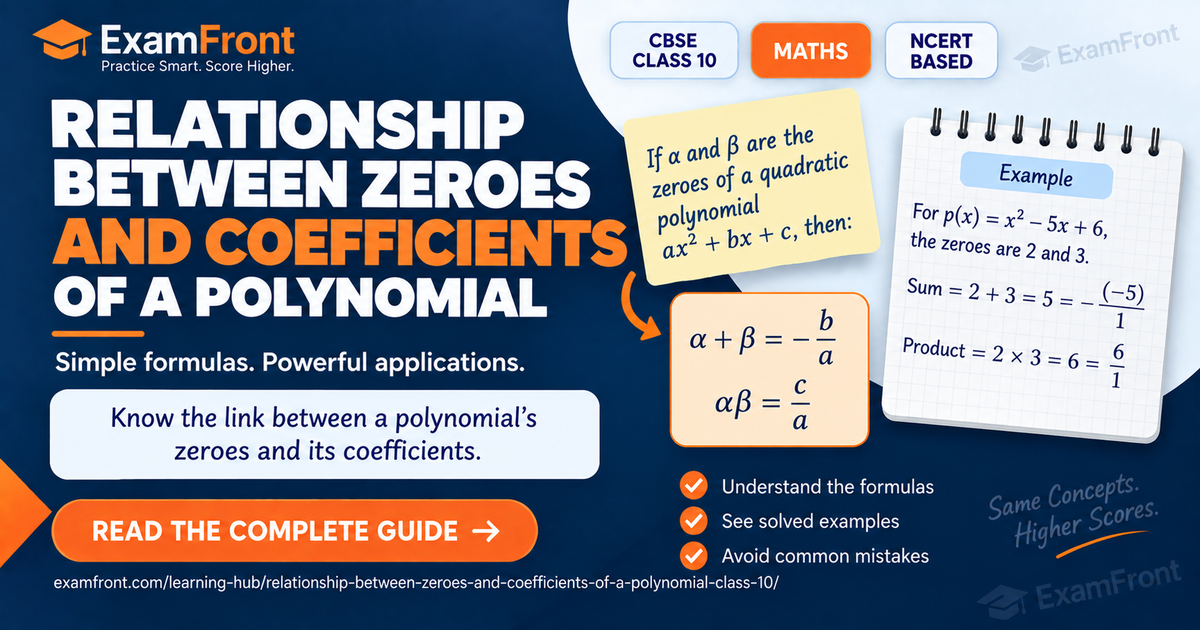
In one line: for a quadratic polynomial ax² + bx + c with zeroes α and β, the sum of the zeroes is α + β = −b/a and the product of the zeroes is αβ = c/a.
This is one of the most useful ideas in the whole Polynomials chapter, because it lets you know the sum and product of the zeroes straight from the coefficients — without solving the polynomial at all. If you can read off a, b and c, you already know two important facts about the zeroes.
This guide covers Section 2.3 of your NCERT chapter, which is the quadratic case — that is exactly what the CBSE Class 10 syllabus examines, and it is what Exercise 2.2 asks you to do. The same pattern extends to a cubic polynomial ax³ + bx² + cx + d, and that extension is covered further down as background rather than as exam material. Everything here builds directly on the meaning of a zero of a polynomial.
▶️ Watch the 30-second reel: Find the sum of zeroes! 🤔
What are the zeroes and coefficients? (quick recap)
A zero of a polynomial p(x) is a value of x, say k, for which p(k) = 0. A quadratic polynomial can have at most two zeroes; a cubic can have at most three.
The coefficients are the fixed numbers multiplying each power of x. In the standard quadratic form ax² + bx + c:
- a = coefficient of x² (must not be 0),
- b = coefficient of x,
- c = constant term.
For example, in 2x² − 8x + 6 we have a = 2, b = −8 and c = 6. Being able to name these correctly — with their signs — is the whole skill, so it is worth being slow and careful here. A quick refresher on classifying polynomials lives in Types of Polynomials — linear, quadratic, cubic.
The relationship for a quadratic polynomial
For a quadratic polynomial ax² + bx + c (with a ≠ 0) whose zeroes are α and β:
- Sum of zeroes: α + β = −b/a = −(coefficient of x) ÷ (coefficient of x²)
- Product of zeroes: αβ = c/a = (constant term) ÷ (coefficient of x²)
Where these come from (the intuition). If α and β are the zeroes, then (x − α) and (x − β) are factors, so we can write
ax² + bx + c = a(x − α)(x − β) = a[x² − (α + β)x + αβ] = ax² − a(α + β)x + aαβ.
Comparing the matching terms on both sides:
- comparing the x terms: b = −a(α + β), which rearranges to α + β = −b/a,
- comparing the constant terms: c = aαβ, which rearranges to αβ = c/a.
Conditions: this applies to any quadratic with a ≠ 0, and it works whether the zeroes are whole numbers, fractions, or irrational — you do not even need the zeroes to be “nice.”
Worked example 1 — a first check
Take p(x) = 2x² − 8x + 6. Splitting the middle term, 2x² − 8x + 6 = 2(x − 1)(x − 3), so the zeroes are 1 and 3. Here a = 2, b = −8, c = 6.
| Quantity | From the zeroes | From the coefficients | Match? |
|---|---|---|---|
| Sum | 1 + 3 = 4 | −b/a = −(−8)/2 = 4 | ✓ |
| Product | 1 × 3 = 3 | c/a = 6/2 = 3 | ✓ |
Both sides agree, so the relationship checks out.
▶️ Watch the 30-second reel: Product of zeroes in seconds! 🤔
Worked example 2 — verifying the relationship (exam-style)
Find the zeroes of x² + 7x + 10 and verify the relationship between the zeroes and the coefficients.
Factorise: x² + 7x + 10 = (x + 2)(x + 5), so the zeroes are −2 and −5. Here a = 1, b = 7, c = 10.
- Sum from zeroes: (−2) + (−5) = −7; from coefficients: −b/a = −7/1 = −7 ✓
- Product from zeroes: (−2) × (−5) = 10; from coefficients: c/a = 10/1 = 10 ✓
The relationship is verified. This “find, then verify” format is exactly how the question is asked in the board exam — it is the shape of every part of NCERT Exercise 2.2 Q1 — and presenting both the zero-side and coefficient-side clearly is what earns full method marks — see how CBSE maths answers are marked.
Worked example 3 — irrational zeroes still work
Verify the relationship for x² − 3.
Using a² − b² = (a − b)(a + b), we get x² − 3 = (x − √3)(x + √3), so the zeroes are √3 and −√3. Here a = 1, b = 0, c = −3.
- Sum: √3 + (−√3) = 0; −b/a = −0/1 = 0 ✓
- Product: (√3)(−√3) = −3; c/a = −3/1 = −3 ✓
Even with irrational zeroes, the coefficients still fix the sum and product perfectly. Working a mixed set of these — whole-number, fractional and irrational zeroes together — is the fastest way to make the pattern automatic; the Topic Practice sets on examfront group them for exactly this, and the Practice Companion flags the step where you slip.
▶️ Watch the 30-second reel: One zero is given—find the other!
Watch the sign: sum uses a minus
The single most common error in this topic is dropping the minus sign in the sum. Read the rule carefully:
- Sum = −b/a → there is a minus in front.
- Product = c/a → no minus.
So for x² − 5x + 6, the coefficient b is −5, and the sum of zeroes is −b/a = −(−5)/1 = +5 (the two minuses cancel). The zeroes are 2 and 3, and indeed 2 + 3 = 5. If you had written “−5”, that would be wrong. A reliable memory line: “Sum flips the sign of b; product just copies c.”
▶️ Watch the 30-second reel: Find k without solving!
The cubic extension — useful to see, but beyond the Class 10 syllabus
Scope note first: the CBSE Class 10 curriculum examines this relationship for quadratic polynomials only, and the rationalised NCERT chapter works only with quadratics. The cubic version below is genuine mathematics and it makes the pattern easier to remember, but it will not be asked in your board paper — read it for understanding, and spend your practice time on the quadratic case.
With that said, the same idea extends one step further. For a cubic polynomial ax³ + bx² + cx + d (with a ≠ 0) whose zeroes are α, β, γ:
- Sum of the zeroes: α + β + γ = −b/a
- Sum of the products taken two at a time: αβ + βγ + γα = c/a
- Product of all the zeroes: αβγ = −d/a
Notice the pattern of signs: the sum uses −b/a and the full product uses −d/a (both with a minus), while the middle relation uses c/a (no minus).
Worked example — a clean cubic check
Take p(x) = x³ − 6x² + 11x − 6 = (x − 1)(x − 2)(x − 3), so the zeroes are 1, 2, 3. Here a = 1, b = −6, c = 11, d = −6.
| Relationship | From the zeroes | From the coefficients | Match? |
|---|---|---|---|
| α + β + γ | 1 + 2 + 3 = 6 | −b/a = −(−6)/1 = 6 | ✓ |
| αβ + βγ + γα | (1·2)+(2·3)+(3·1) = 11 | c/a = 11/1 = 11 | ✓ |
| αβγ | 1·2·3 = 6 | −d/a = −(−6)/1 = 6 | ✓ |
All three relationships hold, and seeing them lined up is the quickest way to see why the quadratic rules have the signs they do. The harder, mixed quadratic problems — where you must use one relationship to unlock another — are the ones worth your practice time, and they are worked through step by step inside examfront, where the Mistake Identification tool pinpoints exactly which sign or term tripped you up.
▶️ Watch the 30-second reel: Can you find αβ + βγ + γα? 🤔
Where this sits in the NCERT and CBSE syllabus
NCERT sets the scope. This topic is Section 2.3 of Chapter 2, Polynomials — Relationship between Zeroes and Coefficients of a Polynomial — in NCERT Class 10 Maths. After the rationalisation the chapter runs 2.1 Introduction, 2.2 Geometrical Meaning of the Zeroes of a Polynomial, 2.3 Relationship between Zeroes and Coefficients of a Polynomial, 2.4 Summary, and it carries just two exercises.
Watch the numbering, because it trips students every year: Section 2.2 is examined by Exercise 2.1, and Section 2.3 — this page’s topic — is examined by Exercise 2.2. The offset happens because Section 2.1 is a bare introduction with no exercise of its own. Exercise 2.1 is a single question with six graphs; Exercise 2.2 has two questions with six parts each — Q1 is “find the zeroes and verify the relationship”, Q2 is the reverse direction. That is three questions in the whole chapter, the smallest set in the book, which means every single part is worth doing rather than sampling. If you are working straight from the textbook, how to study NCERT maths in Class 10 and the NCERT Class 10 Maths guide set out an order that works.
Two things were removed from this chapter, and both still circulate. The division algorithm for polynomials (the old Section 2.4, with old Exercises 2.3 and 2.4) is gone, and so is the cubic form of this relationship. The CBSE curriculum states the chapter’s content in one line:
“Zeros of a polynomial. Relationship between zeros and coefficients of quadratic polynomials.”
The word quadratic is the whole scope limit. If your textbook has an Exercise 2.3 or an optional Exercise 2.4, it is an older printing — and many solution websites still serve the old four-exercise chapter, so check the edition before you spend an evening on it.
CBSE sets the priority by unit, not by chapter. Polynomials sits inside Unit II Algebra, worth 20 of the 80 theory marks — the largest unit in the paper — shared with Pair of Linear Equations, Quadratic Equations and Arithmetic Progressions. Across the paper the seven units are Number Systems 6, Algebra 20, Coordinate Geometry 6, Geometry 15, Trigonometry 12, Mensuration 10, and Statistics & Probability 11, totalling 80. Chapter-level percentage tables and pie charts circulating online are unofficial estimates — CBSE publishes marks per unit only, which is the point made in full on unit-wise weightage.
How it is actually asked. Most often as a 1-mark MCQ (“the sum of the zeroes of 3x² − 7x + 2 is…”) or a 2-mark very short answer. The Exercise 2.2 Q1 style — find the zeroes and verify the relationship — turns up as a 2- or 3-mark question, and there the working is the answer: you must show the sum and product computed from the zeroes and from the coefficients, then state that they match. A bare correct number with no verification loses the method marks. The question types in the CBSE Class 10 Maths paper explains where each of those formats sits.
Where this is heading next
Once you can go from a polynomial to the sum and product of its zeroes, the natural next skill is the reverse: building a quadratic polynomial when you are told the sum and product of its zeroes (using x² − (sum)x + product). That reverse skill is NCERT Exercise 2.2 Q2 and a favourite board-exam question — it has its own guide, forming a quadratic polynomial from the sum and product of its zeroes. Practising both directions together, and tracking your accuracy with Progress Tracking on examfront, is what turns this into guaranteed marks.
Key Takeaways
- For a quadratic ax² + bx + c with zeroes α, β: α + β = −b/a and αβ = c/a.
- The sum has a minus sign (−b/a); the product does not (c/a).
- You can read off the sum and product of the zeroes straight from the coefficients, without solving.
- The relationship holds for whole-number, fractional and irrational zeroes alike.
- This is NCERT Section 2.3, Exercise 2.2, and CBSE examines it for quadratic polynomials only.
- For a cubic ax³ + bx² + cx + d with zeroes α, β, γ: α + β + γ = −b/a, αβ + βγ + γα = c/a, αβγ = −d/a — background, not board-exam material.
- To verify, compute the sum/product from the zeroes and from the coefficients and check they match.
Quick Facts
- Sum of zeroes (quadratic): −b/a = −(coefficient of x) ÷ (coefficient of x²).
- Product of zeroes (quadratic): c/a = (constant term) ÷ (coefficient of x²).
- NCERT reference: Chapter 2 Polynomials, Section 2.3, examined by Exercise 2.2 (2 questions, 6 parts each).
- CBSE scope: quadratic polynomials only. The cubic relationship and the division algorithm were removed in the rationalisation.
- Cubic (background only) — sum: α + β + γ = −b/a.
- Cubic (background only) — two-at-a-time: αβ + βγ + γα = c/a.
- Cubic (background only) — full product: αβγ = −d/a.
- Condition: a ≠ 0 in every case.
- Chapter: Polynomials · Unit: Algebra, 20 of 80 · Class: 10 · Subject: Maths · Board: CBSE.
Common Mistakes
- Dropping the minus in the sum. The sum is −b/a, not b/a. For x² − 5x + 6 the sum is −(−5)/1 = 5, not −5. Fix: always write the minus first, then substitute b with its sign.
- Forgetting to divide by a. With a ≠ 1, both formulas divide by a. For 2x² − 8x + 6 the product is 6/2 = 3, not 6. Fix: the coefficient of x² is always the denominator.
- Reading coefficients without their signs. In x² + 7x + 10, b = +7; in x² − 7x + 10, b = −7 — these give opposite sums. Fix: copy each coefficient together with the sign in front of it.
- Mixing the cubic signs into a quadratic answer. For a cubic, αβγ = −d/a (with a minus), unlike the quadratic product c/a — and since CBSE examines the quadratic case only, the cubic rules should never appear in a board answer at all. Fix: in the exam, use −b/a and c/a and nothing else.
- Skipping the two-sided check in “verify” questions. Showing only the zero side (or only the coefficient side) loses marks. Fix: always compute both and state that they match.
📄 Download the 2-page summary PDF — the formulas, a worked verification and the exam checklist on one printable sheet.
FAQ
Q. What is the relationship between the zeroes and coefficients of a polynomial? For a quadratic ax² + bx + c with zeroes α and β, the sum is α + β = −b/a and the product is αβ = c/a. The coefficients fix the sum and product of the zeroes directly.
Q. What is the formula for the sum of zeroes of a quadratic polynomial? Sum of zeroes = −b/a = −(coefficient of x) ÷ (coefficient of x²). The minus sign matters: for x² − 5x + 6 the sum is −(−5)/1 = 5.
Q. What is the product of zeroes of a quadratic polynomial? Product of zeroes = c/a = (constant term) ÷ (coefficient of x²). For x² − 5x + 6 the product is 6/1 = 6, which matches the zeroes 2 and 3.
Q. What is the relationship between zeroes and coefficients of a cubic polynomial? For ax³ + bx² + cx + d with zeroes α, β, γ: α + β + γ = −b/a, αβ + βγ + γα = c/a, and αβγ = −d/a. The full product of the three zeroes carries a minus sign. Be aware that the CBSE Class 10 syllabus examines this relationship for quadratic polynomials only — the cubic version is useful background, not board-exam material.
Q. How do you verify the relationship between zeroes and coefficients? Find the zeroes by factorising, compute their sum and product, then compute −b/a and c/a from the coefficients. If both pairs match, the relationship is verified.
Q. Is the relationship between zeroes and coefficients part of the NCERT and CBSE Class 10 syllabus? Yes — it is Section 2.3 of NCERT Class 10 Maths Chapter 2, Polynomials, and it is examined through Exercise 2.2. The CBSE curriculum for Class 10 Maths lists the chapter’s content as “Zeros of a polynomial. Relationship between zeros and coefficients of quadratic polynomials.” That word quadratic is the scope limit: the cubic relationship and the old division algorithm for polynomials were both removed in the NCERT rationalisation, so a question on them will not appear in the board paper. Check your textbook edition — older printings and many solution sites still carry Exercises 2.3 and 2.4, which no longer exist.
Related Concepts
- Zeroes of a Polynomial — meaning and how to find: what a zero is and how to compute it — the starting point for this topic.
- Geometrical Meaning of the Zeroes of a Polynomial: how these same zeroes appear as x-axis crossings on a graph.
- Number of Zeroes of a Polynomial from a Graph: Exercise 2.1’s skill, and the natural companion to this page’s Exercise 2.2.
- Forming a Quadratic Polynomial from the Sum and Product of its Zeroes: the reverse direction, and Exercise 2.2 Q2.
- Types of Polynomials — linear, quadratic, cubic: the degree-based classification that sets a, b, c, d.
- Quadratic Equations Class 10 — chapter guide: where sum and product of roots return in the very next topic.
- Polynomials Class 10 — how to approach the chapter: the full chapter roadmap and where this section fits.
Ready to make this automatic? Verify a few polynomials, then flip to building them, inside the Topic Practice on examfront — the Practice Companion shows you exactly where a sign slips, and Progress Tracking tells you when you have mastered it. Start on examfront →