How to Find the Number of Zeroes of a Polynomial from a Graph (Class 10)
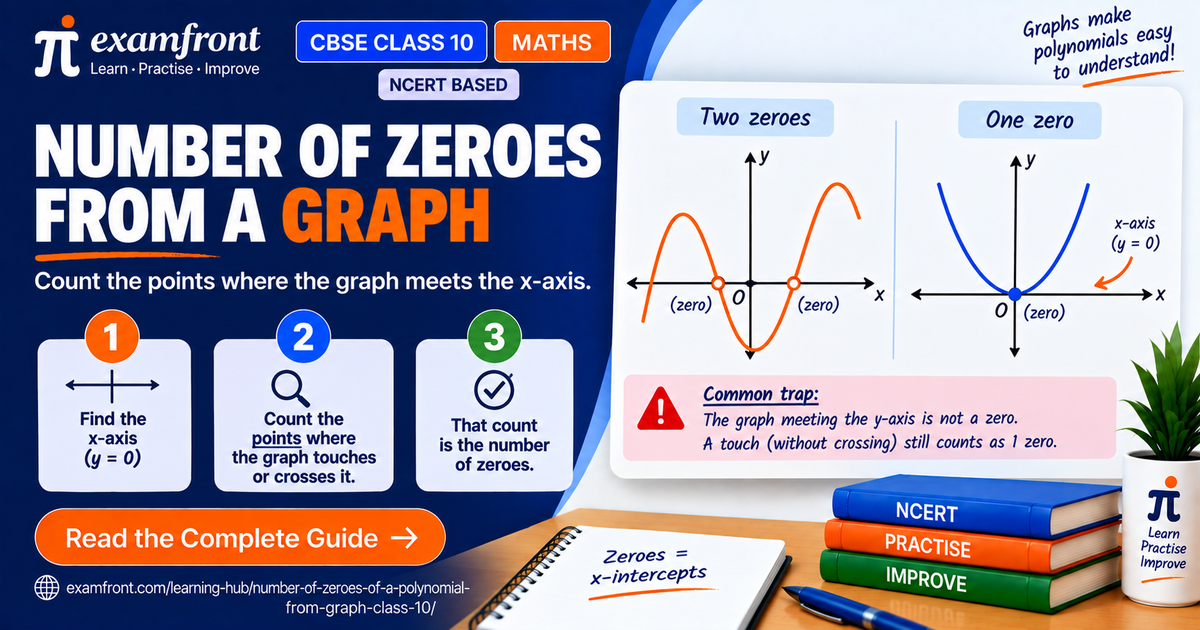
The rule in one line: the number of zeroes of a polynomial equals the number of points where its graph meets the x-axis. Count the x-axis intersection points — that count is your answer.
This is one of the most common and most scoring question types in the Polynomials chapter (it is exactly what NCERT Exercise 2.1 asks). You are given the graph of y = p(x) and simply asked, “How many zeroes does p(x) have?” You do not need any formula and you do not need to know the polynomial itself — you only need to count how many times the curve touches or crosses the x-axis.
Each meeting point with the x-axis is one zero, because along the x-axis the value of the polynomial is 0. So if a graph meets the x-axis at 3 places, the polynomial has 3 zeroes; if it never meets the x-axis, it has 0 zeroes. (If you want to know why this works, see Geometrical Meaning of the Zeroes of a Polynomial.)
The one rule you need
To find the number of zeroes from a graph, follow a single rule:
Number of zeroes = number of distinct points where the graph cuts or touches the x-axis.
Here, the x-axis is the horizontal line where y = 0. Wherever the curve meets it, p(x) = 0 at that x-value, so that point contributes one zero. This works for any polynomial graph — line, parabola, or a wavier curve.
Two small clarifications that decide most exam answers:
- A point where the graph crosses the x-axis → counts as one zero.
- A point where the graph only touches the x-axis (turns back without crossing) → still counts as one zero.
A simple 3-step method
You can answer any “number of zeroes from a graph” question with three quick steps:
- Find the x-axis (the horizontal line, y = 0).
- Mark every point where the curve touches or crosses it. Scan the whole curve from its left edge to its right edge, and mark a meeting point even if the question has not circled or labelled it.
- Count those points. That count is the number of zeroes.
Worked example. Suppose a graph of y = p(x) crosses the x-axis at exactly two separate points and lies below the x-axis between them (a simple upward parabola). Applying the steps: there are 2 intersection points, so p(x) has 2 zeroes. That is the complete answer — you do not need to find what the zeroes are, only how many.
▶️ Watch the 30-second reel: 2 x-axis crossings — how many zeroes? 🤔
Practising a batch of these back-to-back is the quickest way to build speed. The Topic Practice on examfront gives you graph after graph so counting becomes instant.
Reading the common cases
Most exam graphs fall into a few recognisable shapes. Here is how each reads:
| What the graph does | Number of zeroes |
|---|---|
| Straight line crossing the x-axis once | 1 |
| Parabola crossing the x-axis at two points | 2 |
| Parabola just touching the x-axis at one point | 1 |
| Parabola staying fully above or below the x-axis | 0 |
| Curve crossing the x-axis at three points | 3 |
| Curve meeting the x-axis at four points | 4 |
Notice the pattern: you are always just counting meeting points. The shape of the curve only helps you see those points clearly; it never changes the counting rule. (The degree behind each shape is explained in Types of Polynomials.)
▶️ Watch the 30-second reel: Touches & crosses x-axis — how many zeroes?
Worked example: a touching graph
Imagine a downward parabola whose highest point sits exactly on the x-axis, so the curve touches the x-axis at one point and lies below it everywhere else. Count the meeting points: there is 1. So the polynomial has 1 zero — even though it is a quadratic (degree 2), which is allowed to have at most two zeroes but can have fewer.
▶️ Watch the 30-second reel: Touches & crosses x-axis — how many zeroes?
Worked example: no zero
Now imagine a parabola sitting entirely above the x-axis (it never dips down to touch it). The number of meeting points is 0, so the polynomial has no real zero. “Zero zeroes” is a correct, complete answer whenever the curve avoids the x-axis.
A useful sanity check: zeroes vs degree
The count you read off a graph should always respect one limit: a polynomial of degree n can have at most n zeroes, because its graph can meet the x-axis at most n times.
- Linear (degree 1): at most 1 zero.
- Quadratic (degree 2): at most 2 zeroes.
- Cubic (degree 3): at most 3 zeroes.
▶️ Watch the 30-second reel: 3 x-axis crossings — how many zeroes?
▶️ Watch the 30-second reel: 4 x-axis meets — what’s true? 🤔
So if a graph is labelled as a quadratic and you think you counted three crossings, re-check — a quadratic can never have three zeroes. This quick check catches careless counting mistakes. To make sure you are not making silent errors like this, the Mistake Identification tool on examfront reviews your answers and points out exactly where a miscount crept in.
We are keeping the trickier graphs — higher-degree curves, borderline touch-vs-cross cases, and mixed sets that combine several graphs in one question — lighter here. You will find the complete drill set and harder variations inside examfront, where the Practice Companion walks you through each graph step by step and the Progress Tracking shows when you have truly mastered this question type. When you are ready for the next topic, move on to the Polynomials chapter guide and the relationship between zeroes and coefficients.
Where this sits in the NCERT and CBSE syllabus
This question type comes straight out of the textbook, so it is worth knowing exactly where it lives and how it is marked.
NCERT sets the scope. Counting zeroes from a graph belongs to Chapter 2 (Polynomials), Section 2.2 — Geometrical Meaning of the Zeroes of a Polynomial. The textbook first works Example 1, six graphs of y = p(x) in Fig. 2.9, and then sets Exercise 2.1, which is a single question: “The graphs of y = p(x) are given in Fig. 2.10 below, for some polynomials p(x). Find the number of zeroes of p(x), in each case.” Mind the numbering: the topic is Section 2.2 but its exercise is 2.1, because Section 2.1 is the introduction and has no exercise. Once you have worked Exercise 2.1 yourself, your six answers should read 0, 1, 3, 2, 4 and 3. If you are not sure how to work through an NCERT section properly, start with how to study NCERT Maths in Class 10 and the NCERT Class 10 Maths guide.
CBSE sets the wording. The current syllabus line for this chapter reads, in full: “Zeros of a polynomial. Relationship between zeros and coefficients of quadratic polynomials.” This page is the first half of that sentence, read off a picture; the second half is the relationship between zeroes and coefficients. The division algorithm for polynomials was removed in the rationalised syllabus, and you are expected to read graphs like these, not plot cubic ones. The full scope is set out in the CBSE Class 10 Maths syllabus.
CBSE sets the shape. The theory paper is 80 marks (plus 20 for internal assessment): 38 questions in three hours, with no overall choice, across five sections — A 20 × 1, B 5 × 2, C 6 × 3, D 4 × 5 and E 3 × 4. The CBSE Class 10 Maths exam pattern explains how each section works.
CBSE sets priority by unit, not by chapter. Polynomials sits in Unit II — Algebra, 20 of the 80 marks, the largest unit, which it shares with Pair of Linear Equations, Quadratic Equations and Arithmetic Progressions. The other six units carry Number Systems 6, Coordinate Geometry 6, Geometry 15, Trigonometry 12, Mensuration 10 and Statistics & Probability 11. Chapter-by-chapter percentages you see online are unofficial estimates; the official split is in the unit-wise weightage guide.
How it is actually asked. Almost always as a one-mark objective question in Section A: a graph is printed and the options are counts. It can also open a case-based question in which a curve models something real. Because it is worth one mark, there are no method marks to fall back on — one uncounted crossing costs the whole mark. Two habits protect it: scan the curve from edge to edge before you answer, and when the degree is given, check that your count does not exceed it. For how one-mark questions are built, see MCQ questions in Class 10 Maths and the CBSE Class 10 Maths question types.
Key Takeaways
- Number of zeroes = number of points where the graph meets the x-axis.
- Both crossing and touching the x-axis count as one zero each.
- A graph that never meets the x-axis means the polynomial has 0 real zeroes.
- The count can never exceed the degree (degree n → at most n zeroes).
- Only x-axis meetings count; the y-axis crossing is not a zero, unless the graph passes through the origin, which lies on both axes.
- This is the exact skill tested by NCERT Exercise 2.1 — no formula needed.
- NCERT reference: Chapter 2, Section 2.2, Example 1 and Exercise 2.1; Polynomials sits in the 20-mark CBSE Algebra unit.
Quick Facts
- Counting rule: zeroes = x-axis intersection points of y = p(x).
- Touch = 1 zero; cross = 1 zero.
- No intersection → 0 zeroes.
- Max zeroes: degree n ⇒ at most n zeroes.
- y-intercept: gives p(0), not a zero — unless p(0) = 0, when the graph passes through the origin.
- NCERT reference: Class 10 Maths, Chapter 2 (Polynomials), Section 2.2, Exercise 2.1 (one question, six graphs).
- CBSE unit: Unit II — Algebra, 20 of 80 theory marks; usually a one-mark Section A question.
- Chapter: Polynomials · Class: 10 · Subject: Maths · Board: CBSE.
Common Mistakes
- Counting the y-axis crossing as a zero. Only points on the x-axis are zeroes. The y-axis meeting point gives p(0), not a zero. The one exception is a graph through the origin: there p(0) = 0 and the point is on the x-axis too, so it counts once, as an x-axis meeting.
- Counting a touch point as two zeroes. When the curve only touches the x-axis, that is one zero, not two — you are counting points, not the two equal roots behind them.
- Counting turns or bends instead of crossings. Bends (turning points) are not zeroes. Only count where the curve actually meets the x-axis.
- Ignoring the degree limit. Reporting more zeroes than the degree allows (e.g., 3 zeroes for a quadratic) signals a miscount — always sanity-check against the degree.
- Saying a graph “must have a zero.” If the curve stays fully above or below the x-axis, the correct answer is 0 zeroes — don’t force a zero that isn’t there.
- Counting only the points that are marked. A graph may circle or label some meeting points and not others. Every point where the curve meets the x-axis counts, including one near the edge of the drawing — scan the whole curve before you answer.
Download the 2-page summary
📄 Download the 2-page number of zeroes from a graph summary (PDF) — the counting rule, correctly drawn graphs for every case, a worked NCERT-style question and the Exercise 2.1 answer check, on two printable pages.
FAQ
Q. How do you find the number of zeroes of a polynomial from a graph? Count the distinct points where the graph meets or crosses the x-axis. Each such point is one zero, so the total count is the number of zeroes.
Q. What if the graph only touches the x-axis without crossing? A touch point still counts as one zero. Touching the x-axis at one point gives one zero at that x-value.
Q. What does it mean if the graph never touches the x-axis? The polynomial has no real zero — the number of zeroes is 0.
Q. Can the number of zeroes be more than the degree of the polynomial? No. A polynomial of degree n meets the x-axis at most n times, so it has at most n zeroes. The graph count can never exceed the degree.
Q. Does the graph crossing the y-axis count as a zero? No. Only x-axis intersections give zeroes. The y-axis crossing gives p(0), which is not a zero — unless the graph passes through the origin. There p(0) = 0 and the point also lies on the x-axis, so it counts once, as an x-axis meeting.
Q. Is finding the number of zeroes from a graph part of the NCERT and CBSE Class 10 syllabus? Yes. It is Section 2.2 of NCERT Class 10 Maths Chapter 2 (Polynomials), worked in Example 1 and set as Exercise 2.1 — a single question with six graphs in Fig. 2.10, whose answers are 0, 1, 3, 2, 4 and 3. The CBSE syllabus lists zeros of a polynomial under Unit II Algebra, which carries 20 of the 80 theory marks, and the skill is usually tested as a one-mark Section A question.
Related Concepts
- Geometrical Meaning of the Zeroes of a Polynomial: why x-axis intersections are the zeroes in the first place.
- Zeroes of a Polynomial — meaning and how to find: the algebraic definition of a zero and how to compute it.
- Types of Polynomials — linear, quadratic, cubic: how degree sets the maximum number of zeroes.
- Polynomials Class 10 — how to approach the chapter: the full chapter roadmap and where this skill fits.
- Relationship between Zeroes and Coefficients: the next topic in the chapter, which turns zeroes into formulas.
Want counting zeroes to become instant? Run through a graph set in Topic Practice on examfront, and let Progress Tracking confirm when you’ve mastered it. Start on examfront →