How to Form a Quadratic Polynomial from the Sum and Product of Its Zeroes (Class 10)
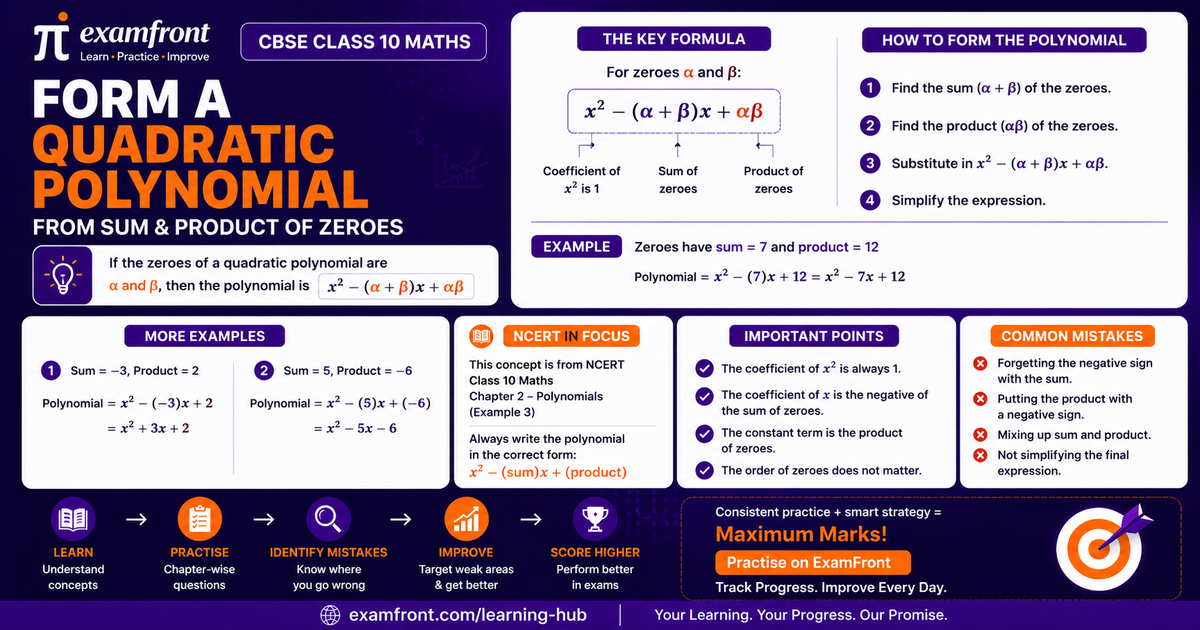
In one line: to form a quadratic polynomial from the sum and product of its zeroes, use
x² − (sum of zeroes)x + (product of zeroes).
If the sum of the zeroes is S and the product is P, the quadratic polynomial is simply x² − Sx + P. For example, if the zeroes add up to 5 and multiply to 6, the polynomial is x² − 5x + 6. This is the reverse of the previous topic: instead of starting from a polynomial and finding the sum and product, you start from the sum and product and build the polynomial.
This guide covers that skill for CBSE Class 10 (Section 2.3, Example 4 and Exercise 2.2). It builds directly on the relationship between zeroes and coefficients, where you learned that sum of zeroes = −b/a and product of zeroes = c/a. Here we run those same two facts backwards.
▶️ Watch the 30-second reel: Can you form the polynomial? ✍️
The formula (and why it works)
To build a quadratic polynomial whose zeroes have sum S and product P:
Quadratic polynomial = x² − Sx + P = x² − (sum of zeroes)x + (product of zeroes)
Why this works. From the relationship between zeroes and coefficients, a quadratic with zeroes α and β can be written as
x² − (α + β)x + αβ.
Since α + β is the sum and αβ is the product, replacing them with S and P gives x² − Sx + P. So the middle coefficient is the negative of the sum, and the constant term is the product.
The one sign to watch: the sum comes in with a minus in front (−Sx), while the product is just added (+P). Get that minus right and the rest is substitution.
▶️ Watch the 30-second reel: One minus sign changes everything! 👀
Worked example 1 — sum and product given directly
Find a quadratic polynomial whose zeroes have sum −3 and product 2.
Here S = −3 and P = 2. Substitute into x² − Sx + P:
x² − (−3)x + 2 = x² + 3x + 2
Notice the double negative: −(−3)x becomes +3x. Quick check: x² + 3x + 2 = (x + 1)(x + 2), so the zeroes are −1 and −2. Their sum is −3 ✓ and product is 2 ✓ — exactly what we were given.
Worked example 2 — clearing fractions with k
Find a quadratic polynomial whose zeroes have sum ¼ and product −1.
Substitute S = ¼ and P = −1:
x² − ¼x + (−1) = x² − ¼x − 1
This is already a correct answer, but board answers are usually written with whole-number coefficients. Because any multiple of a polynomial has the same zeroes, we can multiply the whole thing by a convenient number — here 4, to clear the quarter:
4(x² − ¼x − 1) = 4x² − x − 4
Quick check using the relationship from the previous topic: for 4x² − x − 4, sum = −b/a = −(−1)/4 = ¼ ✓ and product = c/a = −4/4 = −1 ✓. Choosing the right multiplier to clear denominators is a small but frequently tested move — drill a mixed set of fractional and surd cases in the Topic Practice on examfront, where the Practice Companion shows you the cleanest multiplier each time.
▶️ Watch the 30-second reel: Can you spot it? 🤔
Worked example 3 — building from the zeroes themselves
Sometimes you are given the two zeroes instead of their sum and product. The method is the same — just compute the sum and product first.
Find a quadratic polynomial whose zeroes are 2 and −5.
- Sum: S = 2 + (−5) = −3
- Product: P = 2 × (−5) = −10
Substitute into x² − Sx + P:
x² − (−3)x + (−10) = x² + 3x − 10
Quick check: x² + 3x − 10 = (x + 5)(x − 2), whose zeroes are −5 and 2 ✓.
▶️ Watch the 30-second reel: Find the polynomial from its zeroes! ✍️
Worked example 4 — when the sum is zero
If the sum of the zeroes is 0, the middle term vanishes and you are left with just x² + (product).
Find a quadratic polynomial whose zeroes are √3 and −√3.
- Sum: S = √3 + (−√3) = 0
- Product: P = (√3)(−√3) = −3
Substitute: x² − (0)x + (−3) = x² − 3. That matches the familiar polynomial x² − 3, whose zeroes are indeed √3 and −√3. So a “missing middle term” is a signal that the two zeroes are equal and opposite.
Why there is more than one answer
For a given sum S and product P, every polynomial of the form
k(x² − Sx + P), where k is any non-zero real number,
has the same zeroes — because multiplying a polynomial by a constant does not move where it equals zero. So x² − 5x + 6, 2x² − 10x + 12 and −3x² + 15x − 18 all share the zeroes 2 and 3.
In practice: if the question just says “find a quadratic polynomial,” give the simplest one with k = 1 (that is, x² − Sx + P). Only reach for a different k when you need to clear fractions and present tidy whole-number coefficients, as in Worked example 2. Recognising when a question wants the simplest answer versus whole-number coefficients is the kind of exam judgement the Mistake Identification tool on examfront helps you sharpen.
▶️ Watch the 30-second reel: Equal zeroes challenge! 🎯
We have kept to the core cases here. The tougher board variations — building polynomials from conditions on the zeroes (such as “one zero is twice the other” or “the zeroes differ by 3”), surd-heavy sums and products, and full word-problem framings — are worked through step by step inside examfront, where Progress Tracking shows you when the skill is exam-ready.
Where this sits in the NCERT and CBSE syllabus
This is not a side topic — it is a named piece of the NCERT course and a reliable CBSE question.
- NCERT source. It is Class 10 Maths Chapter 2, Polynomials, Section 2.3 — Relationship between Zeroes and Coefficients of a Polynomial. Example 4 of that section is this exact question (“the sum and product of whose zeroes are −3 and 2”), which is why Worked example 1 above uses the same numbers, and Exercise 2.2 Q2 gives six more to practise. Working the NCERT text first and then drilling variations is the pattern set out in how to study NCERT Maths in Class 10.
- Where the marks are. Polynomials sits in the Algebra unit — 20 of the 80 theory marks, the biggest unit in the paper. See the NCERT Class 10 Maths guide for how the chapters map onto the units.
- Scope, exactly. The CBSE syllabus names the relationship between zeroes and coefficients for quadratic polynomials only. Cubic relationships and the division algorithm for polynomials are not part of the current course, so forming a quadratic from S and P is the whole of this skill at Class 10 — a small, closed topic worth locking down completely.
- How it is asked. Most often as a 1-mark objective question (“The quadratic polynomial whose zeroes are 3 and −2 is …”) or a 2-mark very-short-answer, and sometimes as the opening part of a longer Algebra question. The wording changes — sum and product given, or the zeroes given — but the method does not. The six CBSE question formats explain what each one expects you to show.
Key Takeaways
- To form a quadratic from sum S and product P of the zeroes: x² − Sx + P.
- The middle term is −(sum); the constant term is the product.
- Watch double negatives: a negative sum gives a positive middle term.
- Given the zeroes instead, first find their sum and product, then substitute.
- The answer is not unique — any k(x² − Sx + P) works; use k = 1 for the simplest, or a k that clears fractions.
- Sum = 0 removes the middle term, leaving x² + product.
Quick Facts
- Formula: quadratic polynomial = x² − (sum of zeroes)x + (product of zeroes).
- Middle coefficient: −(sum of zeroes).
- Constant term: product of zeroes.
- Family of answers: k(x² − Sx + P), k ≠ 0.
- Clearing fractions: multiply by the LCM of the denominators.
- NCERT reference: Chapter 2 Polynomials, Section 2.3, Example 4 and Exercise 2.2.
- Chapter: Polynomials · Class: 10 · Subject: Maths · Board: CBSE.
Common Mistakes
- Adding the sum instead of subtracting it. The middle term is −(sum), so the polynomial is x² − Sx + P, not x² + Sx + P. Fix: write the minus first, then insert the sum with its own sign.
- Mishandling a double negative. For sum = −3, the middle term is −(−3)x = +3x, not −3x. Fix: substitute the sum inside brackets first, then simplify the signs.
- Swapping the sum and product. Putting the product where the sum belongs (or vice-versa) gives the wrong polynomial. Fix: remember “sum sits with x, product sits alone.”
- Leaving fractions when whole numbers are expected. x² − ¼x − 1 is correct but often should be written as 4x² − x − 4. Fix: multiply by the denominator’s LCM to tidy the coefficients.
- Thinking there is only one answer. Any k(x² − Sx + P) is valid. Fix: give x² − Sx + P unless the question asks for whole-number coefficients or a specific leading coefficient.
📄 Download the 2-page summary (PDF) — the formula, the sign rules and a worked board question on one printable sheet.
FAQ
Q. How do you form a quadratic polynomial from the sum and product of its zeroes? Use x² − (sum)x + product. If the sum is S and the product is P, the polynomial is x² − Sx + P. For sum = 5 and product = 6, it is x² − 5x + 6.
Q. What is the formula for a quadratic polynomial when the zeroes are given? First find the sum and product of the two zeroes, then substitute into x² − (sum)x + product. For zeroes 2 and 7: sum = 9, product = 14, so the polynomial is x² − 9x + 14.
Q. Is the quadratic polynomial formed this way unique? No. Any k(x² − Sx + P) with k ≠ 0 has the same zeroes. Take k = 1 for the simplest answer; use a suitable k to clear fractions.
Q. How do you form a quadratic polynomial when the sum or product is a fraction? Write x² − Sx + P, then multiply the whole polynomial by a value that clears the denominators. For sum = ½ and product = −3, x² − ½x − 3 becomes 2x² − x − 6.
Q. What if the sum of the zeroes is 0? The middle term disappears, leaving x² + product. For zeroes √3 and −√3, the sum is 0 and the product is −3, so the polynomial is x² − 3.
Q. Is forming a quadratic polynomial from its zeroes in the NCERT and CBSE Class 10 syllabus? Yes. It is NCERT Class 10 Maths Chapter 2 (Polynomials), Section 2.3 — Example 4 and Exercise 2.2 — and the CBSE syllabus lists the relationship between zeroes and coefficients of quadratic polynomials inside the Algebra unit, which carries 20 of the 80 theory marks.
Related Concepts
- Relationship Between Zeroes and Coefficients of a Polynomial: the forward direction — going from a polynomial to the sum and product of its zeroes.
- Zeroes of a Polynomial — meaning and how to find: what a zero is and how to compute it.
- Geometrical Meaning of the Zeroes of a Polynomial: how these zeroes show up on a graph.
- Quadratic Equations Class 10 — chapter guide: where building expressions from roots continues into Chapter 4.
- Polynomials Class 10 — how to approach the chapter: the full chapter roadmap and where this section fits.
Ready to make this automatic? Build a few polynomials from sums and products, then flip to verifying them, inside the Topic Practice on examfront — the Practice Companion catches sign slips, and Progress Tracking tells you when you’ve mastered it. Start on examfront →