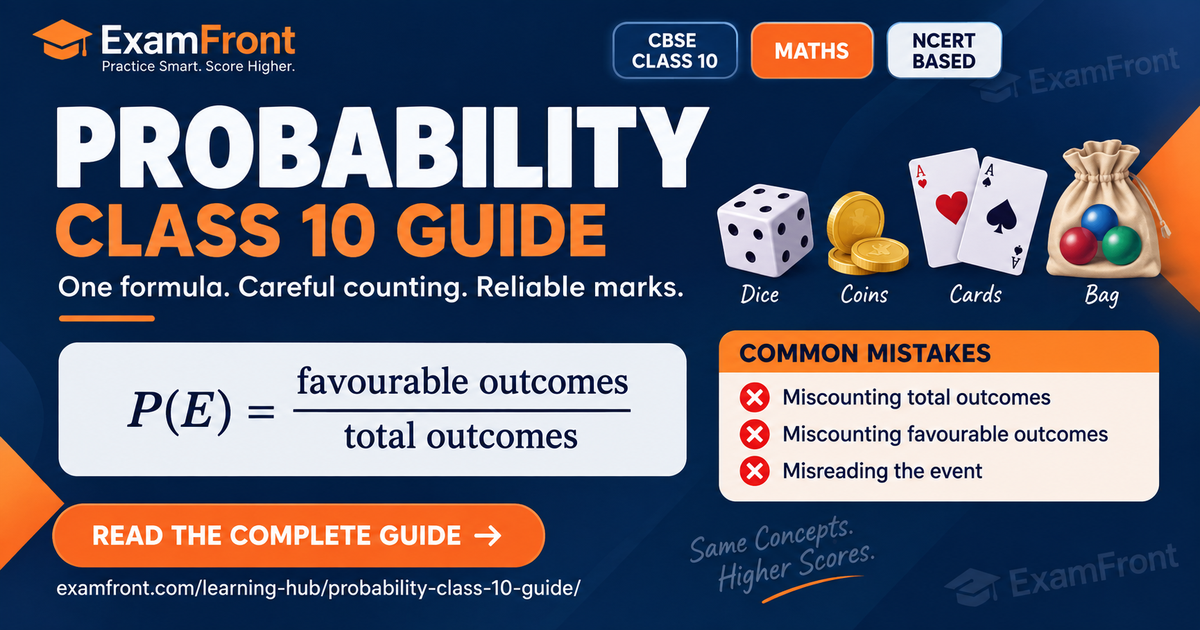
What the Probability chapter covers, how CBSE tests it, the mistakes to avoid, and how to turn it into guaranteed marks.
Probability is one of the easiest and most scoreable chapters in Class 10 Maths — it rests on a single core idea, and once you can count outcomes carefully, the marks are almost automatic. It rounds out the Statistics & Probability unit. This guide orients you on what it covers, how it’s tested, the traps, and how to make it a guaranteed-marks chapter.
Chapter snapshot
| Unit | Statistics & Probability |
| Official unit weightage | 11 marks (CBSE assigns marks per unit, not per chapter) |
| Difficulty | Easy ⭐⭐☆☆☆ |
| Practice priority | High (easy, reliable marks) |
| Prerequisites | Fractions, basic counting, sample spaces |
| Estimated study time | 1–2 focused sessions |
(Difficulty and study time are a preparation guide, not official CBSE figures.)
What this chapter covers
Probability at Class 10 level is built on one central idea:
- Theoretical (classical) probability — the probability of an event equals the number of favourable outcomes divided by the total number of outcomes.
- Sample space — listing or counting all the possible outcomes of an experiment.
- Common contexts — dice, coins, playing cards, and drawing objects from a bag.
- Certain and impossible events — recognising probabilities of 1 and 0, and that probability always lies between them.
One formula, applied to careful counting, carries the whole chapter — which is why it’s so reliably scoreable.
The one formula — and where the marks actually go
The whole chapter runs on a single line, so it is worth writing out exactly:
P(E) = (number of outcomes favourable to E) / (number of all possible outcomes)
It holds whenever the outcomes are equally likely — a fair coin, a fair die, a well-shuffled deck, a bag drawn from without looking. Two rules come free with it and are both marks in the exam:
- 0 ≤ P(E) ≤ 1. An impossible event has probability 0, a sure event has probability 1. If you ever write 1.5 or −0.2, you have miscounted — recount before moving on.
- P(E) + P(not E) = 1. The complement rule is usually the fastest route to an answer, and it is often the intended method.
Here is the counting trap, in the chapter’s own words. NCERT Exercise 14.1 Q24 throws a die twice. The total number of outcomes is not 6, and it is not 12 — each throw has 6 possibilities, so the sample space is 6 × 6 = 36 equally likely outcomes. The throws that avoid a 5 entirely are 5 × 5 = 25, so P(5 does not come up either time) = 25/36, and by the complement rule P(5 comes up at least once) = 1 − 25/36 = 11/36.
Notice what did the work there: no new formula, just an honest count of the sample space and one subtraction. That is the whole chapter in miniature — and it is why the deeper walk-through of theoretical probability and the classical formula is worth half an hour before you start the exercise.
Why this chapter matters
Probability introduces reasoning about chance that grows into a major branch of maths:
Classical probability → counting & sample spaces → statistics & probability in higher classes
The careful-counting and clear-reasoning habits you build here underpin all later probability and data work. And within Class 10, it’s simply one of the best return-on-effort chapters in the paper.
How much is Probability worth?
This chapter is part of the Statistics & Probability unit, worth 11 marks (see the unit-wise weightage guide). CBSE assigns weightage by unit, not by individual chapter, so Probability contributes to that 11-mark total alongside Statistics. Given how approachable it is, it’s a chapter to secure fully.
How CBSE tests Probability
The board tests the same core skills in familiar formats:
| Common question type | Skill tested |
|---|---|
| Probability with dice or coins | Concept |
| Probability with a deck of cards | Application |
| Drawing objects from a bag | Application |
| Certain / impossible / complementary events | Reasoning |
These appear as MCQs, short-answer, and long-answer questions. The wording changes yearly while the skills repeat (the idea behind analysing previous year questions).
Common mistakes in Probability
A few classic traps cost students marks here:
- Miscounting total outcomes — getting the size of the sample space wrong. Two coins give 4 outcomes (HH, HT, TH, TT), not 3; two dice give 36, not 12.
- Miscounting favourable outcomes — missing cases, or including ones that don’t fit.
- Misreading the event — solving for a slightly different event than the one asked.
- Card-deck confusion — miscounting the cards that satisfy a condition. Learn the deck once and this bullet disappears: 52 cards, four suits of 13, 26 red and 26 black, 12 face cards (jack, queen, king in each suit), and 4 of each rank. An ace is not a face card, and “a red king” is 2 cards, not 4.
Almost every Probability error is a counting or question-reading mistake, not a formula one — exactly the kind the examfront Mistake Framework helps you catch and fix.
Where this sits in the NCERT and CBSE syllabus
Probability is the last chapter of the book, and knowing its exact shape stops you practising the wrong things.
NCERT sets the scope. Probability is Chapter 14 of the rationalised NCERT Class 10 Maths textbook, and it is a short chapter: the theoretical-probability section, a single exercise — Exercise 14.1, 25 questions — and the summary. The older optional exercise was removed in the rationalisation. That matters practically: if your textbook or a solutions website still offers an “Exercise 14.2” for this chapter, or numbers Probability as Chapter 15, you are looking at a pre-2023 edition, and some of what it asks you to do is no longer examinable. Working the NCERT exercise properly is most of the preparation — see how to study NCERT Maths in Class 10 and the NCERT Class 10 Maths guide.
CBSE sets the scope even more tightly. Under Unit VII, the syllabus gives Probability exactly one line: “Classical definition of probability. Simple problems on finding the probability of an event.” The competency it names is “applies concepts from probability to solve problems on the likelihood of everyday events” and “determines the probabilities in simple real-life problems”. Read that as a limit you can use: nothing in this chapter should need a method beyond counting outcomes and dividing. If a solution you find online reaches for conditional probability or permutations, it has left the Class 10 syllabus.
CBSE sets the priority by unit, not by chapter. The seven units are Number Systems 6, Algebra 20, Coordinate Geometry 6, Geometry 15, Trigonometry 12, Mensuration 10 and Statistics & Probability 11 — 80 marks in the theory paper, plus 20 for internal assessment. Probability shares its 11 with Statistics. The chapter-wise percentage tables and pie charts circulating online are unofficial estimates, not CBSE figures.
How it is actually asked. Probability turns up most often as a 1-mark MCQ and a 2- or 3-mark short answer, in the question formats CBSE uses across the five sections of the paper. In anything above one mark, write the outcome counts down — “total outcomes = 36, favourable = 11” — because that count is where the method mark sits, and an examiner cannot award it for a bare fraction. That is worth knowing in detail: see how CBSE Maths answers are marked.
Skills you’ll build
Master this chapter and you’ll be able to:
- ✓ Apply the theoretical probability formula confidently
- ✓ Count total and favourable outcomes accurately
- ✓ Handle dice, coin, card, and bag problems
- ✓ Recognise certain, impossible, and complementary events
Your roadmap to full marks
Understanding Probability takes minutes; mastering it means building the careful-counting habit so you never miscount outcomes or misread the event — the two things that cause nearly every lost mark.
That’s where examfront turns understanding into marks. You get targeted, chapter-wise adaptive practice across dice, coins, cards, and bag problems — with instant feedback that pinpoints exactly where you slip (a miscount? a misread event?) so you fix it fast. The adaptive practice serves the right questions at the right level, and mistake-tracking reveals your patterns. Practise Probability on examfront and make this a guaranteed-marks chapter.
Before moving on
To be confident this chapter is exam-ready, make sure you can:
- ✓ Apply the theoretical probability formula
- ✓ Count outcomes accurately for dice, coins, and cards
- ✓ Read exactly which event a question asks for
- ✓ Use complementary events (probability of “not E”)
Continue your journey
← Previous: Statistics · You’ve reached the final chapter!
Browse the full chapter list to revisit any chapter, or see how to study Class 10 Maths to tie it all together.
📄 Download the Probability Class 10 summary (2-page PDF) — the formula, the counting rules, a worked NCERT question and the deck facts, on two printable pages.
Frequently asked questions
Is Probability an important chapter in Class 10 Maths? Yes — it’s part of the Statistics & Probability unit (11 marks), and it’s one of the easiest, most scoreable chapters. The single core formula makes it a reliable source of marks.
What are the main topics in Probability Class 10? Theoretical (classical) probability — the probability of an event as favourable outcomes over total outcomes — applied to dice, coins, cards, and similar situations.
Why do students lose marks in Probability? Usually through miscounting the total or favourable outcomes, missing cases, or misreading the event — the formula is simple, so errors are almost always in the counting.
How do I get full marks in Probability? Count the total and favourable outcomes carefully, read exactly what event is asked, and apply the probability formula — showing your outcome counts clearly.
Is Probability part of the NCERT and CBSE Class 10 syllabus? Yes. Probability is Chapter 14, the last chapter of the NCERT Class 10 Maths textbook, and the CBSE syllabus lists it under Unit VII Statistics and Probability as “Classical definition of probability. Simple problems on finding the probability of an event.” The rationalised chapter has a single exercise, Exercise 14.1 with 25 questions — the older optional exercise was removed, so a book or solutions page still offering an “Exercise 14.2”, or numbering this chapter 15, is an older edition.
Turn Probability into guaranteed marks. Practise on examfront →