Theoretical Probability Class 10: Formula, Meaning & Examples
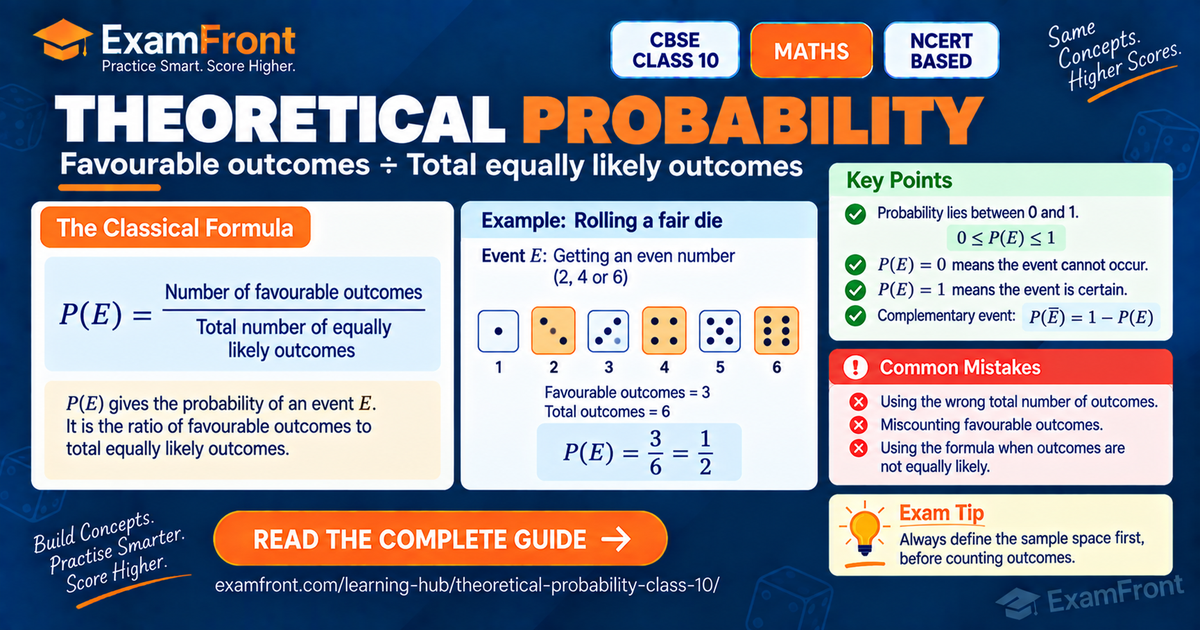
Quick answer: In Class 10, the theoretical (classical) probability of an event E is P(E) = (number of outcomes favourable to E) ÷ (number of all possible outcomes), provided all the outcomes are equally likely. So for a fair coin, P(head) = 1/2, and for a fair die, P(getting a 3) = 1/6. You don’t have to actually toss or roll anything — you count the favourable outcomes and divide by the total.
Theoretical probability predicts how likely an event is by reasoning about equally likely outcomes, unlike experimental probability, which is measured by actually repeating an experiment many times. This section is all about the theoretical approach: count, divide, done.
Two rules follow immediately and are worth memorising up front: the probability of any event always lies between 0 and 1 (0 ≤ P(E) ≤ 1), and an event and its complement add to 1 (P(E) + P(not E) = 1). This guide explains each idea with definitions, conditions and worked examples.
What is theoretical probability? (the classical formula)
Theoretical probability (also called classical probability) of an event E is defined as:
P(E) = (Number of outcomes favourable to E) / (Number of all possible outcomes)
- Meaning in words: out of everything that could happen, what fraction of it counts as the event you want?
- Variables: “favourable outcomes” = the outcomes in which the event occurs; “all possible outcomes” = the complete list of things that can happen (the sample space).
- Condition: this formula only works when the outcomes are equally likely (see the next section).
This definition was given by Pierre Simon Laplace in 1795, and it’s the backbone of the entire chapter.
Worked Example 1 (a coin). A fair coin is tossed once. Find the probability of getting a head.
- Possible outcomes: Head, Tail → total = 2.
- Favourable outcomes (a head) = 1.
- P(head) = 1/2. Similarly P(tail) = 1/2.
Worked Example 2 (a die). A fair die is thrown once. Find the probability of getting a number greater than 4.
- Possible outcomes: 1, 2, 3, 4, 5, 6 → total = 6.
- Favourable outcomes (greater than 4): 5, 6 → 2 outcomes.
- P(number > 4) = 2/6 = 1/3.
Want to practise counting favourable outcomes without second-guessing yourself? examfront’s Topic Practice for Probability gives you graded questions right after you learn the formula.
🎬 Quick challenge: Can you find the probability of rolling a number greater than 4? 🎲
What are equally likely outcomes?
Equally likely outcomes are outcomes that each have the same chance of occurring.
- A fair (unbiased) coin: head and tail are equally likely.
- A fair die: 1, 2, 3, 4, 5, 6 are each equally likely.
Not every experiment has equally likely outcomes. If a bag has 4 red balls and 1 blue ball, drawing “a red ball” and “a blue ball” are not equally likely — red is far more probable. The classical formula P(E) = favourable/total applies only when the individual outcomes are equally likely, so always check this first.
Key condition: the classical probability formula assumes equally likely outcomes. When they aren’t equally likely, you must model the situation differently (e.g. count each ball as a separate equally likely outcome).
What is an elementary event, and why do probabilities add to 1?
An elementary event is an event that has exactly one outcome. For a die, “getting a 3” is an elementary event; “getting an even number” is not (it has three outcomes: 2, 4, 6).
A useful fact:
The sum of the probabilities of all the elementary events of an experiment is 1.
For a die: P(1) + P(2) + P(3) + P(4) + P(5) + P(6) = 6 × (1/6) = 1. This is a quick way to check your work — if your separate probabilities don’t add up to 1, something is off.
What is a complementary event? (P(not E) = 1 − P(E))
The complement of an event E, written “not E” (or E̅), is the event that E does not happen. Since either E happens or it doesn’t:
P(E) + P(not E) = 1, so P(not E) = 1 − P(E)
- Meaning in words: the chance of an event and the chance of it not happening always add to a full 1 (100%).
- Variables: P(E) is the probability of the event; P(not E) is the probability of its complement.
- Condition: always true for any event E.
Worked Example 3 (a deck of cards). One card is drawn from a well-shuffled deck of 52 cards. Find (i) the probability the card is an ace, (ii) the probability it is not an ace.
- Total outcomes = 52. There are 4 aces.
- (i) P(ace) = 4/52 = 1/13.
- (ii) P(not an ace) = 1 − P(ace) = 1 − 1/13 = 12/13. (Check: there are 48 non-aces, and 48/52 = 12/13 ✓.)
The complement rule is a huge time-saver: instead of counting 48 non-aces, subtract from 1.
The card, dice and marble problems get longer from here — practise the full graded set inside examfront’s Chapter Quizzes, and let Mistake Identification catch the counting slips before the exam does.
What is the range of probability? (sure and impossible events)
For any event E:
0 ≤ P(E) ≤ 1
Because the number of favourable outcomes can never exceed the total number of outcomes, and can never be negative. Two boundary cases give the endpoints:
- Impossible event → P = 0. Example: getting an 8 on a normal die. No face shows 8, so 0 favourable outcomes → P = 0/6 = 0.
- Sure (certain) event → P = 1. Example: getting a number less than 7 on a die. All 6 faces qualify → P = 6/6 = 1.
So a value like 1.5, −0.2, or 8/3 can never be a probability. If you ever compute one, recount.
🎬 Quick challenge: Can you find the probability of rolling a number greater than 4? 🎲
Theoretical vs. experimental probability (a quick contrast)
- Theoretical (this section): calculated by reasoning about equally likely outcomes — P(E) = favourable/total. No experiment performed.
- Experimental (empirical, from Class 9): measured by actually repeating an experiment — P(E) = (trials in which E happened) / (total trials).
As the number of trials grows large, the experimental probability tends to get close to the theoretical value — but they are found in different ways.
Where this sits in the NCERT and CBSE syllabus
Probability is a small chapter with an unusually tight scope, and knowing its exact shape tells you when you have done enough.
NCERT sets the scope — and the theoretical approach is the whole chapter. Probability is Chapter 14 of the rationalised NCERT Class 10 Maths textbook, the last chapter of the book. It has an introduction, one teaching section — Probability — A Theoretical Approach, which is exactly what this page covers — and a summary. There is a single exercise, Exercise 14.1, with 25 questions; the older optional exercise was removed in the rationalisation. Two practical consequences. First, watch the numbering trap: the theory sits in Section 14.2 but the questions are in Exercise 14.1, and it is easy to write the wrong one in a revision note. Second, if your textbook or a solutions site still offers an “Exercise 14.2” for this chapter, or numbers Probability as Chapter 15, you are looking at a pre-2023 edition. Working Exercise 14.1 honestly is most of the preparation for this chapter — see how to study NCERT Maths in Class 10 and the NCERT Class 10 Maths guide.
Four of those 25 questions are, in effect, this page written as exam questions. Q1 asks you to complete five statements — P(E) + P(not E) = ___, the probability of an event that cannot happen, the probability of an event that is certain, the sum of the probabilities of all the elementary events, and the two numbers a probability lies between. Q2 asks which experiments have equally likely outcomes. Q4 asks which of 2/3, −1.5, 15% and 0.7 cannot be a probability. Q5 gives P(E) = 0.05 and asks for P(not E). If those four feel obvious to you after reading this page, the chapter is largely done.
CBSE sets the scope even more tightly. Under Unit VII, the CBSE syllabus gives Probability exactly one line: “Classical definition of probability. Simple problems on finding the probability of an event.” That phrase — the classical definition — is the formula on this page, and nothing beyond it is examinable here. Read the line as a limit you can use in the exam: if a solution you find online reaches for conditional probability, permutations or combinations, it has left the Class 10 syllabus.
CBSE sets the priority by unit, not by chapter. The seven units are Number Systems 6, Algebra 20, Coordinate Geometry 6, Geometry 15, Trigonometry 12, Mensuration 10 and Statistics & Probability 11 — 80 marks in the theory paper, plus 20 for internal assessment. Probability shares its 11 marks with Statistics, so neither chapter has a mark value of its own; the unit-wise weightage guide explains why the chapter-wise percentage tables circulating online are unofficial estimates rather than CBSE figures.
How it is actually asked — and the one line that earns the method mark. Theoretical probability turns up most often as a 1-mark MCQ and as a 2- or 3-mark short answer, among the question formats CBSE uses. In anything worth more than one mark, write the two counts down before the fraction — “total outcomes = 6, favourable outcomes = 3” — because that count is the method mark, and an examiner cannot award it for a bare fraction with no working. That is worth reading about properly in how CBSE Maths answers are marked. It is also your own best check: a sample space you have written out is a sample space you can recount.
Key Takeaways
- Theoretical probability: P(E) = favourable outcomes ÷ total outcomes, when outcomes are equally likely.
- Outcomes must be equally likely for the classical formula to apply — always check first.
- An elementary event has one outcome; the probabilities of all elementary events sum to 1.
- Complement rule: P(not E) = 1 − P(E) — often the fastest route to an answer.
- Probability is always between 0 and 1: impossible event = 0, sure event = 1.
- Write the sample space down. The two counts are where the method mark sits, and where your own recount starts.
Quick Facts
- Probability of a sure event = 1; probability of an impossible event = 0.
- Range of any probability: 0 ≤ P(E) ≤ 1.
- P(head) on a fair coin = 1/2; P(any given number) on a fair die = 1/6.
- A standard deck has 52 cards, 4 aces, 12 face cards (K, Q, J × 4 suits), 26 red and 26 black.
- The classical definition of probability is due to Laplace (1795).
- NCERT Chapter 14, theory in Section 14.2, questions in Exercise 14.1 — 25 questions, and no Exercise 14.2.
- CBSE Unit VII Statistics & Probability = 11 marks of 80, shared with Statistics.
Common Mistakes
- Using the formula when outcomes aren’t equally likely — check for equal likelihood first.
- Miscounting the total number of outcomes (the sample space) — list them if unsure.
- Forgetting the complement rule — P(not E) = 1 − P(E) is often quicker than direct counting.
- Writing a probability greater than 1 or negative — impossible; recount.
- Confusing theoretical with experimental probability — one is reasoned, the other is measured.
- Writing only the final fraction — with no “total = …, favourable = …” line, the method mark has nowhere to land.
📄 Download the Theoretical Probability Class 10 summary (2-page PDF) — the formula, the four free facts, the NCERT and CBSE scope and three worked exercise questions, on two printable pages.
FAQ
What is the formula for theoretical probability in Class 10? Theoretical (classical) probability of an event E is P(E) = (number of outcomes favourable to E) ÷ (number of all possible outcomes), assuming all outcomes are equally likely. For a fair coin, P(head) = 1/2, because there is 1 favourable outcome out of 2 possible outcomes.
What is the difference between theoretical and experimental probability? Theoretical probability is calculated from the assumption of equally likely outcomes using P(E) = favourable/total, without doing the experiment. Experimental (empirical) probability is measured by actually repeating an experiment and using (trials in which the event happened) ÷ (total trials). Over many trials, the experimental value tends towards the theoretical one.
What are equally likely outcomes? Equally likely outcomes each have the same chance of occurring — like head/tail on a fair coin or 1–6 on a fair die. The classical probability formula only applies when the outcomes are equally likely.
What is a complementary event and its probability? The complement of an event E (“not E”) is the event that E does not happen. Their probabilities satisfy P(E) + P(not E) = 1, so P(not E) = 1 − P(E). If P(ace) = 1/13, then P(not an ace) = 12/13.
Can the probability of an event be more than 1 or negative? No. For any event, 0 ≤ P(E) ≤ 1. An impossible event has probability 0 and a sure event has probability 1, so values like 1.5 or −0.2 are never valid probabilities.
Is theoretical probability part of the NCERT and CBSE Class 10 syllabus? Yes — it is the whole of it. Probability is Chapter 14, the last chapter of the rationalised NCERT Class 10 Maths textbook, and the theoretical approach is its only section, with a single exercise, Exercise 14.1, of 25 questions. The CBSE syllabus gives the chapter one line under Unit VII Statistics and Probability: “Classical definition of probability. Simple problems on finding the probability of an event.” A book or solutions page still offering an “Exercise 14.2”, or numbering this chapter 15, is a pre-2023 edition.
Related Concepts
- Experimental (empirical) probability (Class 9) — the measured approach that this theoretical approach complements.
- Sample space and outcomes — listing all possible outcomes correctly is the foundation of every probability question.
- Fractions, ratio and percentage — probabilities are written as fractions and can be read as percentages.
- Probability chapter guide — the full chapter roadmap, including two-dice and card problem types.
- Class 10 Maths formula sheet — every probability formula in one place.
- Previous year questions — practise the exact probability question types the board asks.
Ready to test yourself? Start with examfront’s Probability quiz, track which question types trip you up with Progress Tracking, and get personalised help exactly where you slip.