Number of Tangents from a Point on a Circle Class 10: Theorem 10.2 & Examples
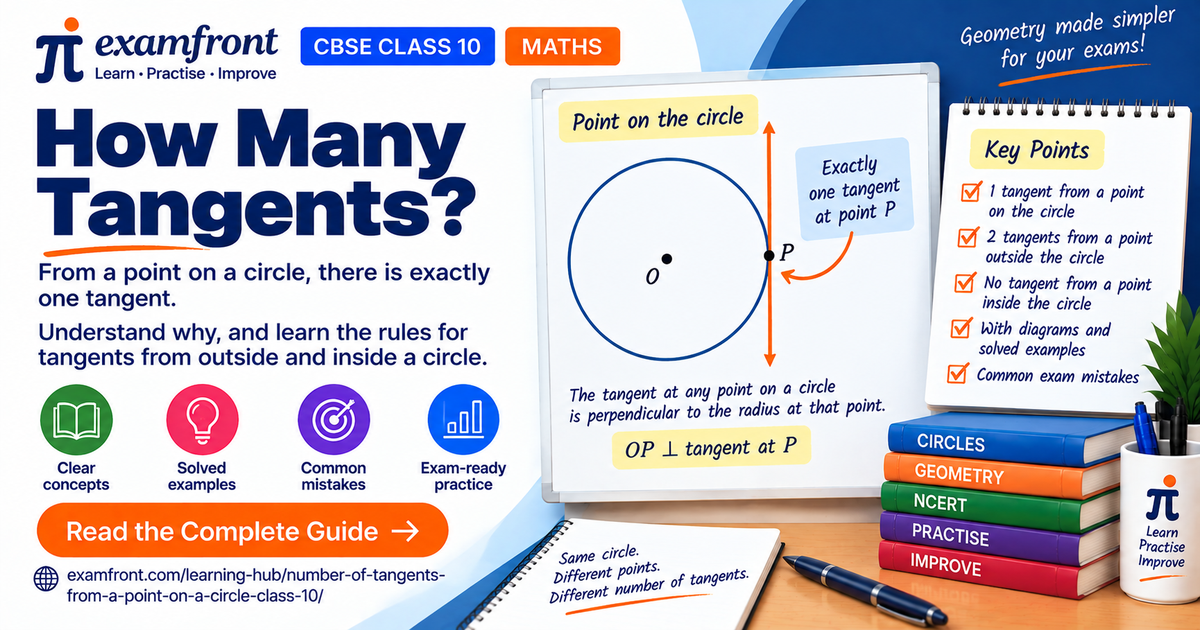
In one line: how many tangents you can draw to a circle depends entirely on where the point is — none from a point inside the circle, exactly one from a point on the circle, and exactly two from a point outside it.
So the number of tangents from a point is 0, 1, or 2. And when the point is outside the circle and you draw both tangents, a beautiful fact appears — the two tangents are equal in length. That is Theorem 10.2: the lengths of tangents drawn from an external point to a circle are equal. If P is outside a circle with centre O, and the tangents from P touch the circle at Q and R, then PQ = PR.
The length of a tangent from an external point P is the distance from P to the point of contact. Because the radius meets a tangent at a right angle (that is Theorem 10.1), this length is found with the Pythagoras theorem: tangent length = √(OP² − r²). This guide covers all three point-positions, the equal-tangents theorem with its proof, and the worked examples you will actually be tested on.
🎬 Watch (60-sec Short): How many tangents can you draw from an external point? ⚡
How many tangents can you draw from a point?
Where the point sits decides everything. There are three cases:
| Position of the point | Number of tangents | Why |
|---|---|---|
| Inside the circle | 0 | Every line through it cuts the circle at two points (a secant) |
| On the circle | 1 | Exactly one tangent exists at any point of the circle |
| Outside the circle | 2 | Two separate lines from the point just touch the circle |
Let us make each case precise:
- Case 1 — point inside: take a point P inside the circle. Any straight line you draw through P enters and exits the circle, meeting it at two points. So it is always a secant, never a tangent. No tangent can pass through an interior point.
- Case 2 — point on the circle: take P on the circle. There is exactly one tangent at that point (this is the uniqueness fact from Theorem 10.1). Why only one? The tangent at P must be perpendicular to the radius OP, and through a given point you can draw only one line perpendicular to a given line — so the tangent at P is fixed. One tangent.
- Case 3 — point outside: take P outside the circle. You can draw exactly two tangents, touching the circle at two different points of contact, say Q and R. Two tangents.
Getting this 0-1-2 rule instant is a guaranteed board mark, and it is the setup for every “tangents from an external point” problem. Drilling quick 0/1/2 identification is exactly what examfront’s Topic Practice is built for.
What is the length of a tangent from an external point?
Length of the tangent (from an external point): the distance from the external point P to the point of contact where the tangent touches the circle.
For a point P outside a circle with centre O and radius r, drawing the tangent to touch at Q creates a right triangle OQP, right-angled at Q (by Theorem 10.1, the radius OQ ⊥ PQ). So by the Pythagoras theorem:
PQ² = OP² − OQ² = OP² − r², giving tangent length PQ = √(OP² − r²).
- OQ = r is the radius (one leg).
- PQ is the tangent length (the other leg).
- OP is the distance from the centre to the external point (the hypotenuse).
This single formula ties together the three quantities — radius, tangent length, and centre-to-point distance — so if a problem gives you any two, you can find the third.
Theorem 10.2 — the two tangents from an external point are equal
Theorem 10.2: The lengths of tangents drawn from an external point to a circle are equal.
Statement in symbols: if P is outside a circle with centre O, and PQ and PR are the two tangents (touching at Q and R), then PQ = PR.
Proof of Theorem 10.2
Given: A circle with centre O, an external point P, and two tangents PQ and PR touching the circle at Q and R. To prove: PQ = PR. Construction: Join OQ, OR and OP.
Proof.
- By Theorem 10.1, a tangent is perpendicular to the radius at the point of contact, so ∠OQP = ∠ORP = 90°.
- Now compare the right triangles OQP and ORP:
- OQ = OR (radii of the same circle),
- OP = OP (common side, the hypotenuse of both),
- ∠OQP = ∠ORP = 90°.
- By the RHS congruence rule, △OQP ≅ △ORP.
- Therefore, by CPCT (corresponding parts of congruent triangles), PQ = PR. ∎
Two bonus results fall straight out of the same congruent triangles (examiners love these):
- ∠OPQ = ∠OPR, so OP bisects the angle ∠QPR — the centre lies on the angle bisector of the two tangents.
- The proof can also be done with Pythagoras: PQ² = OP² − OQ² = OP² − OR² = PR², so PQ = PR.
Being able to write this proof — the RHS congruence and the CPCT line — cleanly is a standard 2-mark or 3-mark board question. Rehearse it until it is automatic; Mistake Identification on examfront flags the step students most often drop (stating all three RHS conditions).
Worked example 1 — find the radius from the tangent length
Question. From a point Q, the length of the tangent to a circle is 24 cm, and the distance of Q from the centre is 25 cm. Find the radius of the circle.
Solution.
- Let the tangent touch the circle at P. By Theorem 10.1, OP ⊥ PQ, so triangle OPQ is right-angled at P.
- Here the tangent length PQ = 24 cm and the hypotenuse OQ = 25 cm; the radius OP = r is what we want.
- Pythagoras: OP² = OQ² − PQ² = 25² − 24² = 625 − 576 = 49.
- So r = √49 = 7 cm.
The radius is 7 cm. Same right triangle as before — this time the tangent length and hypotenuse are given, and we solve for the radius leg. This is NCERT Exercise 10.2, Question 1, which the textbook asks as a multiple-choice question.
🎬 Watch (60-sec Short): Can you find the radius using the tangent theorem? ⚡
Worked example 2 — the angle between two tangents
Question. Two tangents TP and TQ are drawn from an external point T to a circle with centre O, and ∠POQ = 110° (P and Q are the points of contact). Find ∠PTQ.
Solution.
- Look at quadrilateral OPTQ. By Theorem 10.1, the radius is perpendicular to each tangent, so ∠OPT = ∠OQT = 90°.
- The angles of a quadrilateral add to 360°: ∠PTQ + ∠OPT + ∠OQT + ∠POQ = 360°.
- Substitute: ∠PTQ + 90° + 90° + 110° = 360°.
- So ∠PTQ = 360° − 290° = 70°.
The angle between the two tangents is 70°. This is NCERT Exercise 10.2, Question 2 — also a multiple-choice question in the textbook. Notice the shortcut hiding here: because the two radius angles are each 90°, ∠PTQ + ∠POQ = 180° — the angle between the tangents and the angle at the centre are supplementary. That single relationship answers a whole family of questions. The harder versions — tangents combined with chords, quadrilaterals circumscribing a circle, and multi-step proofs — are where you go deeper inside examfront, with personalised help on the exact step you miss.
Where this sits in the NCERT and CBSE syllabus
Everything on this page is one section of one chapter, and knowing exactly which one tells you what the exam can ask and how much of your revision time it deserves.
NCERT sets the scope. Circles is Chapter 10 of the NCERT Class 10 Maths textbook, and the current chapter teaches exactly two theorems. Theorem 10.1 — the tangent is perpendicular to the radius — belongs to Section 10.2, Tangent to a Circle. Everything on this page, the 0-1-2 rule, the length of a tangent and Theorem 10.2, is Section 10.3, Number of Tangents from a Point on a Circle. The Circles chapter guide maps the whole chapter.
Mind the numbering offset. This is Section 10.3, but its exercise is Exercise 10.2 — because Section 10.2 already used Exercise 10.1. So the exercise you want for this page is Exercise 10.2, and it has 13 questions; Exercise 10.1 has 4 questions and belongs to the previous section. Both worked examples above come straight from it — Worked example 1 is Question 1 and Worked example 2 is Question 2 — and the circumscribed-figure proofs in the next section are its Questions 8 and 11. For the full chapter numbering, the Class 10 Maths chapter list and the NCERT Class 10 Maths guide lay it out. The old Constructions chapter, where you once drew the pair of tangents from an external point with a compass, has been removed — so no board question will ask you to construct them.
CBSE sets the wording. The CBSE Class 10 Maths syllabus places Circles in Unit IV — Geometry and, under Tangent to a circle at, point of contact, lists exactly two results:
“1. (Prove) The tangent at any point of a circle is perpendicular to the radius through the point of contact. 2. (Prove) The lengths of tangents drawn from an external point to a circle are equal.”
The second line is this page. Notice the word (Prove): the proof of Theorem 10.2 is named in the syllabus, so you are expected to write it out, not just quote the result. The first line is the sibling result on Tangent to a Circle — and the second proof leans on the first, which is why the two right angles come before RHS in every correct answer.
CBSE sets the priority, by unit. The 80 theory marks are split Number Systems 6 · Algebra 20 · Coordinate Geometry 6 · Geometry 15 · Trigonometry 12 · Mensuration 10 · Statistics & Probability 11, with 20 more marks of internal assessment making 100. Geometry carries 15 of the 80, shared between Triangles and Circles. Be careful with chapter-by-chapter percentage tables online — CBSE publishes marks by unit, not by chapter, so those numbers are unofficial estimates. The CBSE Class 10 Maths syllabus and the unit-wise weightage guide have the official split.
How this topic is actually asked. The paper is 38 questions for 80 marks in three hours, across five sections — see the CBSE Class 10 Maths exam pattern for the full shape. The 0-1-2 count and one-step results like Questions 1 and 2 above suit 1-mark MCQs in Section A. A tangent length or a radius with the working shown fits a 2-mark question, while the proof of Theorem 10.2 or a circumscribed-quadrilateral proof typically arrives as a 3-mark question or as one part of a longer answer. In a proof the marks follow the steps — the Construction line, each RHS condition with its reason, and the CPCT conclusion — which is how CBSE maths answers are marked. Following the NCERT-first approach means working all 13 questions of Exercise 10.2 before anything else; the graded tangent set on examfront then drills those shapes and flags the step you drop.
Where equal tangents show up next
Theorem 10.2 is the workhorse for the trickier circle proofs in the chapter:
- Quadrilaterals circumscribing a circle: using equal tangent segments from each vertex, you prove AB + CD = AD + BC (opposite sides sum equally).
- A parallelogram circumscribing a circle is a rhombus, and tangent lengths from a triangle’s vertices split the sides into equal pieces.
We have kept this guide to the core of Section 10.3 — the 0-1-2 rule, the tangent-length formula, and Theorem 10.2 with its proof and two standard examples. The full set of circumscribed-figure proofs and previous-year drills lives inside examfront; work them there and let Chapter Quizzes and Progress Tracking confirm when your tangent work is exam-ready. If you need the earlier results first, revisit Tangent to a Circle (Theorem 10.1).
Key Takeaways
- Number of tangents from a point: 0 from an interior point, 1 from a point on the circle, 2 from an external point.
- Length of a tangent from external point P: √(OP² − r²), from the right triangle (radius ⊥ tangent, Theorem 10.1).
- Theorem 10.2: the two tangents from an external point are equal — PQ = PR.
- Proof idea: △OQP ≅ △ORP by RHS (equal radii, common OP, two right angles) ⟹ PQ = PR by CPCT; also OP bisects ∠QPR.
- Handy angle fact: the angle between the two tangents and the angle ∠QOR at the centre are supplementary (add to 180°).
- This is NCERT Chapter 10, Section 10.3, Exercise 10.2 (13 questions) — and the CBSE syllabus marks Theorem 10.2 (Prove), so the full proof is examinable.
Quick Facts
- 0 / 1 / 2 tangents for a point inside / on / outside the circle.
- Tangent length: PQ = √(OP² − r²).
- Theorem 10.2: tangents from an external point are equal (PQ = PR).
- Congruence used: RHS (△OQP ≅ △ORP); result by CPCT.
- Centre lies on the bisector of the angle between the two tangents.
- ∠between tangents + ∠at centre = 180° (supplementary).
- NCERT: Chapter 10, Section 10.3, Exercise 10.2 (13 questions) — Worked examples 1 and 2 are its Questions 1 and 2.
- CBSE: Unit IV Geometry, 15 of the 80 theory marks; Theorem 10.2 is listed as a result to prove.
- Chapter: Circles (Ch. 10) · Class: 10 · Subject: Maths · Board: CBSE.
Common Mistakes
- Saying you can draw a tangent from inside the circle. Fix: an interior point gives 0 tangents — every line through it is a secant; you need a point on or outside the circle.
- Mislabelling the hypotenuse in the tangent-length triangle. Fix: OP (centre → external point) is always the hypotenuse; the radius and the tangent are the two legs, so tangent² = OP² − r².
- Stating only part of the RHS conditions in the Theorem 10.2 proof. Fix: write all three — equal radii (OQ = OR), common hypotenuse (OP), and the two right angles — before concluding RHS.
- Forgetting the tangent–centre angle is supplementary, not equal. Fix: ∠PTQ + ∠POQ = 180°, so ∠PTQ = 180° − ∠POQ (not equal to it).
- Assuming the two tangent lengths could differ. Fix: by Theorem 10.2 they are always equal (PQ = PR) — use that equality to set up equations in circumscribed-figure problems.
- Leaving out the Construction line in the Theorem 10.2 proof. Fix: the right angles at Q and R only exist once OQ and OR are drawn — write Construction: Join OQ, OR and OP before the first step. It is part of the answer, not a formality.
Download the 2-page summary
📄 Download the Number of Tangents summary (PDF, 2 pages) — the 0-1-2 rule, the tangent-length formula, the Theorem 10.2 proof and worked NCERT Exercise 10.2 questions on two printable pages.
FAQ
Q. How many tangents can be drawn from a point to a circle? It depends on where the point is. From a point inside the circle you can draw no tangent (every line through it cuts the circle at two points). From a point exactly on the circle you can draw exactly one tangent. From a point outside the circle you can draw exactly two tangents. So the answer is 0, 1 or 2 tangents for an interior, on-circle, or exterior point respectively.
Q. What is Theorem 10.2 in Class 10 circles? Theorem 10.2 states that the lengths of the two tangents drawn from an external point to a circle are equal. If P is a point outside a circle with centre O, and PQ and PR are tangents touching the circle at Q and R, then PQ = PR. It is proved using the right angles from Theorem 10.1 and the congruence of triangles OQP and ORP (RHS).
Q. What is the length of a tangent from an external point? The length of a tangent from an external point P is the distance from P to the point of contact where the tangent touches the circle. If the circle has centre O and radius r, and OP is the distance from the centre to P, then the tangent length = √(OP² − r²), because the radius, tangent and OP form a right triangle (right-angled at the point of contact). For example, if OP = 25 cm and the tangent length is 24 cm, the radius is √(625 − 576) = 7 cm.
Q. Why can’t you draw a tangent from a point inside a circle? Because every straight line drawn through a point inside a circle must cross the circle at two points, which makes each such line a secant, not a tangent. A tangent needs to touch the circle at exactly one point, and no line through an interior point can do that. So there is no tangent from a point lying inside the circle.
Q. Are the two tangents from an external point equal in length? Yes. By Theorem 10.2, the two tangents drawn from an external point to a circle are always equal in length. This happens because the two right triangles formed (using the radius perpendicular to each tangent and the shared line to the centre) are congruent by the RHS rule, so their tangent sides are equal. The centre of the circle also lies on the bisector of the angle between the two tangents.
Q. Is the number of tangents from a point part of the NCERT and CBSE Class 10 Maths syllabus? Yes. It is Section 10.3 of Chapter 10 (Circles) in the NCERT Class 10 Maths textbook, and its exercise is Exercise 10.2 with 13 questions — note the offset, the section is 10.3 but the exercise is 10.2. The CBSE syllabus lists Circles under Unit IV Geometry, which carries 15 of the 80 theory marks, and names this page’s result — the lengths of tangents drawn from an external point to a circle are equal — as one to prove. Constructing tangents with ruler and compass is no longer in the syllabus.
Related Concepts
- Tangent to a Circle Class 10 (Theorem 10.1): the previous section — why a tangent is perpendicular to the radius, the fact this whole section relies on.
- Tangent and Secant of a Circle Class 10: the line–circle positions and definitions that start Chapter 10.
- Circles — Chapter Guide (Class 10): the full Chapter 10 roadmap and formula list.
- Class 10 Maths — All Formulas: the quick-reference sheet where the circle results live.
Ready to make equal tangents and the 0-1-2 rule automatic? Drill a graded set on examfront’s Topic Practice, and let Mistake Identification and Progress Tracking show you exactly where your proof steps slip. Start on examfront →