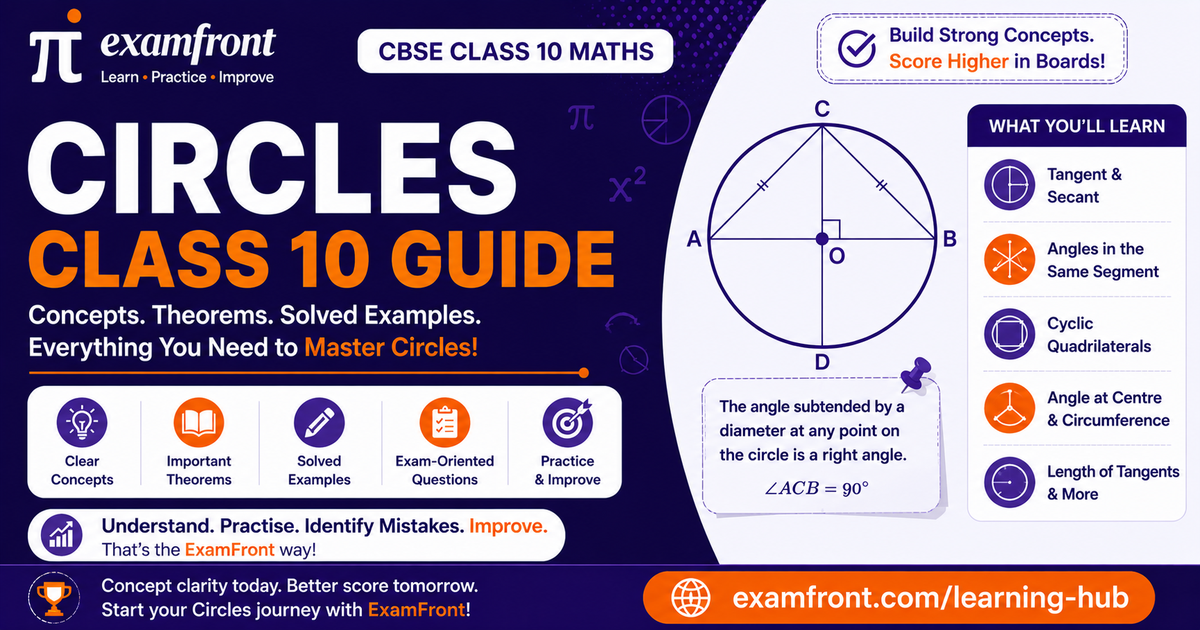
What the Circles chapter covers, how CBSE tests it, the mistakes to avoid, and how to turn it into strong marks.
Circles is a focused, high-value chapter in the Geometry unit — built around tangents and a small set of powerful theorems. It’s a chapter where knowing two key results well, and presenting proofs clearly, earns reliable marks. It contributes to the Geometry unit’s 15 marks, the second-biggest in the paper. This guide orients you on what it covers, how it’s tested, the traps, and how to master it.
Chapter snapshot
| Unit | Geometry |
| Official unit weightage | 15 marks (CBSE assigns marks per unit, not per chapter) |
| Difficulty | Moderate ⭐⭐⭐☆☆ |
| Practice priority | High (proof-based, high-value unit) |
| Prerequisites | Basic circle terms, Triangles, geometric reasoning |
| Estimated study time | 2–3 focused sessions |
(Difficulty and study time are a preparation guide, not official CBSE figures.)
What this chapter covers
Circles at Class 10 level focuses tightly on tangents:
- Tangent to a circle — a line that touches the circle at exactly one point.
- Tangent ⊥ radius — the tangent at any point is perpendicular to the radius at the point of contact.
- Equal tangents — the two tangents drawn from an external point are equal in length.
- Applying the theorems — using these results to prove statements and find lengths and angles.
Just two core theorems carry most of the chapter — which makes it very masterable with focused practice.
Why this chapter matters
Circles sharpens the geometric proof skills the whole unit rewards:
Tangent theorems → geometric proofs → higher-class circle geometry
The reasoning and proof-presentation you build here apply directly across Geometry and into senior classes. Since Geometry carries 15 marks, a strong Circles chapter meaningfully lifts your total.
How much is Circles worth?
This chapter is part of the Geometry unit, worth 15 marks — the second-highest-weighted unit in the paper (see the unit-wise weightage guide). CBSE assigns weightage by unit, not by individual chapter, so Circles contributes to that 15-mark total. As a reliable source of tangent-theorem questions, it’s a high-priority target.
How CBSE tests Circles
The board tests the same core skills in familiar formats:
| Common question type | Skill tested |
|---|---|
| Prove tangent ⊥ radius result | Reasoning |
| Use equal-tangents property | Concept |
| Find a length using tangent properties | Application |
| Prove a result involving tangents | Reasoning |
These appear as MCQs, short-answer, and long-answer proof questions — the same tangent facts asked at different question-paper formats. The wording changes yearly while the skills repeat (the idea behind analysing previous year questions).
Common mistakes in Circles
A few classic traps cost students marks here:
- Incomplete proofs — skipping steps or not justifying them.
- Misstating the theorems — quoting a tangent property inaccurately.
- Missing reasons — writing steps without the reason that earns the mark.
- Diagram errors — mislabelling the point of contact or the external point.
Most are presentation and method mistakes — exactly the kind the examfront Mistake Framework helps you catch and fix.
Skills you’ll build
Master this chapter and you’ll be able to:
- ✓ State and prove the tangent-perpendicular-radius theorem
- ✓ Use the equal-tangents-from-an-external-point property
- ✓ Write complete proofs with justifications
- ✓ Find lengths and angles using tangent properties
Your roadmap to full marks
Understanding Circles is quick — it’s two theorems. Mastering it means applying them fluently in proofs and, crucially, presenting those proofs so every step earns its mark.
That’s where examfront turns understanding into marks. You get targeted, chapter-wise adaptive practice on tangent theorems, proofs, and problems — with instant feedback that pinpoints exactly where you slip (a missing reason? a misstated theorem?) so you fix it fast. The adaptive practice serves the right questions at the right level, and mistake-tracking reveals your patterns. Practise Circles on examfront and turn Geometry into strong marks.
Before moving on
Before you move to the next chapter, make sure you can:
- ✓ Prove the tangent-perpendicular-radius theorem
- ✓ Apply the equal-tangents property
- ✓ Write a complete proof with reasons
- ✓ Find lengths using tangent properties
Continue your journey
← Previous: Applications of Trigonometry · Next: Areas Related to Circles →
Or browse the full chapter list to plan your path.
Take the summary with you
Download the 2-page Circles summary (PDF) → — both tangent theorems, the proof skeleton, and a fully worked external-point example on one printable sheet.
Frequently asked questions
Is Circles an important chapter in Class 10 Maths? Yes — it’s part of the Geometry unit (15 marks, the second-highest), and its tangent theorems are tested reliably, often as proof questions. It’s a high-value chapter.
What are the main topics in Circles Class 10? Tangents to a circle, the theorem that a tangent is perpendicular to the radius at the point of contact, and the theorem that tangents from an external point are equal in length.
Why do students lose marks in Circles? Usually through incomplete proofs, not stating the tangent theorems correctly, or missing reasons for steps — clear proof presentation is where the marks are.
How do I get full marks in Circles? Learn the two key tangent theorems thoroughly, practise applying them in proofs and problems, and write complete step-by-step working with reasons.
Turn Circles into strong marks. Practise on examfront →