Tangent and Secant of a Circle Class 10: Meaning, Difference & Examples
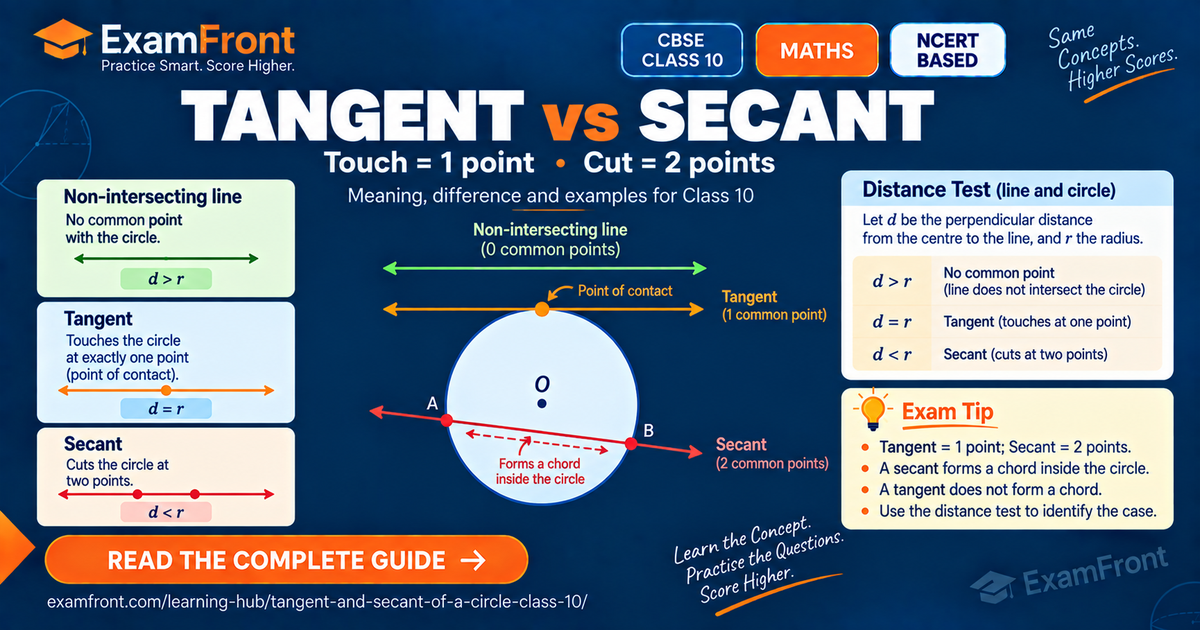
In one line: when a line and a circle sit in the same plane, only three things can happen — the line either misses the circle (a non-intersecting line, 0 common points), cuts through it (a secant, 2 common points), or just touches it (a tangent, exactly 1 common point).
That single count — how many points the line and the circle share — is the whole idea of Section 10.1. A secant meets the circle at two points; a tangent meets it at only one point, called the point of contact. A tangent and a secant of a circle are therefore closely linked: a tangent is just the special case of a secant in which the two crossing points slide together until they become one.
This introduction sets up the rest of Chapter 10. Once you can confidently tell a tangent from a secant, the next articles prove the two big results about tangents — that a tangent is perpendicular to the radius at the point of contact, and that exactly two tangents can be drawn from an outside point. This guide gives you the three cases, clear definitions, the tangent-vs-secant difference, and the quick distance test you will actually use in problems.
🎬 Watch (60-sec Short): Can you identify the line touching the circle at one point? ⚡
The three positions of a line and a circle
Take any circle and any straight line PQ drawn in the same plane. Slide the line around and you will find there are only three possible situations — no fourth case exists.
| Case | What the line does | Common points | Name of the line |
|---|---|---|---|
| 1 | Passes by without meeting the circle | 0 | Non-intersecting line |
| 2 | Cuts across the circle | 2 (say A and B) | Secant |
| 3 | Just grazes the circle | 1 (say A) | Tangent |
Let us define each term the first time it appears, so the idea is fully self-contained:
- A non-intersecting line has no point in common with the circle — it stays completely outside (or the circle stays completely on one side of it).
- A secant is a line that meets the circle at two distinct points. The piece of the secant inside the circle — the segment joining those two points — is a chord.
- A tangent is a line that meets the circle at exactly one point. That one shared point is the point of contact, and we say the tangent touches the circle there.
A real example helps: think of a pulley over a well. The rope on each side, if extended as a straight line, runs alongside the wheel and touches it — each straight length of rope behaves like a tangent to the circular pulley.
What is a secant of a circle?
Secant: a line that intersects a circle at two distinct points.
Because it crosses the boundary, a secant always creates a chord — the segment of the line lying between the two intersection points. For instance, a line through a circle that meets it at A and B is a secant, and AB is the chord it cuts off. A longer chord means the secant passes closer to the centre; a shorter chord means it passes nearer the edge.
Here is the key link to hold onto: if you keep a secant’s direction fixed but push it steadily outward, its two crossing points A and B move closer together and the chord gets shorter. At the exact moment the two points merge into one, the line stops cutting and starts touching — the secant has become a tangent.
What is a tangent to a circle?
Tangent: a line that touches a circle at exactly one point, called the point of contact.
The name itself carries the meaning — tangent comes from the Latin tangere, “to touch.” A tangent does not enter the circle; it meets the boundary at a single point and stays outside everywhere else. Picture a moving bicycle wheel: the flat ground it rolls on touches the wheel at just one point at a time, so the ground is a tangent to the circular wheel.
Two facts about tangents are worth locking in now (they are proved in the next sections of the chapter):
- A tangent is a special secant — the case where the chord shrinks to zero and both end points coincide at the point of contact.
- At any single point on a circle, there is one and only one tangent — you cannot draw two different tangents at the same point.
Knowing which of the three cases you are in is often the first mark in a circles question. Sorting a mixed set of “tangent / secant / non-intersecting” diagrams quickly is exactly the kind of drill examfront’s Topic Practice is built for, and Mistake Identification flags the diagrams students most often mislabel.
Difference between a tangent and a secant
Both a tangent and a secant are straight lines that meet a circle — the difference is entirely in how many points they share and what that creates.
| Feature | Secant | Tangent |
|---|---|---|
| Common points with the circle | Two (A and B) | One (point of contact) |
| Cuts or touches? | Cuts through the circle | Touches the circle |
| Chord formed? | Yes — segment AB inside the circle | No — the two ends have merged into one point |
| Relationship | The general case | The limiting (special) case of a secant |
One-line memory hook: a secant cuts (two points), a tangent touches (one point).
The quick test: use the distance to the centre
You do not always need a picture. If you know the radius r of the circle and the perpendicular distance d from the centre to the line, the case is decided instantly by comparing d with r.
Rule: compare the perpendicular distance d (centre → line) with the radius r.
- d > r → line misses the circle → non-intersecting line (0 points)
- d = r → line just touches → tangent (1 point)
- d < r → line cuts across → secant (2 points)
Why it works: the perpendicular distance is the shortest gap between the centre and the line. If even that shortest gap is bigger than the radius, no point of the line can reach the circle. If it exactly equals the radius, the foot of the perpendicular lands right on the circle — one touch. If it is smaller, the line dips inside and comes back out — two crossings.
🎬 Watch (60-sec Short): Can you tell whether the line is a tangent or secant? 🤔
Worked example 1 — naming the line from the distance
Question. A circle has centre O and radius 5 cm. A straight line lies at a perpendicular distance of 5 cm from O. Is the line a tangent, a secant, or a non-intersecting line? How many points does it share with the circle?
Solution.
- Radius r = 5 cm; perpendicular distance d = 5 cm.
- Compare: d = r (5 = 5).
- By the rule, when d = r the line just touches the circle at one point.
- So the line is a tangent, and it shares exactly one point (the point of contact) with the circle.
The move never changes: read off d and r, compare them, name the case. Try the other two settings yourself — d = 6 cm (non-intersecting) and d = 3 cm (secant) — to feel how one number flips the answer.
Worked example 2 — counting common points
Question. State the number of points a secant, a tangent and a non-intersecting line each have in common with a circle. Also state the maximum number of points a straight line can share with a circle.
Solution.
- A secant shares 2 points with the circle.
- A tangent shares 1 point (the point of contact).
- A non-intersecting line shares 0 points.
- A straight line can meet a circle in at most 2 points, so the maximum is 2 — which is exactly the secant case.
This is the reasoning behind the classic “fill in the blanks” board questions (a tangent meets a circle in ___ point(s); a line meeting a circle in two points is called a ___). Locking these counts in first makes those a guaranteed mark. Work a graded set on examfront’s Topic Practice and let Progress Tracking confirm when the whole “line and circle” idea is exam-ready.
Where this leads next in Chapter 10
Section 10.1 is the doorway; the real theorems come right after:
- Tangent ⊥ radius: the tangent at any point of a circle is perpendicular to the radius through the point of contact — the subject of Tangent to a Circle Class 10.
- How many tangents from a point: none from inside, one from on the circle, and exactly two from an outside point, plus the fact that those two tangent lengths are equal — see Number of Tangents from a Point on a Circle.
We have kept this guide to the core of Section 10.1 — the three positions, the definitions, the tangent-vs-secant difference, and the distance test. The trickier mixed diagrams and full previous-year drills are where you go deeper: work through the complete set inside examfront, where personalised help points out exactly which case you keep confusing.
Where this sits in the NCERT and CBSE syllabus
Two different bodies decide two different things about this topic, and it helps to keep them apart: NCERT decides what you learn, CBSE decides how it is examined.
NCERT sets the scope
The three positions of a line and a circle are introduced in NCERT Class 10 Maths, Chapter 10 — Circles, Section 10.1. The whole chapter is short by design: it has just two exercises, 17 questions in all — Exercise 10.1 with 4 questions and Exercise 10.2 with 13 — plus three worked examples and two theorems.
Everything on this page is examined by Exercise 10.1, and it is worth knowing its four questions by name:
- How many tangents can a circle have? (Infinitely many — one at every point of the circle.)
- Fill in the blanks — a tangent intersects a circle in ___ point(s); a line intersecting a circle in two points is called a ___; a circle can have ___ parallel tangents at the most; the common point of a tangent and the circle is called ___. All four blanks are exactly this article’s Worked example 2 — one, a secant, two, and the point of contact.
- A tangent PQ at a point P of a circle of radius 5 cm meets a line through the centre O at Q, with OQ = 12 cm. Find PQ. Because the tangent is perpendicular to the radius, OP ⊥ PQ, so PQ = √(12² − 5²) = √(144 − 25) = √119 cm — not 13 cm, which is the answer students pick when they treat OQ as a leg instead of the hypotenuse.
- Draw a circle and two lines parallel to a given line such that one is a tangent and the other a secant. A drawing question that is pure d-versus-r: the tangent is the parallel line at distance exactly r from the centre, the secant is any parallel line closer than r.
One scope note that saves wasted revision: rationalised Class 10 Circles contains only two theorems — the tangent is perpendicular to the radius at the point of contact, and the two tangents from an external point are equal in length. Angles in the same segment, cyclic quadrilaterals and the angle-at-the-centre result belong to Class 9 and are not examined here. If a practice sheet sends you there, it is working from an older book. The habit of checking the chapter in your own textbook first is the whole point of studying Maths from NCERT properly, and the NCERT Class 10 Maths guide maps every chapter the same way.
CBSE sets the shape of the paper
Circles sits in Unit IV — Geometry, worth 15 of the 80 theory marks, shared with Triangles. The full paper is 80 theory + 20 internal assessment = 100, and those 80 marks are spread over 38 questions in five sections across three hours, with no overall choice. The complete map is in the CBSE Class 10 Maths syllabus, and the section-by-section split is in the exam pattern guide.
One warning worth repeating, because it changes how you plan: CBSE assigns marks by unit, not by chapter. The chapter-wise percentage tables and pie charts that circulate online are unofficial estimates — the official figures, and what they actually mean for your revision order, are set out in the unit-wise weightage guide.
How this topic is actually asked
Almost always as a 1-mark objective question in Section A — an MCQ or a fill-in-the-blank of exactly the Exercise 10.1 Q2 shape, or a one-line “name the line” from a given d and r. Occasionally it is the opening line of a 2-mark VSA, where you name the case and justify it by comparing d with r.
The justification is the part students drop, and it is the part that carries the mark: writing “tangent” alone answers the question, but writing “d = r, so the line touches the circle at one point — it is a tangent” answers it the way the marking scheme is written. That difference between the right answer and the answer that scores is explained in full in how CBSE Maths answers are marked. If you want those one-markers to become automatic before the board, run them as timed sets on examfront.
Key Takeaways
- A line and a circle have only three possible positions: non-intersecting (0 points), secant (2 points), tangent (1 point).
- A secant cuts the circle at two points and forms a chord; a tangent touches at exactly one point, the point of contact.
- A tangent is the special case of a secant — the two crossing points slide together until they coincide.
- Decide the case from the distance d (centre → line) versus radius r: d > r miss, d = r tangent, d < r secant.
- At any point on a circle there is one and only one tangent; a straight line meets a circle in at most 2 points.
- In NCERT this is Chapter 10, Section 10.1, tested by Exercise 10.1; in CBSE it sits in Unit IV Geometry (15 of 80) and is asked as a 1-mark objective or the opening line of a 2-mark VSA.
Quick Facts
- Secant: line meeting a circle at 2 points → creates a chord.
- Tangent: line meeting a circle at 1 point → the point of contact.
- Non-intersecting line: 0 common points.
- Distance test: d > r (miss) · d = r (tangent) · d < r (secant).
- Word origin: tangent ← Latin tangere, “to touch.”
- Max points a straight line shares with a circle: 2.
- NCERT Chapter 10 has just two exercises — 10.1 (4 questions) and 10.2 (13) — 17 questions in all.
- Unit IV Geometry = 15 of the 80 theory marks, shared with Triangles.
- Chapter: Circles (Ch. 10) · Class: 10 · Subject: Maths · Board: CBSE.
Common Mistakes
- Swapping the point counts of secant and tangent. Students write “tangent = 2 points, secant = 1.” Fix: remember tangent = touch = 1, secant = cut = 2; a touch can only be a single point.
- Calling any line that meets the circle a tangent. A line through the circle is a secant, not a tangent. Fix: it is a tangent only when there is exactly one common point.
- Mixing up “chord” and “secant.” A chord is a segment (inside the circle); a secant is the whole line through the two points. Fix: chord = the piece; secant = the full line carrying it.
- Getting the distance rule backwards. Thinking d > r means “cuts.” Fix: bigger distance means the line is farther, so it misses; only d < r cuts (secant).
- Believing two tangents can exist at one point. Fix: at a single point on the circle there is exactly one tangent; two tangents need an external point (next section).
📄 Download the free 2-page summary PDF — the three cases, the distance test and two worked NCERT questions on one printable sheet.
FAQ
Q. What is the difference between a tangent and a secant of a circle? A secant is a line that cuts a circle at two points, while a tangent is a line that touches the circle at exactly one point. So the difference is the number of common points: a secant has two, a tangent has only one. A tangent is the special case of a secant in which the two intersection points come together and coincide into a single point called the point of contact.
Q. What is a tangent to a circle in Class 10? A tangent to a circle is a line that meets the circle at exactly one point. That single common point is called the point of contact, and the tangent is said to touch the circle there. The word tangent comes from the Latin tangere, meaning “to touch.” At any point on a circle there is one and only one tangent.
Q. What is a secant of a circle? A secant of a circle is a line that intersects the circle at two distinct points. The part of the secant that lies inside the circle, joining those two points, is a chord. As a secant is moved so that its two intersection points slide towards each other, the chord shrinks; when the two points finally coincide, the secant becomes a tangent.
Q. How many points does a tangent share with a circle? A tangent shares exactly one point with a circle. That point is the point of contact. If a line shares two points with the circle it is a secant, and if it shares no points it is a non-intersecting line. So one common point always means the line is a tangent.
Q. How do you decide if a line is a tangent, secant or non-intersecting line? Compare the perpendicular distance d from the centre of the circle to the line with the radius r. If d is greater than r the line misses the circle (non-intersecting line). If d equals r the line just touches the circle at one point (tangent). If d is less than r the line cuts through the circle at two points (secant).
Q. Is tangent and secant of a circle part of the NCERT and CBSE Class 10 syllabus? Yes. The three positions of a line and a circle are introduced in NCERT Class 10 Maths Chapter 10, Circles, in Section 10.1, and they are tested directly in Exercise 10.1 — which asks how many tangents a circle can have, fills in the blanks for the number of common points and the name of a line meeting a circle twice, and asks you to draw a tangent and a secant parallel to a given line. Circles sits in CBSE’s Unit IV Geometry, worth 15 of the 80 theory marks, shared with Triangles.
Related Concepts
- Tangent to a Circle Class 10: the next section — why a tangent is perpendicular to the radius at the point of contact.
- Number of Tangents from a Point on a Circle: how many tangents you can draw from inside, on, and outside the circle.
- Circles — Chapter Guide (Class 10): the full Chapter 10 roadmap and formula list.
- Class 10 Maths — All Formulas: the quick-reference sheet where the circle results live.
Ready to make the three cases automatic? Sort tangent-vs-secant diagrams on examfront’s Topic Practice, and let Mistake Identification and Progress Tracking show you exactly where you slip. Start on examfront →