Tangent to a Circle Class 10: Theorem, Proof & Examples (Tangent ⊥ Radius)
In one line: a tangent to a circle is a line that touches the circle at exactly one point — the point of contact — and its single most important property is that the tangent is perpendicular to the radius drawn to that point.
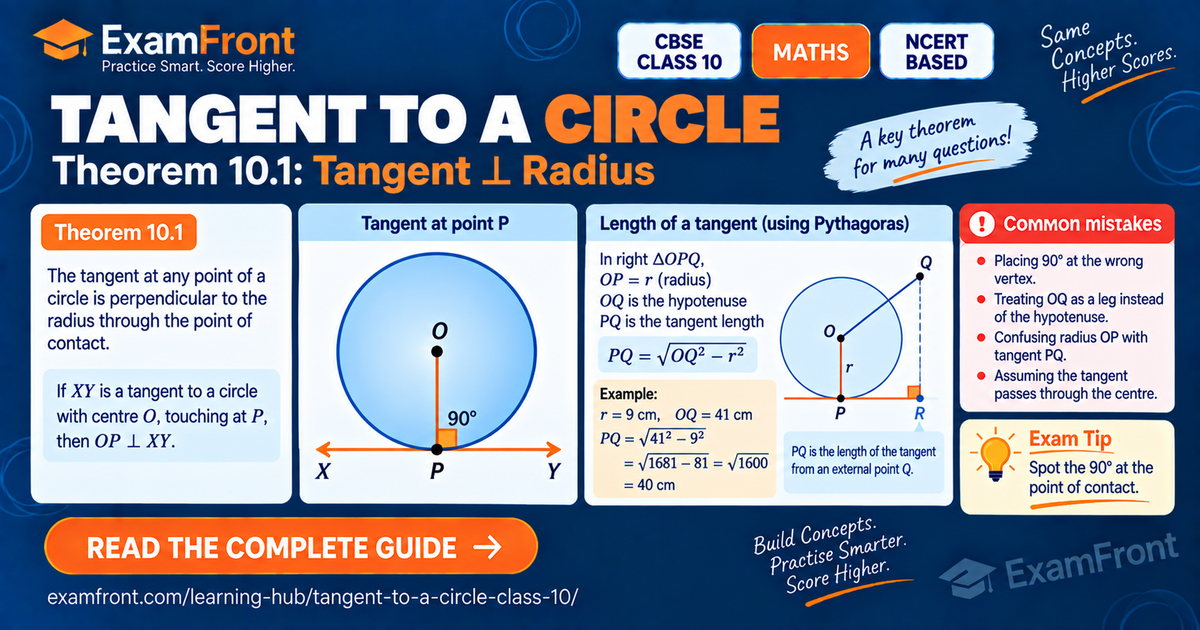
That property is Theorem 10.1: the tangent at any point of a circle is perpendicular to the radius through the point of contact. So if a circle has centre O and a tangent XY touches it at P, then OP ⊥ XY, which means the angle between them is exactly 90°. Almost every tangent problem in the board exam is really this one right angle in disguise.
Why must the angle be 90°? Because the radius OP is the shortest distance from the centre O to the tangent line, and the shortest distance from a point to a line is always the perpendicular. This guide gives you the exact statement of Theorem 10.1, a clean proof you can reproduce, and the worked examples you will actually be asked — where the right angle turns a tangent into a right triangle you finish with the Pythagoras theorem. If you are not yet sure how a tangent differs from a secant, read Tangent and Secant of a Circle Class 10 first.
🎬 Watch (60-sec Short): Can you find the angle between a tangent and radius? ⚡
What is a tangent to a circle?
Tangent: a straight line that touches a circle at exactly one point, called the point of contact. It never crosses into the circle.
A few terms, defined the first time they appear, keep this self-contained:
- The point of contact is the single point the tangent and circle share (often labelled P).
- The radius through the point of contact is the segment OP joining the centre O to that point.
- The normal to the circle at P is the line that contains this radius — so “normal” and “radius direction” point the same way at the point of contact.
There is also a neat uniqueness fact that follows from the theorem below: at any point on a circle there is one and only one tangent. You cannot draw two different tangents at the same point of contact.
Theorem 10.1 — the tangent is perpendicular to the radius
Theorem 10.1: The tangent at any point of a circle is perpendicular to the radius through the point of contact.
In symbols: if XY is a tangent to a circle with centre O, touching it at P, then
OP ⊥ XY, i.e. ∠OPX = ∠OPY = 90°.
Meaning in plain words: draw the radius to wherever the tangent touches; that radius hits the tangent square-on, at a right angle. This is the fact that unlocks the whole chapter, because a 90° angle lets you use right-triangle tools (Pythagoras, trig, similar triangles).
Proof of Theorem 10.1
Given: A circle with centre O and a tangent XY touching the circle at point P. To prove: OP ⊥ XY.
Proof.
- Take any point Q on XY other than P, and join OQ.
- Q lies on the tangent, so Q is outside the circle. (If Q were inside, the line XY would cross the circle at two points and be a secant, not a tangent.)
- Because Q is outside the circle, OQ is longer than the radius OP:
OQ > OP.
- This is true for every point Q on XY except P itself. So of all the distances from O to points of the line XY, the distance OP is the shortest.
- The shortest distance from a point to a line is the perpendicular distance. Therefore OP ⊥ XY. ∎
The heart of the proof is one sentence: every point of the tangent except the point of contact lies outside the circle, so OP is the shortest distance and must be perpendicular. Being able to write that cleanly is what earns the marks — practising the statement-and-proof to the point where you can reproduce it from memory is exactly what examfront’s Topic Practice and Mistake Identification are built to drill.
The one right angle you will use again and again
Theorem 10.1 is useful because of what it builds: a right-angled triangle. Whenever a tangent touches a circle at P and runs out to some external point Q (with O the centre), triangle OPQ has a right angle at P. That means:
OQ² = OP² + PQ² (Pythagoras), where OP = radius, PQ = tangent length, OQ = distance from the centre to Q.
Rearranged for the length of the tangent:
PQ = √(OQ² − OP²) = √(OQ² − r²).
- OP = r is the radius (one leg).
- PQ is the length of the tangent from Q to the point of contact (the other leg).
- OQ is the hypotenuse — the distance from the centre to the external point.
Recognising this right triangle is 90% of solving tangent problems. The next two examples show it in action.
Worked example 1 — tangent length using Pythagoras
Question. A tangent PQ at a point P of a circle of radius 5 cm meets a line through the centre O at a point Q so that OQ = 12 cm. Find the length PQ.
Solution.
- By Theorem 10.1, OP ⊥ PQ, so triangle OPQ is right-angled at P.
- Here OP = radius = 5 cm and OQ = 12 cm (the hypotenuse).
- By the Pythagoras theorem: PQ² = OQ² − OP² = 12² − 5² = 144 − 25 = 119.
- Therefore PQ = √119 cm ≈ 10.9 cm.
The tangent is √119 cm long. This is NCERT Exercise 10.1, Question 3 word for word, and it is set as a multiple-choice question whose tempting wrong option is 13 cm — the answer you get if you treat OQ as a leg and add instead of subtracting. Notice the routine: mark the right angle at the point of contact, name the radius and hypotenuse, then apply Pythagoras. The numbers will change; that sequence will not.
🎬 Watch (60-sec Short): Can you find the tangent length using the right triangle? 🧠
Worked example 2 — a clean whole-number tangent length
Question. A tangent touches a circle of radius 9 cm at P and meets a line through the centre O at Q, where OQ = 41 cm. Find the tangent length PQ.
Solution.
- Triangle OPQ is right-angled at P (Theorem 10.1), with OP = 9 cm and OQ = 41 cm.
- PQ² = OQ² − OP² = 41² − 9² = 1681 − 81 = 1600.
- PQ = √1600 = 40 cm.
So the tangent length is 40 cm. This is the same move as Example 1 — the friendly numbers (9, 40, 41 is a Pythagorean triple) just make the arithmetic land cleanly. When a problem instead gives you the tangent length and asks for the radius or the distance, you use the same equation and solve for the unknown side. The full graded set of these — including the ones that hide the right angle inside a bigger figure — is where you level up next inside examfront, where personalised help shows you which side you mislabelled.
A useful consequence (and a common exam line)
Because the radius meets the tangent at 90°, two neat facts drop out that examiners love:
- The perpendicular drawn to a tangent at its point of contact passes through the centre. (It is just Theorem 10.1 read backwards.)
- The tangents at the two ends of a diameter are parallel — both are perpendicular to the same straight line (the diameter), and two lines perpendicular to the same line are parallel.
These are short “prove that…” questions built entirely on the one right angle. We have kept this guide to the core of Section 10.2 — the definition, Theorem 10.1 with its proof, and the right-triangle technique. The harder chained proofs (concentric circles, quadrilaterals circumscribing a circle) build on the equal-tangents result, which is the next section: see Number of Tangents from a Point on a Circle. Let Chapter Quizzes and Progress Tracking on examfront tell you when your tangent skills are exam-ready.
Where this sits in the NCERT and CBSE syllabus
One theorem is a small thing to learn. Knowing exactly where it sits tells you how the exam can ask it, and how much of your revision time it deserves.
NCERT sets the scope
This page is Section 10.2, Tangent to a Circle, of Chapter 10 (Circles) in the NCERT Class 10 Maths textbook. The chapter is deliberately short: two theorems, three worked examples and just two exercises — 17 questions in total.
Mind the numbering offset. This is Section 10.2, but its exercise is Exercise 10.1, because the introduction and this section share it. So the exercise you want for this page is Exercise 10.1, and it has 4 questions; Exercise 10.2, with 13 questions, belongs to the next section on the number of tangents from a point. Students routinely practise the wrong set because they match the section number to the exercise number.
Worked example 1 above is Exercise 10.1, Question 3 — the only one of the four questions that needs Theorem 10.1 rather than the definitions. The other three are definition and drawing questions, covered in Tangent and Secant of a Circle.
One scope note that saves wasted revision: rationalised Class 10 Circles contains only two theorems — this one, and the equal-tangents result. Angles in the same segment, cyclic quadrilaterals and the angle-at-the-centre theorem are Class 9 material and are not examined here, so a practice sheet that sends you there is working from an older book. Checking the chapter in your own textbook before you trust a worksheet is the whole point of studying Maths from NCERT properly, and the NCERT Class 10 Maths guide maps every chapter the same way. The old Constructions chapter, where you once drew a tangent with a compass, has been removed entirely.
CBSE sets the wording — and marks this one “prove”
The CBSE Class 10 Maths syllabus places Circles in Unit IV — Geometry and, under Tangent to a circle at, point of contact, lists exactly two results:
“1. (Prove) The tangent at any point of a circle is perpendicular to the radius through the point of contact. 2. (Prove) The lengths of tangents drawn from an external point to a circle are equal.”
The first line is this page, and the word that matters is (Prove). The board can ask you for the proof itself, not just the result — which is why the four-line argument above is worth writing out until it is automatic, rather than only memorising “tangent ⊥ radius”.
Unit IV Geometry is worth 15 of the 80 theory marks, shared with Triangles — so this chapter and Triangles between them carry that whole unit. The paper is 80 theory + 20 internal assessment = 100, spread over 38 questions in five sections across three hours, with no overall choice; the full map is in the CBSE Class 10 Maths syllabus and the section-by-section split in the exam pattern guide. One warning worth repeating: CBSE assigns marks by unit, not by chapter — the chapter-wise percentage tables circulating online are unofficial estimates, and the official figures are in the unit-wise weightage guide.
How this topic is actually asked
Three shapes cover almost everything:
- 1-mark objective (Section A). “The angle between a tangent and the radius at the point of contact is ___” — or an MCQ of the Exercise 10.1 Q3 kind, where the tangent length is the answer.
- 2-mark VSA (Section B). A tangent length or a radius from the right triangle, where you are expected to state that OP ⊥ PQ by Theorem 10.1 before using Pythagoras.
- 3-mark statement-and-proof (Section C). The theorem itself, written as Given / To prove / Proof.
In all three, the reason is a mark. Writing “PQ = √(OQ² − r²)” earns less than writing “OP ⊥ PQ (tangent ⊥ radius at the point of contact), so by Pythagoras PQ = √(OQ² − r²)” — the difference between the right answer and the answer that scores is set out in how CBSE Maths answers are marked. To make that line automatic before the board, run timed sets on examfront.
Key Takeaways
- A tangent to a circle touches it at exactly one point, the point of contact, and never crosses inside.
- Theorem 10.1: the tangent at any point is perpendicular to the radius through the point of contact — the angle is 90° (OP ⊥ XY).
- Proof idea: every point of the tangent except P lies outside the circle, so OP is the shortest distance from O to the line and must be perpendicular.
- The right angle creates a right triangle OPQ, so tangent length PQ = √(OQ² − r²) by the Pythagoras theorem.
- Consequences: the perpendicular to a tangent at the point of contact passes through the centre, and tangents at the ends of a diameter are parallel.
- In NCERT this is Chapter 10, Section 10.2, tested by Exercise 10.1 (4 questions); in CBSE it sits in Unit IV Geometry (15 of 80) and is listed as a result to prove.
Quick Facts
- Theorem 10.1: tangent ⊥ radius at the point of contact (∠ = 90°).
- Tangent length: PQ = √(OQ² − r²), with OP = r, OQ = centre-to-point distance.
- Point of contact: the single point where the tangent meets the circle.
- Normal: the line containing the radius at the point of contact.
- Uniqueness: exactly one tangent at any point on the circle.
- Ends of a diameter: the two tangents there are parallel.
- NCERT: Chapter 10, Section 10.2, Exercise 10.1 (4 questions) — Worked example 1 is its Question 3.
- CBSE: Unit IV Geometry, 15 of the 80 theory marks; Theorem 10.1 is listed as a result to prove.
- Chapter: Circles (Ch. 10) · Class: 10 · Subject: Maths · Board: CBSE.
Common Mistakes
- Forgetting the right angle is at the point of contact. Students place the 90° at the wrong vertex. Fix: the right angle is always at P, where the radius meets the tangent — so the radius and tangent are the two legs, OQ is the hypotenuse.
- Using OQ as a leg instead of the hypotenuse. Writing OQ² = … on the wrong side. Fix: OQ (centre → external point) is the longest side, so it is the hypotenuse: OQ² = OP² + PQ².
- Taking the radius as the tangent length. Confusing OP with PQ. Fix: OP = radius (a leg); PQ = tangent length (the other leg) — they are different sides.
- Assuming the tangent passes through the centre. It does not; the radius to the point of contact does. Fix: only the perpendicular at the point of contact heads to the centre.
- Trying to draw two tangents at one point. Fix: at a point on the circle there is exactly one tangent; two tangents need an external point (next section).
📄 Download the free 2-page Tangent to a Circle summary (PDF) — Theorem 10.1, the proof, the tangent-length formula and a worked example, on one printable sheet.
FAQ
Q. What is a tangent to a circle in Class 10? A tangent to a circle is a straight line that touches the circle at exactly one point, called the point of contact. It does not cross into the circle. The most important property, stated in Theorem 10.1, is that a tangent is always perpendicular to the radius drawn to the point of contact, so the angle between the tangent and that radius is 90°.
Q. Why is a tangent perpendicular to the radius? Because the radius to the point of contact is the shortest distance from the centre to the tangent line. Every other point on the tangent lies outside the circle, so its distance from the centre is greater than the radius. The shortest line from a point to a straight line is the perpendicular, so the radius must meet the tangent at a right angle. This is Theorem 10.1.
Q. What is Theorem 10.1 in circles Class 10? Theorem 10.1 states: the tangent at any point of a circle is perpendicular to the radius through the point of contact. In symbols, if XY is a tangent to a circle with centre O touching it at P, then OP is perpendicular to XY, i.e. angle OPX = angle OPY = 90°. This right angle is the key fact used to solve almost every tangent problem.
Q. How do you find the length of a tangent from the radius? Use the right angle from Theorem 10.1. If a tangent touches a circle of radius r at P and meets a line through the centre O at a point Q, then triangle OPQ is right-angled at P. By the Pythagoras theorem, the tangent length PQ = √(OQ² − r²), where OQ is the distance from the centre to the external point. For example, r = 8 cm and OQ = 17 cm give PQ = √(289 − 64) = 15 cm.
Q. What is the point of contact of a tangent? The point of contact is the single point where a tangent touches a circle. It is the only point the tangent and the circle share. The radius drawn to the point of contact is perpendicular to the tangent, and the line containing that radius is called the normal to the circle at that point.
Q. Is the tangent to a circle part of the NCERT and CBSE Class 10 syllabus? Yes. It is Section 10.2 of Chapter 10 (Circles) in the NCERT Class 10 Maths textbook, and it is examined by Exercise 10.1, which has 4 questions — note the offset, the section is 10.2 but the exercise is 10.1. The CBSE syllabus places Circles in Unit IV Geometry, worth 15 of the 80 theory marks, and lists this page’s result — the tangent at any point of a circle is perpendicular to the radius through the point of contact — as one to prove, so the proof itself is examinable. Angles in the same segment and cyclic quadrilaterals are Class 9 material and are not examined here.
Related Concepts
- Tangent and Secant of a Circle Class 10: the previous section — the three positions of a line and a circle, and what “tangent” means.
- Number of Tangents from a Point on a Circle: the next section — how many tangents from a point, and why the two tangent lengths from an external point are equal.
- Circles — Chapter Guide (Class 10): the full Chapter 10 roadmap and formula list.
- Class 10 Maths — All Formulas: the quick-reference sheet where the circle results live.
Ready to make the tangent–radius right angle automatic? Drill a graded set on examfront’s Topic Practice, and let Mistake Identification and Progress Tracking show you exactly where your right-triangle setup slips. Start on examfront →