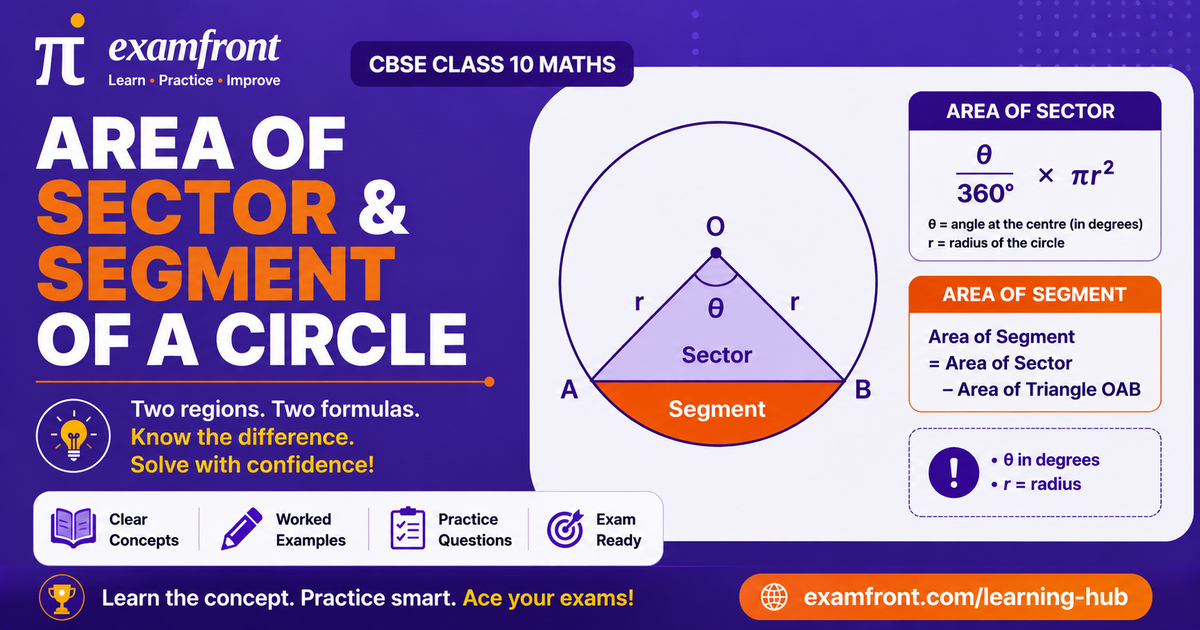
Area of Sector and Segment of a Circle Class 10: Formulas & Examples
Quick answer: In Class 10, the area of a sector of angle θ (the central angle in degrees) in a circle of radius r is (θ/360) × πr², and the length of its arc is (θ/360) × 2πr. The area of a segment is found by subtracting a triangle from a sector: area of segment = area of the sector − area of the triangle made by the two radii and the chord. Everything in this topic comes from one simple idea — a sector is just the fraction θ/360 of the whole circle.
A sector is the part of a circle enclosed by two radii and the arc between them (think of a slice of pizza). A segment is the part enclosed by a chord and the arc between its endpoints (the region a straight chord “cuts off”). Get these two pictures right, and the formulas below follow naturally.
This guide gives you every formula with its meaning, the condition it applies under, and worked examples — the exact toolkit you need for the exam. When you want more practice on the trickier composite-figure questions, you can work through them on examfront.
What is a sector of a circle?
A sector of a circle is the region enclosed by two radii of the circle and the arc joining their ends. The angle between the two radii, measured at the centre, is called the angle of the sector (or central angle), usually written θ.
Every pair of radii creates two sectors:
- The minor sector — the smaller one, with angle θ.
- The major sector — the larger one, with angle 360° − θ.
Unless a question says otherwise, “sector” means the minor sector.
Definition to remember: A sector = “two radii + the arc between them.” It always includes the centre of the circle.
What is a segment of a circle?
A segment of a circle is the region enclosed by a chord and the arc joining the chord’s two endpoints. A chord is a straight line joining two points on the circle. The chord splits the circular region into:
- The minor segment — the smaller region (on the smaller-arc side).
- The major segment — the larger region (on the larger-arc side).
Unless stated otherwise, “segment” means the minor segment.
Sector vs. segment in one line: a sector is cut by two radii; a segment is cut by one chord. A sector touches the centre; a segment need not.
What is the formula for the area of a sector? (with a worked example)
Formula:
Area of a sector of angle θ = (θ / 360) × πr²
- Meaning in words: the whole circle has area πr² and “sweeps” 360° around the centre. A sector sweeps only θ°, so it is the fraction θ/360 of the whole circle’s area.
- Variables: r = radius of the circle; θ = angle of the sector in degrees; π ≈ 22/7 or 3.14.
- Condition: θ must be in degrees (this is the degree form of the formula). Use it for any sector, minor or major — just plug in the correct angle.
Where it comes from (unitary method): an angle of 360° corresponds to area πr², so 1° corresponds to πr²/360, and therefore θ° corresponds to (θ/360) × πr². That’s the whole derivation — no memorising a mystery formula.
Worked Example 1. Find the area of a sector of a circle of radius 6 cm if the angle of the sector is 60°. (Use π = 22/7.)
- Area = (θ/360) × πr² = (60/360) × (22/7) × 6²
- = (1/6) × (22/7) × 36
- = (22 × 36) / (7 × 6) = 132/7 ≈ 18.86 cm²
Finding the major sector. The angle of the major sector is 360° − θ. So its area is either ((360 − θ)/360) × πr², or more simply:
Area of major sector = πr² − area of minor sector.
For Example 1: πr² = (22/7) × 36 = 792/7 ≈ 113.14 cm², so the major sector ≈ 113.14 − 18.86 = 94.28 cm².
Want to drill sector-area questions with instant feedback? examfront’s Topic Practice for Areas Related to Circles gives you graded questions the moment you finish a concept.
🎬 Quick challenge: Can you find what fraction of the circle this 90° sector represents? 🍕
What is the formula for the length of an arc?
Formula:
Length of an arc of a sector of angle θ = (θ / 360) × 2πr
- Meaning in words: the full circle’s boundary (circumference) is 2πr and spans 360°. The arc of a sector spans only θ°, so it is the fraction θ/360 of the circumference.
- Variables: r = radius; θ = angle in degrees.
- Condition: θ in degrees. This gives a length (cm, m), not an area — keep the units straight.
Worked Example 2. For the same sector (r = 6 cm, θ = 60°), find the length of its arc. (Use π = 22/7.)
- Arc length = (θ/360) × 2πr = (60/360) × 2 × (22/7) × 6
- = (1/6) × (264/7) = 44/7 ≈ 6.29 cm
Notice the pattern: the sector’s area uses πr², its arc uses 2πr — and both are multiplied by the same fraction θ/360.
How do you find the area of a segment of a circle?
A segment is a sector with its triangle “sliced off,” so:
Area of a segment = Area of the corresponding sector − Area of the triangle
where the triangle is the one formed by the two radii and the chord.
- Meaning in words: the sector (radii + arc) minus the triangle (radii + chord) leaves exactly the region between the chord and the arc — the segment.
- Variables: sector area = (θ/360)πr²; triangle area depends on the shape (for a right-angled 90° case it is ½ × r × r).
- Condition: you must be able to find the triangle’s area. When the two radii meet at a right angle, the triangle is a right triangle with legs r and r.
Worked Example 3. A chord of a circle of radius 10 cm subtends a right angle (90°) at the centre. Find the area of the corresponding minor segment. (Use π = 3.14.)
- Area of the sector = (90/360) × 3.14 × 10² = (1/4) × 3.14 × 100 = 78.5 cm²
- The triangle has the two radii as its perpendicular sides (90° between them), so its area = ½ × r × r = ½ × 10 × 10 = 50 cm²
- Area of the minor segment = 78.5 − 50 = 28.5 cm²
And the major segment = πr² − minor segment = 314 − 28.5 = 285.5 cm² (since πr² = 3.14 × 100 = 314 cm²).
Tip: For segments where the angle is 60°, 120°, etc., the triangle’s area needs trigonometry (using sin/cos and values like √3 ≈ 1.73). Those are the higher-difficulty variations — practise the full set, step by step, inside examfront’s Chapter Quizzes so the trig part stops feeling scary.
🎬 Quick challenge: Can you find the minor segment’s area from the sector area? 👀
Minor vs. major: a quick relationship you can reuse
For a circle of area πr²:
- Area of major sector = πr² − area of minor sector
- Area of major segment = πr² − area of minor segment
This saves time in the exam: find the smaller piece with the formula, then subtract from the full circle instead of recomputing.
Key Takeaways
- A sector is bounded by two radii and an arc; a segment is bounded by a chord and an arc.
- Area of a sector of angle θ = (θ/360) × πr² — the fraction θ/360 of the whole circle πr².
- Length of an arc of angle θ = (θ/360) × 2πr — the same fraction of the circumference.
- Area of a segment = area of the sector − area of the triangle (radii + chord).
- Major piece = whole circle − minor piece, for both sectors and segments.
Quick Facts
- Full circle area = πr²; full circumference = 2πr; full angle at centre = 360°.
- Angle of the major sector = 360° − θ.
- For a 90° sector, the radii-and-chord triangle has area ½r².
- Use π = 22/7 when the radius is a multiple of 7; use π = 3.14 otherwise (unless the question tells you which to use).
- Area is in square units (cm²); arc length is in linear units (cm).
Common Mistakes
- Using πr² for a sector without the θ/360 fraction — always scale the whole-circle area by θ/360.
- Mixing up area and arc length — area uses πr², arc uses 2πr; check the units.
- Confusing sector with segment — a segment is a sector minus a triangle.
- Forgetting to subtract the triangle when a segment is asked — “segment” ≠ “sector.”
- Wrong angle for the major sector — it is 360° − θ, not just θ again.
Download the 2-page summary
📄 Download the Area of Sector and Segment summary (PDF) — both formulas, the segment method and a solved example on two printable pages.
FAQ
What is the formula for the area of a sector of a circle in Class 10? The area of a sector of angle θ (in degrees) in a circle of radius r is (θ/360) × πr². It is the fraction θ/360 of the whole circle’s area πr². For r = 6 cm and θ = 60°, the area is (60/360) × (22/7) × 36 = 132/7 ≈ 18.86 cm².
What is the difference between a sector and a segment of a circle? A sector is enclosed by two radii and the arc between them (a pizza-slice shape that touches the centre). A segment is enclosed by a chord and the arc between the chord’s endpoints. In short: a sector is cut by two radii, a segment by one chord.
How do you find the area of a segment of a circle? Area of a segment = area of the corresponding sector − area of the triangle formed by the two radii and the chord. Find the sector area with (θ/360)πr², then subtract the triangle. For a 90° sector, the triangle’s area is ½r².
What is the formula for the length of an arc of a sector? Length of an arc of angle θ = (θ/360) × 2πr, where r is the radius. It is the fraction θ/360 of the circumference 2πr. For r = 6 cm, θ = 60°, the arc length is 44/7 ≈ 6.29 cm.
What is the angle of the major sector if the minor sector’s angle is θ? The major sector’s angle is 360° − θ, because both sectors together complete the full 360° around the centre. Its area equals πr² − (area of the minor sector).
Related Concepts
- Circumference and area of a circle — the base formulas 2πr and πr² that every sector/segment formula scales down from; they are all collected in the Class 10 Maths formula list.
- Chord, arc and radius (Circles, Chapter 10) — the vocabulary a segment is built on; see the tangent and secant of a circle guide.
- Trigonometric ratios (Chapter 8) — needed to find the triangle’s area in non-right-angle segment problems.
- Areas Related to Circles chapter guide — the full chapter roadmap and formula list.
Ready to test yourself? Start with examfront’s Areas Related to Circles quiz, track which question types trip you up with Progress Tracking, and get personalised help exactly where you slip.