Similar Figures Class 10: Meaning, Conditions & Examples (Triangles)
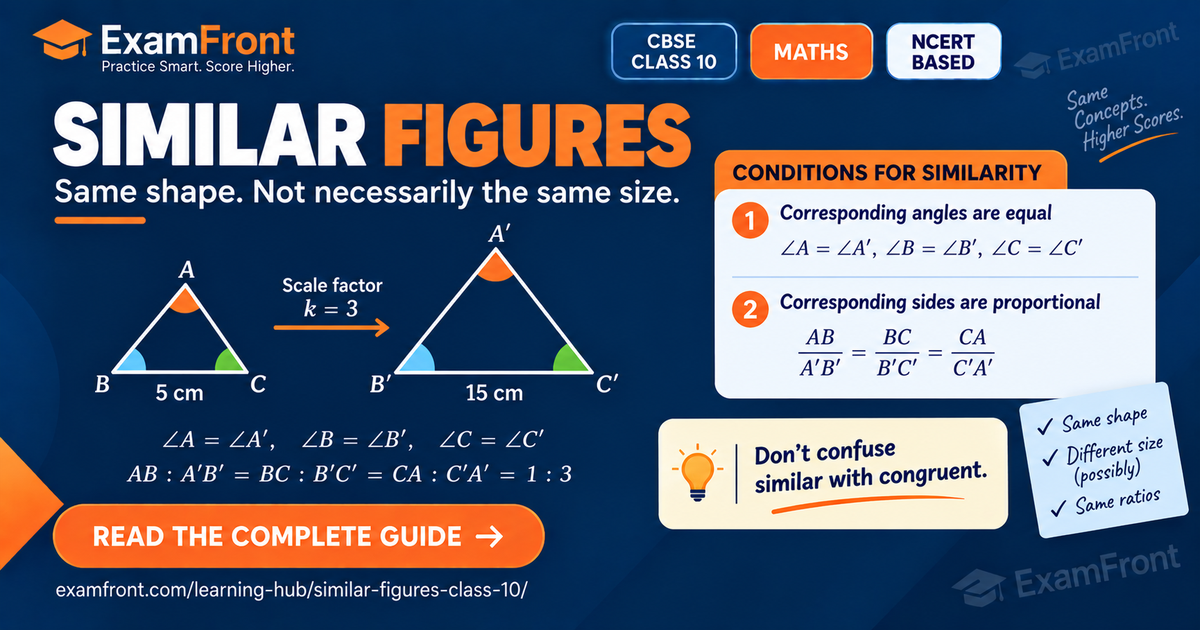
In one line: similar figures are figures that have the same shape but not necessarily the same size — like two photos printed from the same negative, one small and one large.
This is the starting idea of Class 10 Chapter 6, Triangles (Sections 6.1 and 6.2 of the NCERT textbook). In Class 9 you studied congruent figures — figures with the same shape and the same size, so one exactly covers the other. In this chapter we relax that a little: we keep the same shape but allow a different size. Figures related in this way are called similar figures. A useful headline result follows straight away: all congruent figures are similar, but similar figures need not be congruent.
Why does this matter? The idea of similarity is how heights and distances that are impossible to measure directly — the height of a mountain, the width of a river, the distance to the Moon — are found indirectly. It is also the foundation for the similarity of triangles, which powers much of the geometry (and later the trigonometry) you meet in Class 10. The rest of this guide explains exactly what “similar” means, how it differs from “congruent,” the two conditions that decide whether two figures are similar, and the scale factor that connects them.
🎬 Watch (60-sec Short): Which figures are always similar, no matter the size? ⚡
What are similar figures? (definition)
Two figures are similar if they have the same shape, whether or not they have the same size. Each figure is a scaled version of the other — you can enlarge or shrink one to land exactly on the other without bending or distorting it.
Some everyday examples make this concrete:
- The same photograph printed in stamp size, passport size and postcard size — same picture, different sizes → similar.
- A map or a blueprint and the real place or building it represents → similar (drawn to scale).
- A shape and its shadow enlargement on a wall from a nearby lamp → similar.
And a non-example, so the idea is sharp: two photos of the same size of a person at age 10 and at age 40 are not similar — they are the same size but a different shape, so similarity fails. Same shape is the thing that matters, not same size.
Similar vs congruent: what’s the difference?
This is the distinction examiners test most often, so lock it in early.
| Congruent figures | Similar figures | |
|---|---|---|
| Shape | Same | Same |
| Size | Same | Not necessarily the same |
| One covers the other exactly? | Yes | Only if they also happen to be the same size |
| Symbol | ≅ (is congruent to) | ~ (is similar to) |
| Example | Two Rs 5 coins | A Rs 5 coin and a bigger circular clock face |
The key sentence to memorise: every congruent pair is also similar (the size ratio is just 1), but a similar pair is congruent only when the sizes are equal too. In other words, congruence is the special case of similarity where the two figures are the same size.
The two conditions for two polygons to be similar
For polygons (closed figures made of straight sides, like triangles, squares and quadrilaterals), “same shape” is made precise by two conditions that must both hold.
Two polygons of the same number of sides are similar if: (1) their corresponding angles are equal, and (2) their corresponding sides are in the same ratio (i.e., in the same proportion).
Let’s define each term the first time it is used:
- Corresponding angles are the angles that sit at matching positions in the two polygons (first-to-first, second-to-second, and so on).
- Corresponding sides are the sides that join matching pairs of vertices.
- Same ratio (proportion) means that if you divide each side of one polygon by its matching side in the other, you get the same number every time.
Both conditions are required — one alone is not enough. This is the single most important point in Section 6.2, and the two examples below prove it.
Why you need both conditions (two proof-by-example cases)
Case 1 — a square and a rectangle (angles equal, sides not proportional → NOT similar). Take a square of side 4 cm and a rectangle measuring 6 cm × 3 cm. Every angle in both figures is 90°, so condition (1) is satisfied. But check the sides: one pair gives 6/4 = 1.5 while the other gives 3/4 = 0.75. The ratios are different, so condition (2) fails. Result: a square and a rectangle are not similar, even though all their angles match.
Case 2 — a square and a rhombus (sides proportional, angles not equal → NOT similar). Take a square of side 4 cm and a rhombus of side 4 cm whose angles are 60° and 120°. All corresponding sides are in the ratio 4/4 = 1, so condition (2) is satisfied. But the square’s angles are all 90° while the rhombus has 60° and 120° angles, so condition (1) fails. Result: a square and a rhombus are not similar, even though their sides are in the same ratio.
Put together, these two cases show why the definition insists on both equal angles and proportional sides. Spotting which condition a figure secretly breaks is exactly the kind of quick-decision skill that examfront’s Topic Practice and Mistake Identification help you build so it becomes automatic in the exam.
🎬 Watch (60-sec Short): Are a square and rectangle always similar? 🤔
Figures that are always similar
Some standard families of figures are always similar to each other, and these are worth remembering as ready facts:
- All circles are similar. They all have the same round shape; only the radius (size) changes.
- All squares are similar. Every square has four 90° angles and four equal sides, so both conditions always hold.
- All equilateral triangles are similar. Every one has three 60° angles and three equal sides.
Notice the pattern: these figures are “locked” into one shape, so changing the size can never change the shape. That is exactly what similarity needs. (In contrast, “all rectangles” are not all similar, and “all triangles” are not all similar — their shapes can vary.)
Scale factor: the number that links similar figures
When two figures are similar, the common ratio of their corresponding sides has a special name.
Scale factor (k) = (a side of one figure) / (the matching side of the other figure). Here k is the single number by which every length is enlarged or reduced. The scale factor applies to all corresponding sides equally; it does not change the angles. The figures must already be similar for a single scale factor to exist.
Worked example. A small square has side 5 cm and a large square has side 15 cm. Are they similar, and what is the scale factor?
- All squares are similar, so yes.
- Scale factor from small to large: k = 15/5 = 3 (the big square’s sides are 3 times longer).
- Scale factor from large to small: k = 5/15 = 1/3.
Worked example (finding a missing side). Two similar quadrilaterals have a scale factor of 2. If one side of the smaller figure is 7 cm, the matching side of the larger figure is 7 × 2 = 14 cm. This “multiply by the scale factor” move is how similarity lets you find unknown lengths — the everyday engine behind maps, blueprints and model-making. You can drill this length-finding skill on examfront with Chapter Quizzes that check whether you’ve really got it.
🎬 Watch (60-sec Short): Can you find the missing side using the scale factor? 👀
How similarity measures the unreachable (real-life link)
Here is the pay-off that opens the chapter. You cannot lay a measuring tape up Mount Everest or across to the Moon — yet their heights and distances are known. They are found by indirect measurement, which rests entirely on the principle of similar figures: set up a small, measurable figure that is similar to the huge, unreachable one, then scale up.
This is why Sections 6.1 and 6.2 are the doorway to two big Class 10 topics: the similarity of triangles (the rest of Chapter 6) and later the applications of trigonometry — heights and distances (Chapter 9). Getting this foundation solid now makes those chapters far easier, and examfront’s Progress Tracking will show you when your similarity basics are exam-ready to move on.
Where this sits in the NCERT and CBSE syllabus
NCERT sets the scope. Similar figures open Chapter 6, Triangles, of the NCERT Class 10 textbook. Section 6.1 (Introduction) sets up the idea — congruent figures from Class 9, and the question of how the heights of mountains and the distance to the Moon are found — and Section 6.2, Similar Figures, gives the definition and the two conditions. The practice for Section 6.2 is Exercise 6.1, not Exercise 6.2: the exercise number runs one behind the section number because Section 6.1 has no exercise. If you open “Exercise 6.2” looking for similar figures, you will land on the Basic Proportionality Theorem instead.
Exercise 6.1 has only three questions, and this page covers all three:
- Q1 is fill-in-the-blanks: all circles are similar, all squares are similar, all equilateral triangles are similar, and two polygons with the same number of sides are similar if their corresponding angles are equal and their corresponding sides are proportional. That is the “always similar” list and the two conditions above.
- Q2 asks for two examples each of similar and non-similar pairs of figures — the photographs, maps and non-example in the definition section.
- Q3 asks whether two quadrilaterals, a square and a rhombus, are similar. Their sides are in proportion but their angles are not equal, so they are not similar — Case 2 above.
The chapter as a whole now has three exercises: 6.1 (3 questions), 6.2 (10) and 6.3 (16). Two topics were removed in the NCERT rationalisation — areas of similar triangles and the Pythagoras theorem and its converse, together with their old Exercises 6.4 to 6.6. Older editions and some solution websites still carry them, so check that your book matches before you practise from it. The NCERT Class 10 Maths guide and how to study NCERT Maths for Class 10 explain how to work through the textbook itself.
CBSE sets the priority. In the CBSE Class 10 Maths syllabus, Triangles sits in Unit IV, Geometry, worth 15 of the 80 theory marks — a unit it shares with Circles. The other units are Number Systems 6, Algebra 20, Coordinate Geometry 6, Trigonometry 12, Mensuration 10 and Statistics & Probability 11. CBSE gives marks by unit, not by chapter, so any chapter-wise percentage you see online for Triangles is an unofficial estimate — see CBSE Class 10 Maths unit-wise weightage.
The syllabus content for Triangles opens with “Definitions, examples, counter examples of similar triangles”, then lists the results the rest of the chapter builds: the Basic Proportionality Theorem, its converse, and the three criteria for similarity of triangles (AA/AAA, SSS and SAS). That first line is this page’s material — the square–rectangle and square–rhombus cases are exactly the counter examples it asks for.
How it is asked. The definition is too short to carry a long answer on its own, so it usually appears in 1-mark objective items — a multiple-choice or Assertion–Reason question such as “a square and a rhombus are always similar” — and as the reasoning line inside every longer similarity question: corresponding angles equal, corresponding sides proportional. The paper has 38 questions and 80 marks in three hours; CBSE Class 10 Maths question types explains each format.
Where this leads next (similarity of triangles)
A triangle is a polygon, so the same two conditions define similar triangles: corresponding angles equal and corresponding sides in the same ratio. We write it symbolically as △ABC ~ △DEF, always keeping the vertices in matching order.
The good news, which the next sections of Chapter 6 develop, is that you don’t have to check all six measurements every time. Just as Class 9 gave you short congruence tests, Class 10 gives you short similarity criteria — AAA / AA, SSS and SAS (see criteria for similarity of triangles) — plus the Basic Proportionality Theorem (Thales Theorem). Those tools, the proofs behind them, and the full set of worked problems are the heart of the chapter.
We’ve kept this introduction focused on the core of Sections 6.1 and 6.2 — what similarity means and how to recognise it. For the similarity criteria, the Basic Proportionality Theorem, and complete graded practice, continue with the Triangles Class 10 chapter guide and work the full example set on examfront, where personalised help points out exactly which similarity idea is tripping you up.
Key Takeaways
- Similar figures have the same shape but not necessarily the same size; the symbol is ~.
- Congruent means same shape and same size, so all congruent figures are similar, but not the reverse — congruence is the special case where sizes match too.
- Two polygons are similar only if both: (1) corresponding angles are equal, and (2) corresponding sides are in the same ratio.
- One condition is never enough: a square and rectangle fail the side-ratio test; a square and rhombus fail the equal-angle test.
- The scale factor is the common ratio of corresponding sides; all circles, all squares and all equilateral triangles are always similar.
- NCERT and CBSE: similar figures is NCERT Chapter 6, Section 6.2, practised in Exercise 6.1 (three questions), and it counts toward CBSE Unit IV Geometry (15 of 80 marks).
Quick Facts
- Similar figures: same shape, not necessarily same size. Symbol: ~.
- Congruent figures: same shape and same size. Symbol: ≅.
- Rule: all congruent figures are similar; similar figures need not be congruent.
- Similarity of polygons — needs BOTH: equal corresponding angles and corresponding sides in the same ratio.
- Scale factor (k): ratio of corresponding sides; same for every pair; does not change angles.
- Always similar: all circles, all squares, all equilateral triangles.
- Not automatically similar: all rectangles, all triangles (must be checked).
- Use: indirect measurement of heights and distances relies on similarity.
- Chapter: Triangles (Ch. 6) · Class: 10 · Subject: Maths · Board: CBSE.
- NCERT map: 6.1 Introduction · 6.2 Similar Figures → Exercise 6.1 (3 questions) · 6.3 Similarity of Triangles → Exercise 6.2 (10) · 6.4 Criteria for Similarity → Exercise 6.3 (16).
- Removed from the syllabus: areas of similar triangles; the Pythagoras theorem and its converse.
Common Mistakes
- Treating “similar” as “same size.” Students assume similar figures must look identical. Similar only means same shape; the sizes can differ. Fix: think “scaled copy,” like small and large prints of one photo.
- Checking only one condition for polygons. Seeing equal angles (or equal side-ratios) alone and declaring the figures similar. Fix: always confirm both equal angles and proportional sides — a rectangle vs square, or rhombus vs square, shows why.
- Mismatching corresponding parts. Pairing the wrong angles or sides across the two figures. Fix: match vertices in order and write similarity as △ABC ~ △DEF with the letters lined up.
- Confusing congruent (≅) with similar (~). Using the wrong symbol or claiming similar figures are congruent. Fix: remember “≅ = same size too; ~ = shape only.”
- Assuming all figures of a type are similar. Believing all rectangles or all triangles are similar. Fix: only “locked-shape” families — circles, squares, equilateral triangles — are always similar; the rest must be tested.
📄 Download the 2-page Similar Figures summary (PDF) — definitions, the two conditions, the NCERT and CBSE map, and a worked Exercise 6.1 question.
FAQ
Q. What are similar figures in Class 10 Maths? Similar figures are figures that have exactly the same shape but not necessarily the same size. For example, all circles are similar and all squares are similar, because enlarging or shrinking one gives the other without changing its shape. This is the core idea of Chapter 6 (Triangles) and it later leads to the similarity of triangles.
Q. What is the difference between congruent and similar figures? Congruent figures have the same shape AND the same size, so one can exactly cover the other. Similar figures have the same shape but not necessarily the same size — one may be a scaled (bigger or smaller) copy of the other. So all congruent figures are similar, but similar figures need not be congruent.
Q. What are the two conditions for two polygons to be similar? Two polygons with the same number of sides are similar only if BOTH conditions hold: (1) their corresponding angles are equal, and (2) their corresponding sides are in the same ratio (proportion). If only one condition holds, the polygons are not similar — a square and a rectangle fail condition 2, and a square and a rhombus fail condition 1.
Q. What is the scale factor of similar figures? The scale factor is the common ratio of the corresponding sides of two similar figures. If every side of one figure is k times the matching side of the other, then k is the scale factor. For a 3 cm square and a 9 cm square, the scale factor is 9/3 = 3. Maps and blueprints are drawn using a scale factor.
Q. Are all triangles similar in Class 10? No. All equilateral triangles are similar to each other, because their angles are all 60° and their sides are always in the same ratio. But triangles in general are not automatically similar — you must check the similarity conditions. Class 10 gives shorter tests (AAA/AA, SSS, SAS criteria) for checking when two triangles are similar.
Q. Is similar figures part of the NCERT and CBSE Class 10 Maths syllabus? Yes. Similar figures is Section 6.2 of NCERT Class 10 Chapter 6 (Triangles), and it is practised in Exercise 6.1, which has three questions. The exercise number is one behind the section number, because Section 6.1 is an introduction with no exercise. In the CBSE syllabus it falls under Unit IV Geometry, worth 15 of the 80 theory marks together with Circles, and the Triangles content opens with definitions, examples and counter examples of similar triangles. Areas of similar triangles and the Pythagoras theorem were removed from the chapter, so an older book that still teaches them is out of date.
Related Concepts
- Triangles — Chapter Guide (Class 10): the full chapter roadmap, including the similarity criteria and the Basic Proportionality Theorem.
- Class 10 Maths — All Formulas: the quick-reference sheet for the similarity results alongside every other Class 10 formula.
- Introduction to Trigonometry (Class 10): builds on similar right triangles to define the trigonometric ratios.
- Coordinate Geometry (Class 10): uses ratios and the section formula, close cousins of the proportion idea in similarity.
Ready to make similarity automatic? Practise a full graded set on examfront’s Topic Practice, and let Mistake Identification and Progress Tracking show you exactly where your angle/side checks slip. Start on examfront →