Heights and Distances (Class 10): How to Solve Trigonometry Problems
In one line: to solve a heights and distances problem, draw a right-angled triangle from the situation, mark the given angle of elevation or depression, and use a trigonometric ratio — most often tan θ = height ÷ distance — to find the unknown.
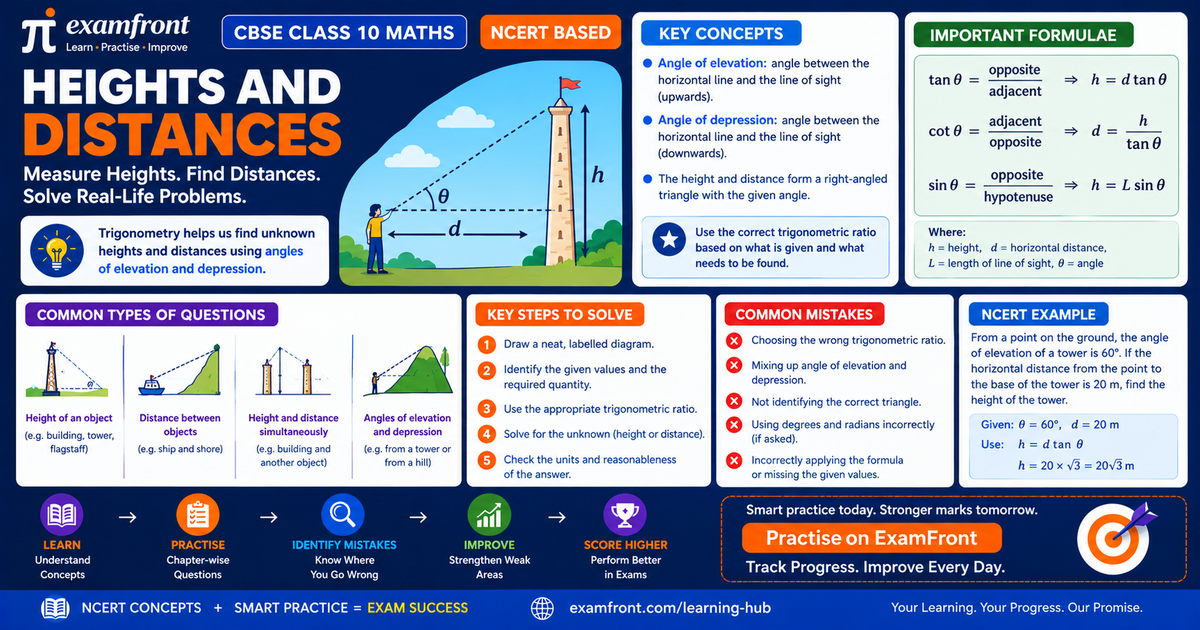
Heights and distances is the practical side of trigonometry: it lets you find the height of a tower, the width of a river, or the length of a ladder without measuring them directly. You measure an angle and one accessible distance, and trigonometry does the rest. Every problem reduces to the same idea — a vertical object and a horizontal ground line form a right-angled triangle, and a trig ratio links the sides.
The whole skill comes down to a repeatable 4-step method: draw and label, mark the angle, choose the ratio, solve. Because the unknown is usually a vertical height with a known horizontal base, tan is the ratio you will reach for most; sin and cos come in when a slant length like a ladder or rope is involved. This guide gives you the method, the ratio-choosing rule, and worked examples. If you are still unsure what “angle of elevation” and “angle of depression” mean, read Angle of Elevation and Angle of Depression (Class 10) first.
What are heights and distances?
Heights and distances is the branch of Some Applications of Trigonometry that uses trigonometric ratios to calculate an unknown height (like a tower or chimney) or distance (like how far a boat is from shore) from a measured angle and a known length.
The set-up is always a right-angled triangle: a vertical object stands at a right angle to the horizontal ground. The angle of elevation or depression sits at one corner, and the sides of the triangle are the height (opposite the angle), the horizontal distance (adjacent to the angle), and the line of sight (the hypotenuse).
The heights and distances formula (which ratio to use)
There is no single “formula” to memorise — you apply the three trigonometric ratios to a right triangle. Each ratio comes with its meaning, its variables, and the condition for using it:
- tan θ = opposite ÷ adjacent = height ÷ horizontal distance. Use when you know a horizontal distance and want a vertical height, or vice versa. Rearranged: height = distance × tan θ, and distance = height ÷ tan θ.
- sin θ = opposite ÷ hypotenuse = height ÷ slant length. Use when a slant length (ladder, rope, string) is given or wanted along with a vertical height.
- cos θ = adjacent ÷ hypotenuse = horizontal distance ÷ slant length. Use when a slant length is involved along with a horizontal distance.
Here θ is the angle of elevation or depression, “opposite” is the side across from θ, “adjacent” is the side next to θ (along the ground), and “hypotenuse” is the slant line of sight. Every problem below is just one of these three applied once.
🎬 Watch — 30-sec Short: Which trig ratio finds the tower’s height fastest? 📐
The 4-step method for any problem
Use this exact sequence every time — it turns a wordy problem into a one-line equation.
- Draw and label. Sketch the right-angled triangle. Mark what you know (a distance, a height, or a slant length) and what you want to find.
- Mark the angle. Place the angle of elevation or depression at the correct vertex. For a depression angle, use the equal-angle rule to copy it into the ground-level triangle as an angle of elevation.
- Choose the ratio. Look at the side you know and the side you want. Pick the ratio that connects exactly those two: opposite + adjacent → tan; opposite + hypotenuse → sin; adjacent + hypotenuse → cos.
- Solve — then adjust. Solve the equation for the unknown. If the angle was measured from an observer’s eyes, add the observer’s height at the end.
Exam tip: Always draw the figure first, even if you think you can picture it. A labelled diagram earns method marks and stops you from choosing the wrong ratio.
Worked example 1 — find a height (tan)
Problem: A point on the ground is 15 m from the foot of a tower. The angle of elevation of the top of the tower is 60°. Find the height of the tower.
- Step 1–2: Right triangle; height = opposite, 15 m = adjacent, angle = 60°.
- Step 3: Opposite and adjacent → use tan. tan 60° = height ÷ 15.
- Step 4: height = 15 × tan 60° = 15 × √3 = 15√3 ≈ 25.98 m.
The tower is about 25.98 m tall. Choosing tan the moment you see “distance on the ground + height” is the habit to build.
Worked example 2 — include the observer’s height
Problem: An observer 1.5 m tall stands 28.5 m from a chimney. The angle of elevation of the top of the chimney from her eyes is 45°. Find the height of the chimney.
- Step 1–2: The triangle is drawn from her eye level, not the ground. Height above eye level = opposite; 28.5 m = adjacent; angle = 45°.
- Step 3: Opposite and adjacent → tan. tan 45° = height-above-eye ÷ 28.5.
- Step 4: height above eye = 28.5 × tan 45° = 28.5 × 1 = 28.5 m. Now add the observer’s height: 28.5 + 1.5 = 30 m.
The chimney is 30 m tall. Forgetting Step 4’s adjustment is one of the most common ways students lose a mark here — the kind of slip Mistake Identification on examfront points out instantly.
🎬 Watch — 30-sec Short: Can you avoid the height trap? 📏
Worked example 3 — find a distance (tan)
Problem: The angle of elevation of the top of a 50 m tall tower from a point on the ground is 30°. How far is the point from the foot of the tower?
- Step 1–2: Height 50 m = opposite; distance d = adjacent; angle = 30°.
- Step 3: Opposite and adjacent → tan. tan 30° = 50 ÷ d.
- Step 4: d = 50 ÷ tan 30° = 50 × √3 = 50√3 ≈ 86.6 m.
The point is about 86.6 m from the tower. Notice the only change from Example 1 is which side is unknown — the ratio choice stays the same.
🎬 Watch — 30-sec Short: Which trig ratio solves the ladder-length trick? 🪜
When to use sin or cos instead of tan
Reach for sin or cos the moment a slant length appears — a ladder against a wall, a rope to a pole, or a kite string. For example, if a ladder makes an angle with the ground and you know how high up the wall it reaches (a vertical height) and want the ladder’s length (the hypotenuse), you use sin θ = height ÷ ladder length. If instead you know the foot-of-ladder distance (horizontal) and want the ladder length, you use cos θ = distance ÷ ladder length.
The deciding question is always the same: which two sides am I linking? Match them to opposite/adjacent/hypotenuse and the correct ratio picks itself.
Where this sits in the NCERT and CBSE syllabus
Heights and distances is not a corner of a chapter — it is the chapter. In the NCERT Class 10 Maths textbook it is Chapter 9, Some Applications of Trigonometry: Section 9.1 is a one-page introduction, and Section 9.2, “Heights and Distances”, carries all seven worked examples and the chapter’s only exercise.
Watch the numbering. The topic is Section 9.2, but the exercise attached to it is Exercise 9.1 — the single exercise in the chapter, with 16 questions. There is no Exercise 9.2 in Chapter 9, so if a teacher or a solution site sends you looking for one, that is a typo, not a missing set.
In the CBSE scheme this chapter sits inside Unit V — Trigonometry, worth 12 of the 80 theory marks, which it shares with Introduction to Trigonometry (Chapter 8). The two are inseparable in practice: every heights-and-distances answer ends in a standard trigonometric value, so if tan 30°, sin 45° and cos 60° are still shaky, fix them first in Introduction to Trigonometry (Class 10).
Two scope limits are written into the syllabus, and knowing them will stop you panicking in the exam. CBSE specifies that problems “should not involve more than two right triangles”, and that “angles of elevation / depression should be only 30°, 45° and 60°”. So no board question will hand you a 37° angle that needs a calculator, and none will need a third triangle. If your working has sprouted a third triangle, you have taken a wrong turn — you have not found an unusually hard question.
How it is asked: almost always as a descriptive question rather than an objective one, because the figure is part of the answer. The examiner is buying four things — a labelled diagram, the ratio you chose, the substitution, and the final value with its unit — and the diagram alone is worth marks even when the arithmetic goes wrong, which is why Step 1 is never optional. See the CBSE question formats for how the different sections of the paper are marked.
Because every examined question is set on the NCERT text, the fastest revision here is narrow and finite: the seven worked examples and the 16 questions of Exercise 9.1, done the way How to study NCERT Maths (Class 10) describes — figure first, then ratio. The NCERT Class 10 Maths guide sets out the same approach for the rest of the book.
Going further
This guide covers the core method and the single-triangle problems that make up most of the marks. The harder variations — two-triangle problems (a flagstaff on a building, or a tower on a canal bank), a shadow that changes length as the Sun’s angle changes, and moving-object problems (a car approaching a tower, or a balloon drifting across the sky) — are exactly where students need extra practice and guidance. Work through the full set with step-by-step solutions and personalised help inside examfront, where Chapter Quizzes and Progress Tracking show you which problem types still need work. For the definitions behind every angle here, keep Angle of Elevation and Angle of Depression (Class 10) handy.
Key Takeaways
- Heights and distances finds an unknown height or distance from a measured angle and one known length, using a right-angled triangle.
- Follow the 4-step method: draw and label → mark the angle → choose the ratio → solve (and adjust for observer height).
- tan θ = height ÷ distance is the most-used ratio; use sin or cos when a slant length (ladder, rope, string) is involved.
- For a depression angle, copy it down as the equal angle of elevation before solving.
- Add the observer’s height whenever the angle is measured from eye level, not the ground.
- In NCERT it is Chapter 9, Section 9.2 (Exercise 9.1); in CBSE it is Unit V, Trigonometry — 12 of 80 marks, with angles limited to 30°, 45° and 60° and at most two right triangles.
Quick Facts
- Heights and distances: using trigonometry to find heights/distances indirectly.
- Set-up: a right-angled triangle (vertical object ⟂ horizontal ground).
- tan θ = opposite/adjacent: height ÷ horizontal distance (most common).
- sin θ = opposite/hypotenuse; cos θ = adjacent/hypotenuse: used with slant lengths.
- height = distance × tan θ; distance = height ÷ tan θ.
- Observer height: add it back when the angle is measured from the eyes.
- NCERT reference: Chapter 9, Some Applications of Trigonometry — Section 9.2, Exercise 9.1 (16 questions, 7 worked examples).
- CBSE unit: Unit V, Trigonometry — 12 of 80 theory marks; angles restricted to 30°, 45°, 60°; at most two right triangles.
- Chapter: Some Applications of Trigonometry · Class: 10 · Subject: Maths · Board: CBSE.
Common Mistakes
- Not drawing the figure. Skipping the diagram leads to the wrong side being labelled opposite or adjacent. Always sketch and label first.
- Choosing the wrong ratio. Using sin when both sides are opposite and adjacent (should be tan). Match the two sides you have to the correct ratio.
- Forgetting to add the observer’s height. When the angle is from eye level, the triangle gives the height above the eyes; add the observer’s height for the true total.
- Mishandling a depression angle. Leaving the angle at the top instead of copying it down as the equal angle of elevation, so no solvable triangle forms.
- Slipping on standard values. Writing tan 30° as √3 (it is 1/√3) or tan 60° as 1/√3 (it is √3). Memorise tan 30° = 1/√3, tan 45° = 1, tan 60° = √3.
📄 Download the 2-page heights and distances summary (PDF) — the 4-step method, the ratio-choosing rule and a full board-style answer on one printable sheet.
FAQ
Q. How do you solve heights and distances problems in Class 10? Draw a labelled right-angled figure, mark the given angle of elevation or depression at the correct vertex, choose the trig ratio that links the known side with the unknown one (usually tan = opposite/adjacent), solve the equation, and add the observer’s height if the angle was from eye level.
Q. Which trigonometric ratio should I use? Use tan when linking a horizontal distance and a vertical height. Use sin or cos when a slant length (ladder, rope, string — the hypotenuse) is involved: sin = opposite/hypotenuse, cos = adjacent/hypotenuse.
Q. What is the formula for heights and distances? There is no single formula; you apply the trig ratios in a right triangle. The most common is tan θ = height ÷ horizontal distance, giving height = distance × tan θ and distance = height ÷ tan θ.
Q. Do I need to add the height of the observer? Yes, when the angle is measured from the observer’s eyes. The triangle then gives the height above eye level, so you add the observer’s height for the total. If the observer is a point on the ground, no adjustment is needed.
Q. Why do these problems use tan the most? Because most give a horizontal ground distance and ask for a vertical height (or the reverse). Height is opposite the angle and the ground distance is adjacent, and tan = opposite/adjacent connects exactly those two sides.
Q. Is heights and distances part of the NCERT and CBSE Class 10 syllabus? Yes. It is NCERT Class 10 Maths Chapter 9, Some Applications of Trigonometry — Section 9.2, with Exercise 9.1 as the chapter’s only exercise (16 questions, 7 worked examples). In the CBSE scheme it sits in Unit V, Trigonometry, worth 12 of the 80 theory marks. The syllabus limits problems to at most two right triangles, and to angles of elevation or depression of 30°, 45° and 60° only.
Related Concepts
- Angle of Elevation and Angle of Depression (Class 10): the definitions and the equal-angle rule these problems depend on.
- Applications of Trigonometry — Chapter Guide: the full Chapter 9 roadmap and exam relevance.
- Introduction to Trigonometry (Class 10): the sin, cos and tan ratios and their standard values.
- Triangles (Class 10): right-triangle properties underlying every heights-and-distances figure.
Ready to master heights and distances? Work through a full graded set on examfront’s Topic Practice, and let the Practice Companion, Chapter Quizzes and Progress Tracking guide you from easy to exam-level problems. Start on examfront →