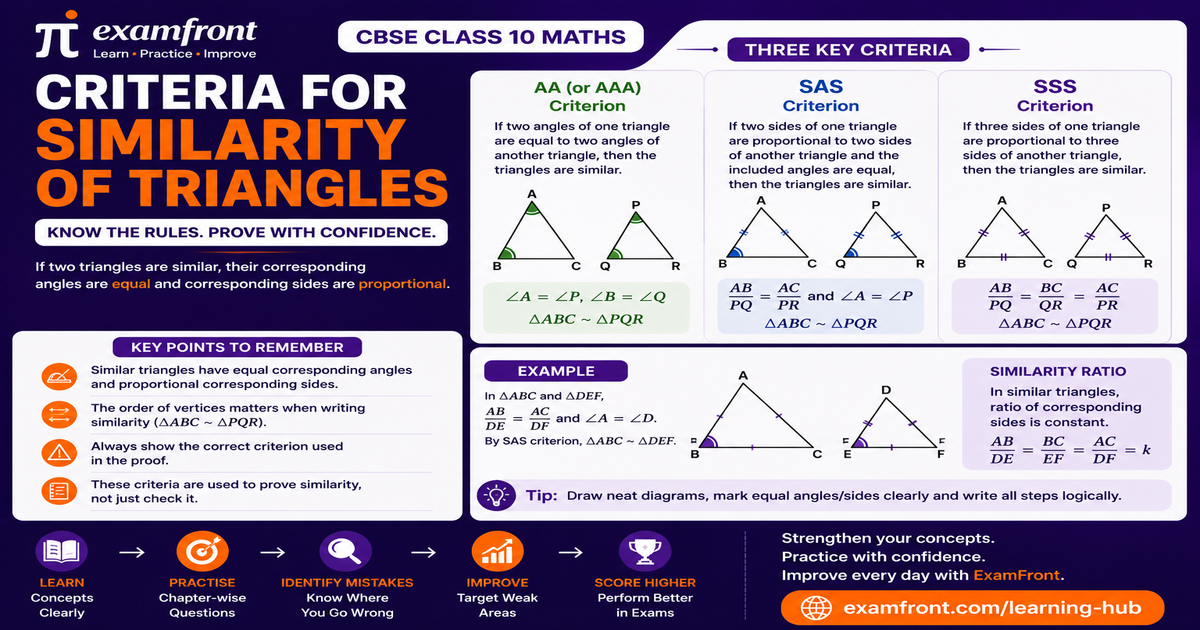
Criteria for Similarity of Triangles Class 10: AAA, AA, SSS & SAS (With Examples)
In one line: the criteria for similarity of triangles are three shortcut rules — AAA (or AA), SSS and SAS — that let you prove two triangles are similar by checking just three facts instead of all six.
Two triangles are similar when they have the same shape — their corresponding angles are equal and their corresponding sides are in the same ratio. Checking all six of those conditions every time would be slow, so Class 10 gives you shorter tests, exactly like the congruence rules you learned in Class 9. The three you need are: AAA — all three pairs of corresponding angles equal; SSS — all three pairs of corresponding sides in the same ratio; and SAS — one pair of equal angles with the two sides including that angle in the same ratio. Each one, on its own, is enough to conclude the triangles are similar (written with the symbol ~).
The most-used rule in the exam is AA, a shorter form of AAA: if two angles of one triangle equal two angles of another, the third pair is automatically equal (the angles of every triangle add to 180°), so the triangles are similar. The rest of this guide defines each criterion precisely, tells you the one condition students most often get wrong, and works one clean example per rule so you can see the exact steps to write in your answer.
🎬 Watch (60-sec Short): Which similarity criterion fits this situation? 🤔
New to the same-shape idea? Read Similar Figures Class 10 first, then come back — these criteria will click much faster.
What does “similar triangles” mean? (quick recap)
A triangle is a three-sided polygon, so the general definition of similar polygons applies to it directly.
Similar triangles: two triangles are similar if (1) their corresponding angles are equal and (2) their corresponding sides are in the same ratio (proportion). We write △ABC ~ △DEF, where ~ means “is similar to.”
Two terms defined the first time they appear: corresponding angles are the angles at matching vertices, and corresponding sides are the sides joining matching vertices. The order of letters carries this matching — △ABC ~ △DEF means A↔D, B↔E and C↔F. Because of this, you must always write similarity with the vertices lined up correctly: △ABC ~ △DEF is not the same statement as △ABC ~ △EDF.
When △ABC ~ △DEF, both of these hold together:
∠A = ∠D, ∠B = ∠E, ∠C = ∠F and AB/DE = BC/EF = CA/FD
The three criteria below are simply the fastest ways to establish this similarity — each proves the full set of six equalities from only three well-chosen facts.
The three similarity criteria at a glance
| Criterion | What you must show | How many facts | Everyday name |
|---|---|---|---|
| AAA / AA | Corresponding angles equal (two are enough) | 2–3 angles | “Same angles ⇒ same shape” |
| SSS | Corresponding sides in the same ratio | 3 side ratios | “Sides scale together” |
| SAS | One equal angle + the two sides including it in the same ratio | 1 angle + 2 sides | “Angle wedged between matching sides” |
Each row is a complete, standalone test: satisfy any one of them and the triangles are similar. Knowing which rule to reach for is half the skill — the worked examples below train exactly that decision.
AAA and AA similarity criterion (angles decide the shape)
AAA similarity criterion (Theorem 6.3): If in two triangles the corresponding angles are equal, then their corresponding sides are in the same ratio, and so the two triangles are similar.
In plain words: if two triangles have the same set of angles, they must have the same shape — one is just a scaled copy of the other. The angles lock the shape; the size is free.
The AA short form. Because the three angles of any triangle add up to 180°, fixing two angles automatically fixes the third. So you never actually need to check all three:
AA similarity criterion: If two angles of one triangle are equal to two angles of another triangle, the two triangles are similar.
- Meaning: two matching angles are enough to guarantee similarity.
- Condition: the equal angles must be corresponding (matched correctly between the triangles).
- When to use: any time a figure hands you equal angles — parallel lines (alternate/corresponding angles), vertically opposite angles, or a shared common angle.
Worked example (AA). In the figure, PQ ∥ RS, and the segments PS and QR cross at O. Prove that △POQ ~ △SOR.
- Since PQ ∥ RS, the alternate angles are equal: ∠P = ∠S and ∠Q = ∠R.
- The lines cross at O, so ∠POQ = ∠SOR (vertically opposite angles).
- All three pairs of angles match, so by the AAA (AA) criterion, △POQ ~ △SOR. ∎
Notice the whole move: hunt for equal angles using the parallel lines and the crossing point, then quote AA. Spotting these angle pairs quickly is a skill that rewards reps — examfront’s Topic Practice serves graded AA problems and Mistake Identification flags the classic slip of matching the vertices in the wrong order.
SSS similarity criterion (sides in the same ratio)
SSS similarity criterion (Theorem 6.4): If the three sides of one triangle are in the same ratio as the three corresponding sides of another triangle, then their corresponding angles are equal and the two triangles are similar.
- Meaning: if every side scales by the same factor, the shape is preserved.
- Each variable: compare matching sides as fractions — smallest-to-smallest, largest-to-largest — not sides picked at random.
- Condition: all three ratios must be equal. If even one differs, the triangles are not similar by SSS.
Worked example (SSS). In △ABC, AB = 4 cm, BC = 6 cm, CA = 8 cm. In △DEF, DE = 6 cm, EF = 9 cm, FD = 12 cm. Are they similar?
- Pair up matching sides and form the ratios:
- AB/DE = 4/6 = 2/3
- BC/EF = 6/9 = 2/3
- CA/FD = 8/12 = 2/3
- All three ratios are equal (2/3), so by the SSS criterion, △ABC ~ △DEF. ✅
- Because the triangles are now similar, their angles also match: ∠A = ∠D, ∠B = ∠E, ∠C = ∠F. So if you were told ∠B = 50°, you could immediately conclude ∠E = 50°.
That last step is a favourite exam twist: use SSS to establish similarity, then read off an unknown angle from the correspondence. The reverse-and-simplify habit — reduce each ratio to lowest terms before comparing — is the single thing that makes these questions safe.
🎬 Watch (60-sec Short): Can you match the corresponding angles in similar triangles? 🤔
SAS similarity criterion (equal angle between matching sides)
SAS similarity criterion (Theorem 6.5): If one angle of a triangle equals one angle of another triangle, and the two sides including those angles are in the same ratio, then the two triangles are similar.
- Meaning: one matching angle plus the two sides that form it, scaling together, is enough to fix the shape.
- The load-bearing condition: the equal angle must be the included angle — the angle between the two proportional sides. If the equal angle is somewhere else, SAS does not apply.
Worked example (SAS). In △ABC and △DEF, ∠A = ∠D = 70°, with AB = 4 cm, AC = 6 cm, DE = 6 cm and DF = 9 cm. Are the triangles similar?
- Check the two sides that include the equal angle. In △ABC the 70° angle A sits between AB and AC; in △DEF the 70° angle D sits between DE and DF.
- Form the ratios of those including sides:
- AB/DE = 4/6 = 2/3
- AC/DF = 6/9 = 2/3
- The included angles are equal (∠A = ∠D = 70°) and the two including sides are in the same ratio, so by the SAS criterion, △ABC ~ △DEF. ✅
The trap here is using an angle that is not between the two sides you compared. Always confirm the equal angle is wedged between the proportional pair before you write “SAS.” This is precisely the check examfront’s Practice Companion walks you through step by step when a similarity proof stalls.
🎬 Watch (60-sec Short): Is it really SAS? 🤔 Test the included angle carefully!
How to choose the right criterion
Match the rule to what the question gives you:
- Given angles (parallel lines, vertically opposite angles, a common angle)? → Use AA.
- Given all three sides of both triangles? → Use SSS.
- Given one equal angle and the two sides that form it? → Use SAS.
A quick self-check before you commit: does my chosen rule use only facts the figure actually provides, matched in the correct correspondence? Building this instant “which rule?” reflex is what turns similarity from a slow chapter into an easy-marks chapter, and it is exactly what Chapter Quizzes on examfront are designed to sharpen.
Where these criteria are used (and what’s next)
Similarity criteria are not just a proof exercise — they are a working tool:
- Indirect measurement. Set up a small, similar right triangle and scale up to find heights and distances you can’t measure directly — the height of a tower from its shadow, for instance. This idea powers heights and distances in Chapter 9.
- Proving lengths and ratios. Once two triangles are similar, every pair of corresponding sides shares one ratio, which lets you solve for unknown lengths.
- Congruence connection. SSS and SAS similarity mirror the SSS and SAS congruence rules — congruence is just the special case where the ratio is 1.
We’ve kept this guide to the core of Section 6.3 — the three criteria, the AA short form, and one clean worked example each. The full proofs of AAA, SSS and SAS, the multi-step figure problems (medians, altitudes, overlapping triangles), the RHS similarity bonus rule for right triangles, and complete previous-year drills are where you level up next. Work through that full set inside examfront, where personalised help points out exactly which correspondence or included-angle step is tripping you — and let Progress Tracking tell you when your similarity skills are exam-ready.
Key Takeaways
- Two triangles are similar (~) when corresponding angles are equal and corresponding sides are in the same ratio — the three criteria prove this from just three facts.
- AAA / AA: equal corresponding angles ⇒ similar. Two angles are enough, because the third is forced by the 180° angle sum.
- SSS: all three pairs of corresponding sides in the same ratio ⇒ similar (e.g. 4, 6, 8 and 6, 9, 12 give 2/3 each).
- SAS: one equal angle plus the two sides including it in the same ratio ⇒ similar. The equal angle must be the included angle.
- Always write similarity with vertices in matching order (△ABC ~ △DEF means A↔D, B↔E, C↔F).
Quick Facts
- Similarity criteria: AAA (or AA), SSS, SAS.
- AA rule: two equal pairs of angles ⇒ similar triangles.
- SSS rule: AB/DE = BC/EF = CA/FD ⇒ △ABC ~ △DEF.
- SAS rule: one equal included angle + the two sides around it in the same ratio ⇒ similar.
- Symbol: ~ (“is similar to”); vertices must correspond in order.
- Bonus (Note to reader): RHS similarity — in two right triangles, if the hypotenuse and one side are in the same ratio, the triangles are similar.
- Congruence vs similarity: congruent = same size (ratio 1); similar = same shape, any size.
- Chapter: Triangles (Ch. 6) · Class: 10 · Subject: Maths · Board: CBSE.
Common Mistakes
- Writing the correspondence in the wrong order. Saying △ABC ~ △EDF when the matching is actually A↔D, B↔E, C↔F. Why it happens: students copy vertices in the order they appear, not the order that matches. Fix: line up equal angles first, then write the similarity so matching vertices sit in the same position. Memory tip: “the letters must dance in pairs.”
- Using SAS with a non-included angle. Comparing two sides but quoting an equal angle that isn’t between them. Why: the word “angle” in SAS is misread as “any angle.” Fix: check the equal angle sits between the two proportional sides before writing SAS. Memory tip: SAS = Side-Angle-Side, angle sandwiched in the middle.
- Comparing sides that don’t correspond. In SSS, pairing the longest side of one triangle with a short side of the other. Why: sides are compared in the order written, not by role. Fix: order each triangle’s sides (small→large) and pair like with like. Memory tip: “smallest with smallest, largest with largest.”
- Forgetting to simplify ratios before comparing. Declaring 4/6 and 6/9 “different” because they look different. Why: ratios aren’t reduced. Fix: reduce every ratio to lowest terms (both are 2/3) before deciding if they match. Memory tip: “simplify, then compare.”
- Treating one condition as enough for the full similar-polygon definition. Assuming equal angles alone (or equal side-ratios alone) proves similarity for any figure. Why: the triangle shortcuts get over-generalised. Fix: the AA/SSS/SAS shortcuts are special to triangles; general polygons still need both conditions. Memory tip: “triangles get shortcuts; other polygons don’t.”
📄 Download the 2-page summary (PDF) — the three criteria side by side, the included-angle rule, and two fully worked board-style questions on two printable pages.
FAQ
Q. What are the criteria for similarity of triangles in Class 10? Class 10 gives three shortcut rules to prove two triangles are similar without checking all six measurements: AAA (all three pairs of corresponding angles equal), SSS (all three pairs of corresponding sides in the same ratio), and SAS (one pair of equal angles with the two sides including that angle in the same ratio). AAA has a shorter form called AA — if two angles match, the third must too, so the triangles are similar.
Q. What is the difference between AAA and AA similarity? They are the same criterion stated two ways. AAA needs all three pairs of corresponding angles to be equal. AA needs only two pairs, because once two angles of a triangle are fixed, the angle sum property forces the third angle to be equal as well. In practice you almost always use AA, since proving two angles equal is enough to conclude the triangles are similar.
Q. What is the SSS similarity criterion? The SSS (Side–Side–Side) similarity criterion states that if the three sides of one triangle are in the same ratio as the three corresponding sides of another triangle, then the two triangles are similar and their corresponding angles are equal. For example, triangles with sides 4, 6, 8 and 6, 9, 12 are similar because 4/6 = 6/9 = 8/12 = 2/3.
Q. What is the SAS similarity criterion? The SAS (Side–Angle–Side) similarity criterion states that if one angle of a triangle equals one angle of another triangle, and the two sides that include those equal angles are in the same ratio, then the two triangles are similar. The equal angle must be the angle between the two proportional sides — the included angle — or the rule does not apply.
Q. How is similarity different from congruence of triangles? Congruent triangles have the same shape and the same size (matching sides are equal), while similar triangles have the same shape but not necessarily the same size (matching sides are in the same ratio). Congruence uses SSS, SAS, ASA and RHS with equal sides; similarity uses AAA/AA, SSS and SAS with sides in the same ratio. Every pair of congruent triangles is also similar, with ratio 1.
Related Concepts
- Similar Figures Class 10: the same-shape idea and the two conditions these triangle criteria build on.
- Basic Proportionality Theorem (Thales) Class 10: the theorem used to prove the AAA, SSS and SAS criteria.
- Triangles — Chapter Guide (Class 10): the full Chapter 6 roadmap, from similar figures to Pythagoras’ theorem.
- Heights and Distances (Class 10): where similar right triangles turn into real-world indirect measurement.
- Class 10 Maths — All Formulas: the one-page formula sheet, with the similarity ratio and the rest of Chapter 6 alongside every other chapter.
Ready to make the similarity criteria automatic? Practise a full graded set on examfront’s Topic Practice, and let Mistake Identification and Progress Tracking show you exactly where your correspondence or ratio steps slip. Start on examfront →