Basic Proportionality Theorem (Thales Theorem) Class 10: Statement, Proof & Examples
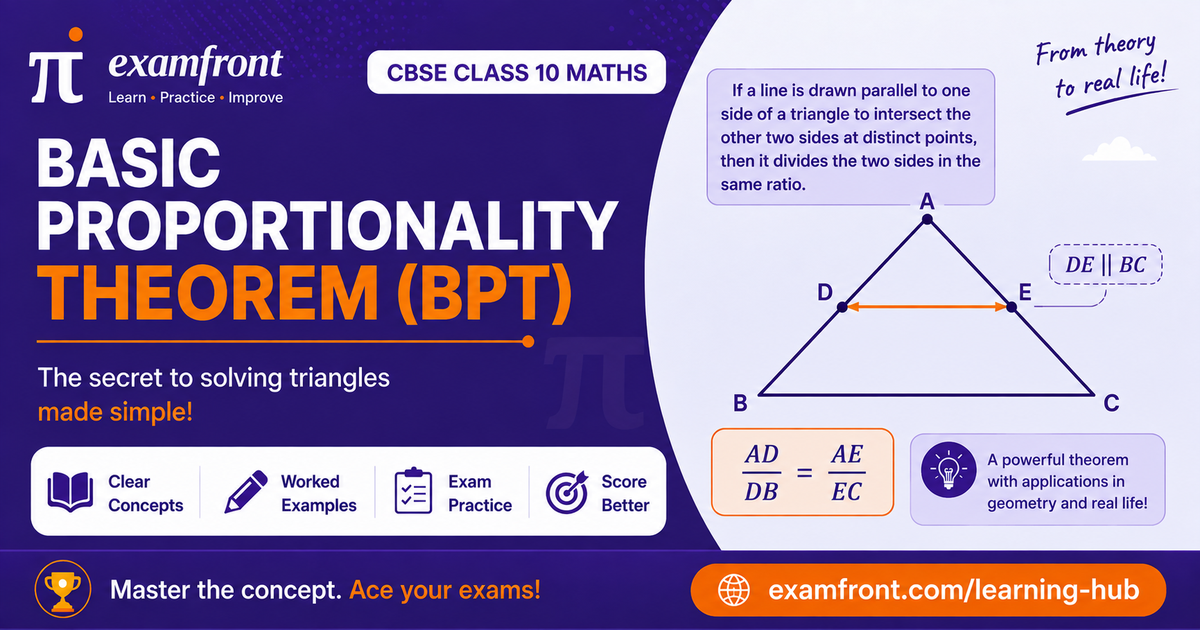
In one line: the Basic Proportionality Theorem (BPT) says that if a line is drawn parallel to one side of a triangle and it cuts the other two sides at two distinct points, then it divides those two sides in the same ratio.
So in triangle ABC, if DE ∥ BC with D on AB and E on AC, then AD/DB = AE/EC. That single equation is the whole idea: a parallel line slices the two sides it crosses into matching proportions. Because a famous Greek mathematician, Thales (about 640–546 BC), is believed to have first used this result, it is also called the Thales Theorem — the two names mean exactly the same thing.
This theorem is the engine room of Chapter 6, Triangles. It builds directly on the idea of similar figures (same shape, possibly different size) and it is the tool that later lets us prove the similarity criteria (AAA, SSS, SAS). The rest of this guide gives you the exact statement, a clean proof you can reproduce in the exam, the converse (which works the other way round), and worked examples for the two question types you will actually be asked: find a missing length and check whether a line is parallel to the third side.
🎬 Watch (60-sec Short): Which fact proves DE ∥ BC? ⚡
New to the shape-vs-size idea behind this chapter? Read Similar Figures Class 10 first, then come back — BPT will click much faster.
What is the Basic Proportionality Theorem? (statement)
Basic Proportionality Theorem (Theorem 6.1 / Thales Theorem): If a line is drawn parallel to one side of a triangle to intersect the other two sides in distinct points, the other two sides are divided in the same ratio.
Let us define each part the first time it appears, so the statement is fully self-contained:
- A triangle ABC has three sides. Suppose we look at side BC as the “one side,” and AB and AC as the “other two sides.”
- A line DE is drawn parallel to BC (written DE ∥ BC), meeting AB at D and AC at E. “Distinct points” simply means D and E are two different points — the line genuinely crosses both sides.
- “Divided in the same ratio” means the piece-to-piece ratio is equal on both sides:
AD/DB = AE/EC
Here AD is the part of AB above the line, DB is the part below it, and AE, EC are the matching parts of AC. In words: the parallel line cuts AB and AC in the same proportion.
Useful corollary forms. From AD/DB = AE/EC, a few equivalent versions are handy in problems (all true whenever DE ∥ BC):
- AD/AB = AE/AC (part-to-whole on each side)
- DB/AB = EC/AC
- AB/AD = AC/AE
These are just the same relationship rearranged, so you can pick whichever matches the lengths a question gives you.
Proof of the Basic Proportionality Theorem (area method)
This proof is a favourite in board exams, and it uses only one idea from Class 9: two triangles on the same base and between the same parallels have equal areas.
Given: A triangle ABC in which DE ∥ BC, meeting AB at D and AC at E. To prove: AD/DB = AE/EC. Construction: Join BE and CD. Draw DM ⊥ AC and EN ⊥ AB (these are the heights we will use).
Proof.
Using area of a triangle = ½ × base × height:
- ar(ADE) = ½ × AD × EN and ar(BDE) = ½ × DB × EN (same height EN, drawn from E to line AB).
So, dividing,
ar(ADE) / ar(BDE) = AD / DB …(1)
Similarly, taking DM as the height from D to line AC:
- ar(ADE) = ½ × AE × DM and ar(DEC) = ½ × EC × DM.
So,
ar(ADE) / ar(DEC) = AE / EC …(2)
Now look at triangles BDE and DEC. They stand on the same base DE and lie between the same parallels DE and BC. Triangles on the same base and between the same parallels are equal in area, so
ar(BDE) = ar(DEC) …(3)
From (1) and (2), the left-hand sides both equal ar(ADE) divided by equal quantities (because of (3)). Therefore their right-hand sides are equal:
AD/DB = AE/EC ∎
That is the complete proof. The whole trick is spotting equation (3) — once the two lower triangles have equal area, the two ratios must match. Practising this proof until you can write it without notes is exactly the kind of drill examfront’s Topic Practice is built for, and Mistake Identification will flag the step students most often drop (the equal-area line).
The converse of the Basic Proportionality Theorem
BPT has a matching converse that runs the theorem backwards — and it is the version you use whenever a question asks you to prove that a line is parallel.
Converse of BPT (Theorem 6.2): If a line divides any two sides of a triangle in the same ratio, then the line is parallel to the third side.
In symbols: in triangle ABC, if D is on AB and E is on AC with AD/DB = AE/EC, then DE ∥ BC.
So the two theorems are a pair:
- BPT: parallel line ⟶ equal ratios.
- Converse: equal ratios ⟶ parallel line.
Knowing which direction you are in is half the battle: if you are told a line is parallel and asked about lengths, use BPT; if you are given lengths and asked whether the line is parallel, use the converse.
Worked example 1 — using BPT to find a missing length
Question. In triangle ABC, DE ∥ BC with D on AB and E on AC. If AD = 1.5 cm, DB = 3 cm and AE = 1 cm, find EC.
Solution.
- Since DE ∥ BC, by the Basic Proportionality Theorem: AD/DB = AE/EC.
- Substitute the known values: 1.5/3 = 1/EC.
- Cross-multiply: 1.5 × EC = 3 × 1, so 1.5 × EC = 3.
- Therefore EC = 3 ÷ 1.5 = 2 cm.
The matching part of AC is 2 cm long. Notice the method: write the BPT ratio, put in the three known lengths, and solve for the fourth. That is the entire “find the missing length” question type — the numbers change, the move does not. Drilling a graded set of these on examfront’s Topic Practice makes the setup automatic under exam pressure.
🎬 Watch (60-sec Short): Can you find EC using similarity? 👀
Worked example 2 — using the converse to check for a parallel line
Question. In triangle PQR, E lies on PQ and F lies on PR. Given PE = 4 cm, EQ = 4.5 cm, PF = 8 cm and FR = 9 cm, is EF ∥ QR?
Solution.
- To test parallelism, compare the ratios in which EF divides the two sides: PE/EQ and PF/FR.
- PE/EQ = 4/4.5 = 8/9 (multiply top and bottom by 2).
- PF/FR = 8/9.
- The two ratios are equal (8/9 = 8/9), so by the converse of BPT, EF ∥ QR. ✅
Contrast case (so the test is sharp). If instead PE = 3.9 cm, EQ = 3 cm, PF = 3.6 cm and FR = 2.4 cm, then PE/EQ = 3.9/3 = 1.3 while PF/FR = 3.6/2.4 = 1.5. The ratios are unequal, so EF is not parallel to QR. This shows why you must actually compute and compare both ratios — never assume.
🎬 Watch (60-sec Short): Can you spot whether EF is parallel to QR? 🤔
A quick corollary in action (parallel line and the full sides)
Sometimes a question gives you the whole side, not the two pieces. The corollary form handles this neatly.
Question. In triangle ABC, DE ∥ BC, with D on AB and E on AC. Show that AD/AB = AE/AC.
Solution.
- By BPT, AD/DB = AE/EC.
- Take reciprocals: DB/AD = EC/AE.
- Add 1 to both sides: (DB/AD) + 1 = (EC/AE) + 1, i.e. (DB + AD)/AD = (EC + AE)/AE.
- But DB + AD = AB and EC + AE = AC, so AB/AD = AC/AE, which rearranges to AD/AB = AE/AC. ∎
This part-to-whole version is the one that reappears when you meet the similarity criteria later in the chapter, so it is worth recognising now. The harder mixed problems — trapeziums, medians, and multi-step proofs that chain BPT with its converse — are where you level up next; work through the full set inside examfront, where personalised help points out exactly which ratio step is tripping you.
Where the Basic Proportionality Theorem is used
BPT is not a stand-alone curiosity — it is a building block:
- It is used to prove the similarity criteria (AAA / AA, SSS, SAS) in the next section of Chapter 6.
- It gives a quick proof of the Mid-point Theorem (a line through the mid-point of one side, parallel to another side, bisects the third side) — a Class 9 result you now prove more powerfully.
- Through similar triangles, it feeds into indirect measurement — finding heights and distances you cannot measure directly, which is the heart of Chapter 9.
We have kept this guide to the core of Section 6.2 — the statement, the exam-ready proof, the converse, and the two main question types. The complete graded practice, the trickier trapezium and median proofs, and full previous-year drills are where you go deeper. For the whole chapter roadmap, see the Triangles Class 10 chapter guide, and let Chapter Quizzes and Progress Tracking on examfront show you when your BPT skills are exam-ready.
Key Takeaways
- The Basic Proportionality Theorem (Thales Theorem): a line drawn parallel to one side of a triangle divides the other two sides in the same ratio — in triangle ABC with DE ∥ BC, AD/DB = AE/EC.
- The proof uses areas: ar(ADE)/ar(BDE) = AD/DB, ar(ADE)/ar(DEC) = AE/EC, and ar(BDE) = ar(DEC) because they share base DE and lie between the same parallels.
- The converse reverses it: if a line divides two sides in the same ratio, it is parallel to the third side — this is how you prove parallelism.
- Two question types: given a parallel line, use BPT to find a missing length; given lengths, use the converse to check parallelism (equal ratios ⇒ parallel).
- Handy corollary form: AD/AB = AE/AC, which is BPT written part-to-whole.
Quick Facts
- Statement (BPT / Thales): DE ∥ BC in △ABC ⟹ AD/DB = AE/EC.
- Converse: AD/DB = AE/EC ⟹ DE ∥ BC.
- Also known as: Thales Theorem (after Thales, c. 640–546 BC).
- Proof idea: equal-area triangles on the same base (DE) between the same parallels (DE ∥ BC).
- Corollary forms: AD/AB = AE/AC and DB/AB = EC/AC.
- Use: proving similarity criteria, the mid-point theorem, and indirect measurement.
- Chapter: Triangles (Ch. 6) · Class: 10 · Subject: Maths · Board: CBSE.
Common Mistakes
- Writing AD/DB = AE/AC (mixing part-to-part with part-to-whole). The standard BPT form pairs matching pieces: AD/DB = AE/EC. If you use whole sides, keep both sides whole: AD/AB = AE/AC. Fix: decide up front whether you are using piece/piece or piece/whole, and match both sides the same way.
- Using BPT when the line is not parallel. BPT only applies once DE ∥ BC is given or proved. Fix: if parallelism is not stated, you cannot write the ratio equation — you must use the converse to establish it first.
- Skipping the equal-area step in the proof. Students often jump from the two ratio equations to the answer without justifying ar(BDE) = ar(DEC). Fix: always state “same base DE, between the same parallels DE and BC,” which is the line that earns the mark.
- Comparing the wrong ratios in a converse question. Pairing PE with FR, or PF with EQ. Fix: keep each side’s own pieces together — PE/EQ on one side, PF/FR on the other — then compare.
- Not simplifying before comparing ratios. Declaring 4/4.5 and 8/9 “different” because they look different. Fix: reduce both to lowest terms (both equal 8/9) before deciding whether they match.
Download the 2-page summary
📄 Download the Basic Proportionality Theorem 2-page summary (PDF) — the statement, the area proof, the converse and a worked example on one printable sheet for last-minute revision.
FAQ
Q. What is the Basic Proportionality Theorem in Class 10? The Basic Proportionality Theorem (also called the Thales Theorem) states that if a line is drawn parallel to one side of a triangle to intersect the other two sides at distinct points, then it divides those two sides in the same ratio. In triangle ABC, if DE is parallel to BC with D on AB and E on AC, then AD/DB = AE/EC. It is the foundation of the similarity of triangles in Chapter 6.
Q. What is the converse of the Basic Proportionality Theorem? The converse states that if a line divides any two sides of a triangle in the same ratio, then that line is parallel to the third side. So in triangle ABC, if D lies on AB and E lies on AC with AD/DB = AE/EC, then DE is parallel to BC. This is the test you use to prove that a line is parallel.
Q. How do you prove the Basic Proportionality Theorem? You prove it using the area of triangles. In triangle ABC with DE parallel to BC, join BE and CD and drop perpendiculars. Then ar(ADE)/ar(BDE) = AD/DB and ar(ADE)/ar(DEC) = AE/EC. Because triangles BDE and DEC lie on the same base DE and between the same parallels DE and BC, they have equal areas, so AD/DB = AE/EC.
Q. Why is it called the Thales Theorem? It is named after the Greek mathematician Thales (about 640–546 BC), who is believed to have used the result that the ratio of any two corresponding sides in two equiangular triangles is always the same. In CBSE Class 10 this idea is stated as the Basic Proportionality Theorem, so “Thales Theorem” and “Basic Proportionality Theorem” refer to the same result.
Q. How do I check if a line is parallel to the third side of a triangle? Use the converse of the Basic Proportionality Theorem. Work out the ratio in which the line cuts each of the two sides, then compare them. If PE/EQ = PF/FR, the line EF is parallel to QR; if the two ratios are unequal, EF is not parallel to QR. For example, PE = 4, EQ = 4.5, PF = 8, FR = 9 gives 4/4.5 = 8/9, so EF is parallel to QR.
Related Concepts
- Similar Figures Class 10: the same-shape idea and the two similarity conditions that BPT builds on.
- Triangles — Chapter Guide (Class 10): the full chapter roadmap, including the similarity criteria (AAA, SSS, SAS) that BPT is used to prove.
- Class 10 Maths — All Formulas: the quick-reference sheet where the similarity and proportionality results live.
- Introduction to Trigonometry (Class 10): builds on similar right triangles, the natural next use of the ideas here.
Ready to make BPT automatic? Practise a full graded set on examfront’s Topic Practice, and let Mistake Identification and Progress Tracking show you exactly where your ratio steps slip. Start on examfront →