Sum of n Terms of an AP: Formula, Examples & How to Find It (Class 10)
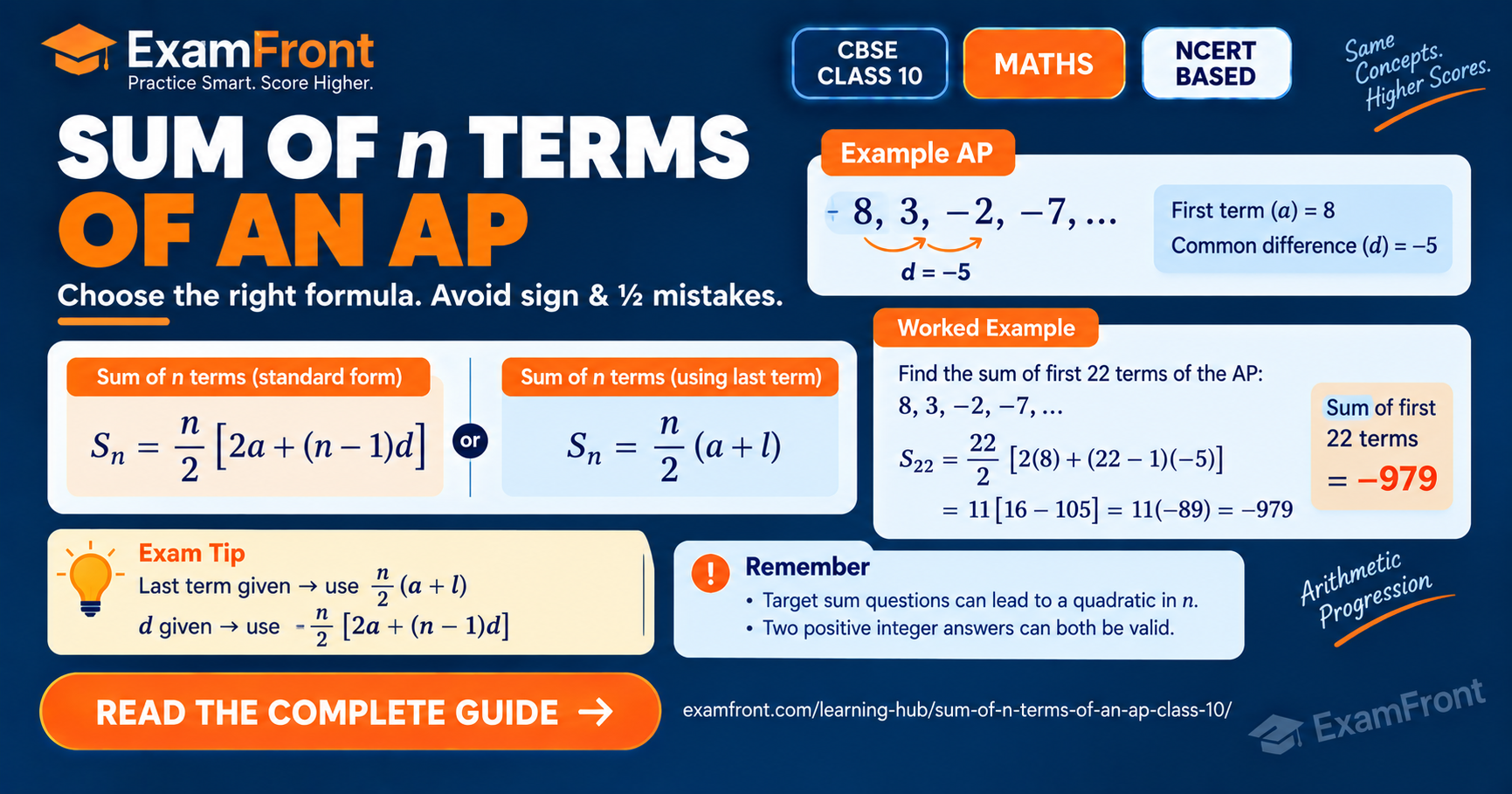
In one line: the sum of the first n terms of an AP is Sₙ = n/2 × [2a + (n − 1)d], where a is the first term, d is the common difference and n is how many terms you are adding.
If you also know the last term l, there is a shorter version: Sₙ = n/2 × (a + l). Both give the same answer, because the last term is just l = a + (n − 1)d. So, for the AP 8, 3, −2, …, the sum of the first 22 terms is S₂₂ = 22/2 × [2×8 + (22 − 1)×(−5)] = 11 × (16 − 105) = 11 × (−89) = −979.
Sₙ means “the sum of the first n terms.” The clever idea behind the formula (the one Gauss used as a schoolboy) is to add the list to its own reverse: pair the first term with the last, the second with the second-last, and so on. Every pair adds up to the same total, (a + l), and there are n terms, giving n/2 pairs — which is exactly Sₙ = n/2(a + l). The rest of this guide shows you how to pick the right formula, add up an AP, find how many terms reach a target sum, and pull a single term back out of Sₙ.
🎬 Watch (60-sec Short): Can you find the sum of the first 20 terms? ⚡
This guide assumes you already know the nth term formula. If aₙ = a + (n − 1)d is new, read nth Term of an AP first, then come back — the sum formula builds straight on it.
The sum of n terms of an AP formula
For an AP with first term a and common difference d, the sum of the first n terms is:
Sₙ = n/2 × [2a + (n − 1)d]
What it means in plain words: to add the first n terms, take half of n and multiply it by “twice the first term plus (n − 1) times the common difference.”
What each symbol means:
- Sₙ — the sum of the first n terms (the “answer”).
- a — the first term of the AP.
- d — the common difference (subtract any term from the next: d = a₍ₖ₊₁₎ − aₖ).
- n — the number of terms being added (a positive whole number).
When it applies: to any AP, whenever you know a, d and n. If you know the last term l instead of d, use the partner formula below.
Worked example. Find the sum of the first 22 terms of the AP 8, 3, −2, …
- a = 8, d = 3 − 8 = −5, n = 22.
- Sₙ = n/2 × [2a + (n − 1)d] → S₂₂ = 22/2 × [2×8 + (22 − 1)(−5)]
- = 11 × [16 − 105] = 11 × (−89) = −979.
The sum is −979 — negative, because most terms in this decreasing AP are negative. A tidy habit that examfront’s Mistake Identification reinforces: simplify the inside bracket fully before multiplying by n/2, so a stray sign can’t slip through.
The Sₙ = n/2(a + l) formula (when the last term is known)
When a question gives you the first term a and the last term l (but not the common difference), use this shorter form:
Sₙ = n/2 × (a + l)
Here l is the last term of the (finite) AP. This is the direct result of Gauss’s pairing trick, and it is often faster because there is no d to handle.
Worked example. The first and last terms of an AP are 17 and 350, and it has 20 terms. Find the sum.
- a = 17, l = 350, n = 20.
- Sₙ = n/2 × (a + l) → S₂₀ = 20/2 × (17 + 350) = 10 × 367 = 3670.
A classic use — adding consecutive integers. The sum of the first 1000 positive integers is S₁₀₀₀ = 1000/2 × (1 + 1000) = 500 × 1001 = 500500. More generally, the sum of the first n positive integers is Sₙ = n(n + 1)/2 — a result worth memorising. Which form to reach for is a judgement you sharpen quickly with Topic Practice on examfront: last term given → use n/2(a + l); common difference given → use n/2[2a + (n − 1)d].
How to find how many terms give a required sum
Here the sum Sₙ is known and you want n. Because n appears twice in Sₙ = n/2[2a + (n − 1)d], this becomes a quadratic equation in n — solved exactly the way you learned in solving quadratic equations by factorisation.
Method: put the target sum into the formula, expand into a quadratic, solve for n, and keep only positive whole-number answers.
Worked example. How many terms of the AP 24, 21, 18, … must be taken so that their sum is 78?
- a = 24, d = −3, Sₙ = 78.
- 78 = n/2 × [48 + (n − 1)(−3)] = n/2 × (51 − 3n)
- 156 = 51n − 3n² → 3n² − 51n + 156 = 0 → n² − 17n + 52 = 0
- (n − 4)(n − 13) = 0 → n = 4 or n = 13.
Both answers are correct — the sum of the first 4 terms and the sum of the first 13 terms are each 78. This surprising “two answers” case happens because the AP starts positive but d is negative, so terms 5 through 13 add up to zero and cancel out. Always keep every positive-integer solution; don’t throw one away.
🎬 Watch (60-sec Short): Can you spot why this AP has two valid answers? 🤯
Watch out: if solving gives a negative or fractional n, reject only that value. If it gives two valid whole numbers, both are genuine answers — unless the question is a real-life story and one value makes something impossible (a row with a negative number of logs, say). Then that value goes, and you say why in one line.
Finding a missing quantity (a, d, n or Sₙ)
The formula links four quantities — Sₙ, a, d and n. Know any three and you can find the fourth. These “fill in the missing piece” questions are common in exams.
Worked example. The sum of the first 14 terms of an AP is 1050 and its first term is 10. Find the 20th term.
- S₁₄ = 1050, n = 14, a = 10. Use Sₙ = n/2[2a + (n − 1)d]:
- 1050 = 14/2 × [20 + 13d] = 7 × (20 + 13d) = 140 + 91d
- 910 = 91d → d = 10.
- Now the 20th term: a₂₀ = a + (20 − 1)d = 10 + 19×10 = 200.
Notice how the sum formula and the nth-term formula work together in one problem — a very common exam pattern. Mixed questions like this are exactly where Chapter Quizzes and personalised help on examfront show you which step trips you up.
The link between Sₙ and the nth term
There is a neat relationship connecting sums and terms:
aₙ = Sₙ − Sₙ₋₁
In plain words: the nth term equals the sum of the first n terms minus the sum of the first (n − 1) terms — because subtracting those two sums leaves only the nth term. This lets you recover a single term when a question gives you a formula for Sₙ.
Worked example. If the sum of the first n terms of an AP is Sₙ = 2n² + 3n, find the 10th term.
- S₁₀ = 2(10)² + 3(10) = 200 + 30 = 230.
- S₉ = 2(9)² + 3(9) = 162 + 27 = 189.
- a₁₀ = S₁₀ − S₉ = 230 − 189 = 41.
🎬 Watch (60-sec Short): Can you find the 10th term from the sum formula? 🔎
Where this sits in the NCERT and CBSE syllabus
Everything above is one section of one chapter, and knowing exactly where it sits tells you which questions to practise and how many marks they carry.
NCERT sets the scope. Arithmetic Progressions is Chapter 5 of the NCERT Class 10 Maths textbook. Its sections run 5.1 Introduction, 5.2 Arithmetic Progressions, 5.3 nth Term of an AP, 5.4 Sum of First n Terms of an AP, and 5.5 Summary. Everything on this page is Section 5.4.
Mind the numbering offset. The sum of n terms is Section 5.4, but its exercise is Exercise 5.3 — the exercise number runs one behind because Section 5.1 is an introduction with no exercise. So “the sum exercise” is Exercise 5.3, and it has 20 questions. Exercise 5.4 comes straight after it and is marked optional in the textbook, so it is not examinable. The Class 10 Maths chapter list and the NCERT Class 10 Maths guide lay out the whole book the same way.
What Exercise 5.3 actually asks. Its 20 questions are this page’s sections in textbook form:
- Direct sums and missing quantities open the exercise — the “know three, find the fourth” idea from the section above.
- Question 4 is the target-sum type: how many terms of 9, 17, 25, … give a sum of 636? The quadratic 4n² + 5n − 636 = 0 has roots 12 and −53/4, so the answer is 12 terms.
- Question 6 uses the same first and last terms as our worked example, 17 and 350, but fixes d = 9 — which forces 38 terms and a sum of 6973. Same formula, different missing piece.
- Question 11 gives Sₙ = 4n − n² and asks for terms — the aₙ = Sₙ − Sₙ₋₁ idea, ending in aₙ = 5 − 2n.
- Questions 15 to 20 are all daily-life stories: penalties, cash prizes, planting trees, a spiral, stacked logs and a potato race.
The one that refines the “two answers” rule. Question 19 stacks 200 logs with 20 in the bottom row, 19 in the next, and so on. The sum equation becomes n² − 41n + 400 = 0, with roots 16 and 25 — both positive whole numbers. But the 25th row would hold 20 − 24 = −4 logs, which is impossible, so n = 25 is rejected and the answer is 16 rows with 5 logs in the top row. Compare the 24, 21, 18, … example above, where both answers stand because a negative term is perfectly allowed in a pure number list. The rule, in full: keep every positive whole-number n that makes sense in the question.
CBSE sets the wording. The CBSE Class 10 Maths syllabus places Arithmetic Progressions in Unit II — Algebra and describes the whole chapter in one sentence:
“Motivation for studying Arithmetic Progression Derivation of the nth term and sum of the first n terms of A.P. and their application in solving daily life problems.”
The half of that sentence this page owns is “sum of the first n terms … and their application in solving daily life problems.” That is why six of Exercise 5.3’s twenty questions are stories, and why the derivation — Gauss’s pairing idea in the introduction above — is worth being able to write in two lines rather than just quote.
CBSE sets the priority, by unit. The 80 theory marks are split Number Systems 6 · Algebra 20 · Coordinate Geometry 6 · Geometry 15 · Trigonometry 12 · Mensuration 10 · Statistics & Probability 11, with 20 marks of internal assessment making 100. Algebra is the largest unit, and Arithmetic Progressions is one of its four chapters. CBSE publishes marks by unit, not by chapter, so chapter-wise percentage tables you find online are unofficial estimates — the CBSE Class 10 Maths syllabus and the unit-wise weightage guide have the official split.
How this topic is actually asked. The paper is 38 questions over 80 marks in three hours, across five sections — see the CBSE Class 10 Maths exam pattern. A bare “sum of the first 20 terms” or “sum of the first n odd numbers” usually lands as a 1-mark MCQ or a 2-mark VSA. Target-sum and missing-quantity questions are typically 3 marks, because there is a quadratic or a pair of steps to show. The daily-life versions run to 3 or 5 marks, or turn up inside a 4-mark case study. In every one of them, the line where you write the formula and substitute earns method marks — and in a story question, so does the one line where you reject an impossible value of n. Working NCERT first and then a graded set on examfront covers every one of these shapes.
Where this leads next
You now have the two big tools of Chapter 5 working together: the nth term to reach any single term, and the sum Sₙ to add many terms at once. Together they solve almost every AP word problem — total savings, stacked logs, prize money, distances covered, and more.
We have kept this guide to the core formulas and their most common question types. The trickier applications — spiral and staircase problems, AP word problems with hidden data, questions that combine Sₙ with the nth term in several steps, and full timed practice sets — are where you push for top marks. Work through the complete graded set inside examfront, and let Progress Tracking and Strength & Weakness Analysis show you exactly which AP-sum skills are exam-ready. For the full chapter map, see the Arithmetic Progressions chapter guide.
Key Takeaways
- The sum of the first n terms of an AP is Sₙ = n/2[2a + (n − 1)d].
- If the last term l is known, use the shorter Sₙ = n/2(a + l) — both always agree.
- The sum of the first n positive integers is Sₙ = n(n + 1)/2.
- “How many terms give this sum?” leads to a quadratic in n — keep every positive-integer answer that makes sense (there can be two).
- The nth term and the sum are linked by aₙ = Sₙ − Sₙ₋₁.
- This is NCERT Chapter 5, Section 5.4, Exercise 5.3 — and in a story question, the line rejecting an impossible n is part of the answer.
Quick Facts
- Sum formula (d known): Sₙ = n/2[2a + (n − 1)d].
- Sum formula (last term known): Sₙ = n/2(a + l).
- First n positive integers: Sₙ = n(n + 1)/2.
- Sₙ: sum of first n terms. a: first term. d: common difference. l: last term. n: number of terms.
- Term from sum: aₙ = Sₙ − Sₙ₋₁.
- Target-sum questions: solve a quadratic in n; two positive-integer answers can both be valid, unless the story rules one out.
- NCERT: Chapter 5, Section 5.4, Exercise 5.3 (20 questions). Exercise 5.4 is optional and not examinable.
- CBSE: Unit II Algebra, 20 of the 80 theory marks — the largest unit in the paper.
- Chapter: Arithmetic Progressions (Ch. 5) · Class: 10 · Subject: Maths · Board: CBSE.
Common Mistakes
- Using n as the last term. Sₙ = n/2(a + l) needs the last term l, not n. In “sum of 5, 8, …, 50,” the last term is 50, so use a = 5, l = 50 — don’t plug in n where l belongs.
- Forgetting the ½ (the n/2). Writing Sₙ = n[2a + (n − 1)d] doubles the answer. The formula is half of n times the bracket — keep the /2.
- Discarding a valid second value of n — or keeping an impossible one. In target-sum questions the quadratic can give two positive whole numbers (like n = 4 and n = 13), and both are correct. Reject negative or fractional n, and in a word problem also reject a value that makes the story impossible — in NCERT’s 200-logs question, n = 25 would put −4 logs in the top row, so only n = 16 stands.
- Sign slips inside the bracket. With a negative d, terms like (n − 1)(−3) must keep their minus sign. Simplify 2a + (n − 1)d completely before multiplying by n/2.
- Mixing up Sₙ and aₙ. Sₙ is the total of many terms; aₙ is one single term. If a question asks for “the 20th term,” don’t stop at the sum — use aₙ = a + (n − 1)d, or aₙ = Sₙ − Sₙ₋₁.
Download the 2-page summary
📄 Download the Sum of n Terms of an AP summary (PDF, 2 pages) — both formulas, when to use which, and three worked NCERT Exercise 5.3 questions on two printable pages.
FAQ
Q. What is the sum of n terms of an AP? The sum of the first n terms, written Sₙ, is Sₙ = n/2[2a + (n − 1)d], where a is the first term, d is the common difference and n is the number of terms. If you know the last term l instead of d, use Sₙ = n/2(a + l). For example, the sum of the first 22 terms of 8, 3, −2, … is −979.
Q. What is the formula for the sum of an arithmetic progression? There are two equivalent formulas: Sₙ = n/2[2a + (n − 1)d] when you know a and d, and Sₙ = n/2(a + l) when you know the first term a and last term l. Both give the sum of the first n terms — choose the one matching the information you have.
Q. When do I use Sₙ = n/2(a + l) instead of Sₙ = n/2[2a + (n − 1)d]? Use Sₙ = n/2(a + l) when the last term l is given (for example, “the first and last terms are 17 and 350”). Use Sₙ = n/2[2a + (n − 1)d] when you know d but not the last term. They always agree, because l = a + (n − 1)d.
Q. How do I find how many terms of an AP give a certain sum? Put the target sum into Sₙ = n/2[2a + (n − 1)d] and solve the resulting quadratic for n, keeping only positive whole-number values. Sometimes two values of n give the same sum — this happens when positive and negative terms cancel, so both answers are correct. In a word problem, also check that each value makes sense: in NCERT’s 200-logs question, n = 25 is rejected because that row would hold −4 logs.
Q. How are Sₙ and the nth term related? The nth term equals the sum to n terms minus the sum to (n − 1) terms: aₙ = Sₙ − Sₙ₋₁. So if you are given a formula for Sₙ, you can find any single term by subtracting consecutive sums. For Sₙ = 2n² + 3n, a₁₀ = S₁₀ − S₉ = 230 − 189 = 41.
Q. Is the sum of n terms of an AP part of the NCERT and CBSE Class 10 Maths syllabus? Yes. Arithmetic Progressions is Chapter 5 of the NCERT Class 10 Maths textbook, and the sum of n terms is its Section 5.4, with Exercise 5.3 (20 questions) attached to it — note the offset, the section is 5.4 but its exercise is 5.3. The CBSE syllabus places the chapter in Unit II Algebra, which carries 20 of the 80 theory marks, and names the sum of the first n terms of an AP and its application in solving daily life problems. Exercise 5.4 is marked optional in the textbook, so it is not examinable.
Related Concepts
- nth Term of an AP (Class 10): the aₙ = a + (n − 1)d formula this sum builds on, and the last term l used in Sₙ = n/2(a + l).
- What Is an Arithmetic Progression? (Class 10): the first term, common difference and general form — the foundation for both formulas.
- Arithmetic Progressions — Chapter Guide (Class 10): the full chapter roadmap and where the sum formula fits.
- Class 10 Maths — All Formulas: the quick-reference sheet with both AP-sum formulas.
Ready to make AP sums automatic? Practise a full graded set on examfront’s Topic Practice, and let Mistake Identification and Strength & Weakness Analysis show you exactly where your sign slips and dropped-½ errors happen. Start on examfront →