nth Term of an AP: Formula, Examples & How to Find It (Class 10)
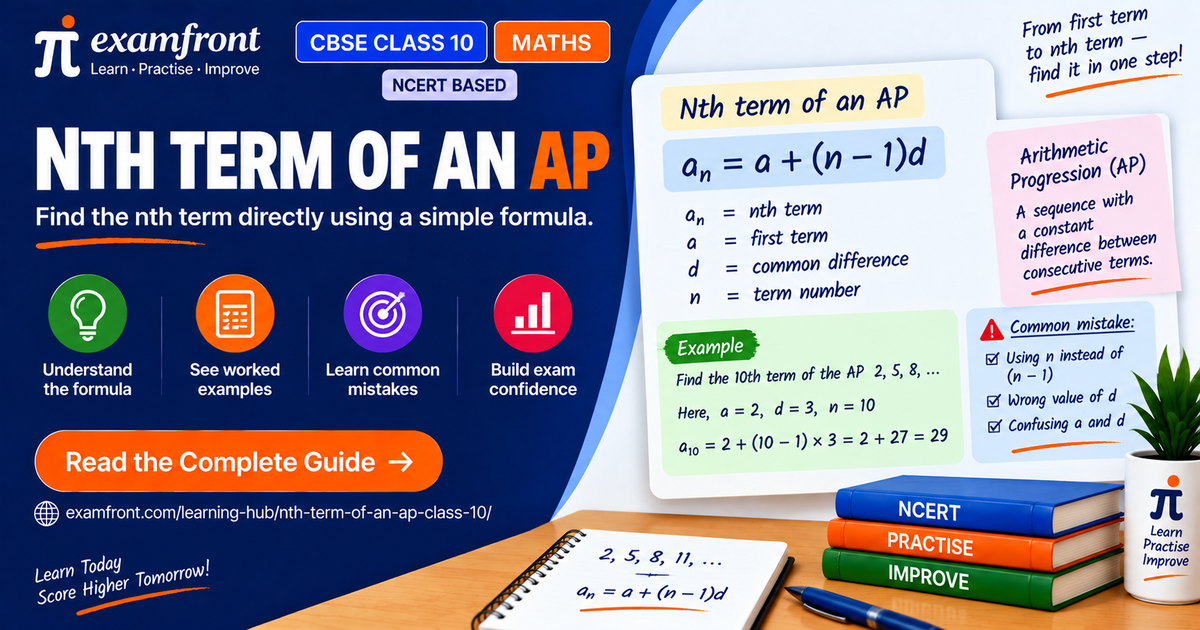
In one line: the nth term of an AP is given by the formula aₙ = a + (n − 1)d, where a is the first term, d is the common difference and n is the position of the term you want.
So if you want the 10th term of 2, 7, 12, …, you don’t have to write out all ten numbers. Here a = 2 and d = 5, so a₁₀ = 2 + (10 − 1)×5 = 2 + 45 = 47. The formula lets you jump straight to any term — the 10th, the 50th, even the 500th — using only the first term and the common difference.
The nth term (also called the general term) is simply the term sitting in the nth position of the list. The idea behind the formula is easy: to reach the nth term you start at a and add the step d again and again. To get to the 2nd term you add d once, to the 3rd you add it twice, so to reach the nth term you add d exactly (n − 1) times — that is why it is (n − 1) and not n. The rest of this guide shows you how to use aₙ = a + (n − 1)d to find a term, work out which term a value is, rebuild an AP from two given terms, and test whether a number belongs to an AP.
🎬 Watch (60-sec Short): Can you find the 100th term of this AP? ⚡
This guide builds directly on the basics of what an AP is. If “first term” and “common difference” feel new, read What Is an Arithmetic Progression? first, then come back here.
The nth term of an AP formula
For an AP with first term a and common difference d, the nth term is:
aₙ = a + (n − 1)d
What it means in plain words: start at the first term, then add the common difference (n − 1) times to reach the term in position n.
What each symbol means:
- aₙ — the nth term, i.e. the term you are trying to find (the “answer”).
- a — the first term of the AP.
- d — the common difference (subtract any term from the term right after it: d = a₍ₖ₊₁₎ − aₖ).
- n — the position (or term number). It must be a positive whole number (1, 2, 3, …).
When it applies: for every arithmetic progression, finite or infinite. The only requirement is that the list really is an AP (equal common difference throughout).
Worked example. Find the 10th term of the AP 2, 7, 12, …
- First term: a = 2. Common difference: d = 7 − 2 = 5. Position: n = 10.
- aₙ = a + (n − 1)d → a₁₀ = 2 + (10 − 1)×5 = 2 + 45 = 47.
The 10th term is 47. Notice we multiplied d by 9, not 10 — because reaching the 10th term takes only 9 steps from the first. Getting this “(n − 1)” right is the single most important habit in this whole topic, and examfront’s Mistake Identification flags it the moment you slip into multiplying by n.
The last term of a finite AP is often written as l, and it is just a special nth term: l = a + (n − 1)d, where n is the total number of terms.
How to find a specific term of an AP
This is the most direct use of the formula: you are given the AP (or a and d) and a position, and you want that term.
Method: identify a, find d, put your value of n into aₙ = a + (n − 1)d, and simplify.
Worked example. Find the 20th term of the AP 2, 7, 12, …
- a = 2, d = 5, n = 20.
- a₂₀ = 2 + (20 − 1)×5 = 2 + 95 = 97.
That is the whole method — no listing, no counting on your fingers. Once the formula feels automatic, you can rattle off the 30th or 100th term just as quickly. Drilling a graded set of “find the term” questions on Topic Practice in examfront is the fastest way to make this second nature.
How to find which term of an AP equals a given value
Here the question is turned around: you know the value of a term and you want its position n. Because n is the only unknown, you solve a simple equation.
Method: set aₙ equal to the given value in aₙ = a + (n − 1)d, then solve for n.
Worked example. Which term of the AP 21, 18, 15, … is −81?
- a = 21, d = 18 − 21 = −3, aₙ = −81.
- −81 = 21 + (n − 1)(−3)
- −81 = 21 − 3n + 3 → −81 = 24 − 3n
- −105 = −3n → n = 35.
So −81 is the 35th term. Because n = 35 is a positive whole number, the value genuinely belongs to the AP.
A quick follow-up you should be able to answer: is any term of this AP equal to 0? Set 21 + (n − 1)(−3) = 0, which gives 3(n − 1) = 21, so n = 8. Yes — the 8th term is 0.
🎬 Watch (60-sec Short): Which term of this AP is exactly 0? 🤔
The key check every time: after solving, n must be a positive whole number. If it is not, the value is not a term (more on that below).
How to find an AP when two terms are given
Sometimes you are not told a and d directly — instead you are given two terms and asked to find the whole AP. Each given term becomes one equation, and two equations let you solve for the two unknowns a and d.
Method: write each given term using aₙ = a + (n − 1)d, then solve the two equations together (subtracting one from the other removes a and gives d).
Worked example. Determine the AP whose 3rd term is 5 and 7th term is 9.
- 3rd term: a + (3 − 1)d = a + 2d = 5 …(1)
- 7th term: a + (7 − 1)d = a + 6d = 9 …(2)
- Subtract (1) from (2): 4d = 4 → d = 1.
- Put d = 1 into (1): a + 2 = 5 → a = 3.
So the AP is 3, 4, 5, 6, 7, …. This is exactly the two-equations-two-unknowns idea you meet in the Pair of Linear Equations chapter, reused here. When the numbers get messier — awkward fractions, or the two terms far apart — that is where working through the fuller example set inside examfront, with personalised help where you slip, pays off.
Watch for the second half of the question. NCERT’s Exercise 5.2 rarely stops at “find a and d”. Question 7, for instance, gives the 11th term as 38 and the 16th as 73 and then asks for the 31st term — so after solving to a = −32 and d = 7 you still have one substitution to do. Finding a and d is the middle of the answer, not the end of it.
How to check whether a number is a term of an AP
To test whether some number belongs to an AP, treat it as aₙ and solve for n. The AP only contains it if that position n turns out to be a positive whole number.
Method: set the number equal to aₙ in aₙ = a + (n − 1)d, solve for n, and check whether n is a positive integer.
Worked example. Is 301 a term of the AP 5, 11, 17, 23, …?
- a = 5, d = 6. Set 301 = 5 + (n − 1)×6.
- 301 = 5 + 6n − 6 → 301 = 6n − 1 → 6n = 302 → n = 302/6 = 50.33….
- n is not a whole number, so 301 is not a term of this AP.
If n had come out as, say, 51, the answer would be “yes, it is the 51st term.” The single deciding rule is: whole-number position → it’s a term; fraction or negative → it isn’t.
🎬 Watch (60-sec Short): Is 100 really a term of this AP? 🤔
A close cousin — counting terms. The same formula tells you how many terms an AP has when you know its last term. For example, how many two-digit numbers are divisible by 3? These are 12, 15, 18, …, 99, an AP with a = 12, d = 3 and last term l = 99. Using l = a + (n − 1)d: 99 = 12 + (n − 1)×3, so 87 = 3(n − 1), giving n − 1 = 29 and n = 30. There are 30 such numbers.
Where this sits in the NCERT and CBSE syllabus
Everything above is one topic in one chapter of one textbook, and knowing exactly where it sits tells you how much of your revision time it deserves.
NCERT sets the scope. Arithmetic Progressions is Chapter 5 of the NCERT Class 10 Maths textbook. Its sections run 5.1 Introduction, 5.2 Arithmetic Progressions, 5.3 nth Term of an AP, 5.4 Sum of First n Terms of an AP, and 5.5 Summary. Everything on this page is Section 5.3.
Mind the numbering offset. The nth term is Section 5.3, but its exercise is Exercise 5.2 — because Section 5.2 already used up Exercise 5.1. So when a teacher says “do the nth-term exercise”, the one you want is Exercise 5.2, and it has 20 questions. The chapter’s other exercises are Exercise 5.1 (4 questions, on recognising an AP and finding a and d) and Exercise 5.3 (20 questions, on the sum of n terms). Exercise 5.4 is marked optional in the textbook, so its 5 questions are not examinable — useful to know before you spend an evening on them. The same section-and-exercise offset trips students up in the Pair of Linear Equations chapter too, so it is worth checking the exercise number rather than assuming it matches the section. If you want the full map of chapters and their numbering, the Class 10 Maths chapter list and the NCERT Class 10 Maths guide lay it out.
CBSE sets the wording. The CBSE Class 10 Maths syllabus places Arithmetic Progressions in Unit II — Algebra, and describes the scope in one sentence:
“Motivation for studying Arithmetic Progression Derivation of the nth term and sum of the first n terms of A.P. and their application in solving daily life problems.”
Two things follow from that line. First, the derivation is named, so “why (n − 1) and not n” is examinable reasoning, not background colour — the two-line argument in the section above is worth being able to write. Second, “application in solving daily life problems” is why so many nth-term questions arrive dressed as savings, salaries, seats in a hall or logs in a stack. Exercise 5.2’s Question 19 is exactly this shape: a salary of Rs 5000 in 1995 rising by Rs 200 a year, asking which year it reaches Rs 7000. Translating the story into a, d and n is half the work.
CBSE sets the priority, by unit. The 80 theory marks are split Number Systems 6 · Algebra 20 · Coordinate Geometry 6 · Geometry 15 · Trigonometry 12 · Mensuration 10 · Statistics & Probability 11, with 20 more marks of internal assessment making 100. Algebra is the largest unit at 20 of 80, and Arithmetic Progressions is one of its four chapters. Be careful with the chapter-by-chapter percentage tables you will find online — CBSE publishes marks by unit, not by chapter, so those numbers are unofficial estimates. The CBSE Class 10 Maths syllabus and the unit-wise weightage guide have the official split.
How this topic is actually asked. The paper is 38 questions over 80 marks in three hours, across five sections — see the CBSE Class 10 Maths exam pattern for the full shape. A bare “find the 15th term” lands as a 1-mark MCQ in Section A or a 2-mark VSA in Section B. “Which term is …?” and “find the AP given two terms” are typically 2 or 3 marks, because there is a real equation to solve. The daily-life versions run to 3 marks, or turn up inside a 4-mark case study. In every one of them the line where you write aₙ = a + (n − 1)d and substitute is itself worth a mark — so write it, even when you can see the answer. When you are ready to make that automatic, the graded nth-term set on examfront works through all of these shapes with the NCERT-first approach this page follows.
Where this leads next
Once you can find any term with aₙ = a + (n − 1)d, the natural next tool is the sum of the first n terms — a formula that adds up many terms at once (very handy for “total savings,” “total logs stacked,” or “total distance” problems). That builds straight on the nth term you have just learned, and it is the other half of the CBSE scope line quoted above.
We have kept this guide to the core of the nth-term topic and its most common question types. Harder mixed problems — such as comparing two different APs, “which term is so-much-more than another term,” middle-term puzzles, and full timed practice — are where you level up next. Work through the complete graded set inside examfront, and let Chapter Quizzes and Progress Tracking show you exactly which nth-term skills are exam-ready and which need one more round. For the full chapter map, see the Arithmetic Progressions chapter guide.
Key Takeaways
- The nth term (general term) of an AP is aₙ = a + (n − 1)d — first term plus the common difference added (n − 1) times.
- Multiply d by (n − 1), not n, because reaching the nth term takes (n − 1) steps from the first term.
- To find which term equals a value, set that value as aₙ and solve for n.
- To find an AP from two given terms, form two equations and solve for a and d together.
- A number is a term of an AP only if solving for n gives a positive whole number.
- This is NCERT Chapter 5, Section 5.3, Exercise 5.2 — and the line where you write the formula and substitute earns a mark of its own.
Quick Facts
- nth term formula: aₙ = a + (n − 1)d.
- aₙ: the nth term (the term you want). a: first term. d: common difference. n: position (a positive integer).
- Last term: l = a + (n − 1)d, where n is the total number of terms.
- Find a term: substitute n. Find which term: substitute the value, solve for n.
- Membership test: the number is a term ⇔ n is a positive whole number.
- Two-terms case: two equations → solve for a and d.
- NCERT: Chapter 5, Section 5.3, Exercise 5.2 (20 questions). Exercise 5.4 is optional and not examinable.
- CBSE: Unit II Algebra, 20 of the 80 theory marks — the largest unit in the paper.
- Chapter: Arithmetic Progressions (Ch. 5) · Class: 10 · Subject: Maths · Board: CBSE.
Common Mistakes
- Multiplying d by n instead of (n − 1). Writing a₁₀ = a + 10d instead of a + 9d is the most common slip. Remember the first term needs zero steps, so the nth term needs (n − 1) steps: aₙ = a + (n − 1)d.
- Getting the sign of d wrong in a decreasing AP. For 21, 18, 15, …, d = 18 − 21 = −3, not +3. Always subtract the earlier term from the later one, then keep that negative sign inside the formula.
- Accepting a fractional or negative n as a “term.” If solving for n gives 50.33 or −4, the value is not a term. A position must be a positive whole number — always check this before answering.
- Confusing “find the term” with “find which term.” “Find the 12th term” means substitute n = 12 and compute aₙ. “Which term is 37?” means set aₙ = 37 and solve for n. Read which one the question wants.
- Solving the two-terms case with only one equation. Two unknowns (a and d) need two equations. Write both given terms with the formula, then solve them together — don’t guess d from a single term.
- Swapping a and d in the formula. Writing aₙ = d + (n − 1)a is a surprisingly common slip under time pressure. The value you start from is a; the value you add repeatedly is d. Say the formula out loud as “first term, plus common difference, (n − 1) times” and the order stays fixed.
Download the 2-page summary
📄 Download the nth Term of an AP summary (PDF, 2 pages) — the formula, the four question types and three worked NCERT Exercise 5.2 questions on two printable pages.
FAQ
Q. What is the nth term of an AP? The nth term of an AP (also called the general term) is the term in the nth position of the list. It is given by aₙ = a + (n − 1)d, where a is the first term, d is the common difference and n is the position. For example, in 2, 7, 12, … the 10th term is a₁₀ = 2 + (10 − 1)×5 = 47.
Q. What is the formula for the nth term of an arithmetic progression? The formula is aₙ = a + (n − 1)d. Here aₙ is the term you want, a is the first term, d is the common difference, and n is the position. You multiply d by (n − 1), not by n, because reaching the first term takes zero steps.
Q. How do I find which term of an AP is equal to a given number? Put the known value into aₙ = a + (n − 1)d and solve for n. For 21, 18, 15, … to find which term is −81: −81 = 21 + (n − 1)(−3) gives n = 35, so −81 is the 35th term. If n is a fraction or non-positive, the value is not a term.
Q. How do you find an AP if only two terms are given? Write each given term using aₙ = a + (n − 1)d to get two equations in a and d, then solve them together. If the 3rd term is 5 and the 7th is 9, then a + 2d = 5 and a + 6d = 9; subtracting gives 4d = 4, so d = 1 and a = 3, and the AP is 3, 4, 5, 6, 7, ….
Q. How do I check whether a number is a term of an AP? Substitute the number as aₙ in aₙ = a + (n − 1)d and solve for n. If n is a positive whole number, it is a term; if n is a fraction or negative, it is not. For 5, 11, 17, 23, …, testing 301 gives n = 50.33, so 301 is not a term.
Q. Is the nth term of an AP part of the NCERT and CBSE Class 10 Maths syllabus? Yes. Arithmetic Progressions is Chapter 5 of the NCERT Class 10 Maths textbook, and the nth term is its Section 5.3, with Exercise 5.2 (20 questions) attached to it — note the offset, the section is 5.3 but its exercise is 5.2. The CBSE syllabus lists it under Unit II Algebra, which carries 20 of the 80 theory marks, and describes the scope as the derivation of the nth term and the sum of the first n terms of an AP and their application in solving daily life problems. Exercise 5.4 is marked optional in the textbook, so it is not examinable.
Related Concepts
- What Is an Arithmetic Progression? (Class 10): the first term, common difference and general form you need before using the nth-term formula.
- Arithmetic Progressions — Chapter Guide (Class 10): the full chapter roadmap, including the sum-of-n-terms formula that comes next.
- Sum of n Terms of an AP (Class 10): the very next tool in the chapter, built directly on aₙ = a + (n − 1)d.
- Class 10 Maths — All Formulas: the quick-reference sheet where aₙ = a + (n − 1)d lives.
- Pair of Linear Equations (Class 10): the two-equations method you use to find a and d from two given terms.
Ready to make the nth-term formula automatic? Practise a full graded set on examfront’s Topic Practice, and let Mistake Identification and Progress Tracking show you exactly where your (n − 1) slips and sign errors happen. Start on examfront →